
Adamiro
What is Adamiro?
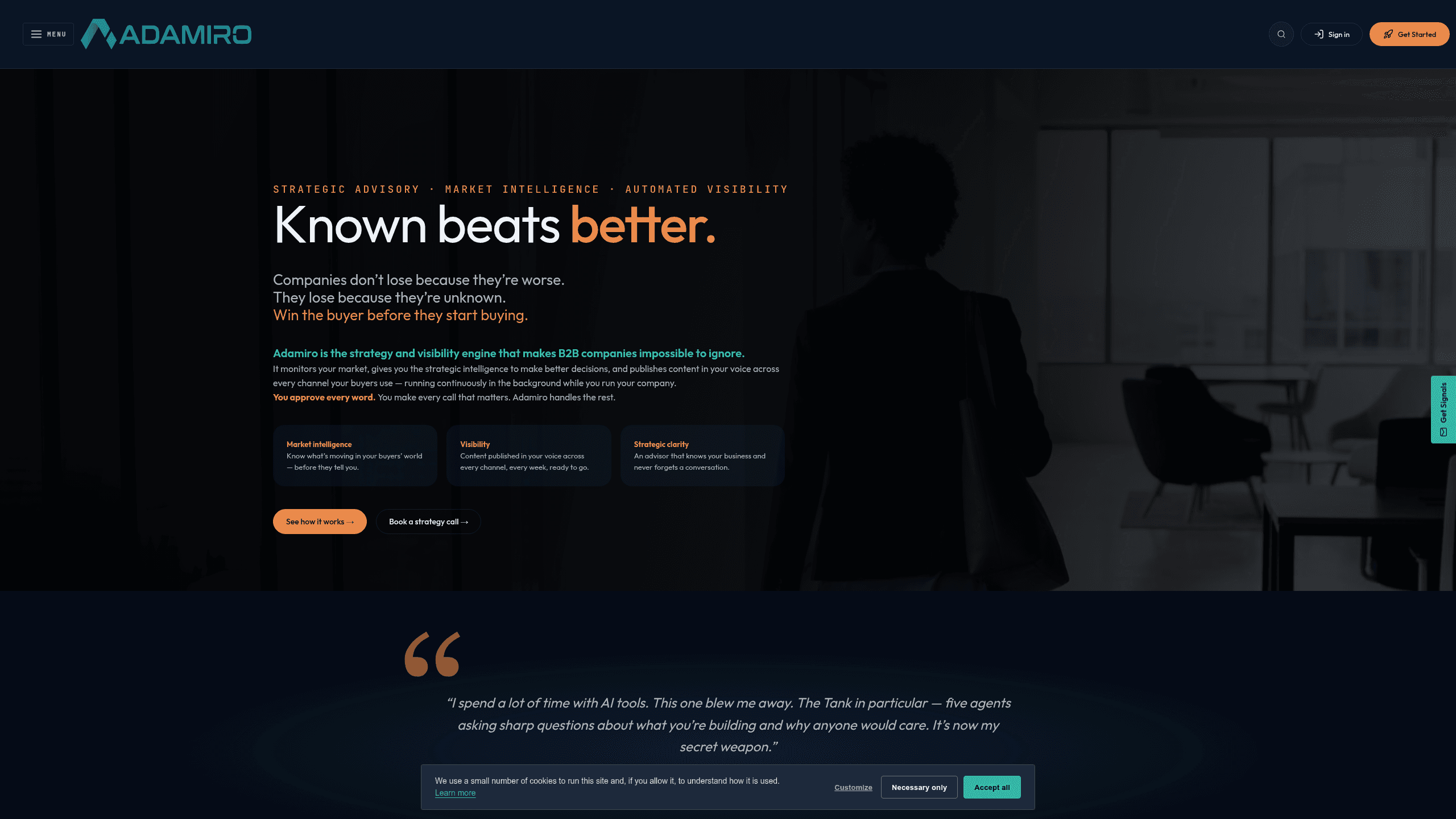
Adamiro is an AI workflow platform for founders and small teams that turns market signals into published content and advisory input into next steps. It combines Signals, Radar, Voice, Reach, Mentor, and The Tank to monitor competitors, technology, regulation, and buyer questions, draft in your voice, and publish with a paper trail. Plans run Starter $49/mo, Growth $99/mo, Business $199/mo, and Team $499/mo.
Last verifiedHow we evaluate
At a glance
- Adamiro is best for founders and small teams who need market intelligence, content, and advisory input in one workflow.
- Starter $49/mo; Growth $99/mo; Business $199/mo; Team $499/mo; 14-day free trial on every plan, no credit card required
- 14 days
Where the price is genuinely good
Adamiro's four plans are $49 (Starter), $99 (Growth), $199 (Business) and $499/month (Team), with annual billing advertised as "2 months free" and a 14-day trial that requires no credit card (https://adamiro.com/pricing/).
The interesting comparison is the AI-visibility module. Adamiro's Growth plan at $99/month tracks ChatGPT, Perplexity and Google AI Mode — all three — with 15 prompts (https://adamiro.com/products/adamiro-ai-visibility/). Profound, a dedicated AI-visibility vendor, publishes a $99/month Starter that is "ChatGPT tracking only" with 50 prompts, and charges $399/month for its Growth tier to reach "3 Answer Engines tracked" with 100 prompts (https://www.tryprofound.com/pricing). So on engine coverage per dollar, Adamiro is roughly a quarter of the dedicated-tool price — and that $99 also buys content drafting, scheduled publishing, competitor monitoring and an AI advisor.
The trade is prompt depth: 5 prompts on Starter, 15 on Growth, 25 on Business/Team. If your category is broad, 15 tracked questions is a thin sample of the queries buyers actually ask. Read the comparison as "cheap breadth, shallow depth" rather than "cheaper Profound".
Do the task arithmetic before you pick a plan
Adamiro meters usage in "tasks" and publishes the cost of each action: Signals briefing 2 tasks, Voice content 1, Reach 1, AI Visibility 1, Radar 1, Mentor 1 per 30 minutes, The Tank 2 per 30 minutes; the Adam assistant is 0 (https://adamiro.com/adamiro-task-economy/). Plans include 10, 30, 60 and 150 tasks per month respectively (https://adamiro.com/pricing/).
Arithmetic from those published numbers (our calculation, not the vendor's): a weekly Signals briefing alone is 4 × 2 = 8 tasks a month. On Starter's 10 tasks, that leaves 2 — barely two published posts, and nothing for competitor monitoring. On Growth's 30, a weekly briefing (8) plus two posts a week where each post uses Voice + Reach (2 tasks × 8 posts = 16) plus one visibility run comes to roughly 25 of 30. That is workable, but it is not headroom.
Overflow is priced honestly and visibly: top-up packs run $20/10 tasks down to $140/100 tasks, i.e. $2.00 to $1.40 per task, valid six months, with Team plans getting 20% off. Unused monthly tasks roll over for up to six months and are consumed oldest-expiry-first. Tasks are deducted before a run begins, and are credited back automatically for verified system errors but not for user misconfiguration (https://adamiro.com/adamiro-task-economy/). The model is legible — you can predict your bill — but it means the sticker price is a floor, not a ceiling, for anyone publishing at real volume.
Publishing reaches three channels, and only three
Reach publishes directly — not by copy-paste — to LinkedIn, Instagram and Substack, via connected accounts, and lets you choose per post whether it goes out from a personal profile or a company page (https://adamiro.com/products/how-it-works/).
That is the complete list. There is no X/Twitter, no company blog or CMS integration, no email platform, no YouTube or TikTok, and no documented public API (not established — we found no API docs on the site). If your buyers are on LinkedIn and you run a Substack, this covers you well. If your distribution runs through your own site's blog or a newsletter tool, Reach does not apply and you are buying Voice as a drafting tool whose output you move by hand.
Setup expects real input from you: a written business profile, brand kit (colours, logo, font), writing samples to train Voice, a competitor watchlist, and OAuth-connected social accounts. Adamiro says "nothing ships without approval" from the publishing queue, and claims "most customers go from a Signals briefing to a published post in under 15 minutes of actual attention" — that time figure is a vendor claim we could not corroborate.
The AI-labelling work is better than the category norm
This is the most technically distinctive thing Adamiro has built, and it is verifiable. Every image the system generates is tagged with IPTC metadata setting DigitalSourceType to trainedAlgorithmicMedia, a credit line of "Generated with AI", and the European Commission's official AI label burned into the pixels rather than only into metadata (https://adamiro.com/legal/ai-transparency/).
The same page is candid about the limits: metadata "can be removed or forged by anyone with a metadata editor", social platforms "routinely discard embedded metadata", generated text carries "no machine-readable marking", and C2PA cryptographic signing is listed as "Not implemented". A vendor publishing its own gaps in a compliance page is unusual.
The timing is relevant: EU AI Act Article 50 transparency obligations became applicable on 2 August 2026 (https://artificialintelligenceact.eu/article/50/), eleven days before this listing. Article 50(4) requires disclosure for AI-generated text published to inform the public on matters of public interest, but exempts content that "has undergone a process of human review or editorial control and where a natural or legal person holds editorial responsibility" — which is the exemption Adamiro's approve-before-publish queue is designed to sit inside. If you are an EU-established company publishing AI-assisted content, this is a real reason to prefer this tool over one that ships unlabelled images.
Data handling: specific where most small vendors are vague
Adamiro publishes where data actually lives: application and account data in Sweden, advisory memory in Germany on Hetzner via Elestio's managed Qdrant, with processing inside the EU. It states TLS 1.2+ in transit, AES-256 or equivalent at rest for production databases and backups, per-customer memory vaults, and that "your briefs, drafts, prompts, and advisory sessions stay in your account and are never used to train an external model". Users can view memories, export data and delete accounts from the dashboard; a DPA is available on request; service data is retained for the account's life plus 90 days (https://adamiro.com/products/data-protection/).
The terms name the sub-processors and model providers: OpenAI, Anthropic, Google (Gemini), Stripe and n8n, with contractual restrictions against training on customer input absent separate written consent (https://adamiro.com/legal/terms-of-service/).
What is absent: no SOC 2, ISO 27001 or equivalent third-party certification is claimed anywhere on the site. That is normal for a company this size and not a red flag on its own, but if you need to pass a vendor-security review at an enterprise customer, there is currently no attestation to hand them. Liability is capped at the greater of fees paid in the prior 12 months or €100.
Who is behind it, and how much that should matter
The service is operated by Hojt Communication AB, a Swedish limited company, registration number 559017-1459, under Swedish law, with terms effective 27 July 2026 (https://adamiro.com/legal/terms-of-service/).
Swedish registry aggregators put that entity in Lomma, registered in 2015, with 0 employees and revenue of 4 KSEK (roughly €350) with a result of −2 KSEK for financial year 2024 (https://www.allabolag.se/5590171459/hojt-communication-ab, https://www.bolagsfakta.se/5590171459-Hojt_Communication_AB); a board member is listed as Lars Fredrik Beckman. Fairness requires the obvious caveat: FY2024 predates Adamiro entirely — the site's earliest content is dated April 2026 — so those figures describe the size of the corporate vehicle, not the traction of the product. The same entity's older consultancy site, hojt.se, shows product-strategy and security consulting work with content dating to 2015–2017 and makes no mention of Adamiro.
Adamiro's own about page declines to name anyone: "Names go up when the platform launches publicly. Until then, you'll see the work, not the bios." It describes "a founding team of operators, not researchers" who have "started companies together. One went public. One didn't survive. One got acquired" (https://adamiro.com/about-adamiro/) — none of which we could verify, since no individuals are named.
How to weigh this: you are considering handing a small, pre-public-launch operation your brand voice, your competitive watchlist and OAuth access to your LinkedIn company page. The monthly commitment is small and cancellable, so the financial exposure is genuinely low. The exposure that isn't low is switching cost if the product stops being maintained — trained voice models, accumulated advisory memory and a publishing queue are not portable. Ask about continuity before you make it load-bearing.
What the product is built on
Adamiro runs on WordPress: response headers across the marketing site, the dashboard and the signup flow return x-powered-by: PHP/8.5.8 and WordPress REST API link: headers, and the site is served with the Rank Math SEO plugin (verified by HTTP request to https://adamiro.com/dashboard/, 13 August 2026). The dashboard is genuinely gated — it returns "Please log in to view your dashboard" — so the application exists behind auth rather than being a mockup, but it is a WordPress application. n8n appears in the terms as a sub-processor, which points to workflow automation rather than a bespoke orchestration layer (https://adamiro.com/legal/terms-of-service/).
None of that is a defect — it is a sensible way for a very small team to ship a real product quickly, and it is invisible to a user who just wants posts scheduled. It is worth knowing if you were assuming enterprise-grade infrastructure, expecting a public API, or planning to depend on it at high volume or with a formal uptime commitment. No SLA is published (not established).
There are no independent reviews yet
We found no listings or user reviews for Adamiro on G2, Capterra, Trustpilot or Product Hunt, no press coverage, and no discussion on Reddit or Indie Hackers as of 13 August 2026. For a product whose public site dates from April 2026 and which describes itself as not yet publicly launched, that is expected rather than suspicious — but it means every performance claim on the site is currently uncorroborated.
The site carries one named testimonial, from Kat McCullough, described as Founder/CEO of RegTechGroup.io (https://adamiro.com/). RegTech Group's own website does not name her, or anyone, in a leadership role, so we could not corroborate the attribution either way (https://regtechgroup.io/).
The practical consequence: you cannot outsource this evaluation to other buyers' experience. You have to run the trial. Fortunately the entry cost is close to zero — 14 days with no card required, plus a free "First Round" tool that gives you three AI advisor verdicts on a business offer with no account and, per the vendor, without writing your idea to their database (https://adamiro.com/first-round/), and a free Signals newsletter. Use those to judge output quality before any money moves.
Cancellation and refunds
The refund policy is clearer than most SaaS of this size. Monthly subscriptions are "refundable on a pro-rated basis for the unused portion of the current billing cycle, within the first 14 days of the most recent charge"; annual plans get a full refund within 14 days of the most recent charge with no pro-rating. After day 14 charges are non-refundable but renewals can be cancelled. Free trials are not refundable because nothing was charged. Tasks are credited back automatically when a run fails "for a verified technical reason", but unused tasks are not refundable as cash — they expire on their original six-month schedule. Mandatory consumer-protection law is stated to apply in addition (https://adamiro.com/legal/refund-policy/).
One thing to be aware of rather than alarmed by: the terms describe the service as operating on a "non-refundable Task model" while the refund policy grants a 14-day pro-rated window on subscription charges. These are reconcilable — the subscription fee is refundable in that window, the consumed tasks are not — but if a refund matters to your decision, get it confirmed in writing before you buy the annual plan.
How much does Adamiro cost?
| Plan | Price | What's included |
|---|---|---|
| Starter | $49/mo |
|
| Growth | $99/mo |
|
| Business | $199/mo |
|
| Team | $499/mo |
|
Frequently asked questions
What is Adamiro?
Adamiro is an AI workflow platform for founders and small teams that turns market signals into published content and advisory input into next steps. It combines Signals, Radar, Voice, Reach, Mentor, and The Tank to monitor competitors, technology, regulation, and buyer questions, draft in your voice, and publish with a paper trail. Plans run Starter $49/mo, Growth $99/mo, Business $199/mo, and Team $499/mo.
How much does Adamiro cost? Is it free?
Adamiro has 4 paid plans: Starter at $49/mo, Growth at $99/mo, Business at $199/mo. Adamiro says every plan comes with a 14-day free trial and no credit card is required to start.
What is Adamiro used for? Who is it for?
Adamiro is used for Market intelligence, Visibility, and Strategic clarity. It's built for Founders, Marketing teams, and Business development leaders.
Does Adamiro have an API and what does it integrate with?
It integrates with LinkedIn, Instagram, Substack, Google AI Mode, RSS feeds, and 1 more.
Editor's read
Check how many monitored sources you need before choosing a tier: Starter includes 10 Signals sources, Growth 20, and Business and Team 30. If your monitoring scope is broad, the source cap is the main reason to move up.

Explore other Marketing Agents
