
TourScanner AI in our research
All researchStudy
AI Tool Pricing Index, November 2026
Pricing
Contact sales
82 of the 361 tools we checked ask you to contact sales for a price.
Edition price, checked 14 November 2026.
Pricing pages of the AI tools, November 2026 editionas of n = 361 tools checked
One API key opens a REST catalog and an MCP server
TourScanner AI sells access to tours and activities inventory in two shapes at once. The REST API covers the whole booking lifecycle: autocomplete and destination search, activity search with facets, a monthly availability calendar, live time slots, booking options with age bands and cancellation policy, a Stripe hold, and a confirm call that returns voucher and ticket URLs. The second shape is a remote MCP server with 12 tools over Streamable HTTP at /api/mcp, and the docs are explicit that it is the same capability surface rather than a separate product: the vendor states "The same capabilities are available as a remote Model Context Protocol (MCP) server".
The MCP tools split into discover, check, book and manage. search_activities accepts keywords, a city id or name, an attraction, a tag, a rating filter or a point with near: { lat, lng, radiusKm }, and results carry distanceKm. check_availability and get_availability_calendar go to the supplier at request time. create_checkout_session validates the chosen slot live and hands back a checkout link with slot, party and price pre-filled.
The catalog claim is 1,000,000+ activities from 14 providers across 5,000+ cities and 7,800+ attractions, with Tiqets, Viator and Headout named as provider ids 2, 3 and 7 in the search parameters. The other eleven providers are not named on any page read.
The agent can reach a checkout but cannot finish a booking
Where the agent path stops matters more than the tool count. Through MCP, the furthest an agent gets is a checkout link: "nothing is booked until the traveller pays there". Two of the manage tools go further and do nothing at all. The docs state that cancel_booking and amend_booking "return real quotes but cancel and change nothing", and the MCP page heads that group "Cancel and amend (demo mode)".
The REST path is the one with real writes. POST /api/booking/hold creates a Stripe Checkout session with capture_method: manual, POST /api/booking/confirm captures the payment and confirms with the supplier, and POST /api/booking/cancel cancels with the provider and refunds. A banner at the top of the docs says this host is production and that holds and payments are real.
So a buyer gets two different autonomy levels from the same key. An assistant wired through MCP is a research and hand-off agent; a product that owns its own checkout flow through REST can complete and reverse bookings. The site does not say when the demo-mode tools become real.
Pricing is a proposal by email, with no figure on the site
The plans page describes three shapes: Partner API over REST, Agent / MCP, and a white-label checkout where TourScanner takes the payment, books with the supplier and delivers the voucher. No plan carries a price, a credit allowance or a commission rate. The FAQ answers the cost question with "It depends on the plan and on how you sell" and asks for an email. The terms push the numbers off the website entirely: pricing, commission, markup and retail price are set in the signed order form or partner agreement.
Two cost variables are therefore invisible before a sales call. Rate limits are "set per API key during onboarding and scaled to your needs", with X-RateLimit-Limit and X-RateLimit-Remaining headers and a 429 carrying Retry-After. And the retail price is yours to set, with the margin decided per partner, so the economics are a negotiation rather than a rate card.
The free surface is the homepage chat, which signs in with Google and runs real API calls against Gemini. It is a demo of the hosted agent, not a free tier of the API: every REST and MCP request needs a key TourScanner issues on request.
Ten years of metasearch behind a two-page product site
The about page dates the company to 2015 and describes the original business as a tours and activities metasearch engine, with the API product as the next step: 2.5 million+ translations across 8 languages, 962 categories, and a proprietary ranking called Activity Caliber that the terms claim as intellectual property. The homepage carries the same framing in one line, "Backed by 10 years of tourscanner experience".
No legal entity name, registered address, country or named team member appears on the pages read, and the only contact is api@tourscanner.ai. The terms leave governing law to "the law of the country where the tourscanner contracting entity is established", which is an unusual formulation for a page that never names that entity. Liability is capped at the fees paid in the prior 12 months, or EUR 100 (about $110) for a non-paying user.
The infrastructure is named, which is more than most vendors publish: Railway for hosting, Supabase for database and sign-in, Stripe for payments.
Security is described, certified and audited nowhere
The privacy policy, dated October 22, 2026, is specific about data flows and silent about assurance. It names the model providers that see agent conversations, Google, OpenAI and Anthropic, and four analytics tools including session recordings and heatmaps. One detail is a deliberate engineering choice worth noting: query strings are not logged on the MCP endpoint, because a key can be passed there, and a shared location is resolved to the nearest city and rounded to about 1 km before logging.
Against that, no SOC 2 report, ISO 27001 or ISO 42001 certificate, penetration test summary or data processing agreement is published. The whole security section is encrypted connections, access controls and keeping keys secret. GDPR rights are set out with a one-month response commitment, and transfers outside the EEA rest on adequacy or standard contractual clauses, but a partner sending traveller data through the API is told it is responsible for its own legal basis without being offered a processor agreement to sign.
Sign-in is a magic link or Google, with no SAML or OIDC option, and there is no customer-readable audit log. The terms also decline any uptime promise: "we do not promise uninterrupted access or error-free data".
Where it fits, and who should look elsewhere
It fits a product that already has travel traffic and no activities inventory: a travel app adding tours beside flights and hotels, a destination content site that wants live prices on its pages, a loyalty program, or an AI travel assistant that needs to do more than recommend. The MCP server plus the claude.ai connector route means a working agent integration without writing code, which is rare in this category.
It fits less well in three cases. A developer who wants to evaluate before talking to anyone cannot: there is no self-serve key, no free API plan, and the "Try it" panels on the docs page are the only way to see a response. A team that needs procurement evidence will find no audit report, no DPA and no SLA. And an agent product whose value is managing bookings after the sale will hit the demo-mode cancel and amend tools, which means building the REST path anyway.
The acceptable use terms add one restriction worth reading before designing around the catalog: bulk copying, reselling raw data and building a competing dataset are all forbidden, and catalog content cannot be kept after access ends.
TourScanner AI price and terms
Terms
- Free to start
- PartlyLimited free use
- Card to start
- YesNot required
- Sign up without sales
- NoNo
The terms in full
The homepage agent chat is free to use after a Google sign-in and runs real API calls, but it is a demo surface only: a key for the REST API and the MCP server is issued by TourScanner on request, and no free API plan is published.
For AI agents
- MCP server
- YesChecked by us,
- API
- Partlytourscanner.ai,
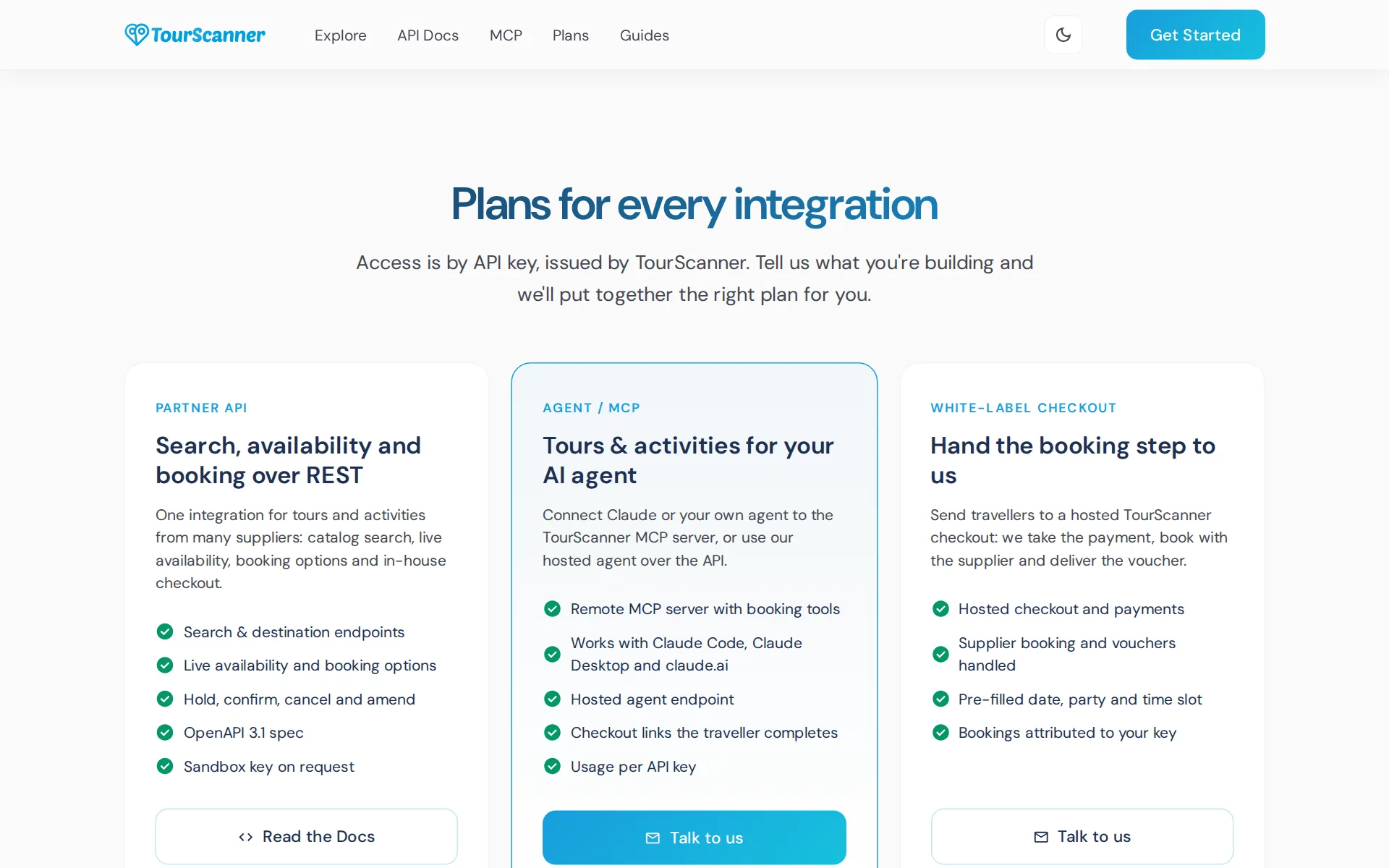
Pricing page, captured
tourscanner.ai/pricing, checked
What we checked on TourScanner AI
What the price counts
No rate card is published on the Plans page: all three plans (Partner API, Agent/MCP, White-label checkout) are priced by proposal after contacting api@tourscanner.ai, so the price is quote only.
It depends on the plan and on how you sell. Write to api@tourscanner.ai with what you are building and we will send you a proposal.
tourscanner.ai/pricingChecked
Free to use
The hosted agent demo on the homepage is free after a Google sign-in, but API and MCP access needs a key TourScanner issues on request, with no free plan published.
Sign in with Google to chat with the agent. It's free and takes a few seconds.
tourscanner.aiChecked
Self-serve signup
There is no self-serve signup for the product: every API and MCP key is issued by TourScanner after you email what you are building, and every request needs one.
API keys are issued by TourScanner. Contact api@tourscanner.ai: once your access is set up, the key appears in your account and works for the REST…
tourscanner.ai/pricingChecked
Card to start
Nothing asks for a card to get started: the agent demo needs only a Google sign-in, and partner access begins with an email rather than a checkout.
On the page: "Try the AI Agent" chat panel, sign-in prompt
tourscanner.aiChecked
Cancel any time
The terms say you can stop using the service at any time, but any notice period or fee would live in the separate partner agreement that overrides these terms.
You can stop using the Service at any time. We can suspend or end your access for breach of these terms, for risk to the Service, or if we stop…
tourscanner.ai/termsChecked
Works with
Named integrations are the MCP clients Claude Code, Claude Desktop and claude.ai custom connectors, plus Stripe for payments and supplier APIs including Tiqets, Viator and Headout.
Any client with remote MCP support (Streamable HTTP) can point at https://tourscanner.ai/api/mcp with the Authorization: Bearer header.
tourscanner.ai/docsChecked
Languages
Search and content are offered in eight languages with translated descriptions and metadata; the vendor gives the count rather than naming all eight, though docs examples use en, it and es.
Full multilingual search and content. Serve your users in their language with translated descriptions and metadata.
tourscanner.aiChecked
Public API
A documented REST API with a machine-readable OpenAPI 3.1 spec is public, but it cannot be called without a key TourScanner issues on request, so programmatic access is gated.
Every request needs an API key, sent as X-API-Key. Keys are issued by TourScanner on request
tourscanner.ai/docsChecked
MCP server
Its MCP server is in the official MCP Registry
io.github.TourScanner-org/tourscanner
registry.modelcontextprotocol.io/v0.1/s…Checked by us,
Acts on its own
An agent can search, check live slots and create a checkout session end to end, but the traveller must complete payment on the checkout page, and cancel and amend only return quotes.
create_checkout_session checks the slot live and returns a tourscanner.io checkoutUrl with the slot, party and price pre-filled: nothing is booked…
tourscanner.ai/docsChecked
Limits on what it may do
Every tool carries MCP read-only and destructive hints so the host can prompt before a write, and booking tools are scoped to bookings made with the calling key.
Tools carry MCP annotations (readOnlyHint, destructiveHint) so agent hosts can ask the user before a write. Booking tools only see bookings made with…
tourscanner.ai/docsChecked
No code needed
Connecting it to claude.ai needs only a server URL pasted into a custom connector, while the Partner API path and Claude Desktop setup both require code or a JSON config file.
Custom connectors cannot send headers, so the key goes in the server URL. In Settings → Connectors → Add custom connector, use:
tourscanner.ai/docsChecked
Retention you control
Retention is described by category and account data can be deleted on request, but no customer-configurable retention window or switch-off is offered for logs or agent conversations.
Logs and AI conversations: only as long as needed for security, debugging and improvement, then deleted or aggregated.
tourscanner.ai/privacyChecked
Open source
The terms claim the catalog, the Activity Caliber ranking and the software as the vendor's or its licensors' property, with display rights only while access is active.
The catalog, descriptions, rankings (including Activity Caliber) and the software behind the Service belong to tourscanner or its licensors and…
tourscanner.ai/termsChecked
Take your data out
GDPR rights cover exporting personal data on request, but the terms forbid keeping catalog content after access ends, so the inventory data itself does not leave with you.
You may not claim ownership of it, strip attribution where it is required, or keep it after your access ends beyond what your customers have already…
tourscanner.ai/termsChecked
Security audits
GDPR handling is documented in detail with a one-month response commitment and standard contractual clauses for transfers, but no DPA document or signed agreement is offered to partners.
Under the GDPR and similar laws you can ask to access, correct, delete or export your data, restrict or object to some processing, and withdraw…
tourscanner.ai/privacyChecked
Single sign-on
Account sign-in is limited to an emailed magic link or Google, which covers Google Workspace teams but gives no SAML or OIDC path for another identity provider.
Email address and sign-in data. You can sign in with an emailed magic link or with Google.
tourscanner.ai/privacyChecked
Uptime promise
The terms explicitly decline an uptime or data-accuracy promise because the service depends on third-party suppliers, and liability is capped at 12 months of fees or EUR 100 (about $110).
We work to keep the Service running, but we do not promise uninterrupted access or error-free data, because the Service depends on third-party…
tourscanner.ai/termsChecked
TourScanner AI alternatives
TourScanner AI and its 3 alternatives
All 3 show a price.
TourScanner AI beside its alternatives: the price on each one's site and the day it was checked Tool Price Checked TourScanner AI On quote Otto Free Layla Free Agentplace Free, then $29 a month


Questions about TourScanner AI
- How much does TourScanner AI cost?
- TourScanner AI gives its price on request. From tourscanner.ai/pricing, checked 20 November 2026.
- Does TourScanner AI have an API or an MCP server?
- TourScanner AI has a limited API. From tourscanner.ai/docs, checked 26 October 2026. TourScanner AI has an MCP server. We checked the Official MCP Registry ourselves on 15 November 2026.
- Is TourScanner AI open source, and can you host it yourself?
- TourScanner AI is not open source. From tourscanner.ai/terms, checked 26 October 2026.
- What have we checked on TourScanner AI?
- 18 facts, under these headings: What it costs to start, what it works with, what it does on its own, what happens to your data, whether a company can buy it.
- How do we check TourScanner AI?
- We hold 18 facts on TourScanner AI, quoted from 7 pages. Facts and price last checked 20 November 2026, when we also found the last change.
TourScanner AI price history
We have read the price once so far, on 20 November 2026: price on request.
| Price | Plan | First seen | Last seen | Readings | Source |
|---|---|---|---|---|---|
| Price on request | 20 November 2026 | 20 November 2026 | 1 | Pricing page, read 20 November 2026 |
From our research on 20 November 2026. A date is when we read the page, not when the price changed.
Is TourScanner AI yours?
Free, and the page then carries the verified owner mark. You confirm it with an email at tourscanner.ai. Claim this listing
Report an error if a fact is wrong.