
Agentplace is a hosted platform for building customer-facing AI agents, each published at its own URL with a page the model rewrites as the conversation changes. Owners describe the business task to an AI Builder instead of writing code.
The agent is the page, not a widget on it
Agentplace publishes each agent at its own URL, where the model picks the content and components a visitor sees. The vendor describes responses that arrive as plans, tables, charts, product cards, forms, maps and documents rather than chat text, and a changed requirement revises the result and the page together: its catering example updates dishes, portions and the estimate when a customer adds guests.
There are two deployment shapes on the homepage: chat and voice added to an existing site, where a request opens the agent across the full page, and a standalone agent that is itself the destination. Phone, WhatsApp and Telegram are listed as separate channels that need the relevant provider configured first, and the vendor is explicit that web voice does not automatically provide a phone number.
Credits, not messages, are the unit you buy
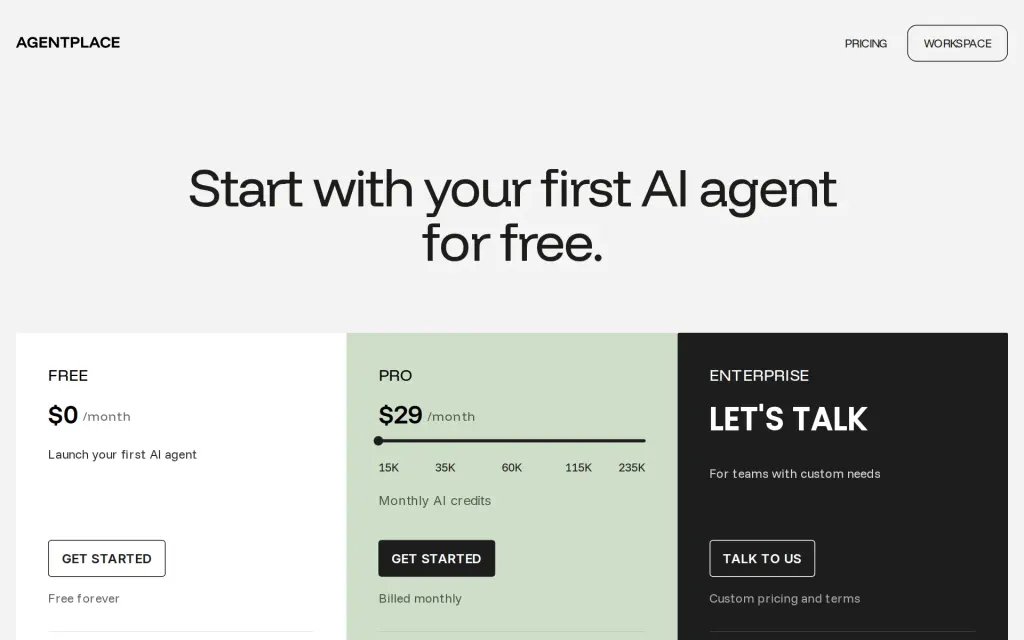
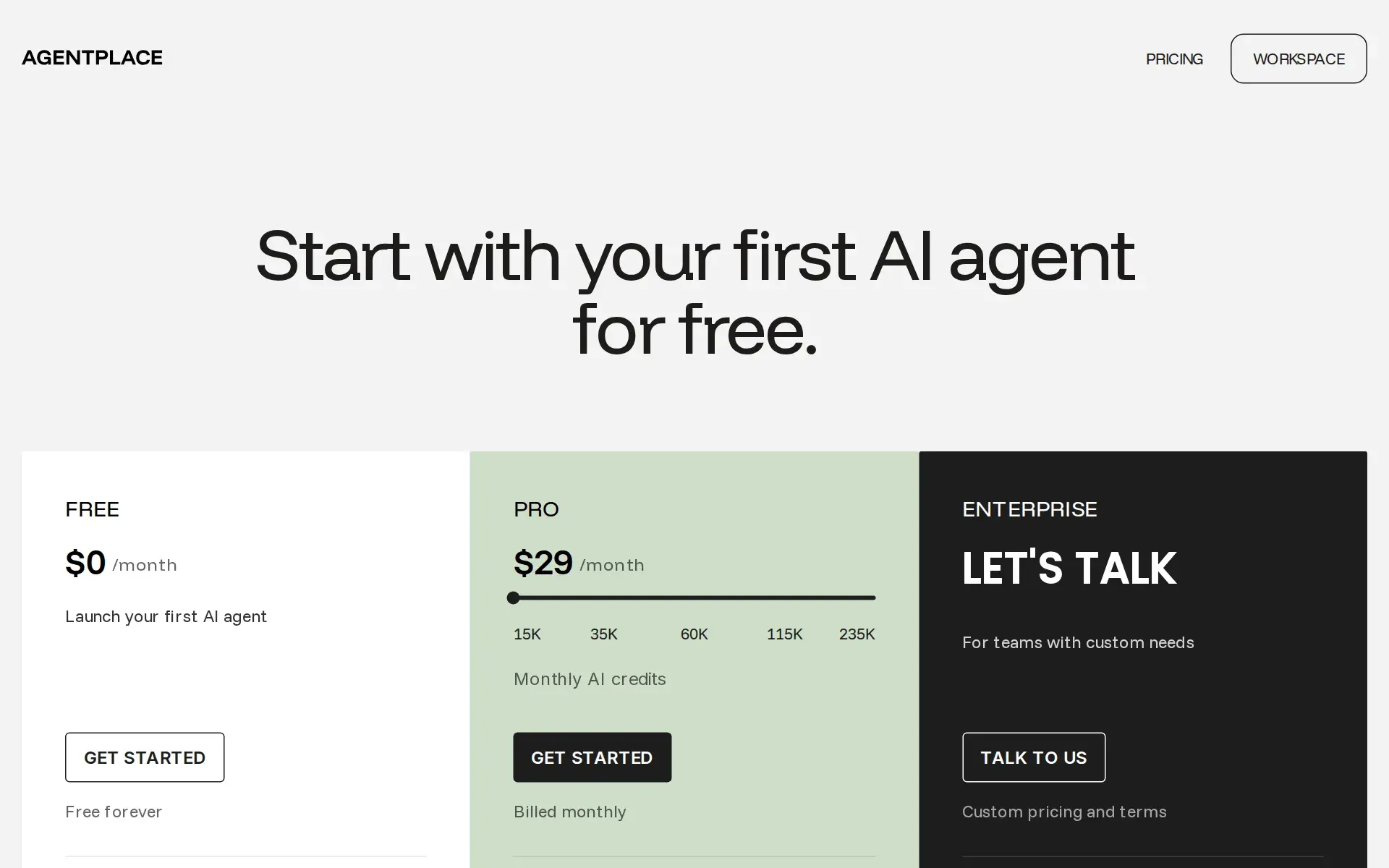
Free is a standing $0 plan with 2,000 AI credits, and Pro starts at $29 a month with 15k monthly credits plus one custom domain. The Pro card offers larger credit steps up to 235k; those steps carry no printed prices beside the entry figure. There is no monthly/annual control on the page, and Pro is labelled Billed monthly.
The docs then spend a whole page warning against arithmetic on that allowance. A credit is not a message, one request that includes research, tool calls and revisions is not a short answer, and a visit can start billable model work before anyone types. Connected services and scheduled work can charge separately. The counterweight is the free model: GPT-6 Luna is free in the Builder and the agent, and an agent at zero credits switches to it automatically rather than going dark.
Connections come from Composio, and MCP runs both ways
Business apps are reached through Composio's catalog of 1,000+ integrations, with Google Calendar, Gmail, HubSpot, Salesforce, Stripe, Shopify, Zendesk, QuickBooks and vertical tools such as Clio Manage and Workiz named as examples. The same page refuses to treat the catalog as a guarantee: availability depends on supported authentication, the provider's API, your account plan and the enabled tools, and you are told to have the Builder check the specific action.
MCP is the more interesting surface. A published agent exposes an MCP connection for compatible clients, so Claude or ChatGPT can call the business's agent, subject to its authentication and access mode. In the other direction the agent can delegate part of a task to a configured tool or another agent. A public REST API for managing agents is not documented anywhere on the site.
Access modes are clear; the compliance paperwork is not published
Publishing offers Public, Restricted and Private modes, with Restricted matching an allowed email address or email domain and an optional Require sign-in switch on Public agents. The same page draws a line most vendors leave blurred: sign-in identifies a visitor and does nothing else, so payments, audience limits and app authorization are separate configuration.
Security disclosure stops at prose. Data is encrypted at rest and in transit, infrastructure spans AWS, Google Cloud, Azure and AI providers depending on the model used, and no SOC 2 report, ISO certificate or DPA is published; buyers are told to email for security documentation. The vendor states it does not train models on customer data, then says written guarantees of that are available only through an Enterprise contract, because its own providers' practices differ. A complete export of an agent's stored data is Enterprise too, while deletion on request is said to take effect immediately.
Agentplace, Inc. of Newark, Delaware, founded by two people
The operator is Agentplace, Inc., with Uladzislau Yanchanka and Eugene Sorokin named as founders on the company reference page and an address at 131 Continental Dr, Newark, DE on the privacy policy. Stripe handles subscriptions, Amazon Cognito handles sign-in, and Sentry, Amplitude and Google Analytics appear in the provider list.
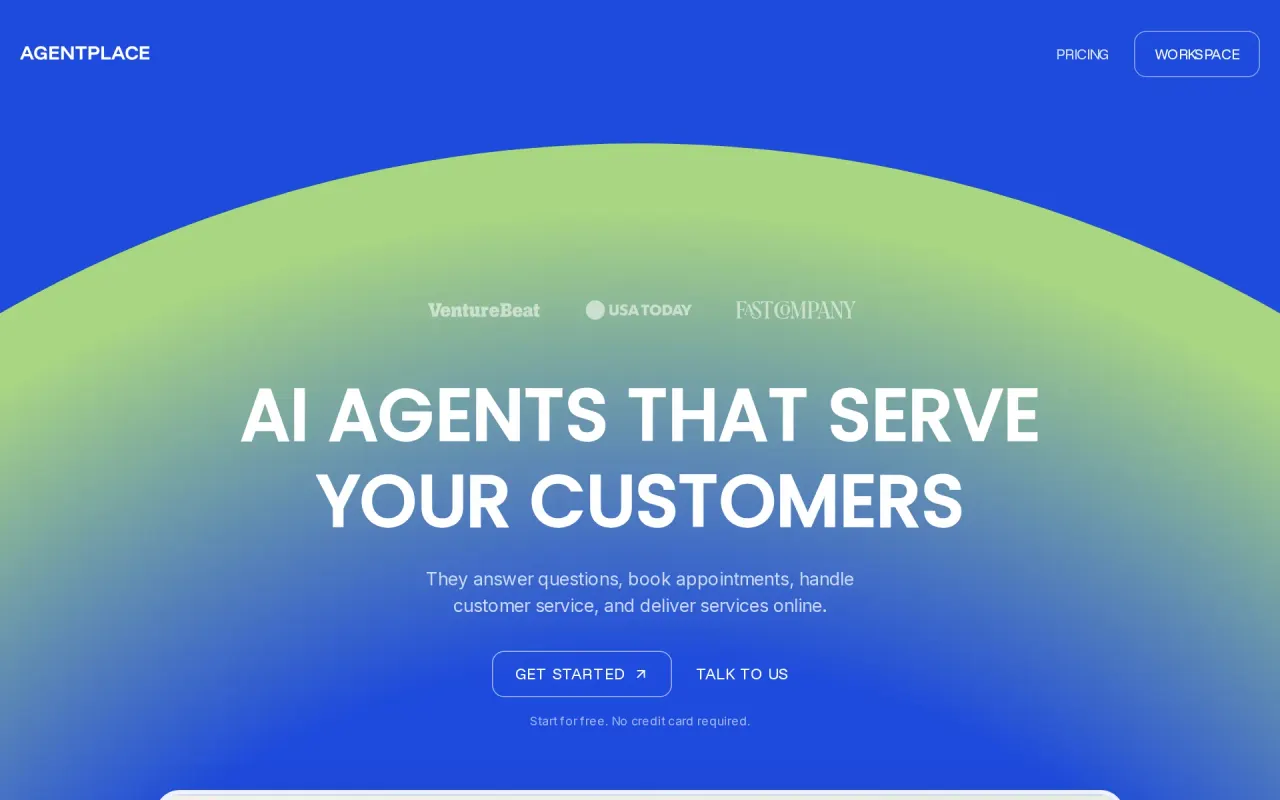
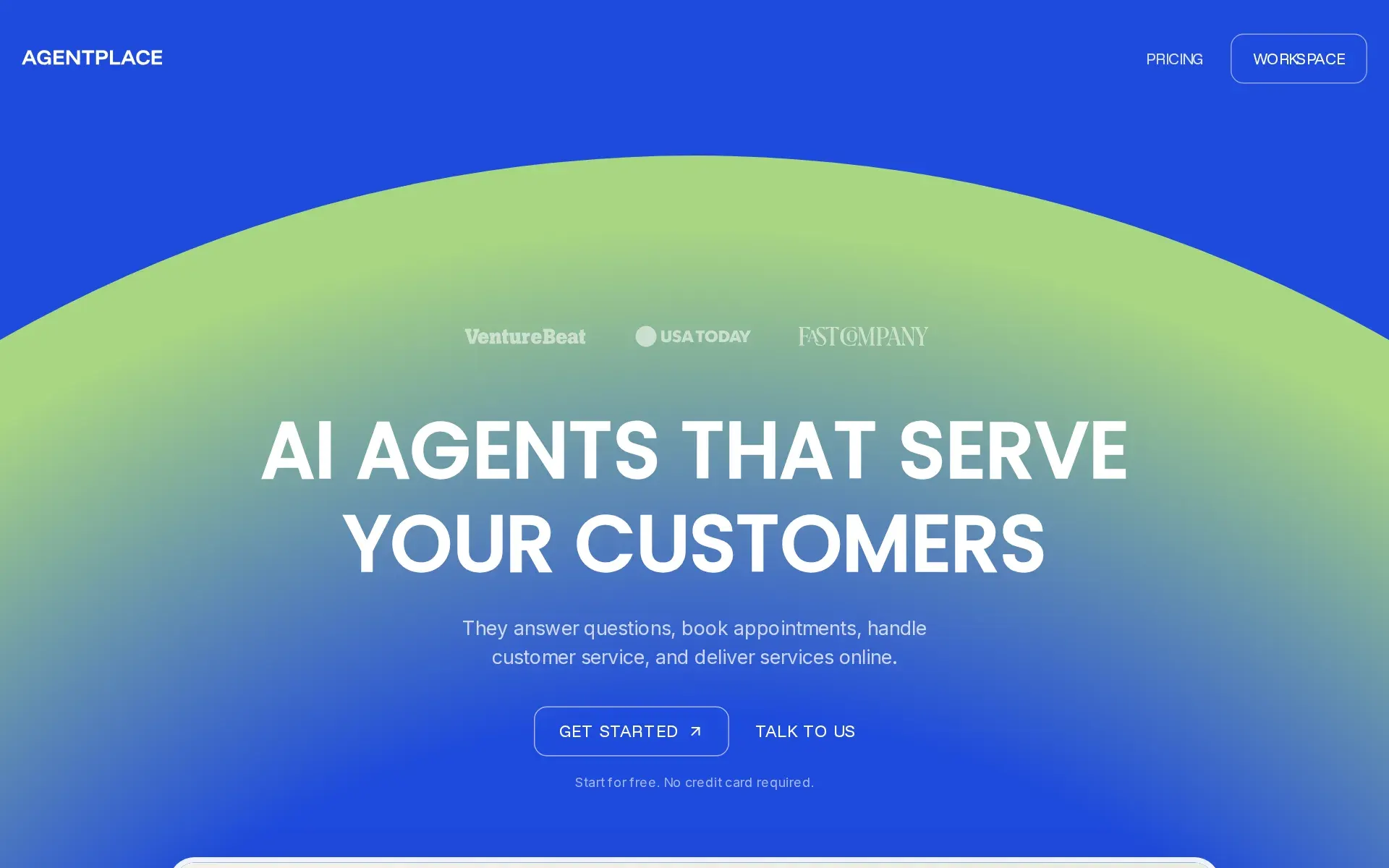
The product's public history runs through three Product Hunt launches from November 2024 to March 2026, plus VentureBeat coverage. Press logos for VentureBeat, USA Today and Fast Company sit at the top of the homepage. One date mismatch is worth noting: the privacy policy is effective 13 October 2026 while the Terms of Service still carry an effective date of 01-06-2023 and read as website terms, granting a licence for "personal and non-commercial purposes" and saying nothing about subscriptions or cancellation.
Where it fits, and who should look elsewhere
The fit the vendor argues for is a customer task rather than a lookup: incomplete or changing requirements, business rules that shape the recommendation, and a result the customer wants to inspect and revise. Travel advisors, caterers, contractors, accounting practices, retailers and consultants selling analysis as a digital service are the named buyers, and owners on a paid plan may build agents for paying clients and set their own fees.
Its own limitations page rules out two groups. A simple FAQ or a fixed trigger-and-action workflow is a better fit when nobody needs a personalized experience, and anyone needing to run the stack themselves is out: the platform is not open source or self-hosted, and syncing generated agent code to GitHub does not change that. Teams that must see an audit report before signing will be in an email thread, not a self-serve checkout.
Plans and pricing
Price and terms
- Free plan
- YesYes
The terms in full
Free plan: $0/month with 2,000 AI credits, the always-free GPT-6 Luna model, customer chat and voice, and calendar, CRM and payment integrations. No custom domain; the custom domain starts on Pro.
- Card to start
- YesNot required
- Sign up without sales
- YesYes
What needs a higher plan
- Enterprise
- Take your data out, Uptime promise
For AI agents
- MCP server
- Yes
Checked .
The facts, with their sources
What it does on its own
- Acts on its own
- PartlyAgents can finish a customer task end to end, but the owner decides where confirmation or a human handoff is mandatory, and the docs advise an enforceable approval step rather than prompt wording.
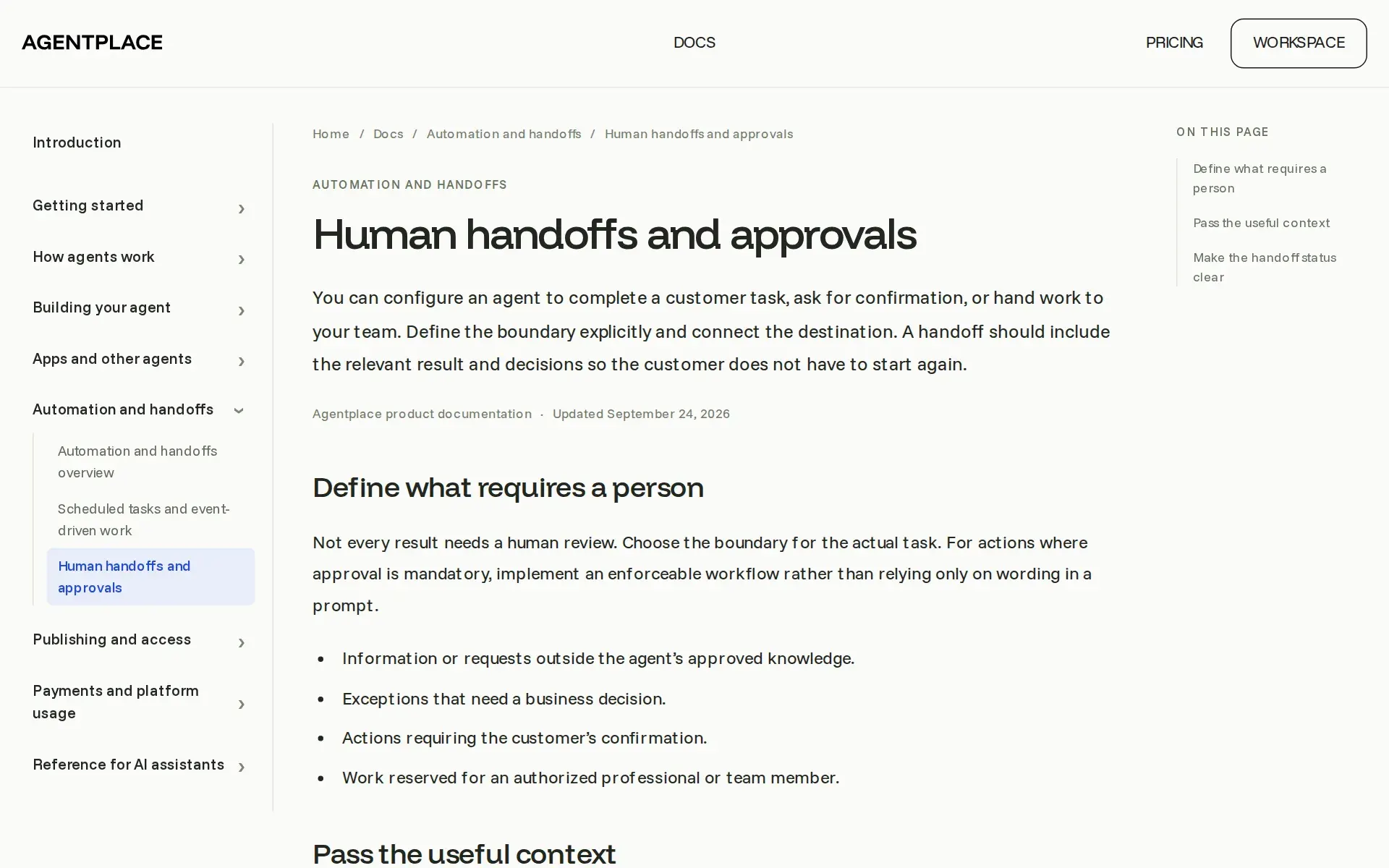
You can configure an agent to complete a customer task, ask for confirmation, or hand work to your team.
agentplace.io/docs/automation/human-han… - Several agents
- PartlyOne customer-facing agent stays in front and can delegate parts of a task to configured tools or other agents, but the vendor describes delegation rather than a pool of agents splitting one job automatically.
A customer-facing agent can pass permitted data or tasks to configured tools, other agents, or back-office workflows, then use relevant returned…
agentplace.io/ai-info - Limits on what it may do
- YesThe owner authorizes each connected account, picks which actions the published customer experience may trigger, and marks what needs confirmation before the agent acts.
Define which actions the customer experience may trigger and what requires confirmation.
agentplace.io/docs/integrations/connect… - No code needed
- YesSetup is a conversation with the Builder from a plain-language business brief; the vendor states no code or technical specification is needed to start.
You can start free with a business idea. You do not need code, a technical specification, or fully formed requirements.
agentplace.io/ai-info
Which models it runs on
- Its own model
- NoAgentplace serves third-party models rather than its own: prompts, voice input and context go to outside AI providers, and no in-house trained model is described anywhere on the site.
we send relevant messages, voice input, uploaded content, and conversation context to AI providers such as OpenAI, Anthropic, Google, and Amazon Web…
agentplace.io/privacy-policy - You pick the model
- PartlyYou pick a model per task inside the agent from the models the platform offers, with a vendor-set default; the published pages never list the full selectable catalog.
Choose a model inside your agent to suit the task.
agentplace.io/docs/monetization/platfor…
How you reach it
- In the browser
- YesEvery agent is a hosted web experience with its own page and URL that customers open in a browser and drive by text or voice.
Agentplace creates AI agents with their own web page and URL.
agentplace.io/ai-info - MCP server
- YesA published agent is itself reachable over MCP by compatible assistants, gated by the agent's authentication and access mode, and the platform also consumes compatible MCP tools.
Published agents also expose an MCP connection for compatible clients, subject to authentication and access settings.
agentplace.io/docs/integrations/connect… - Webhooks
- PartlyAgents can be started by supported external events from a connected provider, and results go out through connected apps; no outbound HTTP webhook to an arbitrary endpoint is documented.
Agentplace agents can run configured work on schedules and respond to supported events.
agentplace.io/docs/automation/scheduled…
What it costs to start
- Free tier
- YesA Free plan carries 2,000 AI credits and the always-free GPT-6 Luna model, and an agent drops back to that model instead of stopping when credits reach zero.
GPT-6 Luna is always free in both the Builder and your agent. You can use it to explore an interface, build, revise, and run the agent even when the…
agentplace.io/docs/monetization/platfor… - Self-serve signup
- YesFree and Pro both start from a Get Started button into the workspace; only the Enterprise tier routes through a sales call.
Start for free. No credit card required.
agentplace.io - Card to start
- NoThe vendor states outright that no card is needed to begin, and the Free plan is a standing plan rather than a timed trial that collects payment details.
Start for free. No credit card required.
agentplace.io - Priced per seat
- NoPricing meters monthly AI credits rather than users: the Pro card sets its price against a credit slider from 15K to 235K and never names a per-seat rate.
Pro $29/month 15k 35k 60k 115k 235k Monthly AI credits
agentplace.io/pricing
What happens to your data
- No training on your data
- PartlyThe vendor states it does not train on customer data, demonstrate with it, or plan to sell it, while the same section limits any written guarantee of that to an Enterprise contract.
Agentplace does not train models on customer data. We do not use customer data in demonstrations without permission, and we do not plan to sell…
agentplace.io/docs/publishing/access-an… - Retention you control
- PartlyThere is no self-serve retention window: the vendor will delete a client's stored agent data on request with immediate effect, and otherwise retains data for as long as it judges necessary.
We can fully delete a client’s stored agent data, and deletion takes effect immediately.
agentplace.io/docs/publishing/access-an… - Data stays in your region
- PartlyRegion choice is not a published setting; which clouds and locations are involved depends on the models used, and Enterprise adds private cloud options on request.
Agentplace uses cloud infrastructure and service providers including AWS, Google Cloud, Microsoft Azure, and AI providers such as OpenAI. The…
agentplace.io/docs/publishing/access-an… - Self-hosted
- NoHosted SaaS only: the vendor states the platform is not self-hosted, and pushing generated agent code to GitHub does not give you a runnable stack.
The Agentplace platform itself is not open source or self-hosted.
agentplace.io/ai-info - Open source
- NoNo published license: the vendor's own specification table records Open source as No, and generated agent code syncing to GitHub is explicitly not the same thing.
Access to generated code does not make the hosted Agentplace platform open source or self-hosted.
agentplace.io/ai-info - Take your data out
- PartlyAgent code can be pushed to and pulled from GitHub on any plan, but a full export of the data an agent has stored is sold as part of an Enterprise contract.
A complete export of an agent’s stored data is available through an Enterprise contract.
agentplace.io/docs/publishing/access-an…
Whether a company can buy it
- Single sign-on
- PartlySign-in is Google or an Agentplace account through Amazon Cognito, which covers Google Workspace teams; no SAML or OIDC connection to another identity provider is documented outside Enterprise access controls.
Amazon Cognito processes sign-in, and we store account information in our AWS-hosted systems.
agentplace.io/privacy-policy - Uptime promise
- PartlyNo uptime figure is published for the self-serve plans; the vendor says round-the-clock service is possible while service levels are contracted separately at Enterprise.
It can serve customers 24/7; contractual service levels are agreed separately through Enterprise.
agentplace.io/ai-info
Screenshots
Pricing page, agentplace.io, captured 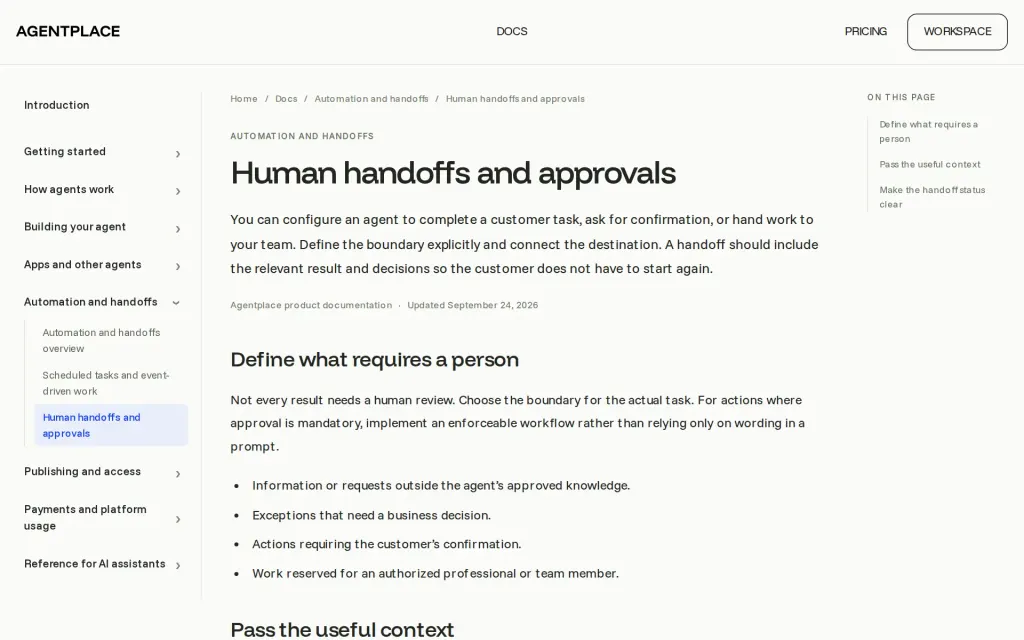
Docs, agentplace.io, captured
Filed under
Sources and updates
Sources on agentplace.io11
Updates2
- Capabilities · Free tier
- Capabilities · Free tier · Price
Is this yours? Claim it free and edit it in your dashboard, or feature it in Travel & Hospitality Agents.