Generative Engine Optimization: How AI-Native Tools Get Discovered
Learn how generative engine optimization helps AI-native tools get discovered through citations, directories, structured content, and AI search visibility.

Written by AgentsIndex
Generative engine optimization is how AI-native tools get discovered inside answer engines, not just how pages rank in blue links. For brands in this category, GEO matters because citations, comparisons, and structured product data now influence visibility as much as traditional search does.
Users no longer find every tool by landing on a homepage. They ask, “what is generative engine optimization, exactly?” and “how do AI-native tools get discovered inside answer engines?” Then they meet citations in AI answers, directory listings, review pages, and product summaries that machines can parse quickly.
Google’s Search guidance has already pushed publishers toward clear source signals, and market data shows AI-assisted discovery is becoming part of the buying path. Pew reported that 58% of U.S. adults saw an AI-generated answer in search in 2024, which is a big shift in how people encounter brands. If you want an AI-first product to be surfaced, quoted, and compared, you need more than a strong landing page.
That means treating discovery as an editorial system: clean product descriptions, consistent categories, source-backed claims, and listings that can be reused across surfaces.
The rest of this article looks at how those signals work together, where control is real, and where the platforms still decide for themselves.
How AI-native tools get discovered in AI search
AI-native tools get discovered through a mix of retrieval, ranking, citation, and plain mention. Ranking is where a page appears in search results. Retrieval is whether an AI system pulls a source into its working set. Citation is when that source is named or linked in the answer. Mention is the looser layer, where the model refers to a brand or product without a formal citation. In practice, those layers do not always move together.
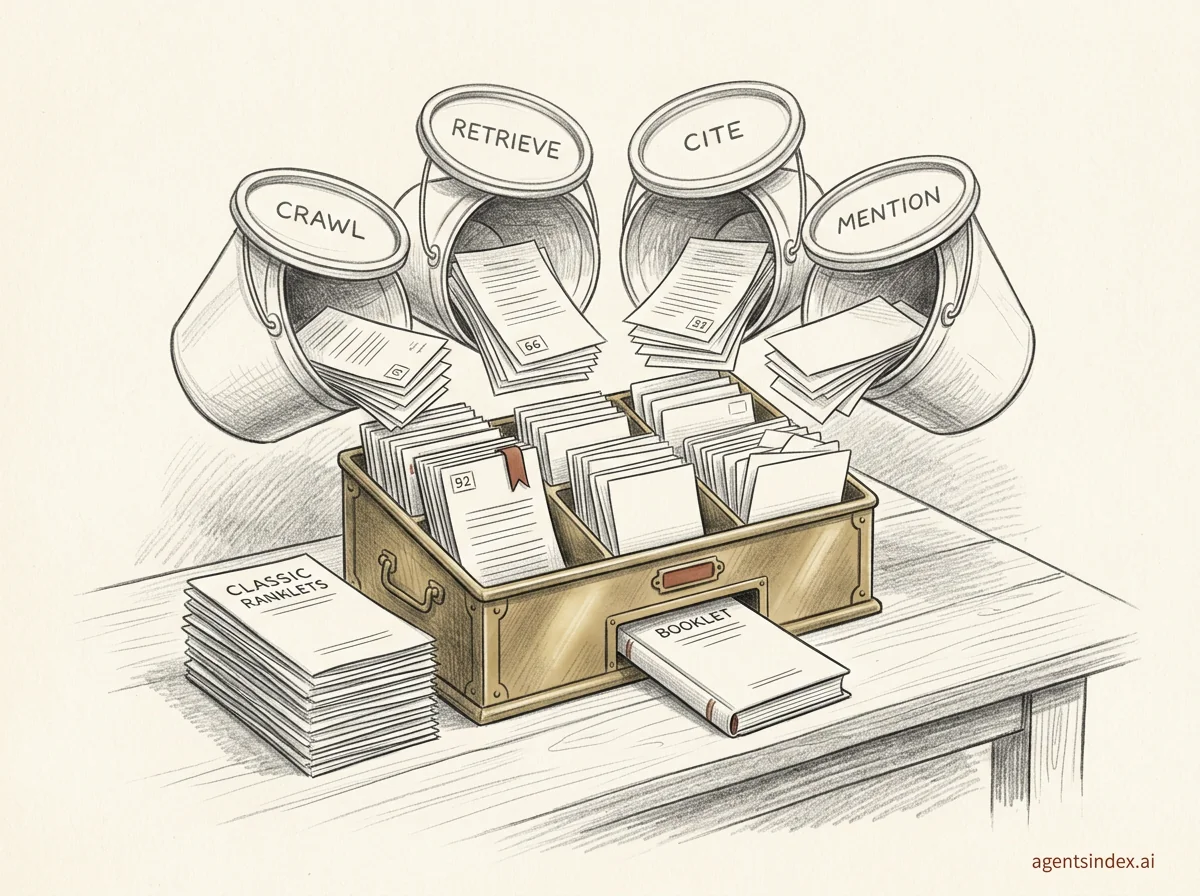
A buyer asking, “how is GEO different from SEO and AEO?” might trigger an engine to scan brand sites, product docs, directories, review pages, comparison content, and third-party mentions. It may then compile a short candidate set from all of them, not just from the pages that rank highest in classic search.
The path usually looks like this: source documents get crawled or ingested, the model retrieves relevant passages, the answer engine assembles a response, and citations or mentions are attached if the system deems them useful. A strong brand site still matters, but so do documentation, directories, review pages, comparison articles, and third-party references that reinforce the same product story.
More than half of search results include AI-generated summaries, and roughly 60 percent of searches ended with no click in 2024. So the visibility game is no longer just about earning traffic. It’s about being included in the answer itself.
For teams wondering whether GEO is real or just SEO with new labels, the practical test is simple: can you tell when an AI system cites your brand, and can you trace which source helped it do so? If you can’t, you’re still measuring discovery from the old search era, not the answer-engine one. Andreessen Horowitz makes the same case in their GEO-over-SEO essay.
What generative engines actually use as evidence
Generative engine optimization is not a citation hack. It’s the discipline of making the right evidence easy to crawl, trust, and summarize when an answer engine assembles a response.
The old search playbook still does part of the work. If your pages are hard to crawl, your canonicals are messy, or your titles hide what the page is about, AI systems have less to work with. The newer layer is just as important: concise definitions, original data, FAQ-ready answers, and clear entity references make your material easier to quote back.
The practical question is not whether GEO replaces SEO. It is which evidence surfaces first when an AI system is deciding what to trust, and where your brand facts are currently scattered.
Start with the basics. Crawlability and indexability still set the floor. A clean canonical page, descriptive titles, and internal linking that points clearly to your core pages help both search engines and answer engines understand what belongs together.
That scattered-facts problem is one of the most common failure modes. A homepage says one thing, the docs imply another, and pricing adds a third version. The result is weaker citation confidence.
Citation-friendly content tends to share the same shape. It opens with a plain-language definition. It includes one or two original data points, not a pile of adjectives. It answers common questions directly enough to stand on its own. It names the entity, product, or category cleanly, so a system can tell whether the page is about the company, the feature, or the market.
Off-site evidence matters too. Directories, reviews, founder interviews, docs, changelogs, GitHub, and reputable media mentions all help establish that a tool exists, does what it claims, and changes over time. For AI-native tools, that mix is often more persuasive than one polished landing page because it gives answer engines multiple corroborating surfaces.
The point is not to force citations. No one outside the platforms can promise that. The point is to remove friction from retrieval and make the evidence trail legible enough that citation becomes the easiest path. That is why a reference index like our AI tools directory can matter: it gives the model a cleaner set of product facts to compare against the rest of the web.
If you want a practical next step, audit every public claim for duplication, contradiction, and clarity. Then tighten the pages that answer engines are most likely to inspect first. Audit your public evidence trail before you publish another top-of-funnel post. Yotpo's GEO tools roundup walks through the same hygiene checks for AI-native products.
How to optimize an AI-native tool for citation and comparison
Start with one canonical product page. It should say exactly what the tool does, who it is for, which category it belongs in, how it connects, what it costs, and where the limits are. If a buyer cannot understand that page in one scan, AI systems will not do much better.
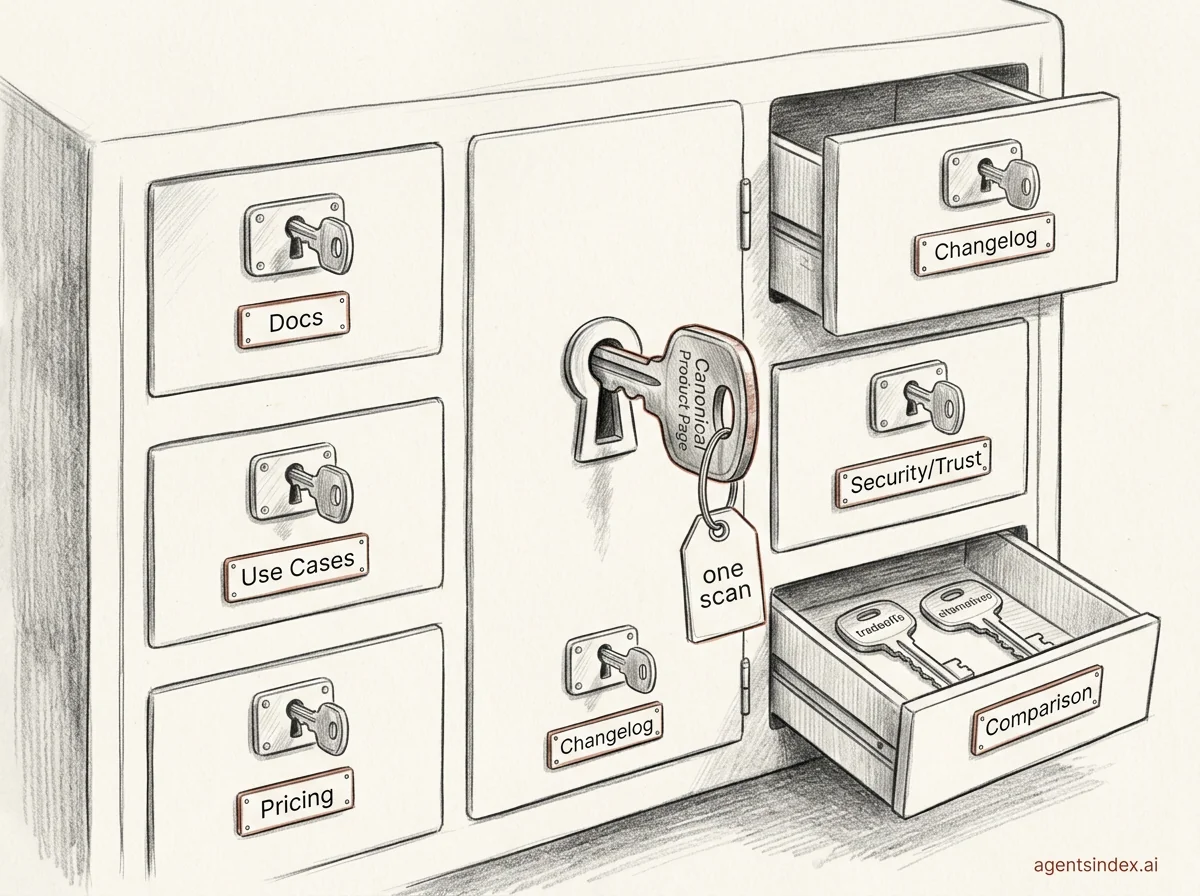
Then build the supporting pages that answer the next layer of questions: docs for setup, use cases for intent, pricing for budget, changelog for freshness, security for trust, and comparison pages where the market needs a side-by-side view. The goal is not volume. The goal is source-backed clarity that can be reused across your site and across the wider reference index.
One practical way to think about this is a simple citation chain. The product page states the core facts. The docs and use cases prove them. The pricing and security pages reduce doubt. The comparison page gives answer engines language for category fit, tradeoffs, and alternatives.
Use numbered steps so the work is executable.
- Write a canonical product page that uses the same wording everywhere: directories, launch posts, founder profiles, and your own site. Keep the facts stable. If the tool is an AI agent for support, say that. If it is for coding or sales, say that too. Don’t drift into generic language on one page and sharper language on another.
- Add structured answer blocks for the questions answer engines actually pull apart: definition, best-fit use case, setup time, and audience. Short answers help here. A definition should fit in one or two sentences. A setup estimate should be concrete, even if it is a range. A best-fit note should name the buyer, not the buzzword.
- Publish source-backed support pages that mirror the same product facts. Docs should show how the product works. Pricing should show the model plainly. Changelog should show that the product is alive. Security should answer procurement. Comparison pages should explain where you win and where you do not.
- Distribute those facts across every place buyers and crawlers look. Your own site, launch listings, directories, and founder profiles should not disagree on category, pricing model, or core use case. Consistency is a ranking signal in practice because it lowers ambiguity.
The mistake to avoid is publishing vague AI claims without product-specific evidence or examples. Saying a tool is intelligent, autonomous, or transformative doesn’t help if the page never shows the workflow, the output, or the customer who uses it. That kind of copy reads like filler to both humans and machines.
This also explains why measurement feels fuzzy. Brands want to know whether they are being cited by AI systems, not just indexed by search, but the switch from clicks to citations hides a lot of the trail. Traditional analytics will miss some of that visibility, so teams need a monthly review of how the product appears in AI answers. Engine behavior changes quickly, and what gets cited this month may not hold next month.
A useful check is simple: if your tool cannot be understood from one page and one listing, fix that first. Your deeper guide on AI tools directory strategy covers the broader catalog layer, but the discovery problem starts with clarity at the source.
Which discovery surfaces matter most for AI-native products
For AI-native products, discovery rarely starts in one place. The practical answer is to treat discovery surfaces as a portfolio: owned pages for control, directories for category fit, review platforms for proof, documentation hubs for depth, and earned mentions for reach.
The reason directories matter so much is simple. Buyers who search by job to be done or category are not looking for your brand name yet. They’re looking for an AI agents marketplace, an ai agent directory, or the tool that fits a use case. That is where classification matters more than polish.
| Surface | Control | Citation value | Update speed | Buyer intent |
|---|---|---|---|---|
| Owned site pages | High | Medium | Fast | Strong once a buyer knows the category or brand |
| Directories | Medium | High | Fast | Very strong for category and job-based discovery |
| Review platforms | Low | Medium | Slow | Strong for evaluation and shortlist building |
| Documentation hubs | High | High | Medium | Strong for technical and implementation intent |
| Earned mentions | Low | High | Slow | Strong when trust and third-party validation matter |
Owned pages are still the anchor because they give you the cleanest message, the clearest metadata, and the fastest path to updates. But they only carry discovery so far if no external system can interpret the product correctly. That is why an article like our breakdown of AI tools directory strategy matters: it shows how a listing layer can reinforce the product story instead of competing with it.
Directories trade control for visibility inside a category frame, which is useful when a model or search engine needs to place you alongside similar tools. For early-stage teams, that makes directories the best fit when the product category is still forming. Established products can depend more on their own pages and earned mentions because they already have brand demand and broader citation trails.
Review platforms matter, but they are not the first place to overinvest if GEO still feels fuzzy. They help when a buyer wants social proof, pricing comparisons, or a sense of operational risk. Documentation hubs matter most for products with real setup complexity, because answer systems often cite exact terminology from docs when the query is implementation-heavy. Earned mentions matter most when you need third-party corroboration, but they are the least controllable and the slowest to build.
Match the surface to the query type. If the query is category-led, prioritize directories. If the query is brand-led, strengthen owned pages. If the query is technical, invest in documentation. If the query is trust-led, earn mentions and reviews. That is a better allocation model than chasing every possible channel at once.
For teams deciding whether GEO is worth the effort, this is the signal to watch: can the surface help both humans and AI systems classify the product correctly? If the answer is yes, it belongs in the mix. If not, it is probably noise.
How to measure GEO when rank tracking is not enough
Rank tracking alone will miss most of GEO. AI answer engines change too fast, and many of them do not expose clean position data. The practical way to measure progress is to track whether your product shows up, how it is described, and whether that discovery turns into pipeline.

The shift from clicks to citations makes measurement feel fuzzy, especially when an answer engine can satisfy the query without a visit. If your team is trying to decide whether GEO is real work or just SEO with a new label, start with observable signals you can log every month.
First, build a prompt set that mixes branded queries and category prompts. Track them across major AI surfaces manually or with monitoring tools, then capture the date, the surface, the prompt, and the response. For each result, log one of three outcomes: cited, merely mentioned, or omitted. That simple split tells you far more than a vague visibility score.
Second, separate discovery metrics from conversion metrics. Discovery tells you whether AI systems are surfacing your brand. Conversion tells you whether that visibility helps the business. Keep both, but do not blend them into one number. A tool can be cited often and still fail to create qualified demand if the page does not match buyer intent.
Third, watch assisted-conversion and sales-qualified-lead patterns in your CRM and analytics. In some B2B contexts, industry estimates suggest AI discovery could influence up to 32% of pipeline by 2026, but treat that as a directional estimate unless you have a primary source for your market. The point is to look for lift in multi-touch journeys, not only last-click sessions.
A monthly review cadence is enough to start, but it should be disciplined. Keep dated snapshots of responses, because AI results can change week to week after model updates, retrieval shifts, or prompt reformulations. One product team may see a citation in March and lose it in April without any obvious website change.
For reporting, keep one view on presence, one on citation quality, and one on downstream conversion. Presence tells you if you are in the index of the answer layer. Citation quality tells you whether the engine is actually relying on your page. Conversions tell you whether the visibility is worth the effort.
Measure presence, citation quality, and downstream conversions together or you will miss the real signal. The teams that win here are not the ones chasing perfect rankings. They’re the ones keeping clean records, reviewing them monthly, and adjusting fast when the answer surface moves.
Frequently Asked Questions
What is generative engine optimization?
How do AI-native tools get discovered by AI search?
Is generative engine optimization different from SEO?
What content helps AI tools get cited more often?
Can a directory help with generative engine optimization?
What to do this week if you want more AI discovery
If you want more AI discovery this week, treat generative engine optimization as evidence design, not a shortcut. The teams that get cited are the ones that make their product easy to classify, easy to verify, and easy to trust across their own site and third-party surfaces.
This is still early. That uncertainty is exactly why disciplined basics beat tactic chasing.
This week: tighten your listing copy so it says what the product is, who it is for, and why it exists in one plain paragraph. Then check that your pricing, use cases, and category labels agree everywhere they appear. If an answer engine cannot cleanly map your product to a job, it has less to work with.
This week: make your source pages easier to cite. That means clearer claims, current screenshots, and pages that read like a reference index instead of a pitch deck. Verify each public claim against a source page before you publish.
This month: review where you already show up in AI results, even if the signal is partial. Citation share, brand mentions, referral traffic from AI surfaces, and repeated phrasing across answers matter more than raw click volume when the engine can satisfy the query without a visit.
This month: build the one thing AI systems reward most consistently, structured listings with clean category clarity. Our deeper guide on AI tools directory strategy goes further on how that editorial structure helps buyers compare options fast.
The category will keep changing, but the direction is clear. AI-native discovery is maturing quickly, and the brands that win will look less like noisy marketers and more like well-edited records.
Get your product indexed where buyers and AI systems can both understand it.

