
At a glance
- Category
- AI model providers
- Tags
- HIPAA, SOC 2
For developers
- Works with
- DeepSeek, Google, OpenAI, Flux, NVIDIA, Meta and 20 more
Fireworks AI in our research
All researchStudy
AI Tool Pricing Index, November 2026
Pricing
Usage-based
43 of the 361 tools we checked bill by usage.
Edition price, checked 8 November 2026.
Pricing pages of the AI tools, November 2026 editionas of n = 361 tools checked
One prepaid balance pays for serving and training
Fireworks sells hosted open models and the GPUs behind them, plus training on top. The pricing page splits the platform into Inference and Training tabs. Inference has three shapes: Serverless pay-per-token on shared capacity, Reserved Throughput sold by contract, and Fireworks Sovereign, a private preview for Enterprise that runs Fireworks-managed inference "on GPUs in your cloud account or data center". Training has three self-serve paths (Managed Training, a Serverless Training API and a Dedicated Training API) and a fourth, Fireworks Lab, where its researchers train a model with your team, "Priced per engagement".
All of it draws on one balance. The pricing FAQ puts it in one line: "You buy credits, and usage draws them down: per token for Serverless, per GPU-second for On Demand, and per token or GPU-hour for training." A new account starts on a $1 starter credit. The credits FAQ says that once it is spent, an account without a payment method "will be suspended until you add a payment method", and that receipts for purchased credits arrive from Stripe. Contracted customers can ask about post-paid billing.
Serverless prices are set per model and per mode
There are no plans to compare. Each serverless request bills on input, cached input and output tokens, and the rate depends on the model and the mode. MiniMax M3 is $0.30 / $0.06 / $1.20 and GLM 5.3 is $1.40 / $0.26 / $4.40. Priority mode costs more on every row (Kimi K3 rises to $3.75 / $0.375 / $18.75). Batch is "50% off input and output", and Spot is "30% off Standard on best-effort capacity" where "Throughput can drop to zero".
US-only Serverless carries a 50% premium on select models, waived on Muse Spark Open. Models without their own row are priced by size on the serverless pricing docs, from $0.10 per million tokens below 4B parameters to $1.20 for a 56.1B to 176B mixture of experts. Embeddings start at $0.008 per million input tokens. Caching is automatic: "Cached input bills at 50% off by default, with deeper discounts on select models."
The two pages disagree at the bottom of the range. The pricing page headline reads "From $0.05 / 1M input tokens", while the docs list Rune 26B-A4B, a decision model that "never generates output tokens", at $0.042 input.
Zero retention is the default, and the Responses API is the exception
The data handling page states that Fireworks "does not log or store prompt or generation data for any open models, without explicit user opt-in". Prompts live in volatile memory for the request, and for several minutes when prompt caching holds them. Metadata such as token counts is logged, and Enterprise admins can switch on a policy that rejects any request or job that would persist content.
The Responses API works the other way round. With store=True, which is the default, it keeps prompts, responses and tool calls "for up to 30 days", though cached responses "can be evicted earlier, often within about an hour". Setting store=False or calling the DELETE endpoint removes them.
The pricing page lists "SOC 2 Type II, ISO 27001, 27701 and 42001, and HIPAA with a BAA", with reports in the trust center.
An October 2026 credential incident is still under monitoring
Fireworks' security bulletin reports that on October 6, 2026 it found "unauthorized use of internal Fireworks credentials", and that a third party reached environment variables used in evaluation jobs in "a limited number of customer accounts". It believes "API keys and tokens stored as secrets were captured" in some of them. It says it found no evidence of access to customer models, datasets, training data, inference traffic or personal information inside its own perimeter.
The bulletin was last updated October 10 and its status reads "Active monitoring". It says "Further credential review and rotation are continuing" and that it is "reviewing how secrets are made available to evaluation jobs". Affected customers are told to rotate third-party credentials with the issuing providers, because "Removing a stored secret alone does not invalidate the underlying credential." A cybersecurity firm is assisting.
Governance and residency controls need an Enterprise account
The Enterprise features page lists model access policy, data residency, the Zero Data Retention policy, custom SSO and audit logs, and says "These features require an Enterprise account." Everyone else signs in with Google.
Data residency offers one listed region, US, and applies to every API key on the account. While it is on, Serverless Training is blocked, though dedicated training now runs if each job names a region inside it. Only where a job runs is enforced: "Where its checkpoints and outputs are stored is not." Deployments outside the region are not stopped, so one "keeps running and keeps costing you money, but requests to it are rejected."
Running on your own hardware is also Enterprise only. Bring Your Own Cluster is "in Private Preview", Fireworks operates the serving stack inside your Kubernetes cluster, and "Training is not supported in BYOC during Private Preview."
It fits engineering teams that have chosen open models
The buyer here is a developer team. The pricing page cards name "ML engineers", "ML researchers" and "Advanced research teams" for the three training paths, and production use means calling the API, an SDK or the firectl CLI. A team that wants a finished app for non-technical staff will find a console and a playground, not a product.
It is a poor match for a buyer who needs an uptime guarantee without a contract, since only Reserved Throughput carries one. Residency outside the US also means a sales conversation, because US is the only listed region.
The usage and revenue figures in that post are the company's own and are not independently verified.
Fireworks AI price and terms
Terms
- Free to start
- PartlyLimited free useOne-time $1 starter credit
- Card to start
- YesNot required
- Sign up without sales
- YesYes
The terms in full
After it is used up, the account is suspended until a payment method is added and prepaid credits are bought. One documented cookbook describes a free first LoRA fine-tune of Muse Glimmer 30B.
For AI agents
- MCP server
- Partlydocs.fireworks.ai,
- API
- Yesdocs.fireworks.ai,
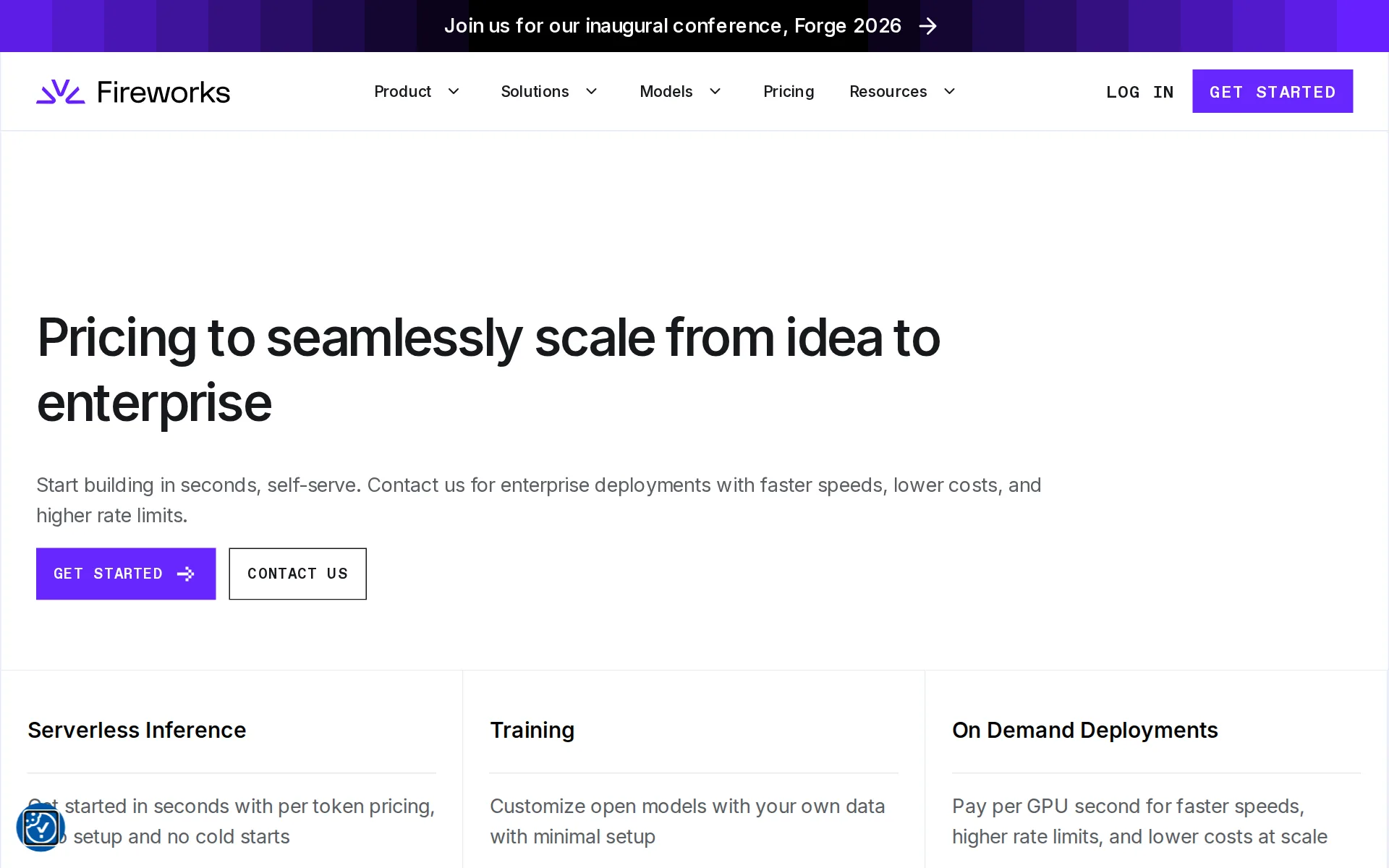
Pricing page, captured
fireworks.ai/pricing, checked
All plans and limits
| Plan | Price | Main limits |
|---|---|---|
| Pro | $8 a month | None stated |
| Team | $10 per seat a month | Up to 200 seats |
| Dedicated Training API | From $8 per GPU-hour | None stated |
| Enterprise | Price on request | None stated |
| Fireworks Sovereign | Price on request | None stated |
| Managed Training | From $0.50 per 1M training tokens | None stated |
| Reserved Throughput | Price on request | None stated |
| Serverless | From $0.05 per 1M input tokens | Small tier Total Prompt TPM: 216M tokens per minute |
Read from fireworks.ai/pricing.
What we checked on Fireworks AI
What the price counts
Fireworks charges for consumption, including tokens and GPU time, rather than publishing a seat subscription.
You buy credits, and usage draws them down: per token for Serverless, per GPU-second for On Demand, and per token or GPU-hour for training.
fireworks.ai/pricingChecked
Free to use
New accounts get a one-time $1 starter credit. Once it runs out, the account is suspended until you add a payment method and buy credits. There is no standing free plan.
When you finish your $1 credit, the following occurs: Account Status Without payment method: Your account will be suspended until you add a payment…
Public API
The product is an API first: chat completions, responses, embeddings, batch jobs, deployments and training are all documented REST endpoints with OpenAI and Anthropic compatibility.
Fireworks AI REST API enables you to interact with various language, image and embedding models using an API Key. It also lets you automate…
MCP server
A hosted Docs MCP server lets Claude Code or Cursor search the Fireworks documentation. It only searches docs and does not manage your account, deployments or inference. Separately, the Responses API can call custom MCP tools.
Once configured, your AI coding agent can search the full Fireworks AI documentation.
Open source
The platform itself is proprietary: Fireworks retains all rights to the service and the terms forbid reverse engineering it, even though the models it serves are open weights.
Fireworks owns all right, title and interest in and to the Service, the Feedback, the Usage Data, and any Deliverables
Questions about Fireworks AI
- How much does Fireworks AI cost?
- Fireworks AI costs $0.05 per 1m input tokens. From fireworks.ai/pricing, checked 8 November 2026.
- Does Fireworks AI have an API or an MCP server?
- Fireworks AI has an API. From docs.fireworks.ai/api-reference/introduction, checked 6 November 2026. Fireworks AI has a limited MCP server. From docs.fireworks.ai/ecosystem/integrations/development-setup, checked 6 November 2026.
- Is Fireworks AI open source, and can you host it yourself?
- Fireworks AI is not open source. From fireworks.ai/terms-of-service, checked 21 October 2026. You can host Fireworks AI yourself on Enterprise. From docs.fireworks.ai/ecosystem/integrations/byoc/overview, checked 21 October 2026.
- What have we checked on Fireworks AI?
- 5 facts, under these headings: What it costs to start, how you build with it.
- How do we check Fireworks AI?
- We hold 5 facts on Fireworks AI, quoted from 23 pages. Facts last checked 6 November 2026. Price last checked 8 November 2026. Last change found 6 November 2026.
Sources and changes
Last changed
Sources23
- fireworks.ai/pricing
- fireworks.ai/terms-of-service
- fireworks.ai/product/training
- docs.fireworks.ai/updates/changelog
- docs.fireworks.ai/
- docs.fireworks.ai/getting-started/introduction
- fireworks.ai/product/inference
- fireworks.ai/
- docs.fireworks.ai/accounts/data-residency
- docs.fireworks.ai/accounts/sso
- docs.fireworks.ai/api-reference/introduction
- docs.fireworks.ai/ecosystem/integrations/byoc/overview
- docs.fireworks.ai/ecosystem/integrations/development-setup
- docs.fireworks.ai/faq-new/billing-pricing/what-happens-when-i-finish-my-1-dollar-credit
- docs.fireworks.ai/faq-new/deployment-infrastructure/is-latency-guaranteed-for-serverless-models
- docs.fireworks.ai/getting-started/concepts
- docs.fireworks.ai/guides/security_compliance/audit_logs
- docs.fireworks.ai/guides/security_compliance/data_handling
- docs.fireworks.ai/guides/security_compliance/data_security
- fireworks.ai/models/fireworks/ember-1
- docs.fireworks.ai/nexus/provider-keys
- docs.fireworks.ai/serverless/pricing
- docs.fireworks.ai/tools-sdks/firectl/commands/dataset-download
What changed2
- What it does
- Free tier
Fireworks AI price history
Plans for Fireworks AI started at $0.05 per 1m input tokens on both of our reads, from 6 November 2026 to 8 November 2026.
| Price | Plan | First seen | Last seen | Readings | Source |
|---|---|---|---|---|---|
| $0.05 per 1m input tokens | 6 November 2026 | 8 November 2026 | 2 | Pricing page, read 6 November 2026 |
From our research, read twice since 6 November 2026. 7 more of our checks could not pick this price out of the page and are left out. A date is when we read the page, not when the price changed.
Similar to Fireworks AI
- ERIUS PHONERented cloud Android phones, each in its own container, that keep an agent's apps and sign-ins between sessions.
- TinyFishWeb search, page fetching, cloud browsers and goal-driven web automation for AI agents, with search and fetch free.
- SmitheryPublic MCP server registry, now run by Arcade, listing direct vendor MCP URLs after its proxy shut down.
- UI DiscoveryA library of real websites, iOS apps and dashboards with each one's palette, fonts and original build prompt.


Is Fireworks AI yours?
Free, and the page then carries the verified owner mark. You confirm it with an email at fireworks.ai. Claim this listing
Report an error if a fact is wrong.