
ERIUS PHONE
What is ERIUS PHONE?
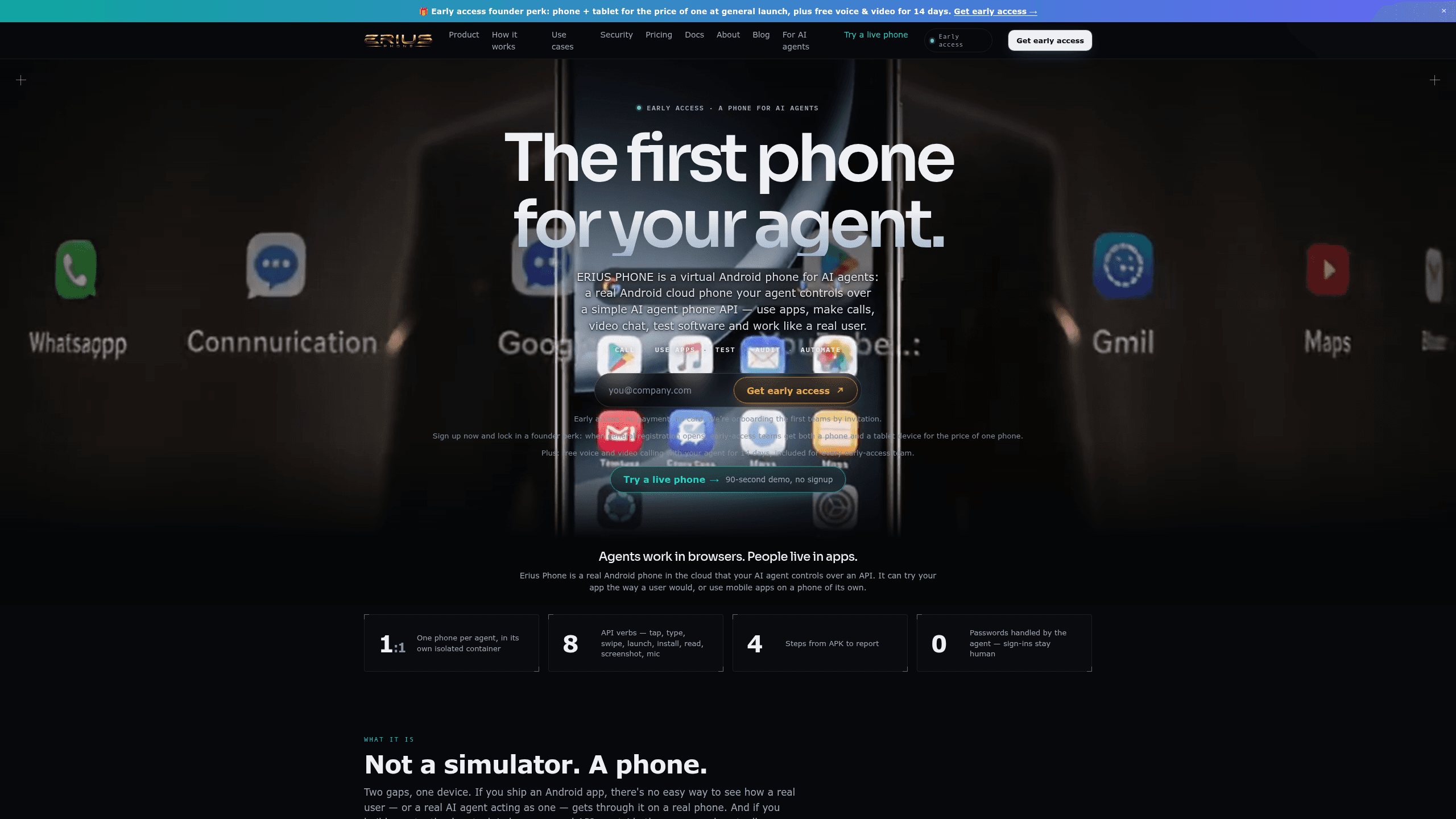
ERIUS PHONE is an AI mobile automation platform for AI product teams, QA engineers, developers, and operations teams that lets agents operate real Android 13 devices through the touchscreen. It combines Real Android, Real apps, real store, Looks before it taps, and One API, every gesture, with isolated containers, persistent sessions, and support for voice and video calls. It integrates with Google Play and uploaded APKs. Plans run Starter $39/mo, Team $129/mo, and Enterprise custom.
Last verifiedHow we evaluate
At a glance
- ERIUS PHONE is best for AI teams that need agents to operate real mobile apps, not browser-only flows.
- Starter $39/mo; Team $129/mo; Enterprise Custom
- Yes — The product provides touch-level control over HTTP, with API verbs for tap, type, swipe, launch, install, read, screenshot, and mic.
What you actually get: a real, isolated Android device, not a mock
Every plan provisions a full Android 13 system — real apps, Google Play, a real mobile browser — running in its own container with its own storage volume and network, rather than an emulator skin or a static screenshot loop. The device API gives an agent two complementary ways to act on it: an accessibility-tree snapshot (/snapshot, with [ref=N] on every tappable element) for anything the OS exposes normally, and raw-pixel /screenshot + coordinate taps for WebViews, Flutter apps and games the tree can't see — the vendor is upfront that those don't show up in the tree. Apps, installed state and signed-in sessions persist between sessions. Source: https://eriusphone.com/docs.html , https://eriusphone.com/about.html
Integration: a shipped, official MCP server, not just an API promise
Beyond raw HTTP, the vendor publishes and maintains its own MCP server (erius-phone-mcp) that exposes the same actions — snapshot, tap, type, launch, install, crash logs — as native tools for Claude Code, Claude Desktop and Cursor, installable with one uvx erius-phone-mcp command and no glue code. It's MIT-licensed, published to PyPI on 2 October 2026 and pushed to GitHub on 9 October 2026 (package metadata names the maintainer as "ERIUS [email protected]", confirming it's vendor-run, not a third-party integration). It's early and says so: version 0.1.0, "Development Status :: 3 - Alpha", and the README itself warns tool names may still change before 1.0. Source: https://pypi.org/pypi/erius-phone-mcp/json , https://api.github.com/repos/Protremix/erius-phone-mcp , https://github.com/Protremix/erius-phone-mcp/blob/main/PKG-INFO
It's a container, not a handset — what that means for app compatibility
The vendor's own security page is explicit that phones "share the server's kernel" and each container "runs in privileged mode" — this is virtualized Android (the open-source redroid project; the MCP server's own example output labels a device "redroid Android 13, no Google services"), not a dedicated physical phone and not a software-emulated one either. Because the devices aren't Play Protect certified, the vendor states plainly in its pricing FAQ that some apps — banking, DRM-protected streaming, some games — refuse to run on them, and that automated use can violate an app's or platform's terms of service, up to and including account bans the vendor says it "can't promise" won't happen and won't guarantee against. Source: https://eriusphone.com/security.html , https://eriusphone.com/pricing.html , https://github.com/Protremix/erius-phone-mcp/blob/main/PKG-INFO
Pricing: preview numbers, per phone, no free tier
Starter is $39/mo for one phone; Team is $129/mo for three phones ($43/phone); Enterprise is custom. A tablet device costs more: $59/mo standalone or $189/mo on the Team tier, per the published terms. These are explicitly labelled "early-access preview prices" that "may still change before general availability" — schema.org pricing markup on the site marks them as "PreOrder" availability. There is no free tier or trial (the vendor explains each device is real compute it has to pay for), but there is a 90-second live demo phone on the homepage that needs no signup. Payment isn't live yet: you sign up by email and the team provisions your account by hand; billing is a flat monthly price with no per-minute metering, cancel anytime once it starts. Source: https://eriusphone.com/pricing.html , https://eriusphone.com/legal.html
Security disclosure: unusually specific for an early-access product
The security page is dated ("checked against the live system: 5 October 2026") and goes well past boilerplate: it describes an isolation test performed from inside a test phone (connections to other phones, the host and the cloud metadata address were all blocked), states API keys are stored only as a SHA-256 hash and shown once, and specifies TLS 1.2/1.3 only with HSTS. It is equally specific about what's missing: no SOC 2 or other certification, no encryption at rest, no bug bounty, and — the material one — everything runs on a single Hetzner server in Helsinki with no second server, no uptime guarantee, and no backup job for phone storage, so data loss on that one machine is not recoverable. Source: https://eriusphone.com/security.html
Legal footing: deliberately unfinished
The combined privacy/terms page is dated 2 October 2026 and opens by saying the text "hasn't been reviewed by legal counsel, it doesn't yet name a legal entity or governing law, and it will be replaced by reviewed terms before commercial launch." That's consistent with the rest of the site treating itself as pre-launch, but it means there is currently no named company to contract with, and the terms that exist could change materially before general availability. Source: https://eriusphone.com/legal.html
Who's behind it
Erius Phone's own site names no company — About says only "built by a small team." The one public trail runs through its own open-source MCP server: the GitHub organisation that owns it, "Protremix" (homepage field set to eriusphone.com, maintainer email [email protected]), identifies itself as "Protremix Technology," based in Spain. That organisation's public GitHub profile simultaneously lists several other early-stage, unrelated projects under development — a blockchain platform, a self-hosted "AI engineering platform," a robotics/"physical intelligence" project and a QR loyalty app — each with zero or one GitHub star and comparably ambitious descriptions. That isn't evidence against Erius Phone specifically (its own API design and security disclosure are more careful than most of what we see at this stage), but it's relevant context on how much of a small team's attention is split across ventures. Source: https://github.com/Protremix , https://api.github.com/repos/Protremix/erius-phone-mcp
How much does ERIUS PHONE cost?
| Plan | Price | What's included |
|---|---|---|
| Starter | $39/mo |
|
| Team | $129/mo |
|
| Enterprise | Contact us |
|
Frequently asked questions
What is ERIUS PHONE?
ERIUS PHONE is an AI mobile automation platform for AI product teams, QA engineers, developers, and operations teams that lets agents operate real Android 13 devices through the touchscreen. It combines Real Android, Real apps, real store, Looks before it taps, and One API, every gesture, with isolated containers, persistent sessions, and support for voice and video calls. It integrates with Google Play and uploaded APKs. Plans run Starter $39/mo, Team $129/mo, and Enterprise custom.
How much does ERIUS PHONE cost? Is it free?
ERIUS PHONE has 3 paid plans: Starter at $39/mo, Team at $129/mo, Enterprise at Contact us.
What is ERIUS PHONE used for? Who is it for?
ERIUS PHONE is used for Real Android, Real apps, real store, and Looks before it taps. It's built for AI product teams, QA engineers, and Developers building mobile automations.
Does ERIUS PHONE have an API and what does it integrate with?
The product provides touch-level control over HTTP, with API verbs for tap, type, swipe, launch, install, read, screenshot, and mic. It integrates with Google Play, WhatsApp, Telegram.
Our take
Starter includes one agent phone, while Team adds three phones and more than one API key. If you need team-wide access or multiple concurrent devices, verify whether Starter's single-phone limit is enough before committing.

Where we've written about ERIUS PHONE
Explore other Browser Agents


