TinyFish
What is TinyFish?
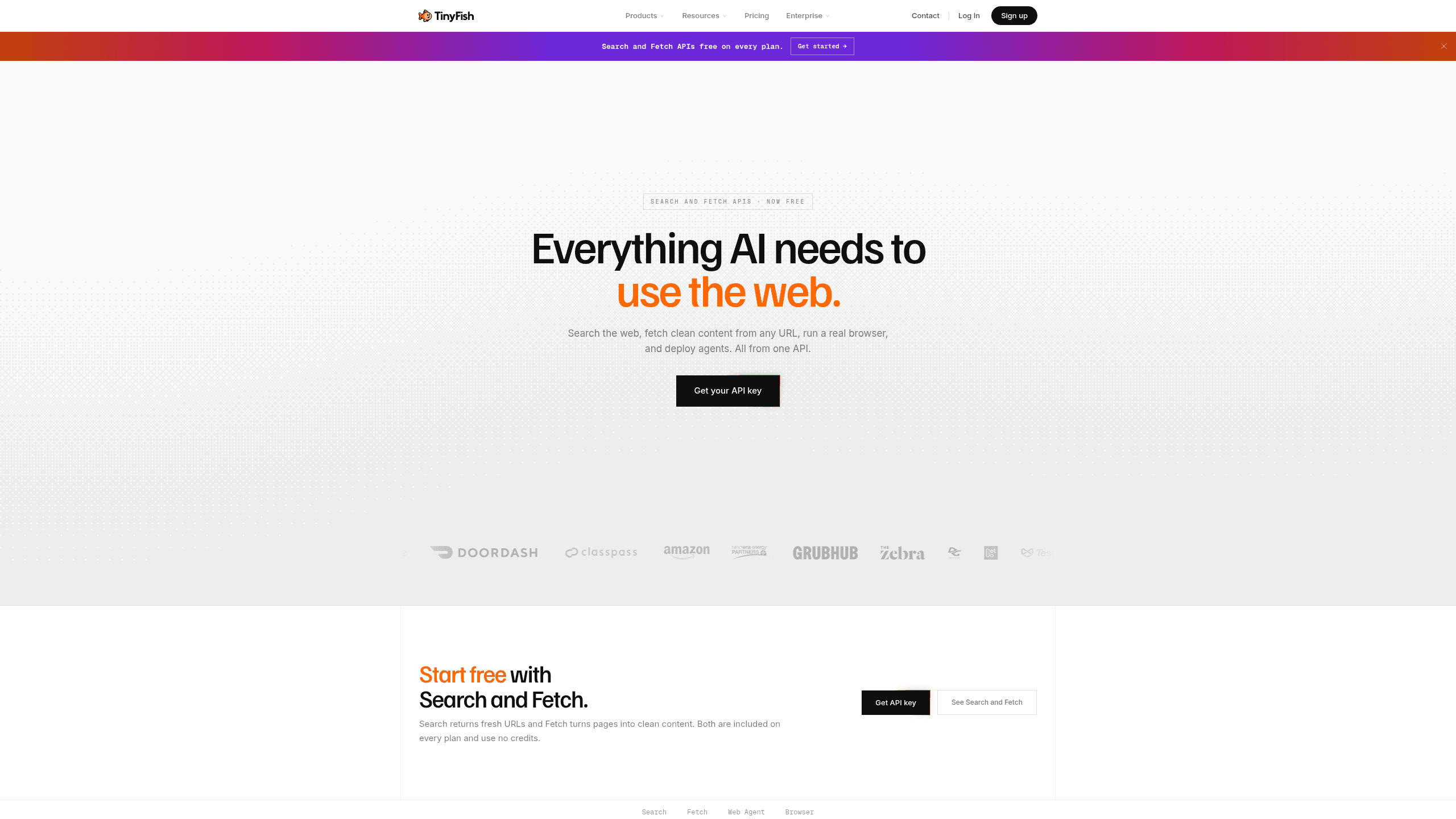
TinyFish is a web automation platform for developers that combines live search, page fetching, browser sessions, and multi-step agent workflows in one API. Its Search, Fetch, Web Agent, Browser API, and One credit pool features let teams move from lookup to extraction to action without stitching tools together. Customers include Google, DoorDash, Amazon, and Grubhub. Plans run Pay as you go at $0.015/credit, Starter at $15/mo, Pro at $150/mo, and Enterprise custom.
Last verifiedHow we evaluate
At a glance
- TinyFish is best for developers who need reliable web search, extraction, and browser automation in one API.
- Pay as you go $0.015/ credit; Starter $15/mo; Pro $150/mo; Enterprise Custom
- Yes — All products share one API key, and the site says direct API is available for custom integrations.
What you are actually buying
Four HTTP APIs behind one key and one credit pool: Agent (natural-language goal, multi-step execution on a live site, optional structured output schema), Search (structured web results), Fetch (URL to clean markdown/JSON/HTML) and Browser (a remote Chromium session you drive yourself over Playwright/CDP). Search and Fetch cost 0 credits; only Agent and Browser consume them (https://tinyfish.ai/pricing).
The surface area around it is genuinely broad for a company this young: Python and TypeScript SDKs, a CLI, an MCP endpoint using OAuth 2.1, plus documented n8n and Dify nodes and plugins for ChatGPT/Claude/Grok (https://docs.tinyfish.ai/llms.txt). Authenticated sites are handled two ways — connect 1Password or Bitwarden as a vault so the agent logs in without the model ever seeing the password, or save a Browser Context Profile after signing in once and reuse the cookies and trusted-device state (https://docs.tinyfish.ai/faq.md).
One point of confusion worth resolving up front: TinyFish is also the company behind AgentQL, its earlier developer product (MIT-licensed, 1,446 GitHub stars, last pushed 2026-08-09 — still actively maintained; https://github.com/tinyfish-io/agentql). AgentQL is a different thing — a query language plus Playwright integration you run yourself — and it is still sold separately on its own pricing page at $99/month for the Pro tier, versus $150/month for TinyFish Pro (https://agentql.com/). Neither site carries a deprecation or migration notice pointing at the other. If you are choosing between them, ask the vendor directly which one gets long-term investment; the public sites do not answer it.
Where it is genuinely strong
The documentation is the best evidence of engineering seriousness here, and it is candid in ways vendor docs usually aren't. The anti-bot guide leads with 'The result field is a better indicator of agentic success' and warns explicitly that 'COMPLETED doesn't mean it worked' — that is the single most expensive failure mode in agentic scraping, and TinyFish tells you about it in its own docs rather than letting you discover it in production (https://docs.tinyfish.ai/anti-bot-guide.md). The same guide gives a diagnostic table mapping what you see in the live browser preview (Cloudflare interstitial, DataDome popup, blank page, 403) to the likely cause. Every run exposes a streaming_url you can open and watch live, and structured error objects distinguish SYSTEM_FAILURE (retry, with a retry_after) from AGENT_FAILURE (your input is wrong) from BILLING_FAILURE (https://docs.tinyfish.ai/key-concepts/runs.md). That is a well-designed operational surface.
The benchmark work, whatever you conclude about the score, was published in a form that lets you check it: 300 tasks, one-shot success with no retries and no manual intervention, and every individual execution trace made public including failures (https://www.tinyfish.ai/blog/mind2web). On Hacker News a reader who went through the traces reported them as 'actual failures, not cherry-picked easy ones' (https://news.ycombinator.com/item?id=46991520). Publishing your failures is rare and it is to the company's credit.
Commercially, two details favour small-scale users: Search and Fetch are genuinely free rather than trial-limited, and failed runs cost $0 (https://tinyfish.ai/pricing). If your workload is mostly page fetching with occasional agent runs, this is cheap.
The vendor also publishes a comparison page that concedes territory rather than claiming everything — it states TinyFish is 'not designed as an end-user consumer browser; best suited to developers and AI-product teams', and that TinyFish, like others, treats a served CAPTCHA as a hard stop (https://www.tinyfish.ai/blog/ai-browser-agents).
The Mind2Web number, in context
TinyFish's homepage leads with '89.9% overall on Mind2Web, the industry-standard benchmark for web agents' and no citation (https://www.tinyfish.ai/). The underlying post makes clear TinyFish ran the evaluation itself — 'We ran TinyFish through the full benchmark in parallel' — and says results were being submitted to the official leaderboard (https://www.tinyfish.ai/blog/mind2web). The post was published around 2026-02-12, the date of its Show HN.
Checked today against the official Online-Mind2Web leaderboard data files maintained by OSU NLP, TinyFish does not appear on either the human-evaluated or the auto-evaluated table. The most recent verified entries are dated 2026-08-04 (https://huggingface.co/spaces/osunlp/Online_Mind2Web_Leaderboard).
Give the company its due on timing: when the post went up in February 2026, the highest verified human-eval score on that leaderboard was Yutori's Navigator at 78.7, so 89.9% would have led the published field. Six months on, the field has moved a long way. Current verified human-eval entries include Hark at 97.7, Navigator n1.5 at 97.3 and Enhans ACT-2 at 92.7; on the auto-eval (o4-mini judge) table, Hark 95.3, ACT-2 92.3, Navigator 87.9 and Microsoft's Webwright 86.7. TinyFish's post does not state which judge it used, so its 89.9 cannot be placed cleanly in either column.
The comparison baselines in TinyFish's post are also worth reading carefully. Operator at 43.2% on hard tasks and 61.3% overall, and Claude Computer Use 3.7 at 56.3%, are the OSU NLP human-eval figures dated 2025-03-22 and 2025-04-20 — accurate as published, but they measure systems from early 2025. A reader could easily take 'beats OpenAI and Anthropic' as a current statement; against the 2026 field it is not one.
A methodology question raised on HN and not answered in the thread is worth putting to the vendor: whether all agents were evaluated in the same time window, since live sites serve different layouts, A/B tests and consent modals across sessions (https://news.ycombinator.com/item?id=46991520).
How pricing works at scale
Published rates as of 2026-08-13: Pay-as-you-go $0.015/credit with 500 free credits; Starter $15/month for 1,650 credits then $0.014; Pro $150/month for 16,500 credits then $0.012; Enterprise custom, with SLA and an on-prem option (https://tinyfish.ai/pricing). The unit is defined as 'One credit = 1 agent step or 4 minutes of browser time', and LLM inference, stealth browser, anti-bot and proxy are included in that — no separate proxy bill, which is a real simplification versus assembling this from a browser host plus a proxy vendor plus model spend.
The thing to model before committing is steps, not tasks. The docs state that max_steps 'caps how many tool-call steps the agent takes', accepts 1 to 500, and that 'runs default to 150 when omitted' (https://docs.tinyfish.ai/key-concepts/runs.md). At $0.015/credit an uncapped run that goes badly can therefore reach roughly $2.25 on its own — our arithmetic from the vendor's published unit price, not a vendor figure. The docs' own example run object shows num_of_steps: 5, so a well-scoped extraction is cheap; the exposure is on complex or looping goals.
Two consequences follow. First, the natural cost control — setting max_steps yourself — is documented as beta-gated: 'Custom max_steps is in beta — you must join the beta to use it (contact support to enable it for your account).' If that is still the case when you sign up, your per-run ceiling is 150 credits until support enables it, and your practical controls are goal design and concurrency caps. An independent developer who built on the platform did exactly that, enforcing hard server-side caps of two attempts per site and a global concurrency of two, which he described as looking 'almost comically small' but necessary to prevent 'fan-out chaos' (https://medium.com/continuous-insights/stop-writing-brittle-scrapers-project-blowfish-with-tinyfish-web-agents-643a38a54c78).
Second, read the homepage savings table with the step definition in hand. It quotes '100 tasks/mo | $240 | $1.50' and '10,000 tasks/mo | $24,000 | $150' for a competing stack versus TinyFish (https://www.tinyfish.ai/). Those TinyFish figures work out to $0.015 per task — one credit — while the credit is defined per agent step. Unless your tasks complete in a single step, the table understates what those volumes cost. Ask sales to restate the comparison in steps.
Operational limits to know before you build
All vendor-stated, all from the docs. Latency: 'Typically 3-10 seconds for simple pages, 30-60 seconds for complex multi-step automations' (https://docs.tinyfish.ai/faq.md). If you need sub-second responses in a user-facing path, this is a background job, not a request handler.
Proxy geography is limited to US, GB, CA, DE, FR, JP and AU (https://docs.tinyfish.ai/faq.md). If you need to appear in Brazil, India or most of the rest of the world, that is a gap to raise before signing.
CAPTCHAs are a hard stop — the anti-bot guide lists 'CAPTCHA (reCAPTCHA, hCaptcha)' with the note 'CAPTCHA gate — cannot be solved automatically' (https://docs.tinyfish.ai/anti-bot-guide.md). The claimed '85% pass rate across Akamai, Cloudflare, DataDome, PerimeterX, and Imperva' carries no citation or methodology on the homepage and should be treated as a vendor figure until you test it on your own targets; the same applies to the '<250ms Browser cold start' claim (https://www.tinyfish.ai/). The independent developer above hit a plain IP block from bol.com in testing ('Your IP address is blocked'), which is a useful reminder that the pass rate is an average across sites, not a guarantee for yours.
Browser choice is explicit: 'Lite' standard Chromium (fast) or 'Stealth' modified Chromium (slower but bypasses bot protection) — expect to pay for stealth in latency (https://docs.tinyfish.ai/faq.md). Batch endpoints cap at 100 runs per request. And one deprecation already flagged in the docs: the ?screenshots=base64 parameter is 'temporary — it will be deprecated soon' (https://docs.tinyfish.ai/key-concepts/runs.md).
Finally, plan for validation. Because COMPLETED does not imply a correct result, anything you build needs its own output assertions; budget for that work rather than assuming the status field is enough.
Contract terms and where the legal risk sits
Automating third-party sites carries compliance exposure that the vendor does not absorb. TinyFish's terms require you to 'indemnify, defend, and hold harmless Tiny Fish... from and against any and all Actions... due to... your access to or use of the Services', and cap TinyFish's own liability at 'the greater of (i) $100 USD, or (ii) the amounts you paid Tiny Fish in the 12 months preceding' the claim (https://www.tinyfish.ai/terms). You retain ownership of Customer Data. Termination is for uncured material breach on 30 days' notice, or immediately for non-payment over 10 days or a Restrictions violation.
That allocation is not unusual for developer infrastructure, but the combination matters more here than for most tools: the product's purpose is to operate other people's websites, sometimes behind a login and sometimes past bot protection, and the party carrying the CFAA, GDPR and target-site terms-of-service risk is you. TinyFish's own guidance is to review a site's terms and robots.txt first and to avoid personal data or authenticated content without permission. If you are in a regulated industry, route this past counsel before a pilot, not after.
The pricing page lists ISO 27001 and SOC 2 alongside the Enterprise tier (https://tinyfish.ai/pricing), and a trust centre exists at https://trust.tinyfish.ai/. We could not read certification status, audit dates, auditor or subprocessors from that page on 2026-08-13 — not established from public sources. Request the reports directly.
Company, funding and how to read the customer list
TinyFish launched from stealth on 2025-08-20 with a $47M Series A led by ICONIQ Growth, with USVP, Mango Capital, MongoDB Ventures, ASG and Sandberg Bernthal Venture Partners participating. Founders named in launch coverage are Sudheesh Nair (former president of Nutanix, CEO), Shuhao Zhang (former Meta engineering leader) and Keith Zhai (former Wall Street Journal senior correspondent) (https://techstartups.com/2025/08/20/tinyfish-launches-from-stealth-with-47m-in-funding-to-transform-enterprise-web-agents-for-fortune-500-companies/). Coverage of the round reported a roughly 25-person team and a stated three-to-four-year runway (https://india.entrepreneur.com/news-and-trends/ai-startup-tinyfish-secures-usd-47-mn-in-series-a-funding/496170). That coverage reads as reprinted announcement material rather than independent reporting, so treat the headcount and runway as company statements. The funding itself is well corroborated across outlets.
On the customer logos — Google, DoorDash, ClassPass, Amazon, Grubhub, The Zebra, NextEra Energy Partners and others appear on the homepage (https://www.tinyfish.ai/) — the specific scale figures trace to a single source. The claims '30M+ operations monthly in production for Google Hotels, DoorDash, and ClassPass', '99.99% reliability, 4x broader coverage, and 50% lower operational cost compared to legacy automation', and ClassPass expanding venue coverage 'from 2,000 to more than 8,000 fitness studios' all come from the Mino beta launch announcement of 2025-11-05, which is explicitly labelled a paid press release distributed via ACCESS Newswire (https://finance.yahoo.com/news/tinyfish-launches-mino-operate-hidden-150000126.html). We found no independent confirmation from Google, DoorDash or ClassPass. None of this means the relationships aren't real — pilot traction with Google was reported as a factor in the Series A — but a logo on a page and a paid wire release are not corroboration of the reliability and scale numbers. Ask for a reference call.
For context on product velocity: the company shipped AgentQL (Feb 2024), the Mino platform (Nov 2025) and the current four-API developer suite, which is a lot of repositioning in two years. That is normal for a company at this stage; it is also a reason to get roadmap commitments in writing if you are building on a specific API surface.
The Hacker News thread you will find when you search
Searching for independent discussion surfaces one prominent thread: 'Show HN: TinyFish Web Agent (82% on hard tasks vs. Operator's 43%)', posted 2026-02-12 (https://news.ycombinator.com/item?id=46991520). It is worth knowing what it is before you weigh it.
The submission came from an account named gargi_tinyfish, so it is a vendor Show HN — normal and legitimate on HN. The thread ran to 12 comments. At least one of the strongly supportive replies is from the company: an account arguing the easy-to-hard drop-off case writes 'TinyFish: 97.5% easy -> 81.9% hard. 15-point drop... We lose 15 points.' Another commenter posted 'I assume you used your own product to hype up this post? @dang. I was excited about it till I saw this behavior' — an allegation, not a finding, and we have no evidence either way. No substantive vendor response to the methodology questions appears in the thread.
The practical takeaway is narrow: treat that thread as vendor material rather than as independent community validation. Genuinely independent hands-on writeups are scarce — the most substantive one we found is the Project Blowfish post cited above. For a product that exited stealth in August 2025 and shipped this API suite recently, thin independent coverage is normal rather than a red flag; it just means you should budget for your own pilot instead of relying on others' experience.
Who this fits
Good fit: a developer or AI-product team that needs multi-step, authenticated automation on sites with no API, wants proxy/stealth/inference on one bill rather than assembled from three vendors, and can run work asynchronously with its own result validation. The free Search and Fetch tier and $0 failed runs make an evaluation cheap, and 500 free credits are enough for a real test.
Poor fit: anything latency-critical in a user-facing request path (30-60s for complex runs); workloads needing proxy exit points outside the seven supported countries; targets that gate on CAPTCHA; and teams that cannot carry the indemnity for automating third-party sites.
Worth comparing against: Browserbase and Steel for raw hosted browsers, Browser Use and Stagehand as self-run frameworks, Firecrawl and Apify for extraction-shaped work, and — if the benchmark question matters to you — the agents currently verified above TinyFish's self-reported figure on Online-Mind2Web. Run the same ten tasks on your own targets across two or three of these; the published numbers will not settle it.
How much does TinyFish cost?
Pay as you go
$0.015/ credit- Try it. No card, no subscription, no commitment.
- 500 credits free to start
Starter
$15/mo- For developers running workflows daily. 40% cheaper than PAYG.
- 1,650 credits / month
- $0.014 / credit overage
- LLM inference
- Stealth browser
- Anti-bot
- Agent proxy
- Vault + Profile
- SDKs + CLI + MCP
- Priority email
Pro
$150/mo- For teams that don't want to think about limits.
- 16,500 credits / month
- $0.012 / credit overage
- Slack + onboarding
- ISO 27001, SOC 2
Enterprise
Custom- For regulated environments and scale.
- Custom credits, SLA, on-prem
- Dedicated engineer
- ISO 27001, SOC 2
- Available
Frequently asked questions
What is TinyFish?
TinyFish is a web automation platform for developers that combines live search, page fetching, browser sessions, and multi-step agent workflows in one API. Its Search, Fetch, Web Agent, Browser API, and One credit pool features let teams move from lookup to extraction to action without stitching tools together. Customers include Google, DoorDash, Amazon, and Grubhub. Plans run Pay as you go at $0.015/credit, Starter at $15/mo, Pro at $150/mo, and Enterprise custom.
How much does TinyFish cost? Is it free?
TinyFish has 4 paid plans: Pay as you go at $0.015/ credit, Starter at $15/mo, Pro at $150/mo.
What is TinyFish used for? Who is it for?
TinyFish is used for Search, Fetch, and Web Agent. It's built for Product engineers, Automation teams, and Data operations teams.
Does TinyFish have an API and what does it integrate with?
All products share one API key, and the site says direct API is available for custom integrations. It integrates with Cursor, Grok, Vercel, n8n, AG2, and 5 more.
Editor's read
Check whether the Starter plan's 1,650 credits per month covers your daily workflow volume, since overages are billed at $0.014 per credit. If you expect heavier usage or need regulated-environment controls, Pro or Enterprise changes the cost and support profile.