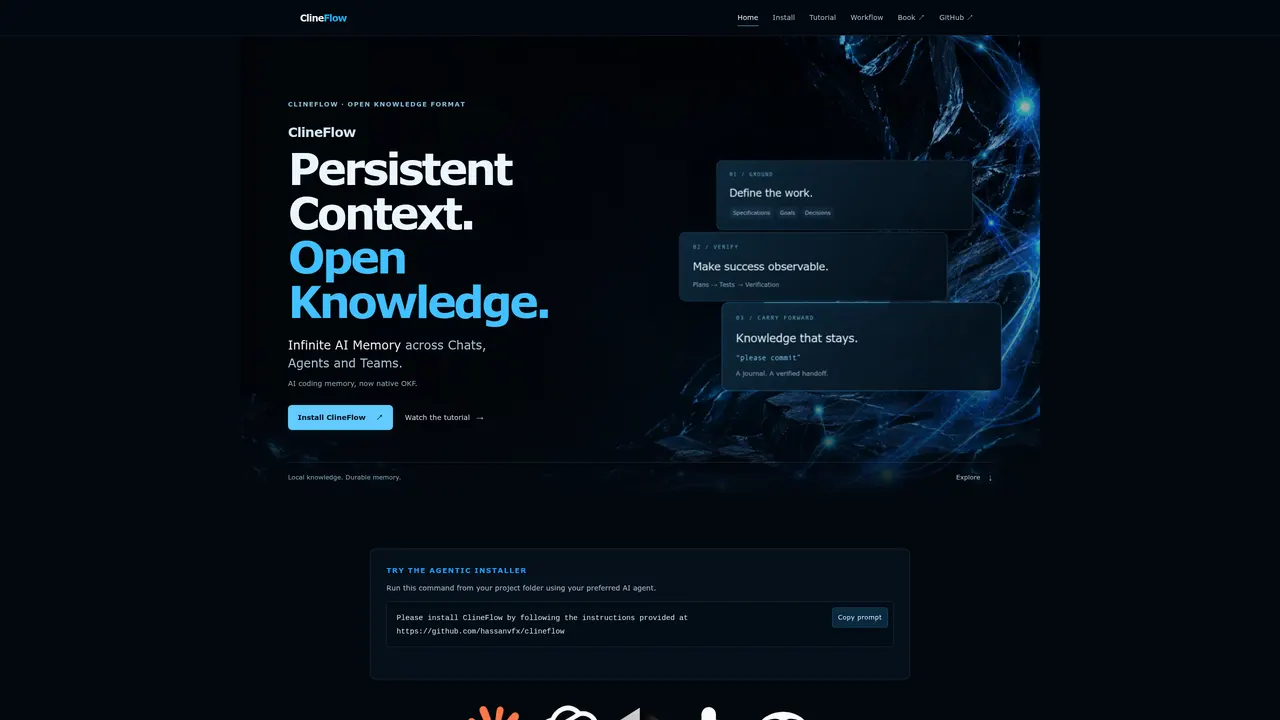
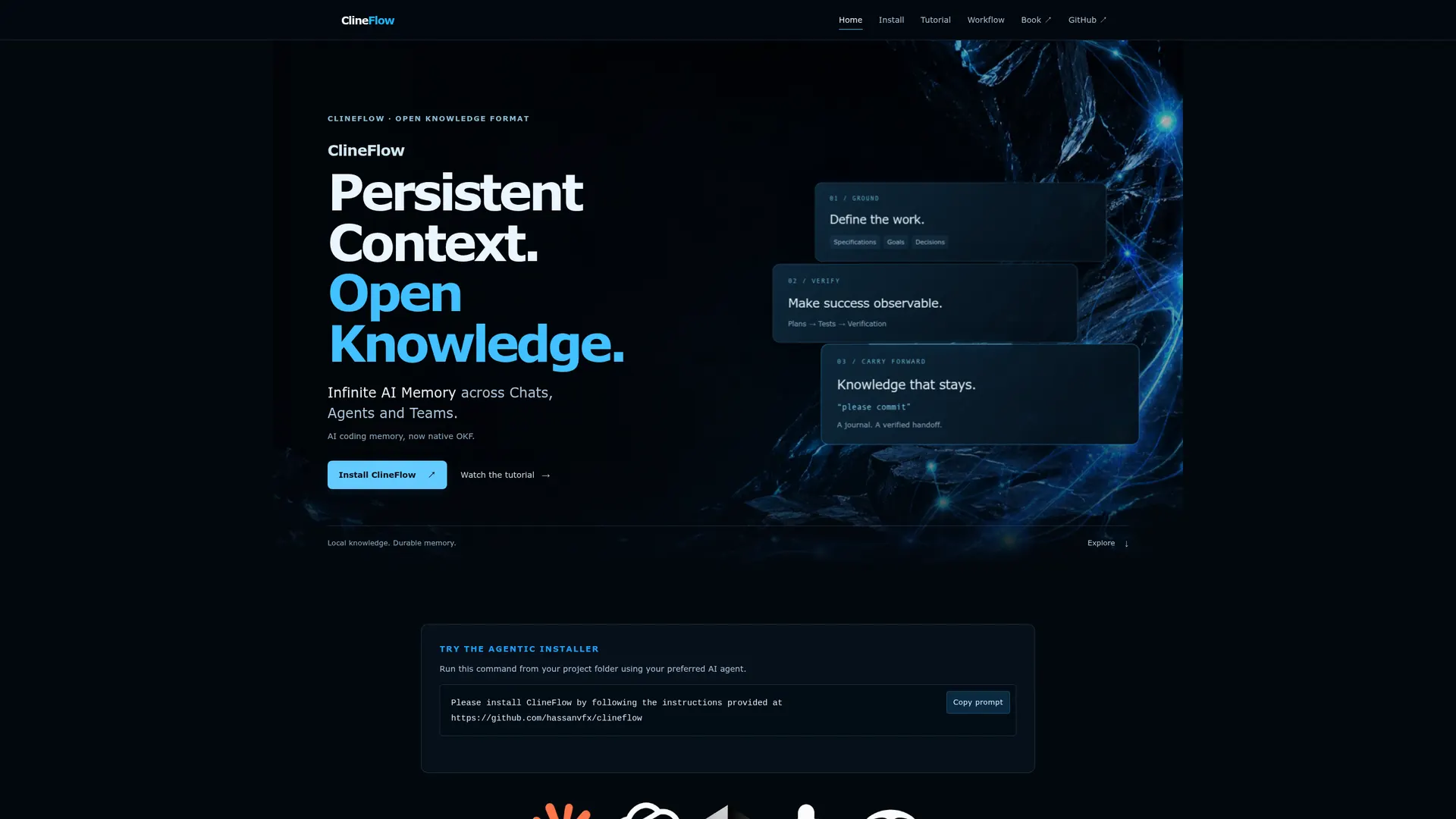
Supported coding agents read and update it through their native instruction files.
At a glance
- Category
- Agent Tools & Integrations
- Tags
- Free, Open Source, Self-Hosted
Code
- Last push
- 12 September 2026
For developers
- Works with
- Cline, Claude Code, ChatGPT Codex, Cursor, GitHub Copilot, Windsurf and 1 more
What it actually installs
ClineFlow is a shell-script installer, not a hosted service. Run one prompt or a curl/PowerShell one-liner from a project directory and it drops a hidden .clineflow/ runtime (installer, updater, validators) plus a knowledge/ directory into the repo, then appends one marker-delimited instruction block to each supported agent's native config file: .clinerules for Cline, AGENTS.md for Codex and Cursor, CLAUDE.md for Claude Code, .github/copilot-instructions.md for Copilot, and .windsurf/rules/clineflow.md for Windsurf. Existing content in those files outside the marker block is left alone. There is no daemon, no account, and no network call at runtime beyond the install/update fetch from GitHub.
The memory model: five ledgers, not a vector store
Project memory lives as plain Markdown and YAML in the repo, not in an embedding index. Five small YAML files (clineflow_goals.yml, clineflow_specification.yml, clineflow_verification.yml, clineflow_last_session.yml, clineflow_timeline.yml) are meant to answer 'why, what, proven how, what's true now, and how did we get here' at a glance, and each substantial task gets a longer-form Engineering Journal file under knowledge/journals/. Saying 'please commit' triggers the agent to update the active journal, refresh all five ledgers with one shared timestamp, and run a bundled validator (validate-knowledge-sync --staged) before the commit is created. The format follows Google Cloud's Open Knowledge Format (OKF) v0.2 spec, a real, actively maintained Apache-2.0 project (9,100+ stars) for making agent-generated knowledge self-describing.
OKF conformance is self-declared, not certified
The README carries an 'OKF v0.2' badge and the repo ships its own OKF and knowledge-sync validators, but there is no independent body certifying conformance — the badge and the checks are both authored by the same maintainer. This is normal for how OKF is designed to work (no central registry, no required tooling) but it means 'OKF-compatible' here is a claim you can verify yourself by reading the spec against the repo, not one a third party has signed off on.
Maturity: near-solo, very early, and its own CI is red
The repo was created 8 November 2025 and has 1 star, 0 forks, and 0 open issues as of 7 September 2026. GitHub's contributor graph lists two accounts, but the second (aeonfluxor, 73 of the commits) is an unidentifiable account with no name, bio, company, or followers and only one public repo — there's no way to confirm it's a distinct person rather than the same maintainer's second account or an automated identity. Treat this as effectively a one-person project until shown otherwise. More concretely checkable: the last three runs of the project's own GitHub Actions test suite on main (as of 7 September 2026) all report conclusion: failure, driven by a windows-lifecycle-smoke job failing at its 'Install through Git Bash' step on every run in that window, even though Windows is one of the three officially supported install paths.
The marketing domain no longer hosts the product page
clineflow.com and www.clineflow.com both return HTTP 301 to https://hassanvfx.github.io/infinite-ai-context/, a GitHub Pages site that still displays the ClineFlow name and installs the same tool. Public RDAP records show clineflow.com was registered on 20 August 2026 — the redirect to GitHub Pages was therefore already in place well within a month of the domain's own registration. The GitHub Pages destination is legitimate (same author, same GitHub repo link, same install prompt) and not a broken link, but a buyer bookmarking clineflow.com should expect to land on a github.io URL, not the branded domain.
Cost
The tool itself is free: MIT-licensed, no account, no hosted tier, no usage limits, confirmed against the repository's LICENSE file and GitHub API metadata. The only paid artifact in the ecosystem is the author's companion book, 'Infinite AI Context: ClineFlow and Google's Open Knowledge Format' — $43.04 for a 159-page paperback on Lulu as of 8 September 2026, with a free web PDF also linked from the product page. Buying the book is optional and has no bearing on what the software does.
Plans and pricing
Price and terms
- Free plan
- YesYesEntire tool is MIT-licensed and installed from the public repository
The terms in full
no account, hosted service or paid tier exists. Requires Git and curl or wget.
- Card to start
- YesNot required
- Sign up without sales
- YesYes
For AI agents
- MCP server
- No
- API
- No
Checked .
The facts, with their sources
What it costs to start
- Free tier
- YesThe whole tool is MIT-licensed and installed from a public repository with no account or hosted service in the path, so there is nothing to pay for.
ClineFlow installs a project-local durable development workflow. It does not require an account, hosted memory service, or always-running process.
github.com/hassanvfx/clineflow/blob/mai…
How you build with it
- Public API
- NoThe documented interfaces are local shell commands and files in your repository; the vendor states the contract itself is Markdown, YAML, links and Git rather than a service you call.
No Codex plugin, proprietary service, or always-running ClineFlow process is required. The durable contract is Markdown, YAML, links, and Git.
github.com/hassanvfx/clineflow - MCP server
- NoIntegration happens by writing instruction blocks into agent config files, and the vendor states no plugin or running process is involved, so there is no MCP server for an assistant to call.
No Codex plugin, proprietary service, or always-running ClineFlow process is required.
github.com/hassanvfx/clineflow - Open source
- YesThe repository publishes the installer, validators and knowledge templates under the MIT license, and GitHub reports MIT as the license for the project.
License: MIT
github.com/hassanvfx/clineflow
Filed under
Sources and updates
Sources on github.com4
Repository
- Licence
- MIT
- Stars
- 1
- Last push
- 12 September 2026
Updates1
- Free tier · Price · What it does