
Wanna is a planner and drafting team, not a builder
You paste the URL of a product you already have. Wanna reads the public pages, writes back what it understood with a source beside each fact, and opens a workspace it calls Wanna OS. From there it gives each day a plan of at most three tasks and hands them to role-based agents: fundraising, sales, marketing, content, product and operations.
The output is cards you read and approve. The first set is fixed: a first grant or accelerator application filled from your facts, a first investor letter, three versions of a LinkedIn post, a first week of tasks, and a scan of competitors and their prices. The home page shows the same format on an invented dental practice and labels each card "Example card, not a real result".
It deliberately stops short of your product. The trust page puts it plainly: "Claude Code works inside your code. Wanna works on the things around it: investor letters, posts, research and applications. It does not write or ship your code." It also reads only pages anyone can open, never signs in to your site and never changes it.
Credits, not seats, decide how much work happens
One task costs 10 credits, and each plan is a credit allowance for a fixed number of companies. Starter is $20 a month for 200 credits, about 20 tasks, which the vendor describes as about one task a day. Growth is $49 for 5,000 credits, about 500 tasks. Scale is $149 for 16,000 credits across up to five companies out of one pool. Top-ups start at $10 on any plan.
Nothing is priced per user, and there is no annual billing: the pricing page offers one monthly figure per plan with no billing toggle on it. Payment runs through Stripe and the card statement reads WANNA.
Two costs sit outside the plan price. Social accounts that Wanna posts to through its publishing service are $13 a month each, with one included on Starter, while channels it connects through its own apps, such as Telegram, are free. The alternative to credits is bringing your own Claude or ChatGPT account, in which case "your tasks run on your machine while it is online" and consume none of Wanna's credits.
The terms also describe a product the pricing page does not: a "Day pass" of $20, once, for 24 hours of work from your Company Passport. The pricing page sells $20 as a recurring Starter plan. Both pages are live, and a buyer cannot tell from the site which one a $20 payment buys.
Autonomy is a mode, and the full one goes through sales
Every new company starts in Approve everything, where each letter, application and post waits for an OK. The second mode lets letters go out on their own, but only after three conditions are met: you switch on "Let me write outside for you", connect a sending address on a separate sending domain, and add your name and postal address for the footer. Posts, applications and advertisements wait for approval in both modes, as do spending money and anything the system judges risky or unusual.
The marketing pages and the sheet disagree about how to get it. The how-it-works page lists Autonomous as "Available" and "Recommended", while the pricing and home pages head the same mode "Only through sales" and route you to a request form, with setup done "by hand for each company". Treat it as a sales-configured option rather than a switch inside the plan you buy.
The vendor is unusually direct about what this has amounted to so far. Its own autonomy page reports zero actions that went outside in the preceding seven days and adds that "the zero for outside actions is why this page does not claim, as a fact, that Wanna works without people".
One founder, an AI as CEO, and zero paying customers
Wanna was founded by Anna Elef, with Alex Galt as co-founder, and the company presents its own AI as the CEO with no employees. The founders keep four things: confirming critical actions, payments, registrations and signatures. In legal papers the company is represented by its founder.
The origin is dated: the product was built over three months of evenings by Anna's husband and given to her on 4 October 2026. The about page, counted on 20 October 2026, reports 3 confirmed sign-ups since that date and 0 paying customers, and the status line reads "Private beta."
The trust page publishes its own counters, refreshed hourly: 4 companies in Wanna OS, 9 tasks finished with proof in the last seven days, 0 platforms connected and working now, and 9 AI actions that waited for a client's OK. A mistakes log is referenced but, in the vendor's words, "The Mistakes page is not up yet, so there is nothing to count." Every number about the product comes from the product.
No audit report, and a privacy page that calls itself a draft
The security position is stated rather than certified. The trust page lists under what it does not have yet: "No security audit report (such as SOC 2) yet." There is no DPA, no subprocessor register in the formal sense and no uptime commitment in the terms, which cover payment, sending, refunds and data only.
What is documented is specific. Text being worked on may go to OpenRouter, OpenAI or Anthropic, and OpenRouter passes it on to OpenAI, Google or Anthropic under their own terms. Wanna logs which service was called, how long it took and what it cost, but not the text or the answer. Credentials it does keep, for a mailbox, calendar or Calendly, are encrypted with AES-256-GCM and bound to the company, with the opening key on the server rather than in the database. Social account keys stay with the platform and with Zernio, the publishing service, which knows a company by number rather than by name.
Nothing on the site says whether customer text may be used to train models. Deletion and export are both self-service in Wanna OS, with no undo. The page carrying all of this ends with "This page is a short draft, not the privacy policy. The policy is being written."
Where it fits, and where it does not
It fits a solo founder with a live product, no team and a funding or first-customer problem: the grant, accelerator and investor matching is the most concrete part of the offer, quoted on the how-it-works page as "458 grants and accelerators open today, each with a checked source" and 311 investors it can write to.
It does not fit a company that needs the work to integrate with what it already runs. Gmail, Google Calendar, Calendly, Drive, Microsoft 365, Outlook, Stripe, QuickBooks, Xero, Slack, Notion and HubSpot are listed under "You can ask for" rather than as connections that exist, and publishing to your own channels is marked coming. There is no API, no MCP server and no developer documentation, so nothing here can be driven from another system.
It also does not fit a buyer who needs procurement evidence. No audit report, no SSO beyond a one-time email code, no uptime commitment, a privacy page marked draft, and a measured record of zero paying customers are each a reason a company with a security review will stop. Daily ceilings of 25 letters, 5 applications and 3 posts per company, lowerable but not raisable, cap the volume for anyone who clears those hurdles.
Wanna price and terms
Terms
- Free to start
- PartlyLimited free useFree, $0: the plan, the matched grants, accelerators, investors and first customers with sources, and the first drafts
- Card to start
- YesNot required
- Sign up without sales
- PartlySome plans
The terms in full
After setup 10 credits are granted, enough for one task at 10 credits each, and they expire after 30 days; the team then pauses. No card needed.
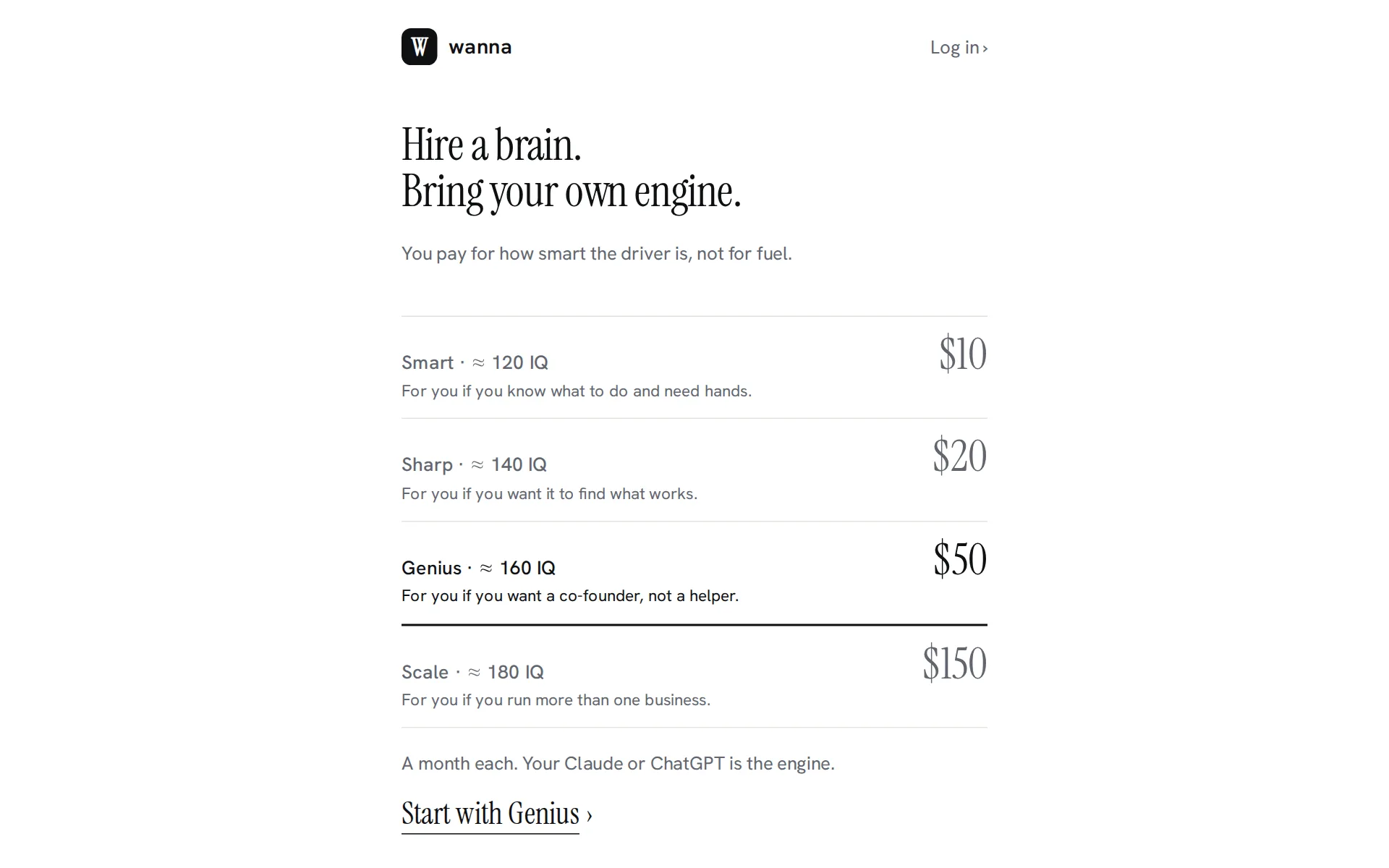
Pricing page, captured
wannable.ai/pricing, checked
What we checked on Wanna
Free to use
The plan, the matched grants and investors and the first drafts cost nothing, but execution stops after the 10 onboarding credits buy one task.
After setup you get 10 credits, enough for one task.
wannable.ai/pricingChecked
Self-serve signup
Starter through Scale are bought by card without a call, but the fully autonomous mode is handed to sales and configured per company by hand.
Only through sales
wannable.ai/pricingChecked
Card to start
Starting the free plan takes no card; payment is only requested when you press Start on paid work inside Wanna OS, through Stripe.
Not for starting. You pay only when you press Start in your Wanna OS - by card, through Stripe. Starting costs nothing.
wannable.ai/pricingChecked
Cancel any time
There is no term and no fee, and refunds are offered on request, but canceling means emailing the vendor and the plan runs to the end of the paid month.
It renews each month until you cancel. To cancel, email us any time: it stops at the end of the month you paid for.
wannable.ai/termsChecked
Acts on its own
An Autonomous mode exists but is sold only through sales, and even there posts, applications and ads always stop for the founder; money and risky steps always wait.
On the page: The two modes comparison table, Posts, applications, advertisements row
wannable.ai/autonomyChecked
Limits on what it may do
Limits are set before the agents act: per-company daily ceilings on letters, applications and posts, sending off by default, and a Stop button that pauses everything.
Daily limits per company: 25 letters, 5 applications, 3 posts, no ads until you set a budget. You can lower them, not raise them.
wannable.ai/productChecked
No code needed
Setup is pasting a product URL, confirming an email code and answering two optional questions; nothing in the documented flow asks for code.
Paste a link to your product One field on the home page. Wanna starts reading your site right away and makes the first cards while you go on.
wannable.ai/productChecked
Several agents
One AI CEO decides the day's plan and distributes the work to a team of role-based agents for fundraising, sales, marketing and product, sized to the company's stage.
Wanna is an AI CEO with a team of AI agents. It reads your product, asks a few questions and starts the work around it: applications, letters to…
wannable.ai/productChecked
Retention you control
Deletion is on demand from inside Wanna OS and removes the vendor's records, but no retention period is configurable; fixed windows apply to the free site check.
Open your Wanna OS and choose Delete my Wanna OS. It removes what Wanna's own records hold about your company
wannable.ai/privacyChecked
Self-hosted
Wanna OS runs on the vendor's infrastructure; the only buyer-side element is model execution through your own Claude or ChatGPT account, not the product itself.
Your team works from Wanna’s machines.
wannable.ai/pricingChecked
Take your data out
A download of your data sits next to the deletion control in Wanna OS, and the terms repeat that both are available at any time without asking support.
Both are in your Wanna OS: Download my data and Delete my Wanna OS, under your sign-in link.
wannable.ai/privacyChecked
Security audits
The trust page lists the absence of an audit among the things Wanna does not have yet, with no SOC 2, ISO 27001 or equivalent report published.
What I do not have yet. No security audit report (such as SOC 2) yet. When there is one, it will be here.
wannable.ai/trustChecked
Single sign-on
The documented way in is a one-time email code valid for 30 minutes, and no identity provider, SAML or Google Workspace sign-in appears on any page.
Confirm your email You get a one-time code. It works for 30 minutes. Your company opens only after the address is confirmed.
wannable.ai/productChecked
Audit log
There is a live feed of finished work with measured durations and a record of actions that waited for approval, but no user-level log of who did what.
The live feed on Waiting on you says how long each finished piece of work took, as measured: “took 37 s”. Nothing is estimated.
wannable.ai/changelogChecked
Its own model
Wanna trains nothing of its own: drafts are written by Anthropic's Claude on machines it operates, or routed out to OpenRouter, OpenAI or Anthropic.
It uses its own agents — Claude, made by Anthropic, running on machines Wanna operates — or an outside AI service: OpenRouter, OpenAI or Anthropic.
wannable.ai/privacyChecked
You pick the model
The vendor picks the model by default and names Claude as its own agent; a buyer's only documented choice is to attach a personal Claude or ChatGPT account.
Your team works from Wanna’s machines. You can connect your own Claude or ChatGPT account too.
wannable.ai/pricingChecked
Your own model key
You attach your own Claude or ChatGPT account rather than a provider API key, you sign in on your own machine, and tasks then run there only while that machine is online.
Optional: your tasks run on your machine while it is online
wannable.ai/pricingChecked
Wanna alternatives
Wanna and its 2 alternatives
All 2 show a price.
Wanna beside its alternatives: the price on each one's site and the day it was checked Tool Price Checked Wanna From $20 a month AutoGPT From $50 a month The Colony Free


Questions about Wanna
- How much does Wanna cost?
- Wanna costs $20 a month. From wannable.ai/pricing, checked 20 October 2026.
- Is Wanna open source, and can you host it yourself?
- You cannot host Wanna yourself. From wannable.ai/pricing, checked 20 October 2026.
- What have we checked on Wanna?
- 17 facts, under these headings: What it costs to start, what it does on its own, what happens to your data, whether a company can buy it, models it can use.
- How do we check Wanna?
- We hold 17 facts on Wanna, quoted from 9 pages. Facts and price last checked 20 October 2026, when we also found the last change.
Sources and changes
Last changed
Sources on wannable.ai9
What changed1
- Free tier
Wanna price history
Plans for Wanna started at $20 a month on all 4 of our reads, from 20 October 2026 to 19 November 2026.
| Price | Plan | First seen | Last seen | Readings | Source |
|---|---|---|---|---|---|
| $20 a month | Starter | 20 October 2026 | 19 November 2026 | 4 | Pricing page, read 20 October 2026 |
From our research on 20 October 2026, an Internet Archive copy from 25 October 2026 and 2 of our own checks since 17 November 2026. A date is when we read the page, not when the price changed.
Similar in Workflow automation
- GumloopNo-code builder for AI agents that connect to company apps, run on triggers and produce files.
- ActivepiecesAutomation workspace that limits each AI agent to the actions, pinned inputs and step caps you set, on any model.
- 5diveHire a team of always-on AI agents that run on a server you own, managed or self-hosted under MIT.
- Precision AI OSManaged AI agents and scheduled routines run by a named engineer, with every send held for staff approval by default.


From our research
Claimed by the Wanna team.
We check its facts against the Wanna site.Facts checked 20 October 2026
Report an error if a fact is wrong.