
Bloomfire in our research
All researchStudy
AI Tool Pricing Index, November 2026
Pricing
Contact sales
82 of the 361 tools we checked ask you to contact sales for a price.
Edition price, checked 28 October 2026.
Pricing pages of the AI tools, November 2026 editionas of n = 361 tools checked
What Bloomfire actually does
Bloomfire began in 2011 as knowledge management software and now sells the layer underneath it: the Enterprise Intelligence Engine, which reads connected systems and keeps what it learns in what the vendor calls a Persistent Semantic Memory. The claim on the AI Connect page is that most AI-ready APIs are only a search endpoint, so the model receives a stack of documents and still has to work out what is current and who may see it.
The product sits in two halves. The knowledge management app is where people author, moderate and search content, with Synapse answering questions conversationally and inside Slack and Microsoft Teams. The engine is headless, and its surfaces are sold as reasoning functions an agent calls: Synapse Active Intelligence for grounded answers, AI Signal Studio for triggers, Learning Studio for decision paths, Organization Simulator for pressure-testing a knowledge base.
Content arrives through named connectors for SharePoint, Google Drive, Confluence, Salesforce, GitHub, Zendesk, Box, Zoom, Gong and Genesys, and goes back out to Amazon Q, Microsoft Copilot and Salesforce Einstein. A second group of connectors covers paid research subscriptions such as Mintel, Kantar, Euromonitor, Forrester and S&P Global, which points at the market research and insights teams Bloomfire has sold to for years.
Agents call the engine over MCP, inheriting the caller's permissions
Every engine surface is reachable over both a REST API and Bloomfire's own MCP server, which the vendor describes as exposing those surfaces as callable tools. The page names Claude, Microsoft Copilot and Glean over MCP, ChatGPT through published function schemas, Gemini through function declarations, and any HTTP client through REST.
Two details matter more than the list. Authentication is per user, so an agent acts with one person's rights and source system access controls still apply: if a user cannot open a file in SharePoint, an agent acting for them does not reach it. And access checks run during reasoning rather than as a filter on the output, so restricted concepts are excluded before an answer is assembled.
The REST API documentation is public and, per the vendor's integrations FAQ, covers searching, returning, creating and modifying posts from any tool a customer already uses. Intelligence Modules each ship with their own endpoints, so a developer can call a module directly or chain several into a multi-step agent workflow.
Guardrails are policies with severity tiers, not reports
Content Guardrails is the part of the platform with the most specific documentation. Policy families ship for credentials, PII and PHI, GLBA, confidentiality markers, deprecated terminology, language and link hygiene, and each policy carries its own severity and its own action: flag it, suppress it from search and AI, or quarantine it and notify an administrator.
Four severity tiers map to effects a buyer can predict. Eligible content participates fully, Warning is advisory, Violation is flagged for human review while retrieval continues, and Critical or Blocked content is excluded from search and synthesis but stays visible in the health report. For credentials, PII and GLBA the vendor says detection is fully deterministic with no model calls, using pattern matching and checksum validation. Content arriving from a connected system can also be held in sandbox for admin review before it becomes searchable.
Custom policies are added as a single JSON file, which is the line where configuration stops being point-and-click.
Pricing is a quote, and the terms contradict the pricing page
There is no rate card. The pricing page is a contact form whose promise is a fixed price scoped by sales, stated as no consumption charges or user counts. No free plan and no trial appear anywhere on the site.
The terms of use describe a different billing shape. A subscription specifies limits on items including the number of members, and exceeding them is charged at a per unit fee from the subscription or from Bloomfire's then current list price. Accounts are designated user accounts that cannot be shared, and sharing can trigger suspension or an invoice for the extra members. The worked example in the terms charges a subscriber for 75 additional members after exceeding the limit by 54. Neither the per unit fee nor the list price is published, so the overage is unpriced for a buyer reading the site.
Subscriptions are paid in advance, are non-refundable, renew automatically, and require written notice at least 30 days before the end date to stop.
SOC 2 Type II is the only audit, and ISO 27001 was dropped in 2022
The trust center is a Vanta-hosted page listing a SOC 2 Type II report dated February 2026, the NIST AI Risk Management Framework, policy documents available on request, and controls grouped by infrastructure, organizational, product and privacy. Subprocessors are named with their regions: AWS carries all hosting, with CloudConvert for document processing, Mailgun and SendGrid for email, and MongoDB Atlas holding community content and vector embeddings on private-only connectivity.
ISO 27001 is a deliberate absence rather than a gap. The data security FAQ says Bloomfire ran both programs for a while, found substantial overlap, and in 2022 adopted SOC 2 as its single compliance program. Healthcare and EU claims are phrased as HIPAA-Ready and GDPR-ready, which is not the same as naming a signed business associate agreement or data processing addendum, and neither document is published.
Identity handling is concrete: SAML 2.0 and OIDC for sign-in, SCIM for Azure Active Directory and Okta, and an implementation estimate of under four hours for IT to connect both.
Where it fits, and where it does not
The buyer this is written for is a large regulated enterprise that already has content scattered across SharePoint, Confluence and a helpdesk, and that wants one governed layer its own agents can query. The company page claims 15% of the Fortune 100 as customers, and the guardrail families for GLBA and PHI point at banks, credit unions, insurers and healthcare administration.
It is a poor fit for a small team. There is no way to start without sales, no published price, and the implementation is described as a phased program with onboarding, content migration and change management staff attached. Teams wanting to evaluate the engine first have a product tour and a demo request, not a sandbox.
On-premise and air-gapped deployment is listed as an engine option, while the security FAQ says most deployments are multi-tenant cloud and stricter architectures are scoped case by case. A buyer whose requirement is on-premise should treat it as a negotiation rather than a product feature. Growth equity came from Primus Capital in 2021, and the company is now led by CEO Philip Brittan.
Bloomfire price and terms
Terms
- Sign up without sales
- NoNo
For AI agents
- MCP server
- Yesbloomfire.com,
- API
- Yesbloomfire.com,
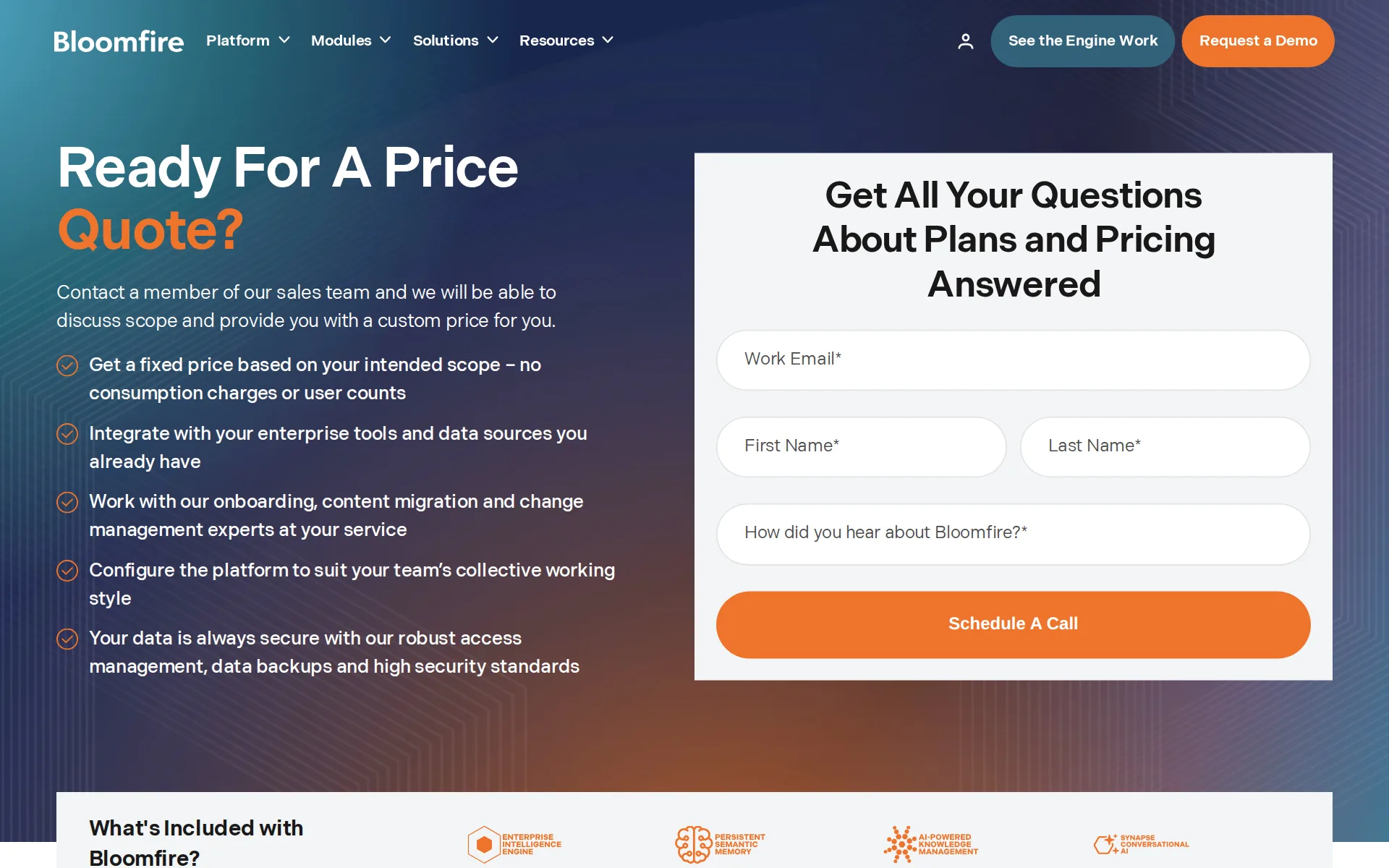
Pricing page, captured
bloomfire.com/pricing, checked
What we checked on Bloomfire
What the price counts
Priced only on a quote: sales scopes the deployment and returns one fixed figure that the page says is not metered by consumption or by user count.
Get a fixed price based on your intended scope – no consumption charges or user counts
bloomfire.com/pricingChecked
Self-serve signup
There is no signup path: the pricing page's only instruction is to contact the sales team, which then scopes and quotes the deployment.
Contact a member of our sales team and we will be able to discuss scope and provide you with a custom price for you.
bloomfire.com/pricingChecked
Contract
Subscriptions run for a fixed term that renews by default, and each subscription carries named limits on members and items that cost extra once exceeded.
Bloomfire subscriptions automatically renew unless a proper notice of cancellation is completed at least 30 days prior to the end date of the current…
bloomfire.com/terms-of-useChecked
Cancel any time
Cancellation is possible but never free of a term: it takes written notice at least 30 days before renewal, and fees already paid are not refunded.
Subscriber can cancel a Membership Community, with at least 30 days notice, by e-mailing cancel@bloomfire.com specifying the Membership Community…
bloomfire.com/terms-of-useChecked
Works with
Named connectors cover SharePoint, Google Drive, Confluence, Salesforce, GitHub, Zendesk, Box, Zoom, Gong, Slack and Teams, plus outbound push to Amazon Q and Microsoft Copilot; the site ties none of them to a plan.
It includes CRM and support tools like Salesforce, Zendesk, and ServiceNow, plus dev tools like GitHub and Jira.
Public API
A documented REST API with an API reference and interactive explorer covers content, search and Synapse answers, authenticated with OAuth 2.0 bearer tokens and filtered by user permissions.
Structured, predictable endpoints for content, search, and Synapse AI.
bloomfire.com/buildChecked
MCP server
AI Connect is Bloomfire's own MCP server, exposing engine surfaces as tools to Claude, ChatGPT and Microsoft 365 Copilot; an admin enables it in settings and each user signs in with OAuth 2.0 PKCE.
Bloomfire’s MCP server exposes the engine’s surfaces as callable tools
bloomfire.com/eie/ai-connectChecked
Acts on its own
Agents connected through AI Connect can search, summarize and draft contributions, but any write they initiate must be reviewed and approved by a person before it is committed.
Write actions require human approval. Users must review and approve any AI-initiated change.
Limits on what it may do
Content Guardrails give every policy a severity tier and an action from advisory flag to hard block, and connected agents must check content against those policies before acting.
Policy flags act as guardrails for agent access, not just reports.
bloomfire.com/eie/ai-connectChecked
No code needed
The core knowledge base and the pre-built connectors for Confluence and SharePoint need no custom setup; building custom applications on the engine goes through the API instead.
Yes. Both are pre-built connectors, ready to use without custom setup.
No training on your data
Customer content and the semantic memory built from it are kept out of generative model training, and the memory is held separate from the language model rather than fine-tuned into one.
Your data and your PSM are never used to train or fine-tune a generative model.
bloomfire.com/eie/ai-connectChecked
Retention you control
Administrators can schedule archiving and unpublishing of aging content and recover deletions for 30 days, but no customer-set retention window or purge control is published.
You can schedule publishing for a future date, as well as automatically scheduling archiving and unpublishing documents when they become out of date.
Data stays in your region
Hosting is on AWS with a choice of jurisdiction arranged through sales, though the vendor says it does not currently host in the Middle East.
Your sales team can help arrange hosting in the jurisdiction of your choice.
bloomfire.com/kmsChecked
Self-hosted
The engine is offered in multi-tenant and single-tenant cloud forms and also as air-gapped or on-premise deployments, per the AI Connect product page.
Multi-tenant, single-tenant, air-gapped, or on-premise.
bloomfire.com/eie/ai-connectChecked
Open source
The platform is proprietary: the terms reserve all software and intellectual property to Bloomfire and grant only a revocable license, with FFmpeg the single open component listed.
the Bloomfire Service and its materials, including software, images, text, graphics, illustrations, logos, patents, trademarks, service marks,…
bloomfire.com/terms-of-useChecked
Take your data out
Admins can export contributions to CSV across all or selected communities, but the documented export carries titles, authors, categories, tags and publish state rather than a full content archive.
Export all contributions from all communities
Security audits
SOC 2 Type II is the named audit, with results shared on request rather than published; the vendor dropped ISO 27001 in favor of SOC 2 alone and states it signs HIPAA BAAs.
Bloomfire has decided to adopt SOC 2 as our single security compliance program going forward.
Single sign-on
Single sign-on runs over SAML 2.0 and OIDC, with SCIM provisioning documented for Azure Active Directory and Okta so roles and removals follow the identity system.
Bloomfire supports single sign-on through SAML 2.0 and OIDC. SCIM is available for Azure Active Directory and Okta too.
Audit log
Usage analytics includes a full audit trail alongside query and engagement reporting, and every request made through the MCP and API layer is recorded for later inspection.
MCP-initiated activity is captured in Bloomfire's standard audit log, the same as any UI or API action.
Uptime promise
The security FAQ commits to 99.9% application uptime and says the commitment is contractual rather than a marketing figure.
We commit to 99.9% uptime for the application – and we put that in writing.
Questions about Bloomfire
- How much does Bloomfire cost?
- Bloomfire gives its price on request. From bloomfire.com/pricing, checked 17 November 2026.
- Does Bloomfire have an API or an MCP server?
- Bloomfire has an API. From bloomfire.com/build, checked 17 November 2026. Bloomfire has an MCP server. From bloomfire.com/eie/ai-connect, checked 17 November 2026.
- Is Bloomfire open source, and can you host it yourself?
- Bloomfire is not open source. From bloomfire.com/terms-of-use, checked 28 October 2026. You can host Bloomfire yourself. From bloomfire.com/eie/ai-connect, checked 17 November 2026.
- What have we checked on Bloomfire?
- 20 facts, under these headings: What it costs to start, what it works with, what it does on its own, what happens to your data, whether a company can buy it.
- How do we check Bloomfire?
- We hold 20 facts on Bloomfire, quoted from 16 pages. Facts and price last checked 17 November 2026, when we also found the last change.
Sources and changes
Last changed
Sources16
- bloomfire.com/eie/ai-connect
- bloomfire.com/terms-of-use
- bloomfire.com/eie/universal-connector-framework
- bloomfire.com/kms/data-security
- bloomfire.com/pricing
- bloomfire.com/eie/content-guardrails
- bloomfire.com/integrations
- bloomfire.com/platform/data-security
- help.bloomfire.com/posts/6018474-understanding-ai-connect
- help.bloomfire.com/series/3492053/posts/3488103-security-faq
- bloomfire.com/build
- bloomfire.com/eie/ai-signals
- bloomfire.com/kms
- bloomfire.com/kms/moderation-tools
- help.bloomfire.com/posts/3464991-how-to-use-the-bulk-contribution-export-import-tool
- bloomfire.com/scale-your-ai
What changed1
- What it does
Bloomfire price history
We have read the price once so far, on 17 November 2026: price on request.
| Price | Plan | First seen | Last seen | Readings | Source |
|---|---|---|---|---|---|
| Price on request | 17 November 2026 | 17 November 2026 | 1 | Pricing page, read 17 November 2026 |
From our research on 17 November 2026. A date is when we read the page, not when the price changed.
Is Bloomfire yours?
Free, and the page then carries the verified owner mark. You confirm it with an email at bloomfire.com. Claim this listing
Report an error if a fact is wrong.