
One chat that feeds five founder modules
Ember is a single workspace for people starting or running a small company. The center is the Second Brain, a chat that reads your documents and connected apps and, per the FAQ, "uses a ReAct architecture to analyze your data, search the web, and provide contextual recommendations." Around it sit four modules that share the same project context: Fund Your Growth (business plan and funding file), Creation (decks, documents and images in your brand), Lead Intelligence (B2B prospect targeting and outreach drafts) and Visibility (content planning).
The homepage example shows the shape of the output: a request for a 2027 cash flow plan comes back as an XLSX file. Lead Intelligence is pitched less as a sequencer and more as a prioritizer, promising a daily list of "3 highest-probability accounts" and a calculated send volume on its module page. There is also a mobile app. The site is published in eight languages.
Plans differ only in credit volume, not features
The pricing page opens on yearly billing.
Credits are the real meter. The page converts them into rough outputs (Starter is "≈ 7 pitch decks per month" or "≈ 83 documents"), but the cost of any single action "depends on the action and its complexity," and only the heaviest actions show an estimate. Credits do not roll over, and when they run out "The relevant action is blocked." Team starts at two seats, each costing "the matching individual tier plus $2" with pooled credits.
The Free plan is a standing plan rather than a trial: 1,000 welcome credits, then 150 a day up to 1,500 a month, no card. The sales terms note that prices are converted from euros at checkout.
The sales terms and pricing page list different plans
The sales terms say that "four plans are available: Free ... Pro, Max and Team," and describe Free as including "one deck generation, one prospecting mission limited to ten prospects and one funding analysis." The pricing page shows a Starter tier that the terms never mention, and describes Free in credits instead. The FAQ on the general FAQ page does mention Starter.
Module readiness is similarly uneven. The homepage presents Fund Your Growth as structuring a funding file "in nine building blocks," while the FAQ says "Promise, Offer, Acquisition and Finance modules are rolling out depending on your plan," and Lead Intelligence notes that "Some automations may be rolling out."
Connectors read your apps and never write without consent
Ember is an MCP client. Its connected apps page lists 24 applications, including Google Workspace, Outlook, Slack, HubSpot, Salesforce, Pipedrive, Apollo, Notion, Airtable, Jira, Stripe, Figma and GitHub, almost all described as read access. The page states that "No connector is used to pay, delete, publish or send to third parties" and that nothing changes "without your confirmation."
The enterprise integrations page is narrower: CRM access is a "Read-only API diagnostic" and "Ember does not automatically sync any CRM." There is no public API, and a general administration API is marked coming soon with no date. Ember does not expose an MCP server that other assistants could call.
Enterprise pages say plainly what is missing
Ember publishes a set of enterprise pages that label each control as available or not. According to them, there is no SSO, no security certification ("Ember does not currently claim any Enterprise security certification"), no quantified SLA, no centralized roles or permissions, and no organization retention controls. A shared team workspace is still "in preparation." Support runs by email and in-app chat, Monday to Friday, 9am to 6pm Paris time, with a stated 48 business-hour average response, per the support page.
Ember says it does not train on your content, but it has "not enabled a no-retention setting with OpenRouter." There is no complete self-service export, so leaving means emailing support.
A young French company led by a repeat founder
The about page credits Joffroy Louchart, a cofounder of Finalcad, with writing the first lines on February 9, 2025. The homepage claims 2,000+ founders use it. The terms limit the platform to professional use and exclude the consumer withdrawal right.
It fits solo founders, freelancers and small teams who want plans, decks and prospect lists generated from one context at a low monthly price. It does not fit organizations that need SSO, a signed uptime commitment, an audit trail, a public API or certified security controls, since Ember's own pages say none are available today.
Ember price and terms
Terms
- Free plan
- YesYes1,000 welcome credits, then 150 a day capped at 1,500 a month
- Card to start
- YesNot required
- Sign up without sales
- YesYes
The terms in full
2 projects and 1 Lead mission of up to 10 prospects; 5 business plan audits and 5 deck audits a day. No card required.
For AI agents
- API
- Noember.do,
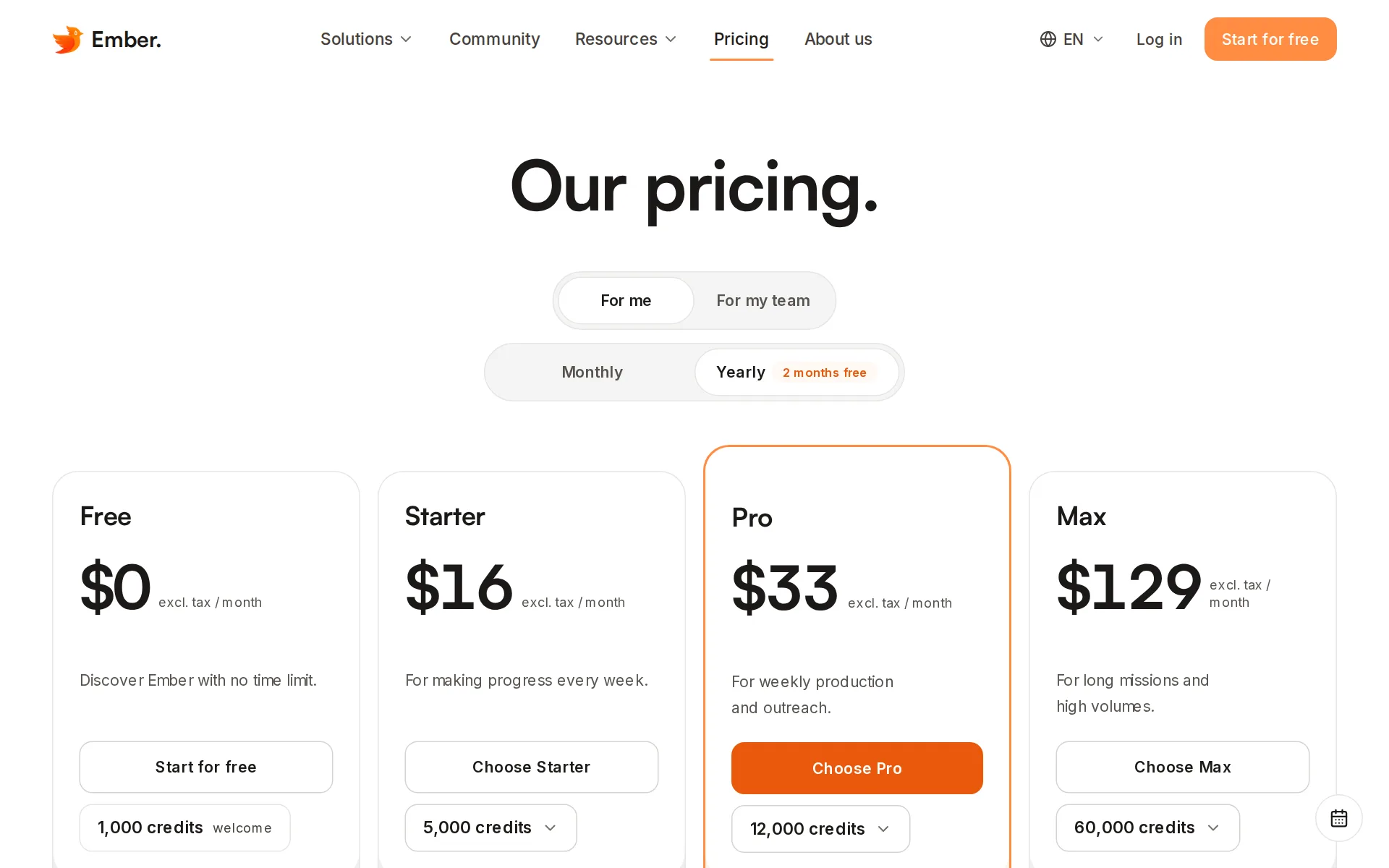
Pricing page, captured
Its own pages, checked
All plans and limits
| Plan | Price | Main limits |
|---|---|---|
| Free | $0 a month | 5 business plan audits and 5 deck audits / day; Daily credits: +150/day, capped at 1,500/month credits; Projects and Lead missions: 2 projects and 1 Lead mission (up to 10 prospects) |
| Starter | $19 a month | Daily credit refresh: +200 credits / day; Monthly credits: 5,000 credits per month; Projects, audits and missions: included |
| Pro | $39 a month | Daily credit refresh: +300 credits / day; Monthly credits: 12,000 credits per month |
| Max | $149 a month | Daily credit refresh: +500 credits / day; Monthly credits: 60,000 credits per month; Projects, audits and missions: Unlimited |
Read from ember.do/en/pricing.
What we checked on Ember
What the price counts
Flat monthly subscription tiers sized by a monthly AI credit allowance, with a daily credit refresh; Team is priced per seat with pooled credits.
A credit measures the use of AI-assisted features. Cost depends on the action and its complexity. An estimate is shown for the most credit-intensive…
ember.do/en/pricingChecked
Free to use
A standing Free plan with no time limit gives 1,000 welcome credits, then 150 credits a day capped at 1,500 a month, with two projects and one bounded Lead mission.
Yes. Free requires no card. It includes 1,000 welcome credits, then 150 credits per day up to 1,500 per month. It is not a time-limited trial.
ember.do/en/pricingChecked
Self-serve signup
Individual plans are bought on the pricing page by card through Stripe; only sizing a Team plan currently requires a conversation with Ember before activation.
Visa, Mastercard and American Express are accepted through Stripe. Applicable taxes are added at checkout.
ember.do/en/pricingChecked
Card to start
The Free plan is opened without a payment card, and the product pages repeat that no credit card is needed to start.
Yes. Free requires no card.
ember.do/en/pricingChecked
Contract
Subscriptions run month to month with no commitment, or annually; both auto-renew for the same term, and Team plans start at a two-seat minimum.
The subscription is offered, at your choice, on a monthly basis without commitment or on an annual basis. It is automatically renewed by tacit…
ember.do/en/legal/salesChecked
Cancel any time
You can cancel from your account at any time with no fee, but it takes effect at the end of the paid period and that period is not refunded.
Yes. You can cancel from your account before the next renewal. Cancellation takes effect at the end of the current, non-refundable period.
ember.do/en/pricingChecked
Works with
Ember lists 24 apps it connects to through MCP connectors, including Google Workspace, Outlook, Slack, HubSpot, Salesforce, Pipedrive, Notion, Stripe and GitHub; connections are read-oriented and no plan gating is stated.
Ember plugs into your applications through MCP connectors (Model Context Protocol, the standard that gives agents controlled access to your tools).
ember.do/en/resources/mcpChecked
Public API
No public API is documented; the enterprise integrations page lists a general administration API as coming soon with no date, and CRM access is a limited read-only diagnostic.
A general API for administering Ember across an organization is not available yet.
Acts on its own
Ember runs multi-step requests and produces documents, decks and prospect lists on its own, but any write to connected tools or outreach is shown first and waits for your confirmation.
Ember reads your applications. Any creation or change is shown to you first, and nothing changes without your confirmation.
ember.do/en/resources/mcpChecked
Limits on what it may do
You grant each connector's permissions from your own account and can disconnect at any time; no connector is used to pay, delete, publish or send. Centralized team roles are not available.
Ember uses it to read your applications with the permissions you grant.
ember.do/en/resources/mcpChecked
No code needed
Setup is conversational: you describe the project to Ember in chat, connect email or LinkedIn, and the modules work from that context with no code or CRM needed.
No CRM required. No complex onboarding.
No training on your data
The privacy policy says Ember does not use your content to train models, though no zero-retention setting is enabled with OpenRouter and each model provider applies its own retention.
We do not use your content to train models. OpenRouter states that it does not use your content to train models; however, We have not enabled a…
ember.do/en/legal/privacyChecked
Retention you control
Deletion is available on request and with account deletion, but there are no retention settings for organizations and several data categories have no automatic deletion.
Administration settings dedicated to organization retention policies are not available.
Take your data out
GDPR portability is honored in a machine-readable format, but there is no complete self-service export; you must email support to receive your data.
The Platform does not offer a complete self-service export: make the request to support@ember.do.
ember.do/en/legal/privacyChecked
Security audits
Ember states plainly it claims no enterprise security certification, so no SOC 2 or ISO audit is named; GDPR handling is documented in the privacy policy instead.
Ember does not currently claim any Enterprise security certification.
Single sign-on
Centralized sign-in for organizations is listed as not available, with no announced date; individual users can sign in with Google.
Centralized sign-in for organizations is not available.
Uptime promise
There is no quantified uptime or availability commitment; support is email and in-app chat on Paris business hours with a stated 48 business-hour average response.
No quantified SLA or availability commitment is provided today.
Ember alternatives


Questions about Ember
- How much does Ember cost?
- Ember has a free plan. Its paid plans are Starter at $19 a month, Pro at $39 a month and Max at $149 a month. From its own pages, checked 13 November 2026.
- Does Ember have an API or an MCP server?
- Ember has no API. From ember.do/en/enterprise/integrations, checked 1 November 2026.
- What have we checked on Ember?
- 17 facts, under these headings: What it costs to start, what it works with, what it does on its own, what happens to your data, whether a company can buy it.
- How do we check Ember?
- We hold 17 facts on Ember, quoted from 11 pages. Facts last checked 1 November 2026. Price last checked 13 November 2026. Last change found 6 November 2026.
Sources and changes
Last changed
Ember price history
Ember was free on both of our reads, from 1 November 2026 to 13 November 2026.
| Price | Plan | First seen | Last seen | Readings | Source |
|---|---|---|---|---|---|
| Free | 1 November 2026 | 13 November 2026 | 2 |
From our research, read twice since 1 November 2026. A date is when we read the page, not when the price changed.
From our research
- The median AI tool started at $25 a month in November 2026, and 57% had a free tier
- Customer service agents: SOC 2, ISO 27001, GDPR and SSO
- Healthcare AI agents: SOC 2, ISO 27001, GDPR and SSO
Is Ember yours?
Free, and the page then carries the verified owner mark. You confirm it with an email at ember.do. Claim this listing
Report an error if a fact is wrong.