
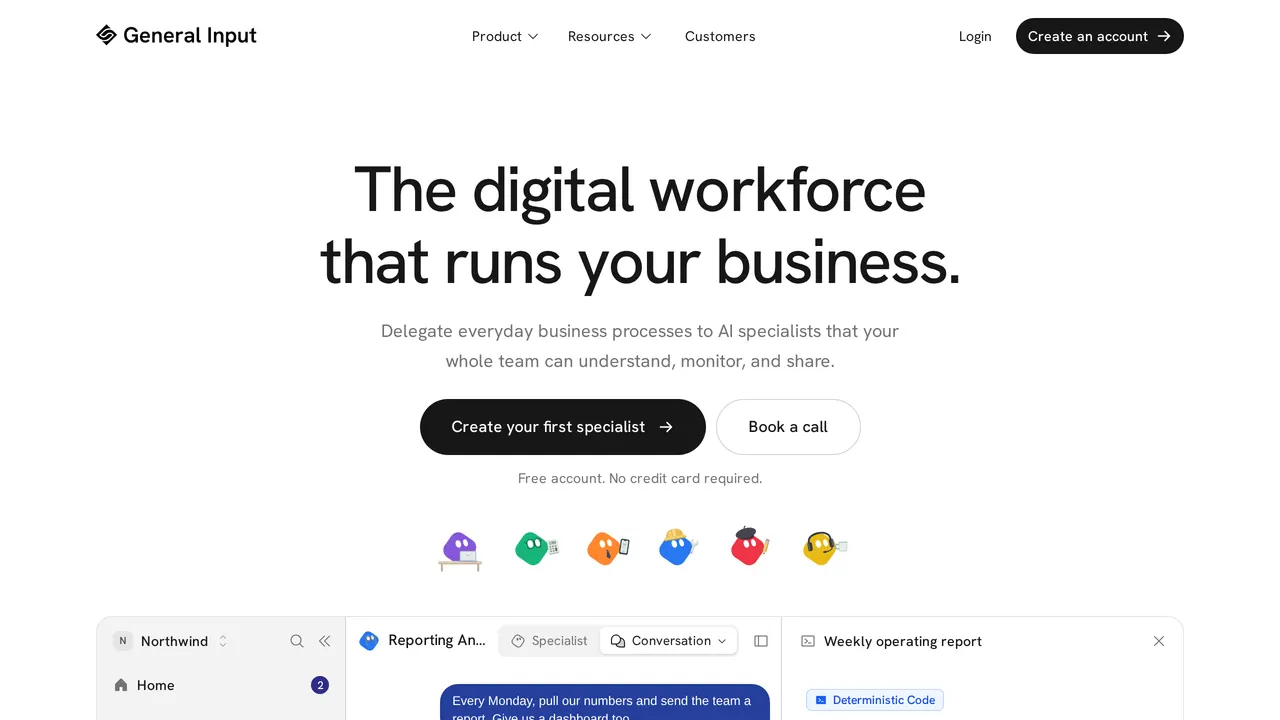
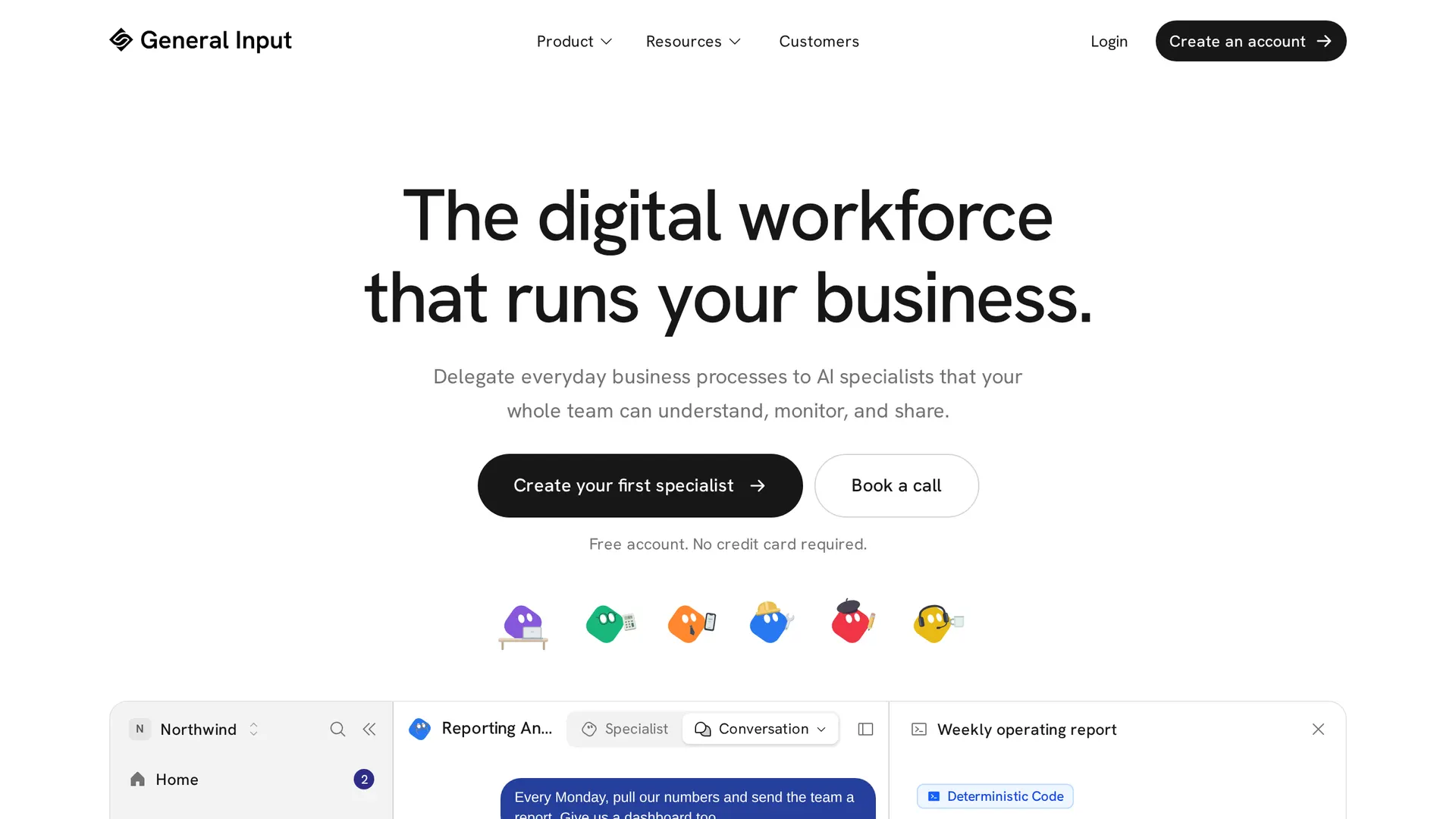
Credentials stay outside the model and each action is checked against a permission policy.
Changed since our last check
- Webhooks: now Partly. It was Yes when we checked on .
- Take your data out: now Yes. It was Partly when we checked on .
- Security audits: now Partly. It was Yes when we checked on .
At a glance
Pricing
- Plans
- Pay as you go · $0USD / month
- Pro · $30USD / month
- Max · $100USD / month
- Category
- Workflow Automation
- Tags
- BYOK, Freemium, Self-Hosted
For developers
- Works with
- HubSpot, Gmail, Google Sheets, Slack, Stripe, 1Password and 24 more
Specialists are folders of workflows, apps and skills
General Input's unit of work is a "specialist": a named agent that owns one job and holds the workflows, apps, skills and shared files behind it. You describe the process, and the platform writes it as clear, readable steps you can inspect before anything runs rather than a node graph.
Workflows come in two shapes, and the distinction matters for cost and reliability. A code workflow is a single main.ts that runs server-side once per trigger. An agent workflow spawns an LLM agent that reads an instructions.md procedure and calls APIs through bash, with a wall-clock cap and a reasoning effort set in agent.json. The vendor's own guidance is to reach for the agent only when "the exact steps aren't known in advance". Triggers are webhook, cron and poll, and an optional filter.ts can gate a noisy source before the body runs. Apps are React single-page applications in a sandboxed iframe that call named server handlers, which is how results come back as dashboards.
Pricing is a seat price with credit metering on top
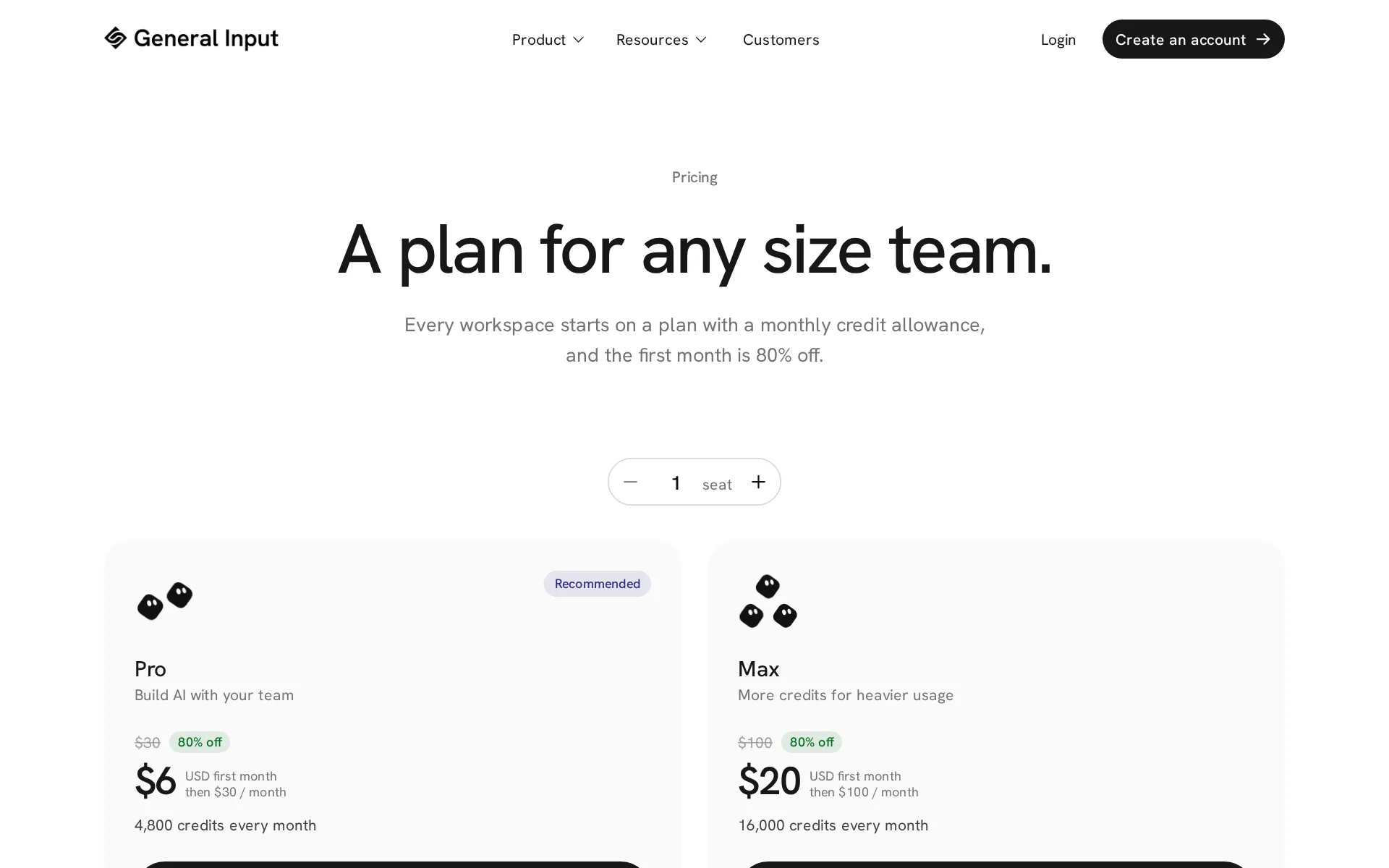
There is no free plan. Pro is $30 per seat per month with 4,800 credits per seat, and Max is $100 with 16,000, both capped at 50 members, and the first month on either is 80% off with the full credit allowance. Enterprise is quote-only.
Credits are the real meter. Overage is $0.0069 per credit on both tiers, plan credits are 25% cheaper than pay-as-you-go top-ups, and subscription credits do not roll over month to month. The vendor publishes its own run costs: a deterministic code workflow costs under 1 credit per run, an agent workflow 10 to 50, and building a workflow 30 to 150. A team running a handful of agent workflows hourly will clear 4,800 credits well before the month ends, and nothing on the page models that. Payment is card-only through Stripe, and plans can be cancelled at any time with the change taking effect next cycle.
The Agent Firewall is the part worth checking
Permissions are set per connection and then per action: the vendor's example allows Gmail reads and draft creation while blocking send and delete. A standing workspace policy is inherited by every member and their agents, including new joiners, and the vendor states that enforcement runs in the sandbox, beneath the credential, so a blocked call never leaves.
Credentials are encrypted at rest with AES-256-GCM and keys held in a separate secrets manager, injected at runtime and stripped before anything reaches the model. Every permitted call is logged with context, and the REST API's vault endpoints note that issuing a credential token is "logged with your reason". For a platform whose selling point is agents acting with live business credentials, that is the right place to put the controls.
Two documented ways in for agents, plus a REST API
The developer page names the geni CLI on npm and a per-workspace MCP server over Streamable HTTP at cloud.generalinput.com/v1/mcp/{organizationId}, authorized with OAuth 2.1, PKCE and dynamic client registration. Both discovery documents are published, RFC 8414 and RFC 9728.
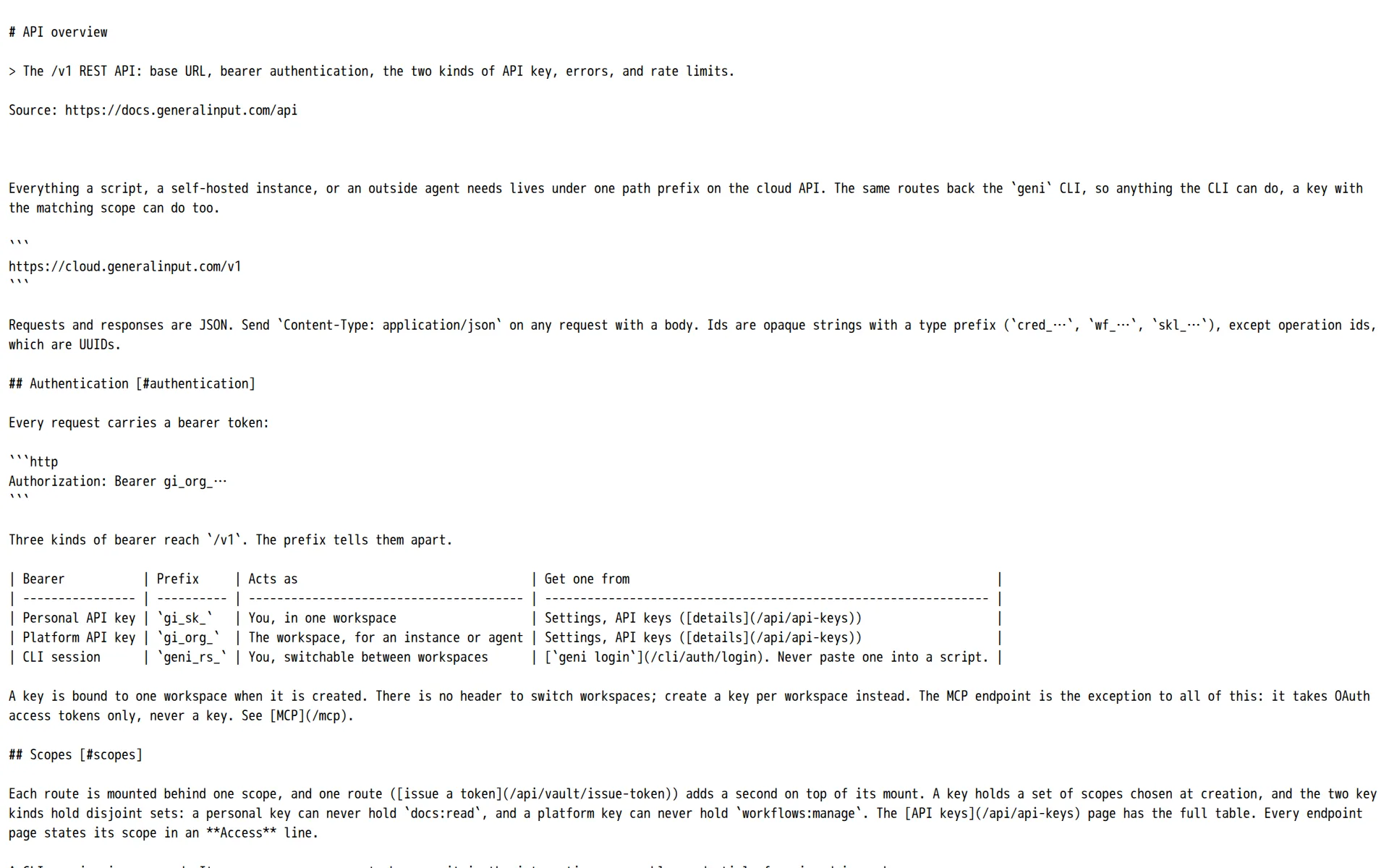
Behind them sits a /v1 REST API with bearer auth and two kinds of key, personal keys that act as you and platform keys that act as the workspace. It covers the integration catalog, the credential vault, workflow and skill authoring, executions and traces, projects, memory, and six first-party hosted services including web search, page scraping and chat completion. Keys are issued from the dashboard without a sales call and can be revoked. The site also ships markdown twins of its pages, an llms.txt index and a real 404 body pointing at them, which is unusual and genuinely useful.
Model choice is broad, and the company behind it is small
The model catalog spans Anthropic, OpenAI, Google, xAI and open-weights labs with per-million-token prices listed, models are switchable per task or conversation, an existing Claude, ChatGPT, Gemini, Grok or Muse subscription can be connected, and any OpenAI-compatible endpoint can be added with the buyer paying their provider directly.
The legal entity is Parla FM, Inc., doing business as General Input, governed by Delaware law, and the about page is a single founder letter signed by Jack. No funding, headcount or founding date is stated. The subprocessor list is unusually complete: Google Cloud, Cloudflare, Vercel, OpenAI, Anthropic, Vertex AI, xAI, Fireworks, OpenRouter, AssemblyAI, E2B, Stripe, Postmark, Sentry, Datadog and more. No SOC 2 report, ISO certificate or DPA is published, only CASA verification on the plan table, and the terms disclaim any uptime warranty.
Where it does not fit
A buyer who needs a free tier to evaluate will not find one, and the 80%-off first month is a discount rather than a trial. SSO, white-label domains, phone support and on-premise deployment are all Enterprise-only, so a 20-person team that needs identity-provider sign-in is talking to sales whatever the published seat price says.
The pricing page states the Business plan tops out at 50 members while also offering it for teams of any size, and the two marketing figures for integration breadth do not agree: the home page and plan table say 850+ tools, while the Agent Firewall FAQ says rules apply "across 80,000+ tools". The larger figure most likely counts individual operations rather than services, but the site never says so. Nothing on the site names a region option for hosted data, which is stored in the United States.
Plans and pricing
Price and terms
- Free plan or trial
- NoNo
- Card to start
- NoRequired
- Sign up without sales
- YesYes
What needs a higher plan
- Enterprise
- Data stays in your region, Self-hosted, Single sign-on
For AI agents
- MCP server
- Yes
- API
- Yes
From generalinput.com/pricing, checked .
The facts, with their sources
What it costs to start
- Free tier
- NoNo standing free plan and no trial: the cheapest way in is a paid seat, discounted 80% for the first month only, with the full credit allowance.
There is no free plan, but your first month on any plan is 80% off with the full month of credits. Cancel anytime.
generalinput.com/pricing - Self-serve signup
- YesSign-up, integration connection and API key creation are all self-service; sales contact is only needed for the Enterprise plan.
Sign up, connect an integration, and start building; there is no sales call in the way.
generalinput.com/developers - Card to start
- YesBecause every workspace starts on a paid plan, a card goes in at sign-up; payment runs through Stripe on major credit and debit cards.
We accept all major credit and debit cards through Stripe.
generalinput.com/pricing - Cancel any time
- YesPlans can be canceled, upgraded or downgraded at any time with the change landing at the next billing cycle, and no term or exit fee is published.
Yes. You can upgrade, downgrade, or cancel at any time. Changes take effect at the start of your next billing cycle.
generalinput.com/pricing
What it works with
- Public API
- YesA documented /v1 REST API covers integrations, vault, workflows, skills, projects and memory, authorized by workspace or personal API keys you issue yourself.
The /v1 REST API: base URL, bearer authentication, the two kinds of API key, errors, and rate limits.
docs.generalinput.com/docs/api - MCP server
- YesEach workspace exposes a Streamable HTTP MCP server with OAuth 2.1, PKCE and dynamic client registration, so Claude or ChatGPT can call the workspace as tools.
Every workspace exposes an MCP server over Streamable HTTP, so Claude, ChatGPT, and any other MCP client can call your workspace as a set of native…
generalinput.com/developers - Webhooks
- PartlyWebhook triggers start workflows on both plans, but the published material covers inbound events only; outbound notification is left to steps that call your API.Was Yes before our last check.
Workflows fire on triggers like schedules, webhooks, and app events, and run the same way every time.
generalinput.com
What it does on its own
- Acts on its own
- YesAgent workflows run unattended on a trigger and only pause if the author switches human-in-the-loop on, so step-by-step approval is opt-in rather than required.
A workflow meant to run unattended on its trigger must not pause
docs.generalinput.com/cli/resource/agent - Limits on what it may do
- YesAgent Firewall sets allow, read-only, write-only or block per connection and per individual action, applied workspace-wide and enforced below the credential.
Choose a policy for each connection, then fine-tune individual actions. Reading an invoice doesn’t have to mean issuing a refund.
generalinput.com/agent-firewall - No code needed
- YesYou describe the process in plain English and a specialist writes the automation as readable steps, with no flowchart or node editor to configure.
No flowcharts. No node editor. Just clear, readable steps you can inspect before anything runs.
generalinput.com/about - Several agents
- PartlyOne agent workflow spawns a single LLM agent per run; the vendor describes agents chaining workflows and skills rather than several agents splitting one task.
Agents run 24/7 on schedules, webhooks, and events, chain workflows and skills, and act across 850+ integrations.
generalinput.com/compare/polsia
What happens to your data
- No training on your data
- YesModel providers are configured for zero retention where supported and contractually barred from training on submitted content, with no opt-in switch to manage.
We configure them for zero data retention where supported, and their terms prohibit training on submitted content.
generalinput.com/privacy - Retention you control
- PartlyWorkspace content lives until you delete it and operational logs and backups expire on a fixed rolling 30-day schedule; no configurable retention window is published.
Operational logs and database backups expire on a rolling schedule of about 30 days.
generalinput.com/privacy - Data stays in your region
- PartlyThe hosted service processes and stores data in the United States with no region choice published; only the Enterprise on-premise deployment puts location in the buyer's hands.
We are based in the United States, and we process and store information in the United States and wherever our subprocessors operate.
generalinput.com/privacy - Self-hosted
- PartlyOn-premise deployment is marked only in the Enterprise column of the plan comparison, so Pro and Max buyers run on General Input's cloud.
You can deploy on our cloud or on-prem with your own infrastructure and models, so your data stays where you want it.
generalinput.com/about - Open source
- NoThe vendor expressly characterizes General Input as a commercial platform rather than open-source software.
No. The platform is commercial.
generalinput.com/compare/n8n.md - Take your data out
- YesProject files download as one gzipped tar, workflow and skill bundles come back through presigned URLs, and the vendor calls its run records exportable.Was Partly before our last check.
Download project files: Every file in the project as one gzipped tar.
docs.generalinput.com/docs/api
Whether a company can buy it
- Security audits
- PartlyCASA verification is listed on both plans, but no SOC 2 report, ISO 27001 certificate or published DPA appears anywhere on the site.Was Yes before our last check.
CASA verified
generalinput.com/pricing - Single sign-on
- PartlySingle sign-on is struck through for Business and ticked for Enterprise in the plan comparison, so Pro and Max teams sign in without an identity provider.
Single sign-on (SSO)
generalinput.com/pricing - Audit log
- YesExecution logs ship on every plan and each permitted credential use is recorded with the reason given, which the vendor presents as its audit record.
Every allowed call is logged with full context, a complete record of what each agent did.
generalinput.com/agent-firewall - Uptime promise
- NoNo uptime commitment is published; the terms of service expressly disclaim any warranty that the service will be uninterrupted.
WE DO NOT WARRANT THAT THE SERVICES WILL BE UNINTERRUPTED, ERROR-FREE, OR SECURE.
generalinput.com/terms
Which models it runs on
- Its own model
- NoGeneral Input trains no model of its own; it resells frontier models from other labs and routes through gateways such as Vercel AI Gateway and OpenRouter.
General Input runs on frontier models from Anthropic, OpenAI, and Google alongside the best open-weights labs.
generalinput.com/models - You pick the model
- YesThe buyer picks the model per task or per conversation from a published catalog spanning several labs, and the model id is set in each agent workflow.
Any model you want. Claude, GPT, Gemini, Grok, open source, and more, switchable per task or conversation.
generalinput.com - Open models
- YesOpen-weight models are in the managed catalog, including Kimi, GLM and DeepSeek entries, and the vendor says local models can be used too.
lets you use any LLM, including open-source and local models
generalinput.com/llms.txt - Your own model key
- YesAny OpenAI-compatible endpoint can be attached from organization settings and used wherever a managed model works, billed by your own provider.
Connect any OpenAI-compatible endpoint from your organization settings and use it anywhere a managed model works. You pay your provider directly.
generalinput.com/models
Screenshots
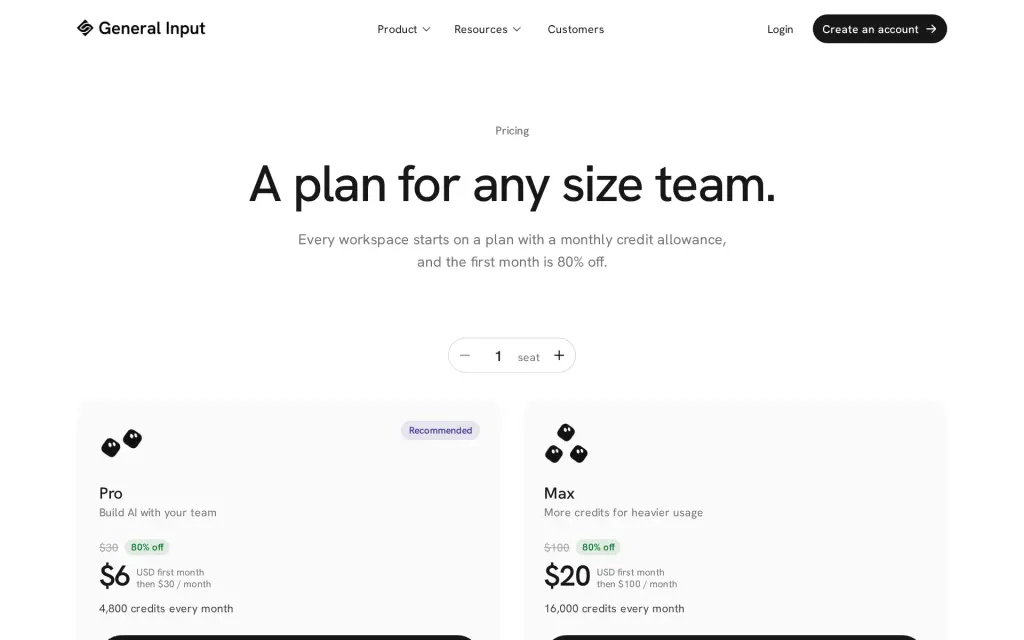
Pricing page, generalinput.com, captured 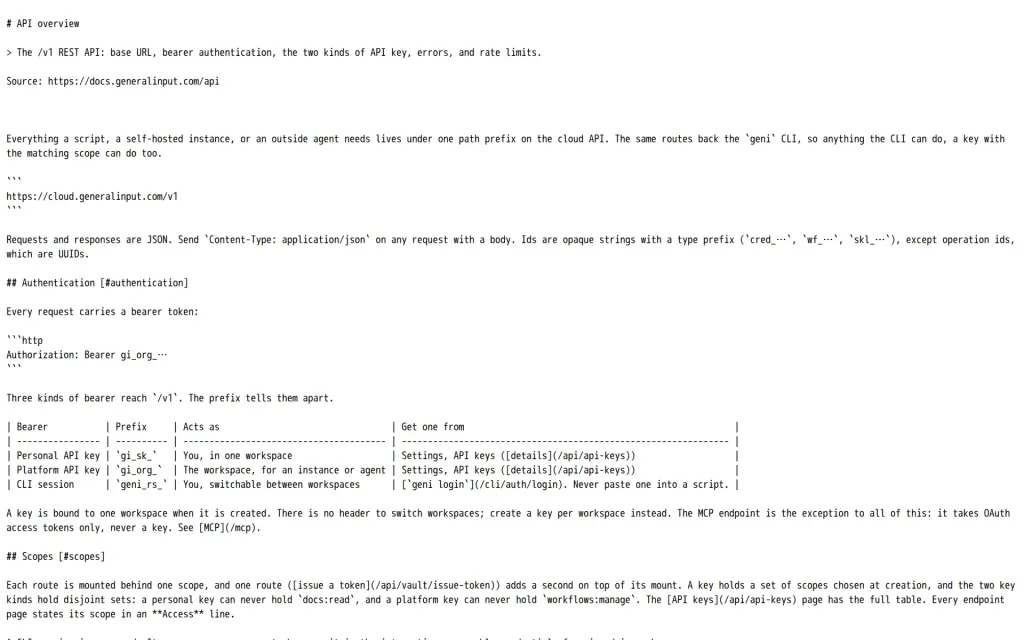
Docs, generalinput.com, captured
Filed under
Sources and updates
Last changed
Sources15
- generalinput.com/pricing
- generalinput.com/models
- generalinput.com/privacy
- generalinput.com/
- generalinput.com/compare/n8n.md
- generalinput.com/about
- generalinput.com/agent-firewall
- generalinput.com/developers
- docs.generalinput.com/docs/api
- generalinput.com/terms
- docs.generalinput.com/cli/resource/agent
- generalinput.com/compare/polsia
- docs.generalinput.com/llms.mdx/docs/api/content.md
- docs.generalinput.com/llms.mdx/docs/cli/specialist/transfer/content.md
- generalinput.com/llms.txt
Updates2
- Free tier · Price · What it does
- Free tier · Price · What it does