Favicon of Merge

Merge

Merge lets software teams add HRIS, ATS, CRM, accounting, ticketing, and more via one unified API and common data models.

Reviewed by Mathijs Bronsdijk · Updated Apr 14, 2026

ToolFree + Paid PlansUpdated 29 days ago
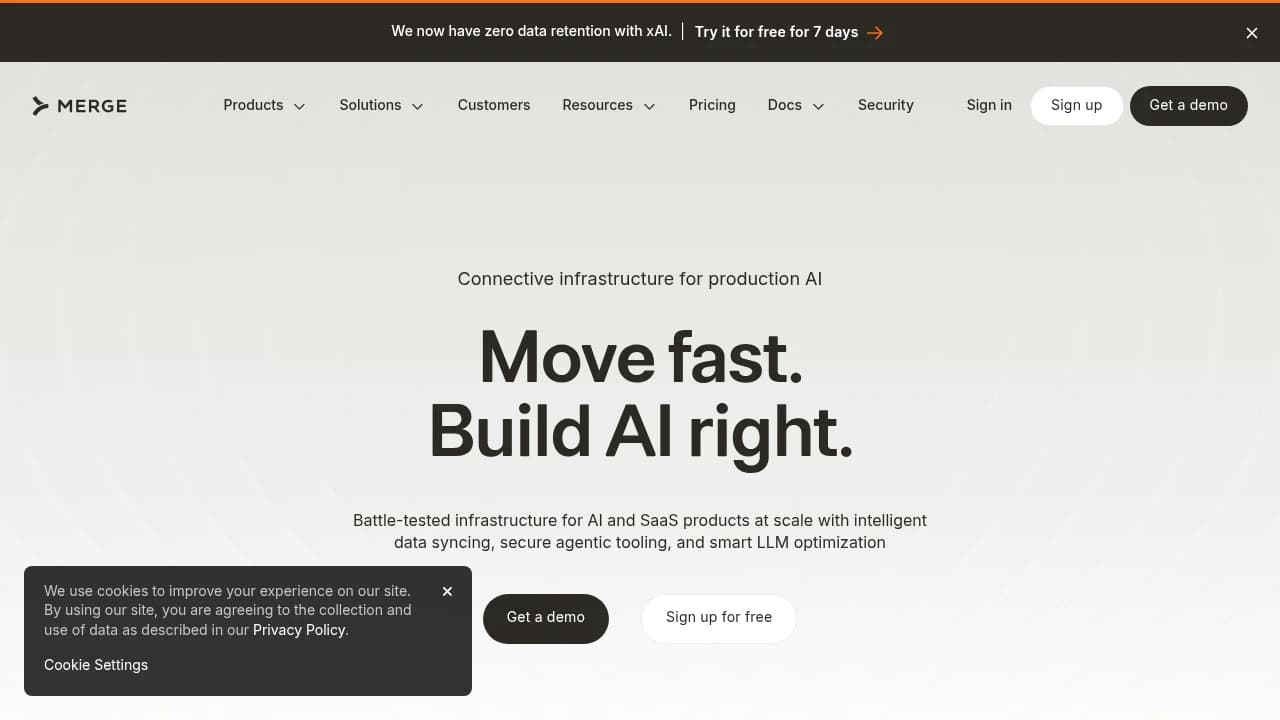
Screenshot of Merge website

What is Merge?

Merge is an integration platform that helps software companies offer many customer-facing integrations without building each one from scratch. Instead of writing separate connectors for systems like Workday, BambooHR, Salesforce, QuickBooks, Zendesk, or Greenhouse, teams integrate once with Merge’s unified API and work against common data models. In practice, that means a product team can support categories like HRIS, ATS, CRM, accounting, ticketing, file storage, and marketing automation through one layer instead of dozens of vendor-specific APIs.

We researched Merge as a company that grew out of a very specific B2B SaaS pain point: customers expect integrations, but maintaining them drains engineering time. Co-founder and CEO Shensi Ding has described the company’s thesis as building a unified API that is not just a shortcut, but a product category with its own design philosophy. That idea has resonated. Merge says it serves thousands of organizations, and named customers in the research include Ramp, BambooHR, AngelList, TripActions, Divvy by Bill.com, and 15Five. The company has raised $74.5 million in funding, including a $55 million Series B led by Accel.

Merge has also expanded beyond its original unified API business. Today the platform includes Merge Unified for SaaS integrations, Merge Agent Handler for giving AI agents governed access to third-party tools, and Merge Gateway for routing across LLM providers. That broader product set matters because it shows where Merge is headed. It is no longer just trying to reduce integration backlog for SaaS teams. It is positioning itself as infrastructure for software that needs to act across many external systems, especially AI products.

Key Features

  • Unified API across 7 major categories: Merge supports HRIS, ATS, CRM, accounting, ticketing, file storage, and marketing automation through one normalized API. For product teams, this changes the job from managing dozens of vendor quirks to building against one set of common models, which is why companies use it to cut integration work from months to weeks.

  • Hundreds of integrations through one build: Merge launched roughly 150 integrations in its first two years and now covers hundreds of platforms across its categories. That breadth matters most for B2B SaaS teams selling into mixed customer bases, where one prospect uses Workday, another uses BambooHR, and another uses ADP.

  • Common models plus custom fields: Merge standardizes objects like employees, candidates, accounts, contacts, invoices, and tickets. When a provider has data that does not fit neatly into the shared model, teams can use Custom Fields and advanced mapping, which keeps the unified approach useful even when real-world customer data gets messy.

  • Sync engine with webhooks, polling, and manual resyncs: Merge continuously syncs integrated accounts and recommends using webhooks plus polling for reliability. This matters because integrations fail in boring ways, missed webhook deliveries, temporary provider outages, stale tokens, and Merge has built the operational layer to recover from that without every customer issue turning into an engineering fire drill.

  • Embedded auth and linking flow: Customers connect their third-party apps through Merge Link, which handles the authentication experience. Teams do not need to build separate OAuth and credential collection flows for each provider, which is one of the biggest hidden time sinks in direct integrations.

  • Rate limit and error handling abstraction: Merge takes on provider-specific rate limits, auth differences, and many API edge cases internally. That matters less in a demo than in production, where every provider behaves differently and support teams need a stable system rather than a collection of brittle one-off connectors.

  • Observability and troubleshooting tools: The platform includes sync status, logs, and issue visibility that support and customer success teams can use. In user feedback we reviewed, this came up often because non-engineering teams could diagnose integration problems without always pulling in developers.

  • Security and compliance certifications: Merge reports SOC 2 Type II, ISO 27001, HIPAA, and GDPR compliance, and participation in international data transfer frameworks. For companies moving HR, financial, or customer data through an intermediary, this is table stakes, but it is still a real differentiator against smaller integration vendors.

  • Agent Handler for AI tool use: Merge Agent Handler gives AI agents access to thousands of third-party tools while adding authentication, rule enforcement, logs, and monitoring. This matters because giving an agent tool access is easy in a prototype and risky in production. Merge is selling the governance layer around that risk.

  • Rule-based controls for sensitive data: Organizations can define rules that block agents from sending or receiving things like credit card numbers or unredacted social security numbers. That is one of the more practical features in the AI stack, because it addresses what security teams actually worry about, not just agent performance.

  • Gateway for multi-LLM routing: Merge Gateway provides one API for multiple model providers with routing and cost visibility. For teams using more than one LLM, this can reduce lock-in and help control spend, especially when simple tasks can go to cheaper models and harder tasks can be routed elsewhere.

Use Cases

One of the clearest Merge stories in the research came from 15Five. The company needed HRIS integrations so customers could bring employee data into its performance management workflows without manual imports. Instead of building and maintaining direct integrations to systems like Workday, BambooHR, and ADP one by one, 15Five used Merge to launch those integrations at scale. Their team described the partnership as enabling them to ship critical integrations faster and deliver more value to customers. That is the classic Merge use case, a SaaS company where integrations are not the whole product, but absolutely affect sales, onboarding, and retention.

Financial software is another strong fit. Ramp and Divvy by Bill.com are named customers, and the reason is easy to understand. Products in spend management, accounting automation, or finance ops live or die on their ability to connect to systems like QuickBooks, Xero, and NetSuite. Building those integrations in-house means dealing with different auth models, different data structures, and constant maintenance. Merge turns that into a shared infrastructure layer, so the finance product team can focus on workflows and reporting rather than connector upkeep.

Recruiting and people software also show up repeatedly in the research. Merge’s ATS and HRIS categories let teams pull candidate and employee data from systems like Greenhouse, Lever, Workday Recruiting, and BambooHR. For a company building internal recruiting tools or AI copilots for talent teams, that means one product can search candidate pipelines, sync employee records, and trigger downstream actions without custom work for every customer’s stack.

The newer AI agent use case is where Merge is trying to extend its story. The company’s own research says 66% of B2B SaaS companies plan to use unified API solutions to build integrations for AI agents in 2026. Agent Handler is built around that demand. The pattern is simple: an agent reasons about a task, Merge exposes the available tools based on the user’s connected apps, and then Merge enforces auth, logging, and policy checks before the action happens. For teams building AI assistants that need to create tickets, update CRM records, access HR systems, or work across back-office tools, Merge is trying to become the action layer.

Strengths and Weaknesses

Strengths:

  • Merge is very good at reducing integration sprawl for B2B SaaS teams. If your roadmap includes dozens of customer requests across HRIS, ATS, CRM, or accounting, the unified model is a real advantage over building direct connectors one at a time. Customers like 15Five illustrate this well, they used Merge to ship important integrations faster without turning their product team into an integration maintenance team.

  • The documentation and developer experience are consistently praised. In the user feedback we reviewed, teams called out the clarity of the docs and SDKs, and said Merge cut work around authentication, debugging, and day-to-day integration operations. That is not flashy, but it is often what determines whether a platform gets adopted.

  • Merge has unusually broad category coverage in one product. Many alternatives are stronger in one area or one architectural style, but Merge covers multiple business software categories under the same roof. That is attractive for companies that would otherwise need separate vendors for HR data, CRM data, and accounting data.

  • The support reputation is strong. Users described the Merge team as responsive, open to feedback, and willing to go the extra mile. For infrastructure software that sits between your product and your customers’ systems, this matters a lot more than slick branding.

  • Agent Handler is a thoughtful extension into AI tooling. Plenty of companies let agents call tools. Fewer focus on audit trails, rule violations, alerting, and sensitive data controls. Merge seems to understand that the hard part of agent tool use is not the demo, it is governance.

Weaknesses:

  • Merge can get expensive fast. Pricing starts simply, but the per-linked-account model scales aggressively. A company with 100 customers connecting two systems each could end up near $12,950 per month based on public pricing, and organizations with 1,000 or more end users can push annual costs past $100,000. That makes Merge easier to justify for higher-ACV SaaS than for cost-sensitive products.

  • The sync-and-store architecture is not right for every use case. Merge keeps synchronized copies of customer data rather than acting purely as a real-time pass-through layer. That gives it better normalization and operational control, but it also means there can be small delays between source-system changes and what your app sees. If you need live reads with no intermediary storage, tools like Apideck or Unified.to may fit better.

  • The unified model smooths over differences, but it cannot erase them entirely. One user review in the research noted that the ATS API still required custom code for each system in practice. That is an honest reminder that a common schema helps a lot, but edge cases and provider-specific features still leak through.

  • Merge is less useful when your customers depend on niche or unsupported systems. It is strongest when your integration needs fall into its supported categories and mainstream providers. If your roadmap includes legacy software, highly vertical systems, or bespoke APIs, you may still need another integration strategy alongside it.

  • Startup buyers may find the pricing conversation frustrating. We found at least one review describing the product as overpriced after an unsatisfying startup pricing inquiry. That does not mean the product lacks value, but it does suggest early-stage teams should model costs carefully before committing.

Pricing

  • Launch: Free for up to 3 production linked accounts
  • Base paid plan: $650/month for up to 10 production linked accounts
  • Additional linked accounts: $65/month each after the first 10
  • Enterprise / custom: Custom pricing

The headline pricing is easy to understand, but the bill can climb quickly. Merge charges by linked account, which means one customer connecting one app counts once, and one customer connecting two apps counts twice. For a small SaaS product testing integrations, the free tier and $650 base plan are enough to get going. For a growing company with hundreds of connected customers, this becomes a meaningful line item.

What users actually spend depends on how many end customers connect how many systems. That is the main pricing gotcha. It is not primarily usage-based, so a lightly used linked account costs the same as a busy one. If you have a lot of customers who connect an integration and barely touch it, Merge can feel expensive compared with alternatives that price more on API volume or infrastructure usage.

We also found evidence that custom pricing exists for larger buyers, and Merge says pricing can reflect business size, client count, API usage, and integration complexity. Still, we would not assume discounts solve the core economics. For teams comparing options, the right question is not “what is the monthly minimum?” but “what happens when 500 customers each connect two systems?”

Alternatives

Nango

Nango is often the alternative for teams that want broad API coverage without the strong abstraction layer Merge imposes. It supports hundreds of APIs and is popular with SaaS and AI companies, but the tradeoff is that developers work closer to native APIs instead of standardized common models. If your team values flexibility and lower costs for certain patterns, Nango can be attractive. If your team wants one normalized model across categories, Merge is the cleaner fit.

Apideck

Apideck also offers unified APIs, but its architecture is more focused on real-time pass-through rather than syncing and storing customer data. That makes it appealing for companies with stricter data handling requirements or use cases where freshness matters more than normalized operational tooling. Merge tends to win when teams want richer sync infrastructure and management features. Apideck tends to win when teams want less intermediary storage and more directness.

Unified.to

Unified.to serves a similar audience to Merge, SaaS and AI products that need many integrations, but it leans into real-time access without storing customer records. Buyers who are uneasy with Merge’s sync layer often look here. Merge has the stronger company profile, broader category maturity, and more developed AI governance story. Unified.to can be more appealing when architecture is the deciding factor.

Truto

Truto is worth looking at if your team wants more control over schema mapping and a proxy-style setup. It is a better story for organizations that do not want to accept a vendor’s predefined common model as the center of the product. Merge is simpler when your needs mostly match the standard objects it already supports. Truto is more interesting when custom mapping is the point.

Paragon

Paragon sits closer to embedded integrations plus workflow automation. If your product vision includes customer-facing integration marketplaces, user-configurable workflows, or more no-code automation experiences, Paragon may be the better narrative. Merge is more infrastructure-first. Paragon is more product-experience-first.

MuleSoft

MuleSoft is the heavyweight enterprise option. Large companies with complex internal systems, big integration budgets, and dedicated implementation teams may choose MuleSoft for its depth and enterprise services. Merge is lighter, faster to adopt, and more focused on SaaS product integrations. MuleSoft is what companies choose when they want a giant enterprise integration program, not just customer-facing connectors.

Zapier

Zapier is not a direct replacement for Merge, but buyers still compare them because both solve “we need integrations” problems. Zapier is better known for workflow automation between apps. Merge is better suited to products that need normalized data models, embedded auth, and ongoing sync infrastructure. If your customers mostly want app-to-app automations, Zapier may cover the need. If your product itself needs to ingest and act on third-party data, Merge is the stronger fit.

FAQ

What does Merge actually do?

Merge gives software companies one API for many third-party integrations. Instead of building separate connectors for each provider, teams use Merge’s unified models and auth flow.

Who is Merge for?

Mostly B2B SaaS companies, product teams, and now AI companies building agents that need tool access. It is especially useful when your customers use many different business systems and expect native integrations.

What kinds of integrations does Merge support?

From the research, the main categories are HRIS, ATS, CRM, accounting, ticketing, file storage, and marketing automation. Coverage within those categories includes many mainstream platforms like Workday, BambooHR, Salesforce, HubSpot, QuickBooks, Xero, Zendesk, and Jira.

How do I get started?

You usually start by picking a category, reading Merge’s docs, and implementing Merge Link so customers can authenticate their accounts. From there, your app works with Merge’s common models instead of each provider’s raw API.

How long does setup take?

For a focused first integration, teams often get something working in days and production-ready in weeks. The exact timeline depends on your product logic, customer onboarding flow, and how much provider-specific behavior you need to handle.

Does Merge store customer data?

Yes, Merge uses a sync-based architecture and stores synchronized data rather than acting only as a live proxy. That is useful for normalization and reliability, but some teams prefer pass-through alternatives for compliance or freshness reasons.

Is Merge real-time?

Not fully in the strictest sense. It uses webhooks, polling, and manual resyncs to keep data current, which is fast enough for many SaaS workflows but not the same as querying the source system directly every time.

How expensive is Merge?

It starts free for 3 production linked accounts, then $650 per month for 10, with $65 per additional linked account. Costs can rise quickly if many customers connect multiple systems, so it is worth modeling your likely account count early.

What is a linked account?

A linked account is one connection between one end customer and one third-party app. If one customer connects both HubSpot and QuickBooks, that counts as two linked accounts.

Does Merge work for AI agents?

Yes. Merge Agent Handler is built for that use case and adds tool access, authentication, monitoring, logs, and policy controls. It is one of the more serious attempts we found to make agent tool use manageable in production.

Is Merge secure enough for sensitive data?

Merge reports SOC 2 Type II, ISO 27001, HIPAA, and GDPR-related compliance coverage. That gives buyers a solid starting point, though companies in regulated industries should still run their own security review.

When should I choose an alternative instead?

If you need real-time pass-through access, lower costs at very large linked-account volume, or support for niche systems outside Merge’s categories, an alternative may fit better. Merge is strongest when you want broad mainstream coverage and are happy to trade some flexibility for speed.

Share:

Similar to Merge

Favicon


Favicon


Favicon