
At a glance
- Category
- AI model providers
- Tags
- HIPAA, No training on your data
For developers
- Works with
- SharePoint, Google Drive, GitHub
OpenAI in our research
All researchStudy
AI Tool Pricing Index, November 2026
Pricing
Usage-based
43 of the 361 tools we checked bill by usage.
Edition price, checked 3 November 2026.
Pricing pages of the AI tools, November 2026 editionas of n = 361 tools checked
What is OpenAI?
OpenAI is an AI platform for teams that need chat, voice, and API models for product and workflow automation. It combines Message ChatGPT, Talk with ChatGPT, and the API Platform with features like Connect your data, Web search, and Containers. The platform is used by companies including BNY, Praktika, and netomi. Pricing starts with GPT-6 Astra at $10.00 / 1M input tokens, GPT-6.1 Sol at $2.00 / 1M input tokens, and GPT-6 Luna at $0.10 / 1M input tokens.
What you're actually buying
OpenAI is three products under one account: ChatGPT (consumer and business chat, with a Work mode for documents/spreadsheets/slides and a Codex coding agent), the API Platform (pay-per-token access to the same models plus tools like web search, file search, code execution containers, and a realtime voice API), and ChatGPT Enterprise/Business (seat-based deployment with admin controls). Most of what's marketed as separate "products" — Dots, Sites, Space, Study Mode — are features inside ChatGPT, not separate purchases.
Current model lineup and API pricing (checked 12 Oct 2026)
The flagship as of today is GPT-6 Astra, OpenAI's frontier model, priced at $10.00/1M input and $50.00/1M output tokens (Standard, short context); a faster, cheaper GPT-6.1 Sol sits at $2.00/$10.00; and GPT-6 Luna, the cheapest current model, is $0.10/$0.50. GPT-6 Astra shipped on 29 Sep 2026 and GPT-6.1 Sol followed within about a week, replacing the GPT-5.5, GPT-5.4 and GPT-5.4-mini models on the pricing table. Fast mode (renamed from "priority processing" on 30 Jul 2026) runs 2x the standard rate for roughly 2x the speed; Batch processing is roughly half price; realtime voice (gpt-realtime-2.1) is $32/$64 per 1M audio tokens; image generation (GPT-Image-2) is $4–8/1M tokens depending on surface; web search tool calls are $10–25 per 1,000 calls plus the underlying model's token rate. Budget against the live pricing page, not a snapshot — this vendor revises its model lineup faster than most buyers will revisit a vendor comparison.
ChatGPT plans
Individual: Free ($0/month, unlimited text chat with limited everything else), Go ($8/month, more messages/uploads, may include ads), Plus ($20/month, GPT-6-class reasoning, expanded limits), Pro (from $100/month, three usage tiers, unlimited image generation, access to GPT-6 Astra's "Pro" reasoning setting). Business seats are $20/month billed annually ($25 monthly) for Standard and $100/month annually ($125 monthly) for Premium, for teams of 2–200. Enterprise is quote-only — no published number, custom data residency (ten regions), SCIM/SSO, and volume discounts negotiated per account.
Security, compliance, and data use
OpenAI publishes a real compliance stack rather than a marketing claim: SOC 2 Type II (API and ChatGPT Business/Enterprise/Edu/Healthcare), ISO/IEC 27001:2022 and 27701:2019, ISO/IEC 42001:2023 (AI management system), PCI-DSS for payment components, and CSA STAR Level 1. It offers a Data Processing Addendum and Business Associate Agreement, supports GDPR, CCPA, HIPAA, and FERPA compliance, and states business/API data is not used for model training by default, with encryption at rest and in transit. This matches the gdpr, hipaa, soc2, and no-training tags already on this listing — all four check out against the vendor's current security page.
What OpenAI discloses about risk, and why it matters to an enterprise buyer
In its own GPT-6 Astra system card, OpenAI states the model "meets the Critical threshold in cybersecurity" under its Preparedness Framework — meaning it can independently find and develop exploits for software vulnerabilities (100% on OpenAI's ExploitBench, including two previously unknown zero-days found during testing). OpenAI says production safeguards block the model from generating proof-of-concept exploits for ordinary users and are expanding more permissive access only through a vetted "Daybreak" program. This isn't a flaw to avoid the product over — OpenAI disclosed it voluntarily and built guardrails around it — but a security-conscious buyer evaluating API access for a technical team should know the vendor itself classifies the model's raw capability at that level, not infer it was overlooked.
Transparency reporting
OpenAI publishes a government-requests report twice a year: for July–December 2025 it logged 224 non-content requests, 75 content requests, and 10 emergency requests, plus 107,817 CyberTipline reports to NCMEC covering child-safety content in the same period. It also files an EU Digital Services Act transparency report and a Brazil election-compliance report. Few AI vendors in this index publish anything comparable.
Evidence of real deployment
OpenAI's customer-story library is active and recent — Oracle, Lowe's, Wayfair, Asana, and Sophos all published case studies in the first two weeks of October 2026 alone. The three customers named in this listing's intro (BNY, Praktika, netomi) still have live case studies on openai.com as of this check: Praktika uses OpenAI models to power a multi-agent language-tutoring system: Netomi runs GPT-4.1/GPT-5.2 inside a governed orchestration layer for Fortune 500 customer-service deployments including United Airlines and DraftKings. A vendor claim that "1M businesses use OpenAI's products" has no live source page, so treat it as an unconfirmed vendor figure, not a verified one.
OpenAI price and terms
Terms
- Free to start
- PartlyLimited free useA Free usage tier is listed for users in an allowed geography, with a $100/month usage limit
The terms in full
API billing is prepaid, so usage beyond any free credits on the account requires buying credits; Build tier starts at $5 in total credit purchases.
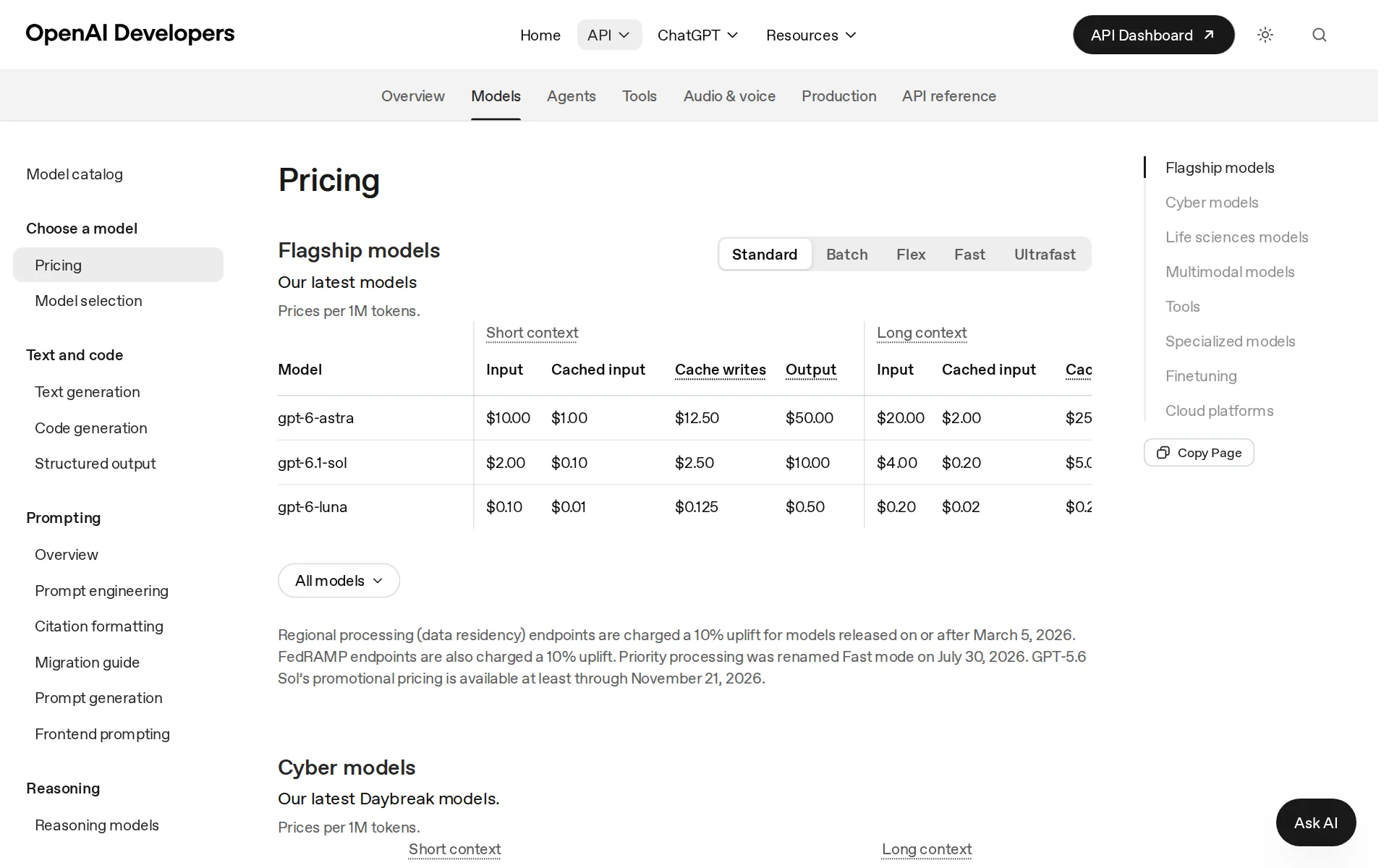
Pricing page, captured
What we checked on OpenAI
What the price counts
Usage-metered: models are billed per 1M input and output tokens, with built-in tools such as web search priced per 1k calls on top of token charges.
Responses API, Chat Completions API, Realtime API, Batch API, and Assistants API are not priced separately. Tokens are billed at the chosen model's…
Questions about OpenAI
- How much does OpenAI cost?
- OpenAI costs $0.10 per 1m input tokens. From developers.openai.com/api/docs/pricing, checked 3 November 2026.
- Does OpenAI have an API or an MCP server?
- OpenAI has an API.
- What have we checked on OpenAI?
- 1 fact, under one heading: What it costs to start.
- How do we check OpenAI?
- We hold 1 fact on OpenAI, quoted from 1 page. Facts and price last checked 3 November 2026, when we also found the last change.
Sources and changes
Last changed
What changed1
- What it does
OpenAI price history
We have read the price once so far, on 3 November 2026: from $0.10 per 1m input tokens.
| Price | Plan | First seen | Last seen | Readings | Source |
|---|---|---|---|---|---|
| $0.10 per 1m input tokens | 3 November 2026 | 3 November 2026 | 1 | Pricing page, read 3 November 2026 |
From our research on 3 November 2026. A date is when we read the page, not when the price changed.
Similar to OpenAI
- Fireworks AIInference, model routing and fine-tuning for open models on one OpenAI-compatible endpoint, serverless or in your cloud.
- ERIUS PHONERented cloud Android phones, each in its own container, that keep an agent's apps and sign-ins between sessions.
- TinyFishWeb search, page fetching, cloud browsers and goal-driven web automation for AI agents, with search and fetch free.
- SmitheryPublic MCP server registry, now run by Arcade, listing direct vendor MCP URLs after its proxy shut down.


Is OpenAI yours?
Free, and the page then carries the verified owner mark. You confirm it with an email at openai.com. Claim this listing
Report an error if a fact is wrong.