
At a glance
- Categories
- Customer service agentsVoice AI agents
- Tags
- GDPR, HIPAA, SOC 2
For developers
- Works with
- HubSpot, Salesforce, Clio, NexHealth, ServiceTitan, Epic and 24 more
Workforce Wave in our research
What it is underneath, and why that's a point in its favor
Workforce Wave's own platform page names its voice stack: ElevenLabs as the primary real-time synthesis engine, with Vapi (webhook-native pipelines) and Retell (enterprise batch provisioning) as alternate engines, sitting on Neon PostgreSQL, Upstash Vector, Upstash Redis and Backblaze B2 (https://www.workforcewave.com/platform). So this is an orchestration and configuration layer over third-party voice infrastructure, not a house-built speech pipeline.
That is worth saying plainly because most receptionist products in this category do not say it at all. Publishing the engine list, the 40+ endpoint REST API with an OpenAPI 3.1 spec, and an MCP server exposing 14 tools is more architectural disclosure than is normal here, and it is directly useful: it tells you what your latency floor and voice quality are actually governed by, and it tells you the switching cost if you later want to run the same agents yourself on Vapi or Retell directly.
One wrinkle a careful buyer will notice: the company publishes comparison pages positioning itself against Vapi, Retell and Bland (https://www.workforcewave.com/vs/patlive, footer). Competing with the platforms you run on is a normal posture for an orchestration layer — you are selling the configuration, integrations and tuning, not the transcription — but it does mean those comparison pages are arguing against part of your own supply chain, and they are vendor-authored with no cited sources for competitor pricing.
One inconsistency to raise in a vendor security review: the privacy policy's subprocessor list names AWS, Google Workspace, Twilio, OpenAI Enterprise/API and a "proprietary white-labeled AI platform" (https://www.workforcewave.com/privacy-policy), while the platform page names ElevenLabs, Vapi, Retell, Neon, Upstash and Backblaze. Neither list is a superset of the other. Ask for the consolidated subprocessor list before signing anything data-sensitive.
Pricing: published in full, and genuinely competitive around 2,000 minutes
The full rate card is public, with no 'contact sales' wall on the self-serve tiers (https://www.workforcewave.com/pricing):
- Free — $0, 1 agent, 100 minutes. No card required; the agent pauses rather than billing you when the minutes run out.
- Starter — $99/mo, 1 agent, 500 minutes, $0.12/min overage.
- Growth — $249/mo, 5 agents, 2,000 minutes, $0.10/min overage, plus daily knowledge-base sync and weekly prompt optimization.
- Platform — $499/mo, 20 agents, 8,000 minutes, $0.08/min overage, plus MCP server access, review queue and policy engine.
- Enterprise — custom, with volume minute pricing, white-label and outcome-based billing available.
- Extra agents are $25/mo each on paid tiers.
For a like-for-like check we pulled Rosie's current rate card today: $49/250 min, $149/1,000 min, $299/2,000 min (https://heyrosie.com/pricing). At the 2,000-minute mark Workforce Wave's Growth tier is $249 against Rosie's $299, and includes five agents rather than one. At the low end the two are near-identical per minute ($0.198 vs $0.196 on the entry tiers), so the advantage is specifically in the mid-band, and specifically if you need multiple agents — multiple locations, or separate after-hours and daytime behavior.
The overage rates are the part worth modeling. Growth's included 2,000 minutes is roughly 660 calls at a three-minute average; a practice running 900 calls a month at that handle time would pay $249 + about $70 in overage. The rate declining as you move up ($0.12 → $0.10 → $0.08) means the tier upgrade can pay for itself before you hit the next minute allowance — worth a spreadsheet, not a guess. Note also that the terms bill monthly in arrears on usage (https://www.workforcewave.com/terms-of-service), so overage arrives after the fact rather than as a hard cap.
One thing we could not verify: Rosie does not publish an overage rate, so the comparison above holds only up to each plan's included minutes.
Where the tier lines fall — the part most likely to change your plan choice
Three capabilities that read as product-level in the marketing are actually tier-gated, and in each case the gate is disclosed by the vendor rather than hidden. Buyers in regulated or multilingual settings should price against the tier they will actually need, not the one on the front page.
HIPAA BAA — Platform ($499) and Enterprise only. The pricing FAQ states it directly: "HIPAA BAA is available on Platform and Enterprise plans" (https://www.workforcewave.com/pricing). The AI receptionist page markets to medical practices and dental offices first, and describes the product as HIPAA-compliant (https://www.workforcewave.com/solutions/ai-receptionist). Both things are true — the storage architecture is described as HIPAA-eligible with AES-256 at rest and PHI redacted from extraction results — but a covered entity cannot lawfully rely on that without an executed BAA. In practice this means a single-location dental practice's real entry price is $499/mo, not $99 or $249. That is still within range for the category, but it is a 2x difference from the headline.
Languages — English and Spanish on all plans; 27 more on Enterprise. The about page advertises "29 Languages" (https://www.workforcewave.com/about). The languages page discloses the split honestly and, to its credit, unusually well: "English and Spanish are included on every plan. 27 more languages are available on Enterprise," followed by the complete list and the line "This is the complete list — not a sample. If a language is not on this page, the agent does not speak it, and we will tell you that before you sign" (https://www.workforcewave.com/languages). That is the right way to publish a capability list, and it is rare.
SLA — an Enterprise line item, and absent from the contract. The about page shows "99.9% Uptime SLA" as a company stat (https://www.workforcewave.com/about) and the pricing page lists "SLA + dedicated support" under Enterprise. The published terms of service contain no uptime percentage and no service-credit mechanism (https://www.workforcewave.com/terms-of-service). Read the 99.9% figure as an operational target on self-serve tiers, not a commitment you can claim against.
What the contract actually commits to
The terms of service are public and short enough to read (https://www.workforcewave.com/terms-of-service). The commercially relevant points:
- Legal entity: Workforce Wave LLC. Governing law South Carolina; exclusive venue Charleston County, SC. If you are outside the US, that venue clause is a real cost consideration on any dispute.
- Term: month-to-month, auto-renewing, no minimum commitment. Terminate in writing at any time; termination takes effect at the end of the billing period. This is genuinely buyer-friendly and worth weighing against competitors that require annual terms.
- Refunds: fees are generally non-refundable. Billing disputes must be raised within 60 days of invoice.
- Liability cap: the greater of fees paid in the preceding 12 months or $100. That is a standard SaaS cap, but note what it means in context — if a misconfigured agent mishandles intake for a practice, your maximum recovery is roughly one year of subscription fees.
- Data ownership: you retain ownership of your content; the vendor takes a limited license to operate and improve the service. The privacy policy states interactions "are not used to train any Large Language Model" (https://www.workforcewave.com/privacy-policy).
- Retention: call recordings 12 months unless you specify shorter; personal data deleted within 90 days of termination; data-subject deletion requests fulfilled within 30 days. The security page adds 90 days for audit logs, extending to 7 years under a HIPAA BAA (https://www.workforcewave.com/security).
One gap to close yourself: all calls are recorded ("Interactions with Workforce Wave AI voice agents are recorded and securely stored"), and neither the privacy policy nor the terms address two-party-consent states. If you operate in California, Florida, Illinois, Pennsylvania or the other all-party-consent jurisdictions, the disclosure obligation sits with you and you should confirm the agent's opening script handles it.
How much of this is independently corroborated
Short answer: the company and its people check out; the product's performance claims do not yet have outside evidence. Both halves matter.
What is corroborated. The founding team is named and traceable. The about page lists Patrick Bryant, Pate Bryant and Colin Highland (CEO) as co-founders (https://www.workforcewave.com/about). Patrick Bryant is an independently documented Charleston serial entrepreneur — CEO of software firm Code/+/Trust in Mount Pleasant, SC, previously co-founder of Go To Team and Teamphoria, chair of the Harbor Entrepreneur Center and former chair of the Charleston Metro Chamber of Commerce (https://wezl.iheart.com/featured/ceos-you-should-know-charleston-sc/content/2024-10-15-patrick-bryant-serial-entrepreneur/). That is a real operating track record behind the company, which is not something you can say about every entrant in this category. The domain was registered 29 July 2024, verified against Verisign RDAP today (https://rdap.verisign.com/com/v1/domain/workforcewave.com), making this roughly a two-year-old company.
What is not. We found no profile or reviews on G2, Capterra, Trustpilot or Gartner. The one press hit that surfaces in search — CustomerThink's August 2026 piece on expanding deployments — is a company announcement carried through CustomerThink's free press-release posting service under a generic "News Editor" byline, not independent reporting (https://customerthink.com/workforce-wave-expands-ai-voice-receptionist-deployments-across-service-industries/). Another directory reached the same conclusion, rating the product "On Our Radar (no independent third-party evidence yet)" and noting no G2 or Capterra presence as of Q3 2026 (https://theaiagentindex.com/agents/workforce-wave); that is a secondary editorial assessment rather than primary evidence, but it is consistent with what we found. No funding is disclosed anywhere we could find, and none is claimed.
For a two-year-old company this absence is normal and not a mark against the product — it simply means you are underwriting the vendor yourself. Ask for two reference customers in your vertical with contactable phone numbers.
Claims we would not take at face value yet. The "150+ integrations" figure appears on the receptionist and about pages, but the integrations page itself lists roughly 25 named systems with no live/beta status labels and no statement of whether they are native, webhook or Zapier-delivered (https://www.workforcewave.com/integrations). If your purchase depends on a specific deep integration — Epic, Dentrix, Open Dental, Athenahealth are all named — get written confirmation of what "integrated" means for that system: read-only availability lookup and write-back of a booking are very different engineering problems, and the page does not distinguish them.
The case studies section is similarly best read as illustrative rather than evidential: most entries are written around named agent personas and generic business archetypes ("The Restaurant", "The Spa") rather than identified customers, and carry no call volumes, conversion rates or ROI figures (https://www.workforcewave.com/case-studies).
SOC 2. The security page states "SOC 2 Type II audit in progress — expected Q3 2025" (https://www.workforcewave.com/security). As of August 2026 that target date is about a year past and no completion is announced anywhere we could find. Treat SOC 2 as not established, and if you have a vendor security review to clear, ask for the current audit status in writing. PCI-DSS is described as "scoped" and TCPA enforcement as "automated"; neither is a certification.
Setup: reconciling '90 seconds' with 'two to four weeks'
The site quotes two very different setup times and it is worth understanding why, because both are probably true of different things.
The how-it-works page claims "Paste your business URL and have a working voice agent in 90 seconds," via an automated pipeline that scans your website and reviews, generates the system prompt, knowledge base and industry guardrails, and provisions a number — with the claim that "most businesses go live without changing a single line" (https://www.workforcewave.com/how-it-works). The AI receptionist page gives a different figure: live within one week for single-location businesses, two to four weeks for multi-location, including a website scan and a one-hour onboarding session (https://www.workforcewave.com/solutions/ai-receptionist).
The reconciliation is almost certainly that 90 seconds is time-to-first-agent on the self-serve free tier, and one to four weeks is time-to-production for a configured deployment with routing logic, calendar write-back and CRM sync tested. Plan against the latter. The company's own technical lead frames call-transfer logic — deciding when a caller needs a human — as where most of the engineering effort goes (https://customerthink.com/workforce-wave-expands-ai-voice-receptionist-deployments-across-service-industries/), which is consistent with configuration, not provisioning, being the real work.
The practical upside: the free tier gives you 100 minutes with no card, so the 90-second claim is directly testable before you commit anything. That is the cheapest due diligence available on this product and you should do it — point it at your own website, then call it and try to break the transfer logic.
Who this suits, and who should look elsewhere
Good fit: multi-location service businesses in the 500–8,000 minute band that want several distinct agents without paying per-seat — the $25/agent add-on and five agents at $249 are the strongest part of the offer. Also a good fit for technical buyers who want to drive the thing programmatically: a 40+ endpoint REST API with an OpenAPI 3.1 spec and an MCP server is more surface area than most receptionist products expose at any price (https://www.workforcewave.com/platform), though MCP access starts at the $499 Platform tier (https://www.workforcewave.com/pricing). And a good fit for anyone who wants to try before buying, given the no-card free tier and month-to-month terms.
Weigh carefully: covered entities under HIPAA. The product is marketed hard into dental and medical, the architecture appears designed for it, and the BAA is available — but only from $499/mo. Price your evaluation there.
Probably look elsewhere: buyers who need a completed SOC 2 report to clear procurement today; buyers needing agent-facing languages beyond English and Spanish below the Enterprise tier; and buyers who require contractual uptime remedies, which the published terms do not provide. Also anyone whose purchase hinges on a specific deep EHR or PMS write-back — get that demonstrated on your own instance during the free trial rather than inferred from the integrations page.
Workforce Wave price and terms
Terms
- Free plan
- YesYesFree plan: 1 agent and 100 minutes of talk time with no time limit and no credit card
- Card to start
- YesNot required
- Sign up without sales
- YesYes
The terms in full
the agent pauses when the free minutes run out and resumes when a card is added. A dedicated phone number costs $7/mo.
For AI agents
- MCP server
- PartlyPlatformworkforcewave.com,
- API
- PartlyGrowthworkforcewave.com,
What needs a higher plan
- Enterprise
- Languages, Uptime promise
- Growth
- Public API
- Platform
- MCP server
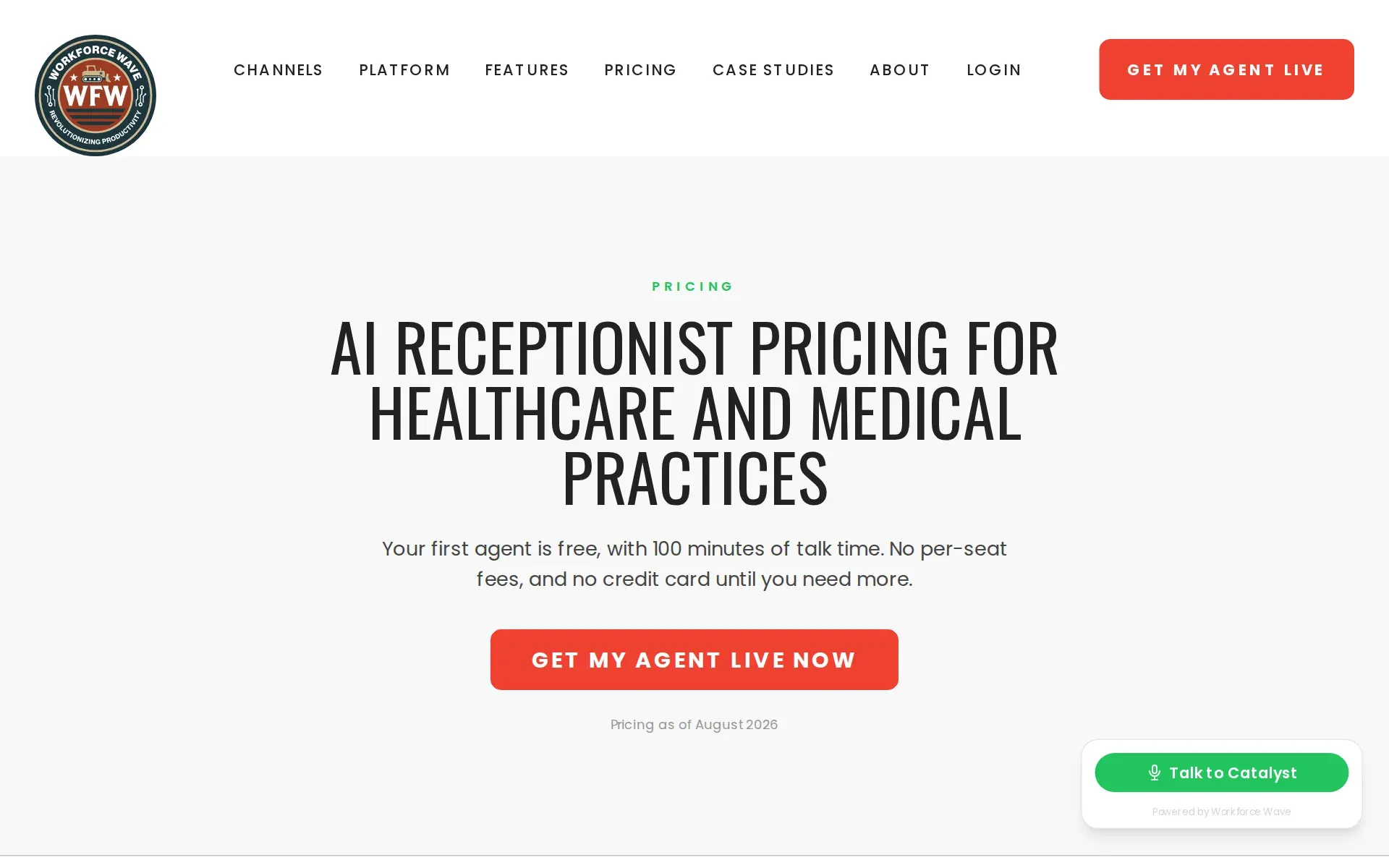
Pricing page, captured
workforcewave.com/pricing, checked
What we checked on Workforce Wave
What the price counts
Flat monthly plans ($99 Starter, $249 Growth, $499 Platform) include a pool of minutes, with per-minute overage on top and no per-seat fees; Enterprise is quote-based and can bill per completed outcome.
Voice is billed per minute. Every other channel is billed as a fraction of a voice minute — so you pay for actual work on every channel, never per…
workforcewave.com/pricingChecked
Free to use
A standing free plan gives one agent and 100 minutes of talk time with no card and no stated time limit; the agent pauses rather than billing when the minutes run out.
Your first agent is free with 100 minutes of talk time, no time limit and no credit card required.
workforcewave.com/pricingChecked
Self-serve signup
You paste a business URL and the agent is provisioned automatically in about 90 seconds, with no sales call required; only Enterprise routes through contact sales.
Paste your website and your agent is live in 60 seconds. 100 free minutes of talk time, no credit card, no sales call.
workforcewave.com/pricingChecked
Card to start
The free first agent with 100 minutes of talk time needs no credit card; a card is asked for only when free minutes run out or a dedicated number is wanted.
On the page: FAQ, 'Is there a free trial?'
workforcewave.com/pricingChecked
Contract
Plans are quoted as monthly rates with no per-seat fee and no setup cost, and the pricing page describes the paid path as pay as you go rather than an annual commitment.
Pay as you go, cancel anytime.
workforcewave.com/pricingChecked
Cancel any time
The vendor states cancellation is available at any time with no term named; the Terms and Conditions page is blank while being updated, so no cancellation clause backs this beyond the pricing page.
Your agent pauses and everything you built stays safe. It resumes the moment you add a card. Pay as you go, cancel anytime.
workforcewave.com/pricingChecked
Works with
The integrations page names practice, property and field-service systems by vendor, including NexHealth, Dentrix, Open Dental, Mindbody, Cloudbeds, OpenTable, ServiceTitan, Clio, HubSpot and Salesforce; no plan gating is stated for them.
Workforce Wave connects with the tools and platforms your team already uses — from CRM and scheduling software to communication providers and AI…
Languages
Only English and Spanish come with every plan; the other 27 languages, including French, German, Hindi and Mandarin, require an Enterprise plan and are enabled per agent during onboarding.
English and Spanish are included on every plan. 27 more languages are available on Enterprise.
workforcewave.com/languagesChecked
Public API
A REST API v2 with OpenAPI spec, webhooks and SSE is documented, but the vendor says self-serve access is not shipped and credentials are issued by invitation; the plan table puts Bot API access at Growth and above.
The self-serve API is in development. Access is by invitation today.
workforcewave.com/developersChecked
MCP server
An MCP server is offered, but the pricing page lists MCP server access only from the $499/mo Platform plan upward; Starter and Growth cards do not include it.
PLATFORM $499 /mo For SaaS builders and platforms deploying voice AI at scale. 20 AI agents 8,000 minutes/mo included Everything in Growth MCP server…
workforcewave.com/pricingChecked
Acts on its own
Agents place outbound calls triggered by events such as a completed call, a form fill or a cron batch, with a policy check instead of a person approving each dial, and results returned by webhook.
The autonomous calling pipeline is deterministic: a triggering event, a policy check, an async initiation, and a webhook-delivered result. No human…
Limits on what it may do
A policy layer gates every outbound dial on calling hours, opt-out status and configured rate limits, and API tokens are scoped per capability such as agents:write or calls:read.
Before dialing, the policy layer checks: calling hours (TCPA compliance), opt-out status, existing scheduled callback, and any rate limits you've…
No code needed
Setup is one URL field: the prompt, knowledge base and greeting are generated automatically, and the vendor says most customers go live without editing the generated output.
Workforce Wave generates your full system prompt from your business URL. It reads your website, extracts services, hours, staff, and specialties, and…
No training on your data
The privacy policy states voice interactions are not used to train any large language model, naming both OpenAI and proprietary components, and that PHI is never used for model training.
Interactions with Workforce Wave AI agents — including voice agents — are not used to train any Large Language Model. This applies to all OpenAI and…
Retention you control
Call audio defaults to 12 months and a client can ask for a shorter period; audit log retention is 90 days by default and seven years under a HIPAA BAA, and personal data is deleted within 90 days of termination.
Audio recordings: 12 months, unless a shorter period is client-specified
Data stays in your region
The relational store is described as EU or US region, but the data architecture table names no region choice for the Backblaze B2 audio store or the vector store, and no self-service region selector is documented.
Encrypted at rest, EU or US region, row-level tenant isolation
workforcewave.com/securityChecked
Take your data out
The privacy policy grants a portability right in machine-readable form, and the documented API returns transcripts, call records and extraction results for export without the dashboard.
Portability: Receive your data in a structured, machine-readable format
Security audits
SOC 2 Type II is described as an audit in progress rather than a held report, a HIPAA BAA is offered, and no ISO 27001 or ISO 42001 certification is claimed anywhere on the security page.
SOC 2 Type II audit in progress — expected Q3 2025
workforcewave.com/securityChecked
Single sign-on
Dashboard sign-in supports OAuth 2.0 social login with Google or GitHub plus TOTP multi-factor, but no SAML, Okta or SCIM enterprise identity provider integration is named on the security page.
OAuth 2.0 social login (Google, GitHub) available
workforcewave.com/securityChecked
Audit log
Every API call is logged with actor, timestamp, IP, user agent and response status, alongside separate policy execution and human action logs, retained 90 days by default.
Every API call is logged with actor identity, timestamp, IP, user agent, and response status. Every automated action is traceable to the…
workforcewave.com/securityChecked
Uptime promise
An SLA is named only as an Enterprise plan inclusion with no uptime percentage, credit schedule or published service level document anywhere on the site.
SLA + dedicated support
workforcewave.com/pricingChecked
Workforce Wave alternatives


Questions about Workforce Wave
- How much does Workforce Wave cost?
- Workforce Wave has a free plan. From workforcewave.com/pricing, checked 2 November 2026.
- Does Workforce Wave have an API or an MCP server?
- Workforce Wave has an API on Growth. From workforcewave.com/developers, checked 25 October 2026. Workforce Wave has an MCP server on Platform. From workforcewave.com/pricing, checked 2 November 2026.
- What have we checked on Workforce Wave?
- 21 facts, under these headings: What it costs to start, what it works with, what it does on its own, what happens to your data, whether a company can buy it.
- How do we check Workforce Wave?
- We hold 21 facts on Workforce Wave, quoted from 8 pages. Facts and price last checked 2 November 2026. Last change found 30 May 2026.
Sources and changes
Last changed
Sources on workforcewave.com8
Workforce Wave price history
The cheapest paid plan has cost $99 a month since 2 November 2026, on all 3 readings.
| Price | Plan | First seen | Last seen | Readings | Source |
|---|---|---|---|---|---|
| $99 a month | 2 November 2026 | 14 November 2026 | 3 | Pricing page, read 2 November 2026 |
From 3 readings of Workforce Wave's pricing page: 3 of our own checks since 2 November 2026. A date is when we read the page, not when the price changed.
Similar in Customer service agents
- AissistMulti-agent AI that resolves support and sales tickets in your existing helpdesk, billed per interaction.
- BotpressAI support agents and helpdesk priced per conversation, with no per-seat fees and AI usage included in plans.
- ChatbaseBuild sales and support agents from your own content without code, on a flat monthly plan with message credits.
- NextivaCloud phone and contact center platform where the XBert AI employee and human staff share one customer thread.


Claimed by the Workforce Wave team.
We check its facts against the Workforce Wave site.Facts checked 2 November 2026
Report an error if a fact is wrong.