
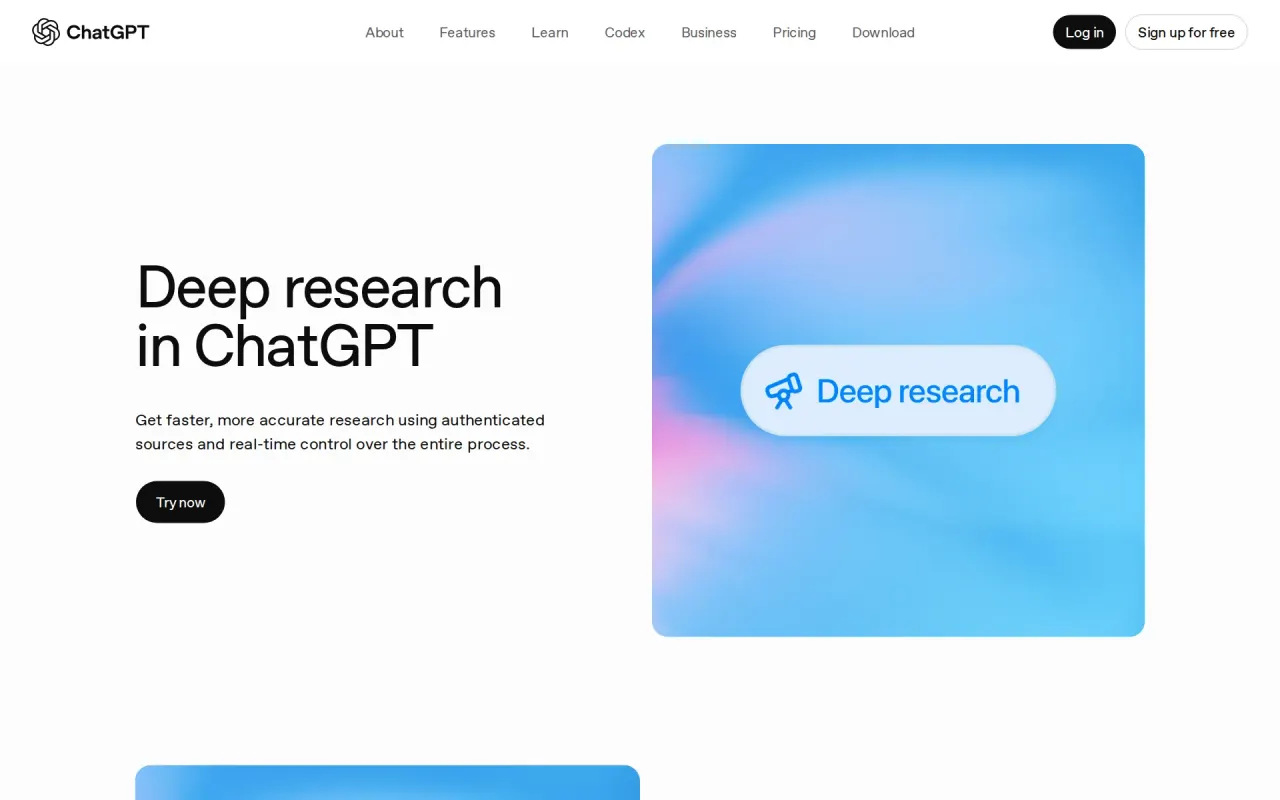
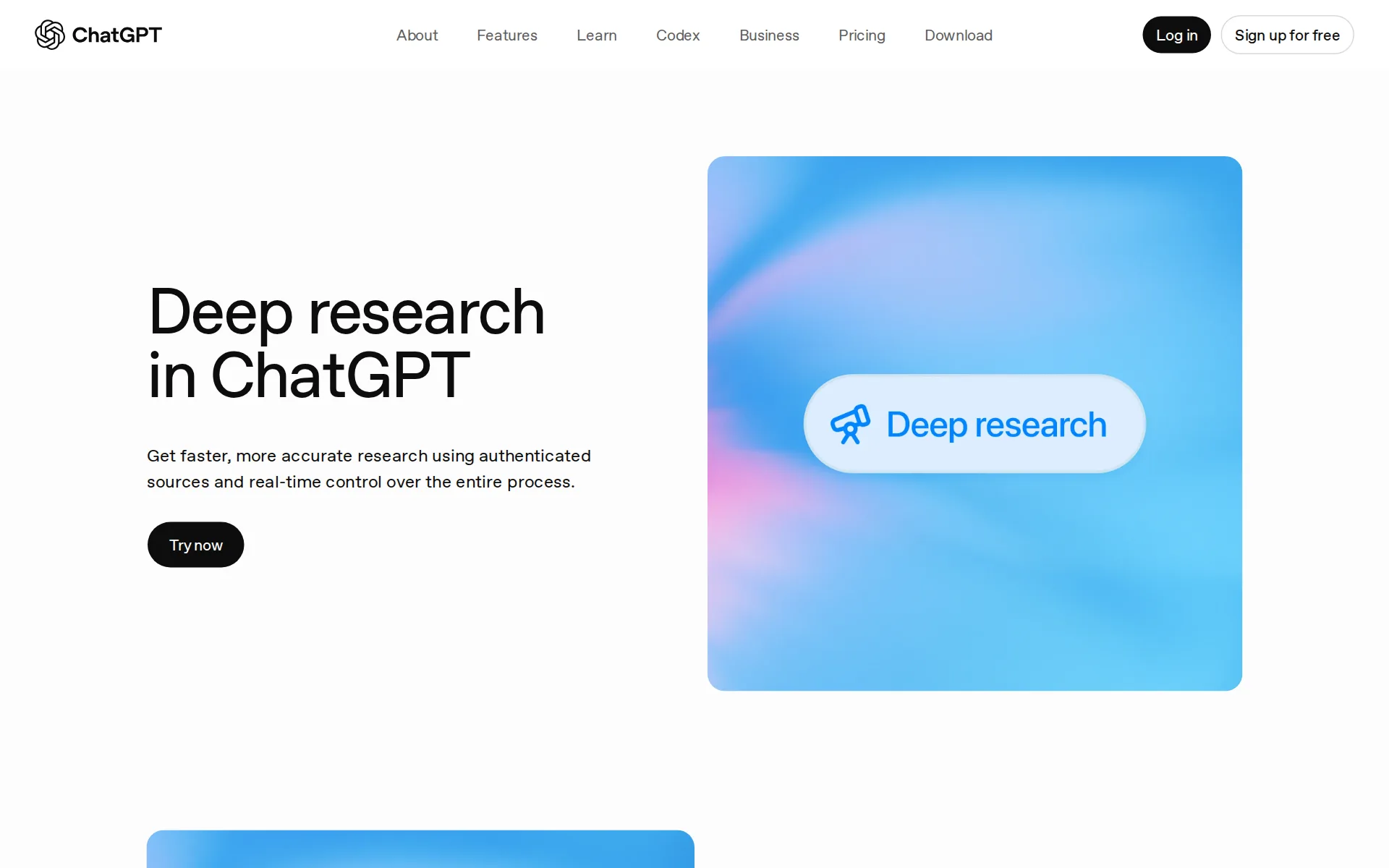
Reports open full screen and download as Markdown, Word or PDF.
Deep research is a source-controlled report mode inside ChatGPT
Deep research is not a separate product with its own login. It is a mode of ChatGPT started by typing /Deepresearch, picking it from the + tools menu, or choosing it in the sidebar, as the help article sets out. The run is a sequence: you state the outcome, choose sources, review a proposed plan, watch the run and interrupt it, then get a report with citations.
Sources are the part worth attention. By default it reads the public web and files you upload. Through Sites > Manage sites you can restrict a run to listed domains, or select "Prioritize these sites, but allow full-web search". Connected apps such as Google Drive or SharePoint and authenticated data services can also be sources, and only their read actions are used: "It does not use app write actions as part of research."
Finished reports open full screen with a table of contents, a sources section and an activity history, and download as Markdown, Word or PDF.
The plan tiers name access levels, not task counts
Every ChatGPT plan includes deep research, and the pricing page grades it in words rather than numbers: "Limited deep research" on Free, "Expanded deep research" on Plus, "Maximum deep research" on Pro. Go, at €8 (about $8.95) a month, is not credited with deep research in its own card at all, while the comparison grid shows Limited for the two lowest columns.
The help article pushes the number into the product: "Deep research usage varies by plan. Your in-product usage counter shows your remaining tasks. For plans with a fixed monthly allowance, it resets every 30 days from the date of your first use." So a buyer cannot size the feature before subscribing, and the reset is anniversary based rather than calendar based.
A second FAQ answer notes availability itself is conditional: asked whether deep research works in all countries, the answer is "No. Availability depends on your plan and your country or territory."
Prices read per user per month, with business seats quoted both ways
Pricing is stated as "priced per user per month" in the FAQ. Read from this location the individual cards show €0 Free, €8 (about $8.95) Go, €23 (about $26) Plus and from €103 (about $115) Pro, all with a / month label; OpenAI serves currency by region, so a reader elsewhere will see local figures.
Business is the clearer case because the card prints both terms in text rather than behind a toggle: a standard seat is "€21/month (about $24) if billed annually. €26/month (about $29) if billed monthly", and a premium seat "€105/month (about $118) if billed annually. €130/month (about $146) if billed monthly" with "5x more usage than standard, with no 5-hour limit". Business starts at two users. Enterprise is "Custom pricing" through sales, with invoicing and volume discounts.
On top of the seat there is a consumption layer: the grid footnote reads "Enterprise and Business can purchase credits for more access", and the Enterprise card mentions credit-based and token-based options. Nonprofits are offered up to a 75% discount on Business or Enterprise.
Admin control over research sources is the enterprise story
For Enterprise and Edu workspaces, access to the feature runs through role-based access control, and the help article is careful about what enabling an app does and does not do: "Enabling an app for a workspace does not guarantee that it supports deep research or that every member can access the same provider content." Research also respects the permissions of the connected account, so it cannot read what the signed-in user cannot.
Auditing exists at the workspace level. Deep research activity is "detailed in the Conversation API, along with the conversation where the task was started", which is the Compliance API that the pricing grid lists as an Enterprise row.
Published assurances are SOC 2 Type 2 for business plans, ISO 27001, 27017, 27018 and 27701 for Enterprise, SAML SSO and MFA on Business, SCIM and Enterprise Key Management above that, and data residency in US, EU, UK, JP, CA, KR, SG, IN, AU and UAE.
Data handling follows ordinary ChatGPT settings, and so do its gaps
"Conversations using deep research follow the same data handling and privacy settings as regular ChatGPT conversations." That cuts both ways. Consumers can switch off "Improve the model for everyone" and keep their history, and business data is not trained on by default. OpenAI will execute a DPA for Business, Enterprise and the API.
Retention is where the plans diverge. Deleted chats are scheduled for permanent deletion within 30 days and temporary chats may be kept up to 30 days for safety, but a configurable retention window is named only for Enterprise, Healthcare and Edu. Export diverges the same way: personal accounts can request their data, while "Self-service data export is not available for ChatGPT Business, Enterprise, or ChatGPT for Healthcare workspaces".
No on-premise option is mentioned anywhere read, and no license or source repository is named.
The API route is a different product with a shutdown date
Programmatic deep research is not this feature. It is a set of models on the API platform, used through the Responses API with at least one data source: web search, remote MCP servers, or file search over vector stores. The same page carries a deprecation notice naming a shutdown date for o3-deep-research and o4-mini-deep-research with a general model as the replacement, and warns that "changing the model ID alone is not a complete migration".
So a team that wants deep research in its own software is buying an API model family in transition, not the ChatGPT surface described above. Background mode, recommended for these long runs, "retains response data for roughly 10 minutes so that polling works reliably, which makes it incompatible with Zero Data Retention (ZDR) requirements".
Where it fits, and where it does not
It fits analysts and professional teams who need a documented, citation-backed report over a mixed source set, and who care which sources were used: approved domains, uploaded files and connected document stores. The vendor's own examples are consulting and market research, finance, legal, life sciences and consumer research, with an illustrative prompt using a paid dataset through an app.
It fits badly where speed matters, which the vendor says plainly: "If time is critical, use search or standard chat for faster responses and save deep research for in-depth analysis." It also fits badly where the volume of research must be budgeted in advance, because no plan publishes a task allowance, and where a connector is assumed to work: "An app being available in ChatGPT or included in a plugin does not, by itself, mean it is available for deep research."
Plans and pricing
Price and terms
- Free plan
- YesYesThe Free plan is €0 and its card reads "Limited deep research"
The terms in full
no task count is published and the remaining allowance is shown only by the in-product usage counter, resetting every 30 days from first use.
- Card to start
- YesNot required
- Sign up without sales
- YesYes
What needs a higher plan
- ChatGPT Enterprise, Edu and Healthcare
- Retention you control
- ChatGPT Enterprise
- Data stays in your region, Audit log, Uptime promise
- ChatGPT Business and Enterprise
- Single sign-on
For AI agents
- MCP server
- Partly
- API
- Partly
Checked .
The facts, with their sources
What it costs to start
- What the price counts
- YesPriced per user per month across the consumer and business plans, with Enterprise quoted by sales and extra deep research capacity sold as credits to business workspaces.
Paid plans (Go, Plus, Business, and Enterprise) are priced per user per month.
chatgpt.com/pricing - Free tier
- YesThe Free plan costs nothing and includes deep research, though the pricing grid describes that access only as 'Limited' without publishing a task count.
Limited deep research
chatgpt.com/pricing - Self-serve signup
- YesFree, Go, Plus, Pro and Business are bought with a credit card from the site without sales contact; only Enterprise routes through a sales conversation.
You can purchase ChatGPT Go, Plus, Pro, or Business with any major credit card. For ChatGPT Enterprise, please contact sales for alternative payment…
chatgpt.com/pricing - Card to start
- NoDeep research is included on the free plan at zero cost, so a card is only needed when upgrading to a paid tier rather than to try the feature.
The free version of ChatGPT is available to everyone.
chatgpt.com/pricing - Contract
- YesMonth to month is available on Go, Plus and Business; annual terms exist for Business and Enterprise, and Business workspaces start at two seats.
We offer monthly plans for Go, Plus and Business and annual plans for Business and Enterprise.
chatgpt.com/pricing - Cancel any time
- PartlySelf-service cancellation stops renewals from account billing settings or the app store used to subscribe, but it refunds nothing already charged and the article excludes Enterprise and Edu.
Canceling stops future renewals. It does not automatically refund previous charges.
help.openai.com/en/articles/7232927-can…
What it works with
- Works with
- YesDeep research reads from connected apps such as Google Drive and SharePoint plus authenticated data services, and business workspaces list Google Workspace, Slack, GitHub and Microsoft 365 connections.
available sources can include document stores such as Google Drive or SharePoint and authenticated industry data services
help.openai.com/en/articles/10500283-de… - Public API
- PartlyThe ChatGPT feature itself has no API, but OpenAI's API platform sells deep research models through the Responses API; those model IDs carry a published shutdown date with a general model as replacement.
To use deep research, use the Responses API with the model set to o3-deep-research or o4-mini-deep-research.
platform.openai.com/docs/guides/deep-re… - MCP server
- PartlyDeep research consumes MCP-based plugins as research sources and uses only their read actions, while the API-side deep research models can call remote MCP servers directly.
Deep research uses available read actions from connected apps. It does not use app write actions as part of research.
help.openai.com/en/articles/10500283-de…
What it does on its own
- Acts on its own
- PartlyIt runs a multi-step research task without step-by-step approval, but it proposes a plan for review first and may ask clarifying questions before starting.
ChatGPT creates a proposed research plan. You can review and modify it before the research begins.
help.openai.com/en/articles/10500283-de… - Limits on what it may do
- YesUsers can confine research to approved domains or uploaded files, and Enterprise and Edu admins gate which apps and sources a role may reach through role-based access control.
For Enterprise and Edu workspaces, admins control access to deep research through role-based access control (RBAC).
help.openai.com/en/articles/10500283-de… - No code needed
- YesStarting a task is a prompt and a menu selection inside ChatGPT, with sources managed in a panel, so no code or configuration file is involved.
Click the ‘+’ and choose ‘Deep research’ from the dropdown.
chatgpt.com/features/deep-research
What happens to your data
- No training on your data
- YesConsumer accounts can switch off 'Improve the model for everyone' and keep their history, and business and enterprise workspaces are excluded from training by default.
When Improve the model for everyone is off, your new conversations won’t be used to train OpenAI models.
help.openai.com/en/articles/7730893-dat… - Retention you control
- PartlyIndividuals can delete chats or use temporary chats kept up to 30 days, but configurable retention windows are a workspace control on Enterprise, Edu and Healthcare rather than a consumer setting.
You control how long your data is retained (ChatGPT Enterprise, ChatGPT for Healthcare, ChatGPT Edu)
openai.com/enterprise-privacy - Data stays in your region
- PartlyResidency is an Enterprise capability covering ten named regions; the consumer and Business rows in the same comparison grid do not carry it.
Support for data residency in ten regions
chatgpt.com/pricing - Take your data out
- PartlyFinished reports download as Markdown, Word or PDF and personal accounts can request a full data export, but self-service export is withheld from Business, Enterprise and Healthcare workspaces.
Self-service data export is not available for ChatGPT Business, Enterprise, or ChatGPT for Healthcare workspaces and should be directed to the…
help.openai.com/en/articles/7730893-dat…
Whether a company can buy it
- Security audits
- YesThe comparison grid marks SOC 2 Type 2 for business plans and ISO 27001, 27017, 27018 and 27701 certification for Enterprise, and the enterprise page repeats the SOC 2 audit.chatgpt.com/pricing
- Single sign-on
- PartlySAML SSO with MFA comes with Business seats and SCIM provisioning is Enterprise only; the individual plans that also include deep research have neither.
Secure workspace with SAML, SSO, and MFA
chatgpt.com/pricing - Audit log
- PartlyDeep research activity is retrievable through the Compliance API alongside its conversation, which the grid lists as an Enterprise row rather than a consumer or Business feature.
Deep research activity is detailed in the Conversation API, along with the conversation where the task was started.
help.openai.com/en/articles/10500283-de… - Uptime promise
- PartlyAn uptime and support commitment is offered inside the Enterprise package for eligible customers, and no SLA is published for the plans a buyer can purchase online.
24/7 priority support, SLAs, custom legal terms, and access to AI advisors (eligible customers)
chatgpt.com/pricing
Screenshots
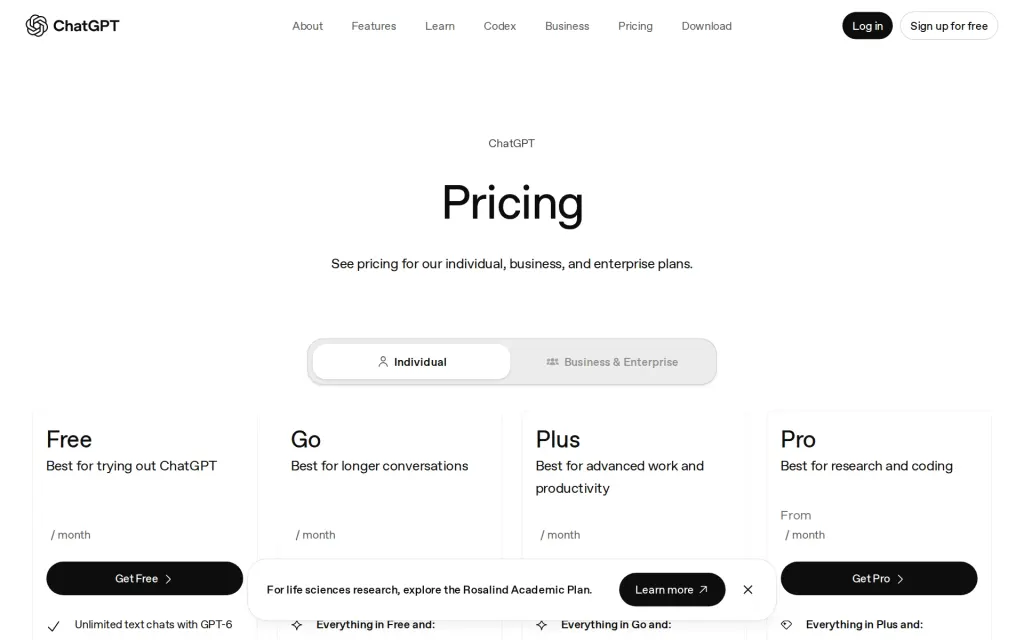
Pricing page, chatgpt.com, captured
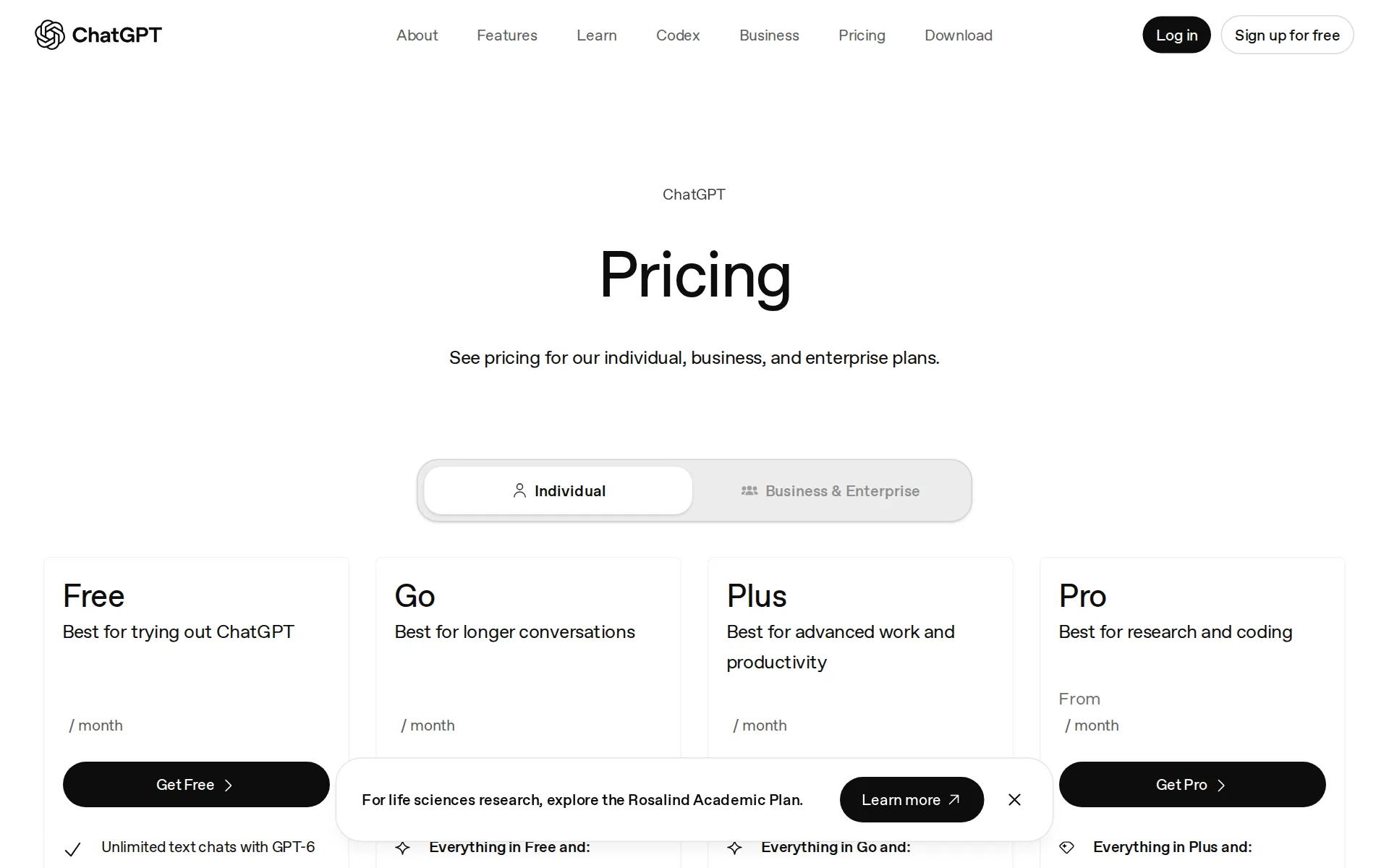
Filed under
Sources and updates
Sources7
- chatgpt.com/pricing
- help.openai.com/en/articles/10500283-deep-research-in-chatgpt
- help.openai.com/en/articles/7730893-data-controls-faq
- openai.com/enterprise-privacy
- platform.openai.com/docs/guides/deep-research
- help.openai.com/en/articles/7232927-canceling-your-chatgpt-subscription
- chatgpt.com/features/deep-research
Updates1
- Free tier · Price · What it does
Is this yours? AI assistants like ChatGPT, Claude and Perplexity opened AgentsIndex pages 807 times from 17 October to 25 October. Claim it free and edit it in your dashboard, or feature it in Research Agents.