
ElevenLabs
What is ElevenLabs?
ElevenLabs is an AI voice platform for enterprises, creators, and developers that turns text into speech, speech into text, and audio into reusable production assets. Its surface includes AI Voice Generator, Voice Cloning, Speech to Text API, Music API, ElevenAgents, ElevenCreative, ElevenAPI, and Dubbing Studio, with 10,000+ voices and 70+ languages. It is used by Twilio, The Walt Disney Studios, Epic Games, Cisco, Salesforce, T-Mobile, and HubSpot. Plans run Free $0 per month, Starter $6 per month, Creator $11 per month, Pro $99 per month, Scale $299 per month, Business $990 per month, and Enterprise custom pricing.
Last verifiedHow we evaluate
At a glance
- ElevenLabs is best for product, content, and engineering teams who need natural voice at scale.
- Free; Starter $6/mo; Creator $11/mo; Pro $99/mo; Scale $299/mo; Business $990/mo; Enterprise custom
- Yes — Public API for text-to-speech, voice cloning, and related audio workflows; docs are linked from the ElevenAPI pages.
Where it measurably leads
On the Coval-run open benchmark — which re-runs continuously against identical inputs and publishes its runner code under Apache-2.0 — ElevenLabs leads on both headline axes against Cartesia, the usual latency-first rival. On a rolling 7-day window, eleven_flash_v2_5 posts a median time-to-first-audio of 208ms against 271ms for Cartesia's sonic-3.5, and eleven_v3 averages 4.9% word error rate against 6.3%. WER here is measured by transcribing the output back with a reference speech-to-text model and comparing it to the input text, which catches skipped, garbled and hallucinated words. This is measured data, not a vendor claim, and it is the strongest single argument for the product.
Breadth is the other real strength. Per the vendor's model docs, eleven_v3 covers 70+ languages, Flash v2.5 covers 32 with a 40,000-character limit, and the scribe_v2 speech-to-text model covers 90+. Few competitors match that span across synthesis, recognition, dubbing, music and sound effects on one API.
One caveat on reading the benchmark: the accuracy win and the speed win come from different models. Flash v2.5 is the fast one, but its 6.6% WER is marginally worse than sonic-3.5's 6.3%. The 4.9% figure belongs to eleven_v3, which runs at a 642ms median. You do not get both numbers from one model.
The latency tail, which is the number that matters for voice agents
Medians flatter ElevenLabs; the distribution does not. In the same 7-day window, eleven_flash_v2_5 shows a p95 TTFA of 2,925ms against 371ms for Cartesia's sonic-3.5 — roughly an eight-fold difference at the tail, on comparable sample counts (3,269 vs 3,478). eleven_v3's p95 is 3,415ms.
For batch work — audiobooks, dubbing, pre-rendered narration — a slow 5% is invisible. For a live phone agent it is not: one call in twenty waiting nearly three seconds for the first audio frame reads to the caller as a dropped line, and it is exactly the failure mode that does not show up in a demo. If you are building real-time conversational agents, this is the number to reproduce against your own traffic before committing, and it is the clearest reason a latency-first competitor still wins deals against a technically superior model.
These figures are a rolling window that refreshes daily, so treat the specific numbers as a snapshot and re-check them rather than quoting them months from now.
How the credit model actually bills
Per the vendor's own pricing FAQ, the ladder is: Free $0 (10,000 credits); Starter $6 (30,000); Creator $22 (121,000, $11 first month); Pro $99 (600,000); Scale $299 (1,800,000, 3 seats); Business $990 (6,000,000, 10 seats); Enterprise custom.
The important structural point is that one shared credit pool funds every product, so the same credits can go to speech, music, dubbing or transcription and spending them on one leaves fewer for the others. Published rates: text-to-speech 1 credit per character; speech-to-text 330 credits/minute; Eleven Music 900/minute; sound effects 200/generation; voice changer and voice isolator 1,000/minute. Unused credits roll over for up to two months, capped at 3x your monthly quota — but on downgrade or cancellation, unused paid credits expire.
Two things worth checking before you budget. First, dubbing costs are stated inconsistently on the vendor's own pricing page: the FAQ says automatic dubbing is 2,000 credits/minute watermarked and 3,000 without, while a tooltip on the same page says automatic dubbing costs 13,500 credits/minute on paid plans (22,000 on Free). That is a ~4.5x spread on the non-watermarked case, so confirm the live rate with sales if dubbing is a material line item. Second, a recurring theme in public user reviews is that regenerations and failed or unsatisfactory outputs consume credits like successful ones — if your workflow involves heavy iteration, model the retries, not just the final output.
ElevenAgents is priced on a separate meter
The conversational agents product does not draw on the credit pool — it bills call minutes. Included minutes and concurrent-call ceilings per plan: Free 15 min / 4 concurrent; Starter 75 / 6; Creator 275 / 10; Pro 1,238 / 20; Scale 3,738 / 30; Business 12,375 / 40. Additional minutes are $0.08, text messages $0.003 each.
Three things compound on top of that headline rate. The LLM and any telephony are billed separately based on usage — the $0.08/min is the ElevenLabs layer only, not the cost of a call. Burst pricing lets you exceed your concurrency limit up to 3x, charged at double the standard rate ($0.16/min). And the concurrency ceiling is the constraint most likely to bite: Business, at $990/month, tops out at 40 concurrent calls before burst rates apply. Any contact-centre-scale deployment is an Enterprise conversation, not a self-serve one.
There is no cap on how many agents you can create on any plan — you are limited by concurrency and credits, not agent count.
Voice cloning: what you can and cannot clone
This is the constraint most likely to invalidate a build plan, and it is not obvious from the marketing. Professional Voice Cloning — the high-fidelity tier — can only clone your own voice. The docs are explicit: "You can only create a Professional Voice Clone of your own voice. Even with their consent, you cannot clone someone else's voice." Every PVC requires a verification recording confirming the voice is yours.
Slots are tightly limited: Free and Starter get none; Creator, Pro and legacy Scale get 1; Scale and legacy Business get 3; Business gets 10; Enterprise is custom. Additional slots can be earned when a voice you share to the Voice Library passes Studio Quality review.
So if you are an agency or studio planning to produce high-fidelity clones of twenty different narrators or clients, self-serve plans will not do it at PVC quality regardless of how much consent you have documented — that is an Enterprise conversation. Instant Voice Cloning remains available on paid plans as the lower-friction, lower-fidelity path.
A practical gotcha for phone agents: numbers are not normalised
Worth knowing before your agent reads a phone number aloud. Per the model docs, text normalisation is disabled by default on Flash v2.5 to preserve its low latency, so "phone numbers might be read out in way that isn't clear for the user. Dates and currencies are affected in a similar manner."
The fix is gated: Enterprise customers can enable it by setting apply_text_normalization to "on". Everyone else's documented workaround is to switch to Multilingual v2, which normalises better — but that is the slower model, so you trade the latency you chose Flash for. If your agent quotes prices, dates, order numbers or phone numbers, test this specific path early.
Compliance and data handling
This is a genuine strength and a common reason ElevenLabs wins enterprise deals over smaller rivals. The vendor states SOC 2 Type II, ISO 27001 and PCI DSS Level 1 certification, with HIPAA attestation and BAAs available for qualifying healthcare customers, plus GDPR compliance and AIUC-1 for insurable agents. Zero Retention Mode is offered as a separately-enabled option so model-processed content is not retained on ElevenLabs servers.
Two qualifications. Data residency is Enterprise-only, with four documented locations: US (standard), EU, India and Singapore. And the public docs do not enumerate which specific services Zero Retention Mode covers — they direct you to your account team to confirm which models are available in your region under ZRM. If retention posture is a gating requirement, get the service-by-service scope in writing rather than relying on the marketing page.
The certifications themselves are vendor-stated. The compliance portal at compliance.elevenlabs.io renders client-side and exposes no certificate detail to an unauthenticated visitor, so independent verification means requesting access.
Developer surface
The tooling is well-maintained and that shows in the GitHub data rather than in claims. The Python SDK carries 3,064 stars under an MIT licence, the UI component library 2,347, the MCP server 1,523, the examples repo 620, an agent skills repo 416 and the JS SDK 440. Checked on 16 August 2026, every one of those had been pushed to within the previous few days — this is an actively staffed SDK surface, not a set of published-once wrappers.
Coverage extends to Swift and Android SDKs, a CLI, an n8n node and a Next.js starter. Documentation quality draws unprompted praise in public user reviews. For a team evaluating integration effort, this is a low-risk part of the decision.
Support and billing friction
ElevenLabs holds 3.1 out of 5 on Trustpilot — "Average" by Trustpilot's own label. We could not establish the total review count: Trustpilot returns 403 to both direct fetches and a headless browser, and the proxy that does return review text does not expose the count, so weight this accordingly.
The pattern in the reviews is consistent and worth knowing. Praise centres on the technology and documentation — one reviewer describes being "pretty floored" by quality, speed and ease of building. Complaints cluster almost entirely on billing and support rather than product: credits purchased but not credited to the account, difficulty getting substantive support responses (one reviewer noted a reply marked "This response was generated by AI"), and credits consumed by regenerations after an output failed to apply a requested change. Several reviewers explicitly separate the two, along the lines of "excellent technology, unacceptable billing and customer support."
ElevenLabs does respond publicly to negative reviews and, in at least one documented case, issued courtesy credits while investigating. For a self-serve buyer this is a moderate risk; for an enterprise buyer with an account team it is likely not the support channel you would be using.
Regulatory context for voice cloning
Context rather than a mark against the product, but it belongs in a purchase decision because the compliance burden partly lands on you.
In March 2025 Consumer Reports assessed voice cloning products from six companies — Descript, ElevenLabs, Lovo, PlayHT, Resemble AI and Speechify — and found four, including ElevenLabs, gated cloning behind only a self-attestation checkbox confirming the user had the legal right to the voice. Descript and Resemble AI used stronger mechanisms. That assessment is now roughly seventeen months old and predates current policy, so treat it as a directional finding rather than a live description; note also that it concerns the Instant Voice Cloning path, whereas Professional Voice Cloning does require a verification recording.
In April 2026, Senator Maggie Hassan sent letters to ElevenLabs, LOVO, Speechify and VEED asking how each prevents scammers from abusing voice clones, citing $893 million in AI-related scam losses from the FBI's 2025 internet crime report. Axios, which received the letters first, states plainly that "the companies have not been accused of any wrongdoing." ElevenLabs told Axios it has "a comprehensive set of safeguards to prevent misuse of our technology," including blocking clones of celebrities and public figures and running both automated and human policy review.
The practical read for a buyer: the category is under active legislative attention, consent documentation is likely to become a harder requirement, and on the Instant Voice Cloning path the attestation — and therefore the liability — is yours.
Company and funding
Not a survival risk. ElevenLabs raised a $500 million Series D led by Sequoia Capital announced 4 February 2026, at an $11 billion valuation — more than three times its January 2025 valuation — with Sequoia's Andrew Reed joining the board. TechCrunch reports a16z quadrupled its position and Iconiq tripled its own, with Lightspeed, Evantic Capital and Bond joining as new investors, and total funding above $781 million since the 2022 founding.
The company says it closed 2025 above $330 million in ARR. That is a company-stated figure reported by TechCrunch rather than an audited one, so treat it as a claim. Note that third-party trackers disagree on totals — one lists $822 million across nine rounds against the $781 million TechCrunch and the company cite — so the exact cumulative figure varies by source.
Stated plans for the capital include research, product development, expansion into India, Japan, Singapore, Brazil and Mexico, and extending agents beyond voice into video. Competitively, the category is well-funded on all sides: Deepgram raised $130 million at a $1.3 billion valuation in January 2026, and Google hired the team behind Hume AI the same month.
How much does ElevenLabs cost?
| Plan | Price | What's included |
|---|---|---|
| Free | $0 per month |
|
| Starter | $6 per month |
|
| Creator | $11 per month |
|
| Pro | $99 per month |
|
| Scale | $299 per month |
|
| Business | $990 per month |
|
| Enterprise | Custom pricing |
|
Frequently asked questions
What does ElevenLabs do?
ElevenLabs provides AI voice generation, voice cloning, and sound effect creation through its platform and API. It is an AI research and product company focused on changing how people interact with technology, with products for creators, enterprises, and developers.
Is there a public API?
Yes. ElevenLabs offers a public API for integrations with other applications, and the site links dedicated docs for text-to-speech, speech-to-text, dubbing, sound effects, music, and agents. The API note specifically calls out text-to-speech and voice cloning.
Can I self-host ElevenLabs?
The public pages provided here do not describe a self-hosted deployment option. What they do show is enterprise support for custom SSO, DPA/SLA terms, BAAs for HIPAA customers, and customized deployment support.
What languages are supported?
ElevenLabs says it supports over 70 languages for voice generation and text conversion. That makes it suitable for localization, multilingual support, and dubbing workflows across regional launches.
Which products does ElevenLabs offer?
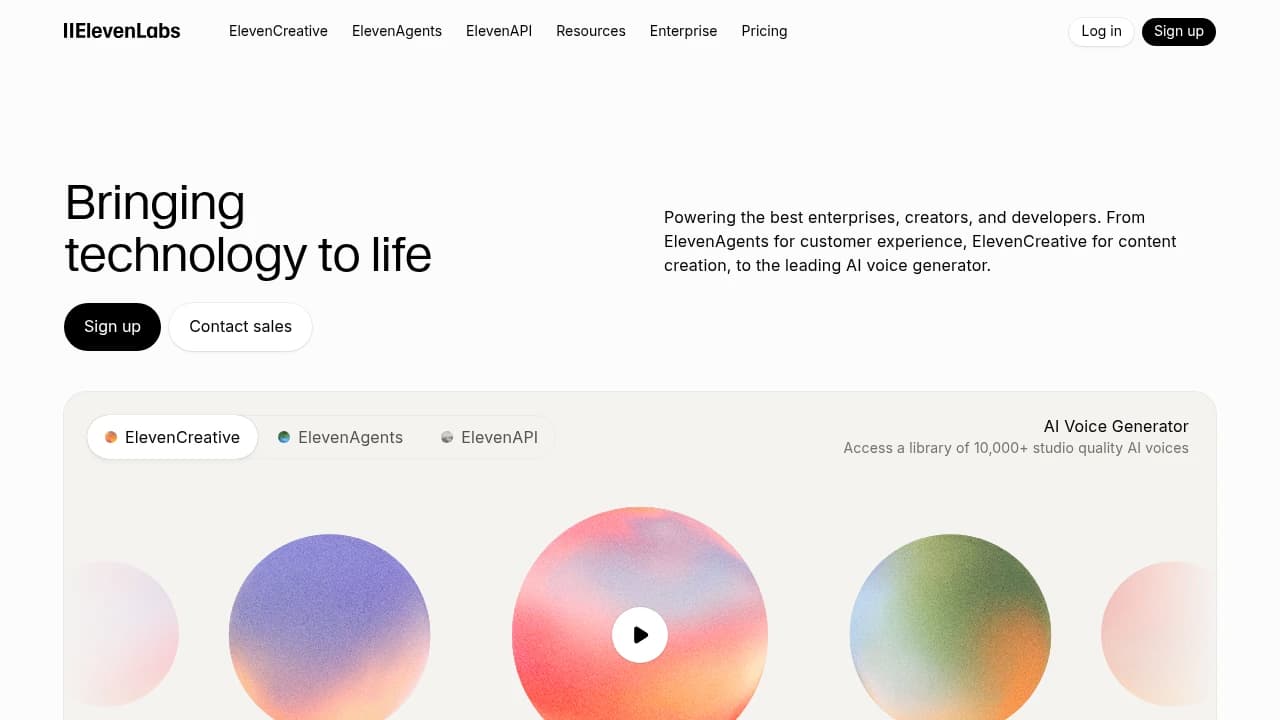
The main products listed are ElevenAgents for customer experiences, ElevenCreative for media generation, and ElevenAPI for developers. The homepage also shows AI Voice Generator, Text to Speech, Speech to Text, Voice Cloning, and Music.
Does ElevenLabs have a free plan?
Yes. The pricing page lists a Free plan at $0 per month with Text to Speech, Speech to Text, Sound Effects, Voice Design, Music, Productions, Image & Video, 3 Projects in Studio, and 10k credits per month.
What security or compliance options are available?
Enterprise includes custom terms and assurance around DPA/SLAs, BAAs for HIPAA customers, and custom SSO. The site also links to a Trust Center and compliance resources, which signals a stronger enterprise security posture.
Can ElevenLabs help with localization?
Yes. ElevenLabs supports dubbing and multilingual workflows, and its customer stories show teams using ElevenCreative to translate course content and update scripts for regional launches. The platform also advertises 70+ languages.
Editor's read
Check the credit ceilings before committing: Free includes 10k credits per month, Starter 30k, Creator 121k, Pro 600k, Scale 1.8M, and Business 6M. If your dubbing or voice-generation volume is likely to exceed those bands, the next tier jump is the real buying decision.

Explore other Voice AI Agents


