
GoodMem
What is GoodMem?
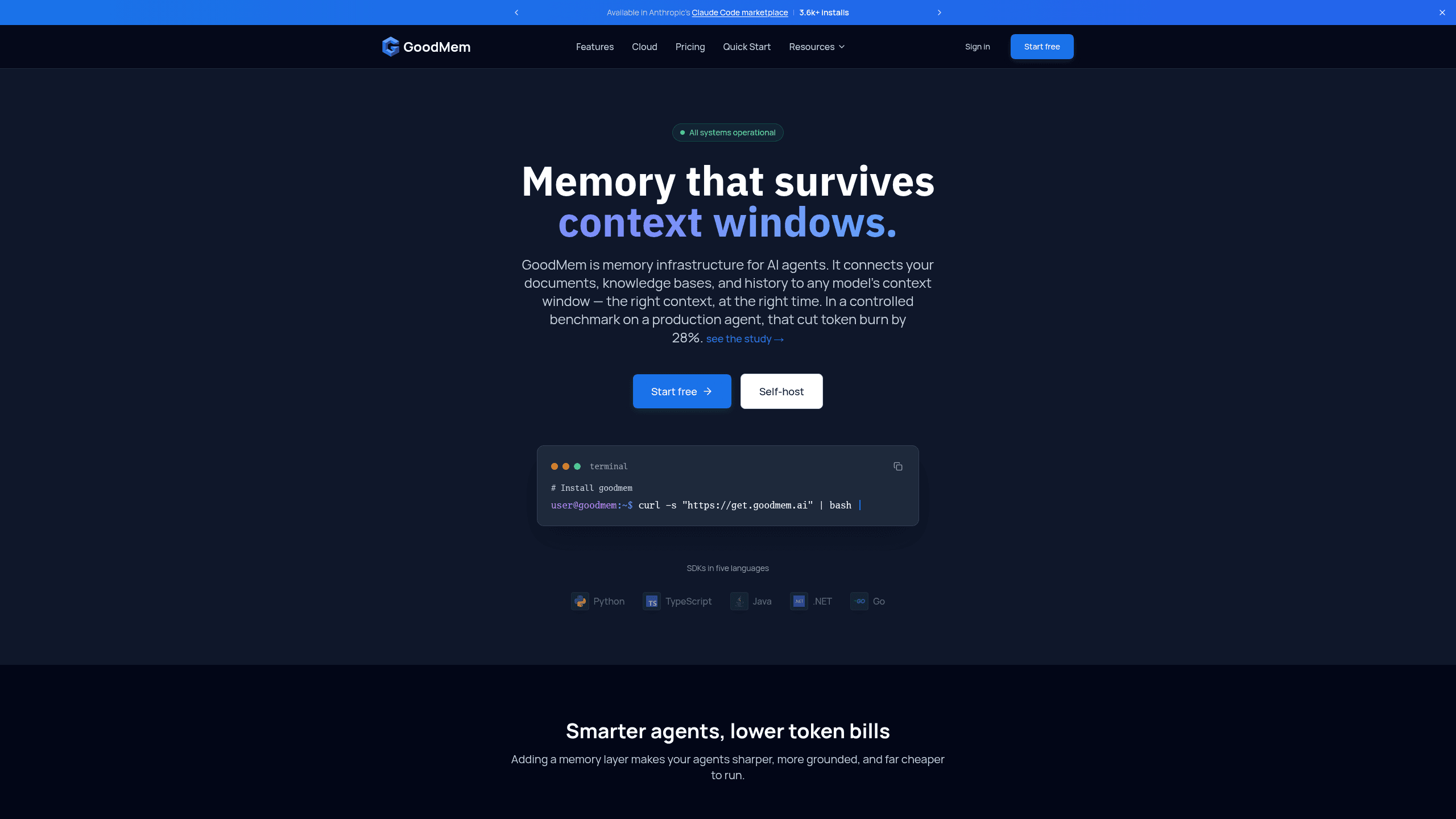
GoodMem is a persistent agent memory platform for AI engineers that ingests documents, extracts and chunks content, and serves governed context through retrieval pipelines. It combines Retrieval Optimizer, Governed & grounded, and Document Ingestion & Visual RAG with scoped API keys and a self-hostable server. GoodMem integrates with Claude Code, Google ADK, OpenAI, AWS Bedrock, and Ollama. Plans run Free, GoodMem Cloud from $15/mo, and Enterprise custom.
Last verifiedHow we evaluate
At a glance
- GoodMem is best for AI engineers who need persistent, permissioned memory across agent workflows.
- Free; GoodMem Cloud From $15/mo; Enterprise Custom
- 14 days
- Yes — Scoped API keys and a retrieval pipeline that works across providers.
What it actually is
GoodMem is not a fact-extraction or auto-summarizing memory layer — by the vendor's own FAQ, "a memory is a document, not an extracted fact." You submit content, GoodMem stores the original, extracts text, chunks it per a space's configuration, embeds each chunk (optionally through several embedders combined with per-embedder weights for hybrid dense+sparse search), and returns cited chunks at query time. It explicitly does not resolve contradictions between an old and new fact, does not expire memories on a timer, and has no in-place update — correcting a memory means delete-then-recreate. That's a narrower, more mechanical scope than some competing "agent memory" products claim, and it's stated plainly rather than buried.
Licensing: free to run commercially, but not open source
The GoodMem server ships only as a binary/container under the GoodMem Free Binary License v1.0. It's free for internal use and for commercial SaaS products built on it, and you may embed it in your own containers or installers — but you may not offer GoodMem itself as a standalone hosted/managed/white-labeled service, and you get no rights to the source code (source_url: https://goodmem.ai/license). PAIR Systems confirms directly: "GoodMem is not open source... 'Free' in the license name refers to price for the covered uses, not to software freedom" (https://goodmem.ai/resources/faq). The five client SDKs (Python, TypeScript, Java, Go, .NET) and the MCP server are separately published under Apache-2.0 and are genuinely open. There is no public repository for the server itself — the PAIR-Systems-Inc GitHub org has ~80 repos, nearly all SDKs, framework integrations (LangChain, LlamaIndex, CrewAI, n8n, etc.) or docs, but a request for github.com/PAIR-Systems-Inc/goodmem returns 404.
Security posture is unusually well-documented for a young vendor
GoodMem publishes a release-pinned security comparison against five competitors (Mem0, Supermemory, Cognee, OpenViking, Graphiti), scoring each on signed image verification, provenance, hardened runtime, TLS, authorization model, and FIPS posture, with dated evidence links to specific commits and workflows (https://goodmem.ai/enterprise-security, refreshed 2026-08-19 and 2026-09-04). Verified independently: the server image (server-v1.0.307) does carry SLSA Build L3 provenance the CLI checks by default, and runs as non-root UID 65532 on a distroless Java 21 image. PAIR Systems holds ISO/IEC 27001 certification today; a SOC 2 Type II audit is in progress with no report yet (confirmed on both the FAQ and the SafeBase-hosted trust center, https://trust.pairsys.ai/). The trust center currently lists two named reference customers, Incorta and Wanclouds. This level of self-published, dated, evidence-linked security comparison is not typical of a company this size — most competitors in that same table score 'not located' on several rows GoodMem scores 'directly evidenced' on.
The token-burn benchmark is real methodology, but it's a vendor-run pilot
GoodMem's headline claim — a 28% cut in aggregate LLM token burn and 23% fewer agent reasoning steps with no measurable quality change — comes from a PAIR Systems-authored whitepaper (https://goodmem.ai/resources/cutting-agent-token-burn), not an independent study. The methodology is disclosed in some depth: 17 matched scenarios on one production enterprise BI agent, 3 replicates per condition, bootstrap confidence intervals (95% CI 2–47% on the token figure), and the paper itself flags it as a "pilot-scale benchmark" with "broader multi-tenant validation in progress." Treat the 28%/23% figures as GoodMem's own reported result on one customer's workload, not a generalizable number — the wide confidence interval (2% to 47%) says as much on its own.
Pricing and deployment
Self-hosting is free for commercial use (infrastructure and any inference-provider costs are on you). GoodMem Cloud starts at $15/month and bills by the second for compute plus storage, with a 14-day free trial and no credit card required; a full rate card was not published at review time ("Pricing estimator coming soon") (https://goodmem.ai/pricing). Enterprise tier is custom-quoted and adds OEM/white-label rights, an MSP/reseller license, source-code access for audit, and a 99.99% uptime SLA. Self-hosting needs only a container runtime and a PostgreSQL database with pgvector — no separate vector store, broker, or object store — and one-command installers exist for Railway, Fly.io, AWS Lightsail, Hetzner, and Google Cloud Marketplace. There is no Kubernetes operator or Helm chart; teams on Kubernetes write their own manifests.
What it won't do for you out of the box
No SSO, SAML, OIDC, or SCIM — authentication is API keys plus a one-time enrollment credential; offboarding means deleting the user account entirely. No packaged connectors for SharePoint, S3, or Confluence — GoodMem exposes ingestion APIs and expects you (or a paid engagement) to write the pipeline. No structured JSON logging or OpenTelemetry tracing yet, just Prometheus metrics and request-ID correlation. GoodMem Cloud has no EU region and isn't offered under a HIPAA BAA; regulated-data customers are pointed toward self-hosting instead. All of this is disclosed plainly in the vendor's own FAQ rather than discovered by digging (https://goodmem.ai/resources/faq).
How much does GoodMem cost?
| Plan | Price | What's included |
|---|---|---|
| Free | Free |
|
| GoodMem Cloud | From $15/mo |
|
| Enterprise | Custom |
|
Frequently asked questions
What is GoodMem?
GoodMem is a persistent agent memory platform for AI engineers that ingests documents, extracts and chunks content, and serves governed context through retrieval pipelines. It combines Retrieval Optimizer, Governed & grounded, and Document Ingestion & Visual RAG with scoped API keys and a self-hostable server. GoodMem integrates with Claude Code, Google ADK, OpenAI, AWS Bedrock, and Ollama. Plans run Free, GoodMem Cloud from $15/mo, and Enterprise custom.
How much does GoodMem cost? Is it free?
GoodMem has a free plan, with paid tiers including GoodMem Cloud at From $15/mo, Enterprise at Custom.
What is GoodMem used for? Who is it for?
GoodMem is used for Retrieval Optimizer, Governed & grounded, and RAG Systems. It's built for AI engineers, Platform teams, and Product builders.
Does GoodMem have an API and what does it integrate with?
Scoped API keys and a retrieval pipeline that works across providers. It integrates with Claude Code, Google ADK, Google Cloud Marketplace, Activepieces, AWS Bedrock, and 25 more.
Is GoodMem open source or self-hostable?
GoodMem can be self-hosted on your own infrastructure.
Editor's read
Check whether your deployment needs the self-hosted server or the managed cloud plan. The cloud tier starts at $15/mo, while Enterprise is custom and adds managed high availability, source code access, and OEM rights.

Explore other Agent Tools & Integrations


