
What is Base2026?
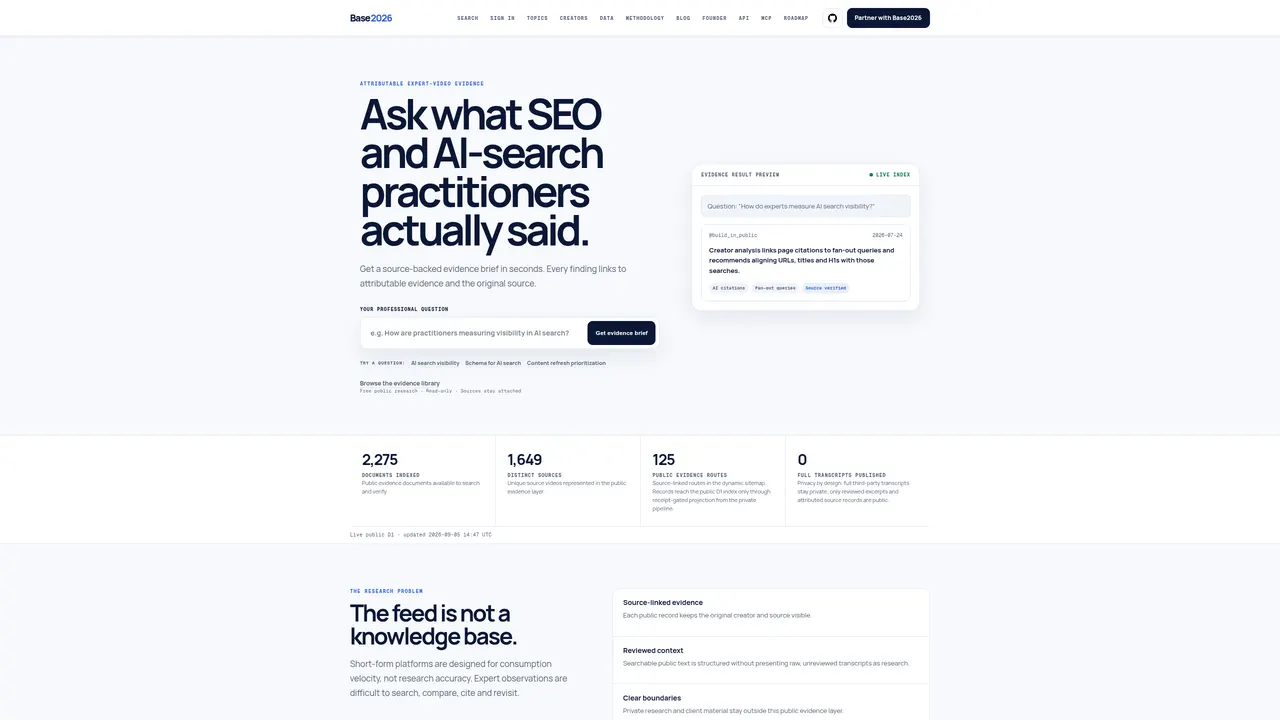
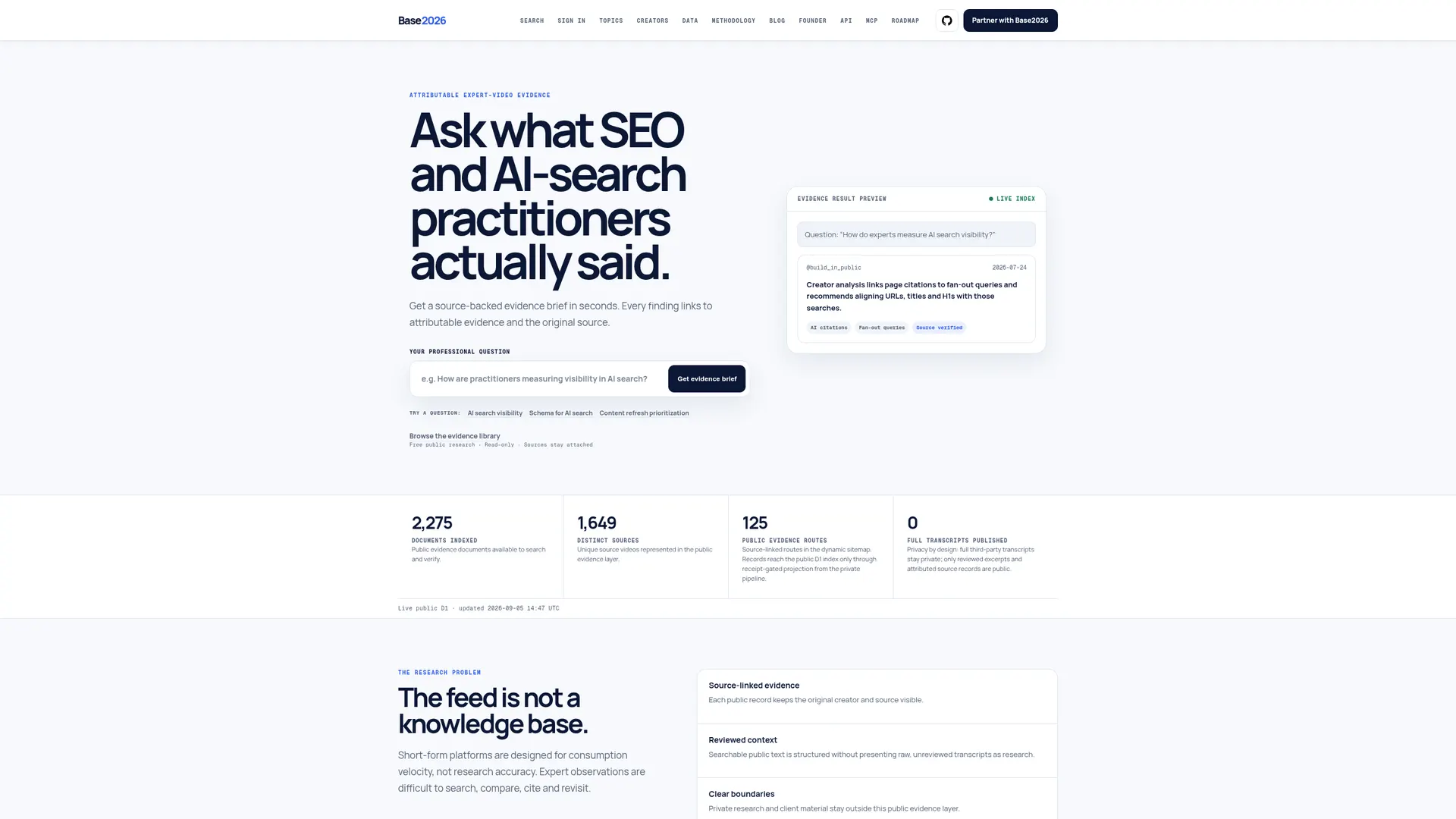
Base2026 is a public research platform for SEO and AI-search researchers that turns expert videos into searchable, attributed evidence records. It shows source-linked evidence, reviewed context, clear boundaries, Cloudflare-backed D1 search, and a read-only API plus MCP server. The public layer surfaces 2,275 indexed documents and 1,649 distinct sources, while the MCP endpoint is free, no-key, and limited to six bounded tools.
What it actually does
Base2026 ingests public TikTok videos from a curated list of SEO/GEO/AEO practitioners, has them transcribed and reviewed, then publishes short attributed excerpts (never full transcripts) tied to a stable source page and the original TikTok link. A free search workspace, a 'Source Diversity Check' (separates record count from creator count from distinct-URL count so repetition of one video isn't mistaken for consensus), and a 'Source-backed Brief' builder sit on top of the same corpus. The vendor is explicit that a matching record is not proof a tactic works — the FAQ and methodology pages spell out what a search match does and doesn't establish, which is unusual candor for a free tool page.
Corpus size and concentration
The live public-stats endpoint reported 2,313 indexed documents and 1,675 distinct source videos as of 8 September 2026 [1]; the last static export manifest (dated 29 July 2026) recorded 1,525 documents from 18 creators [2]. The creator index shows heavy concentration: @tjrobertson52 (357 records), @build_in_public (411) and @joshuamaraney (248) together account for roughly 60% of all source records, while five creators contribute three records or fewer [3]. Coverage is TikTok-only — the manifest's own scope field says 'public TikTok-only export,' despite marketing copy referring more broadly to 'expert video.'
Free tier and pricing
Everything public — search, the two check tools, the API, the MCP endpoint, the WordPress plugin beta and the JSONL dataset exports — is free with no account or key required (confirmed by testing the search endpoint and MCP manifest call directly). The vendor states there is no shipped paid plan; a possible pilot for recurring agency research is listed on the roadmap as unproven and exploratory, not a product ([10], base2026.dev/roadmap).
Developer access: API, MCP, dataset
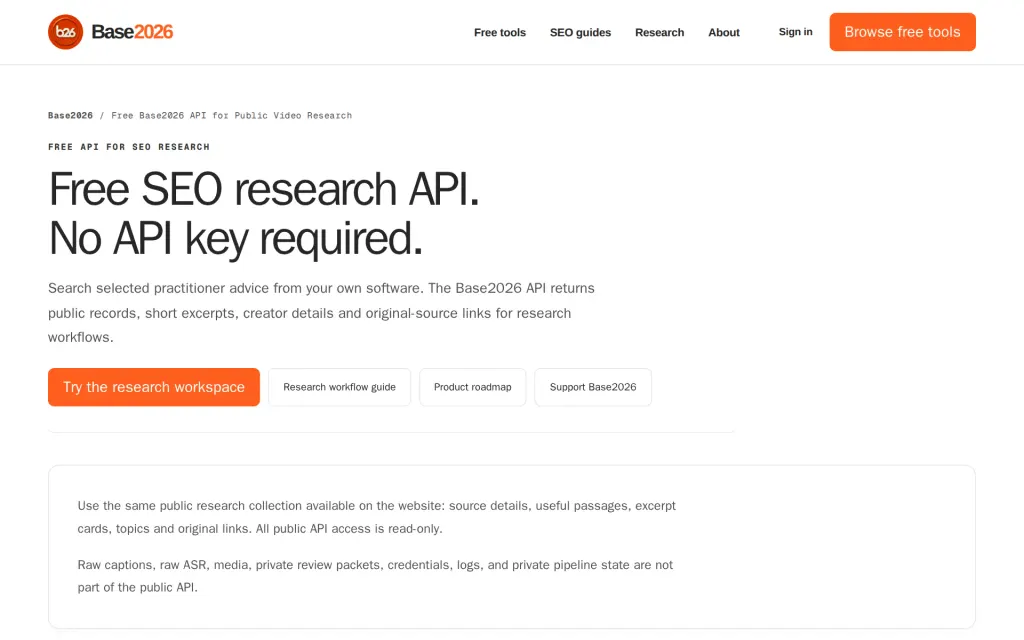
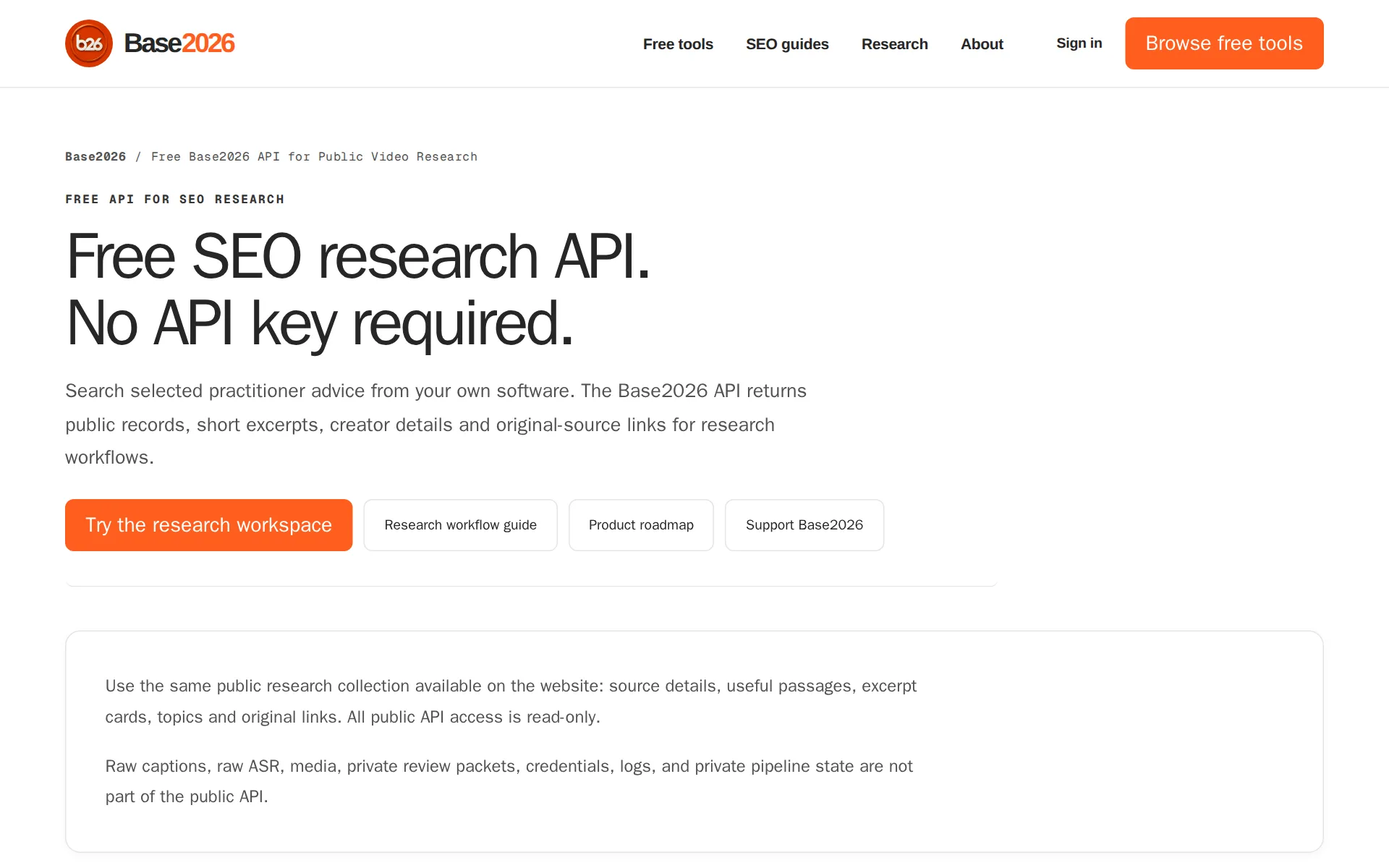
The search API (POST /api/search/multi-search) and MCP endpoint (POST /api/mcp) both work without a key — verified live against both. MCP exposes six bounded read-only tools (search_sources, get_source, get_creator, get_topic, get_topic_signal, get_public_manifest) rate-limited at 60 requests/minute per edge identity [5]. Four JSONL exports (documents, passages, insight cards, topic-signal briefs) are downloadable for offline analysis, with a dated manifest so a cited count can be pinned to a specific export rather than a moving live number.
Open source, company size, and age
The code is Apache-2.0 on GitHub (github.com/offflinerpsy/base2026), pushed as recently as 6 September 2026, with 0 stars, 0 forks and 3 open issues as of this check — an active but essentially unadopted repo [6]. It's a solo-founder project (Alex Yarosh, an SEO practitioner running client sites like Dreamwood and Aster Films on the side; [8]) with no stated funding. The base2026.dev domain was registered 19 August 2026, so the product is under a month old at time of writing (RDAP: [7]). The WordPress 'Evidence Sidebar' plugin (v0.1.1) is a manual-ZIP beta, not listed in the official WordPress.org plugin directory (confirmed via wordpress.org search, zero results) — so anyone using it has no automatic-update path and is trusting a direct download.
Data handling and creator rights
Base2026 never publishes full transcripts or raw captions/ASR — only bounded excerpts with attribution, source-text status, and a working correction/removal path for creators (email-based, documented at base2026.dev/opt-out and [12]). The privacy notice is unusually specific about what its own first-party measurement does and does not collect (no cookies for anonymous use, no raw URLs or queries stored, no IP/user-agent retained with form submissions; [11]). No independent security certification (SOC 2, etc.) is claimed or found; the closest thing to a security page is a GitHub SECURITY.md listing verification commands and access controls, not a compliance program [13].
Plans and pricing
Price and terms
- Free plan
- YesYes
Checked .
Works with
- YesCloudflare
- YesCodex
 Claude Code
- YesCloudflare D1
- YesGitHub
Frequently asked questions
- What is Base2026?
- Base2026 is a public research platform for SEO and AI-search researchers that turns expert videos into searchable, attributed evidence records. It shows source-linked evidence, reviewed context, clear boundaries, Cloudflare-backed D1 search, and a read-only API plus MCP server. The public layer surfaces 2,275 indexed documents and 1,649 distinct sources, while the MCP endpoint is free, no-key, and limited to six bounded tools.
- What is Base2026 used for? Who is it for?
- Base2026 is used for Source-linked evidence, Reviewed context, and Clear boundaries. It's built for SEO and GEO specialists, Researchers, and Developers and AI agents that need read-only evidence access through API or MCP.
- Does Base2026 have an API and what does it integrate with?
- The site offers a read-only API and AI access for finding context and returning to source. It integrates with Cloudflare, Codex, Claude Code, Cloudflare D1, GitHub.
- Is Base2026 open source or self-hostable?
- Yes, Base2026 is open source.
Screenshots
Docs, base2026.dev, captured
Sources
Based on Base2026's own pages, not a hands-on trial. Checked against base2026.dev on .
- base2026.dev/api/stats
- base2026.dev/static/manifest.json
- base2026.dev/creators
- base2026.dev/api/search/multi-search
- base2026.dev/api
- api.github.com/repos/offflinerpsy/base2026
- rdap.org/domain/base2026.dev
- base2026.dev/founder
- wordpress.org/plugins/search/base2026-evidence-sidebar
- base2026.dev/investors
- base2026.dev/privacy
- base2026.dev/source-policy
- github.com/offflinerpsy/base2026/blob/main/SECURITY.md