
At a glance
- Category
- AI model providers
- Tags
- BYOK, SOC 2
For developers
- Works with
- OpenAI, whisper v3 large, whisper-large-v3-turbo, llama-4-scout, llama-3.1-8b-instant, llama-3.3-70b-versatile and 5 more
Groq in our research
All researchStudy
AI Tool Pricing Index, November 2026
Pricing
Usage-based
43 of the 361 tools we checked bill by usage.
Edition price, checked 19 October 2026.
Pricing pages of the AI tools, November 2026 editionas of n = 361 tools checked
Groq sells hosted inference on hardware it designed
Groq operates a cloud that answers model requests, and the models are other people's. Its agreement defines what it serves as models that are openly available, obtained from third party developers, or the Customer, so the catalog is OpenAI's GPT-OSS pair, Meta Llama, Qwen, Whisper for speech to text and Orpheus for speech synthesis. What Groq contributes is the silicon and the data centers: the LPU, and an LPX rack of 256 LPU accelerators stated to pair with NVIDIA hardware when released, running across data centers the company lists on four continents.
The API is a deliberate clone of someone else's. The docs give the OpenAI base URL as https://api.groq.com/openai/v1, so existing OpenAI client code moves over by changing one string, and the official SDKs, LangChain, LiteLLM and the Vercel AI SDK all have published paths in. Throughput is the selling point on every page: 1,000 tokens per second quoted for GPT-OSS 20B, 500 for the 120B model.
Pricing is per token, and the vendor's own pricing page is gone
There is no plan fee. Published rates sit in the models table: $0.075 per million input tokens and $0.30 per million output tokens on GPT-OSS 20B, $0.15 and $0.60 on the 120B model, $0.80 and $4.00 on Qwen 3.8 27B, $0.04 per hour of audio on Whisper Large V3 Turbo. Several entries, including Llama 3.1 8B, Llama 3.3 70B and MiniMax M2.7, read ContactSales instead of a rate, so part of the catalog has no public price at all.
Billing starts before a month ends. New Developer accounts are invoiced at cumulative thresholds of $1, $10, $100, $500 and $1,000, with a different ladder for customers billed in India, after which monthly invoicing takes over. Spend limits and a usage dashboard are Developer tier features, and batch jobs run at half the synchronous rate.
One thing does not add up. Both the services agreement and the batch documentation say fees are published at groq.com/pricing, and that address now serves the homepage instead of a rate card. Opening it in a browser lands on groq.com with no plan table, and the URL appears nowhere in the site's own sitemap. The per-token rates survive only inside the developer documentation.
The agentic half is MCP orchestration, and it is in beta
Groq runs the tool loop rather than handing it back. Point a Responses API request at a remote MCP server and, in the vendor's words, the Groq API will discover tools and pass them into the model at inference time, execute the calls the model returns, and feed results back for another pass. Each tool definition takes an allowed_tools filter and a require_approval field, so the caller decides how much the model may reach.
The direction matters for anyone shopping for a connector. Groq is the MCP client here: it calls servers you nominate, such as Hugging Face or Firecrawl, and publishes no MCP endpoint of its own that ChatGPT or Claude could add. The same page states that remote MCP on Groq is currently in beta, and the beta clause of the agreement puts such features outside the data processing addendum and the HIPAA addendum unless a model is specifically designated.
Governance of model access is further along. Model permissions allow or block individual models at organization and project level, with organization settings always winning, and projects carry their own API keys, rate limits and logs.
Data handling is published, and Zero Data Retention is open to all
Inference requests are not stored by default. Where they are, the data documentation limits it to reliability and abuse logs kept up to 30 days, plus batch files for 30 days and fine-tuning datasets until the customer deletes them. Zero Data Retention is available to every customer, globally or feature by feature, and switching it on disables the features that need storage to work.
Training is ruled out in two places. The agreement says Groq is not permitted to use inputs or outputs for training or fine-tuning without customer instruction, and the trust center states plainly that Groq does not use customer data to train any models for Groq's own purposes. Encryption is TLS 1.2+ in transit and AES-256 GCM at rest, customer managed keys are stated as not offered, and retained data sits in Google Cloud buckets in the United States. Processing inside one country or region is an Enterprise arrangement through sales.
Compliance evidence exists and is gated: SOC 2 Type II maintained with a 2025 report, a 2026 bridge letter and GDPR and HIPAA entries, all behind an access request, with a BAA that excludes beta features and the compound systems. No uptime number is published for self-serve use; service level commitments are bought separately. Nothing in the documentation describes SAML or OIDC sign-in for customer organizations, and the single sign-on mentioned in the DPA is Groq's own internal access control.
Where it fits, and where it does not
It fits an application that already speaks the OpenAI API and wants open-weight models answered fast, or a voice and transcription pipeline that can use Whisper at four cents an audio hour. It fits a team that wants per-project keys, per-project rate limits and model allowlists across development and production.
It does not fit a buyer who wants a frontier proprietary model, because Groq trains nothing and serves what is openly available. It does not fit a non-technical team: the path in is an API key and code. It does not fit a workload that must run in your own data center, since the models stay in Groq's cloud and reach you over the API. And it does not fit anyone who needs a committed uptime figure or an auditable record of administrative actions from the published material alone, because neither is documented.
Groq price and terms
Terms
- Free plan
- YesYesA standing Free tier with lower rate limits
- Card to start
- YesNot required
- Sign up without sales
- YesYes
The terms in full
moving to the pay-as-you-go Developer tier requires a payment method and unlocks higher limits, Batch and Flex processing and spend limits. Groq publishes the Developer plan base limits (for example 30 requests per minute and 1,000 requests per day on openai/gpt-oss-120b) but not a separate Free tier table.
For AI agents
- MCP server
- Noconsole.groq.com,
- API
- Yesconsole.groq.com,
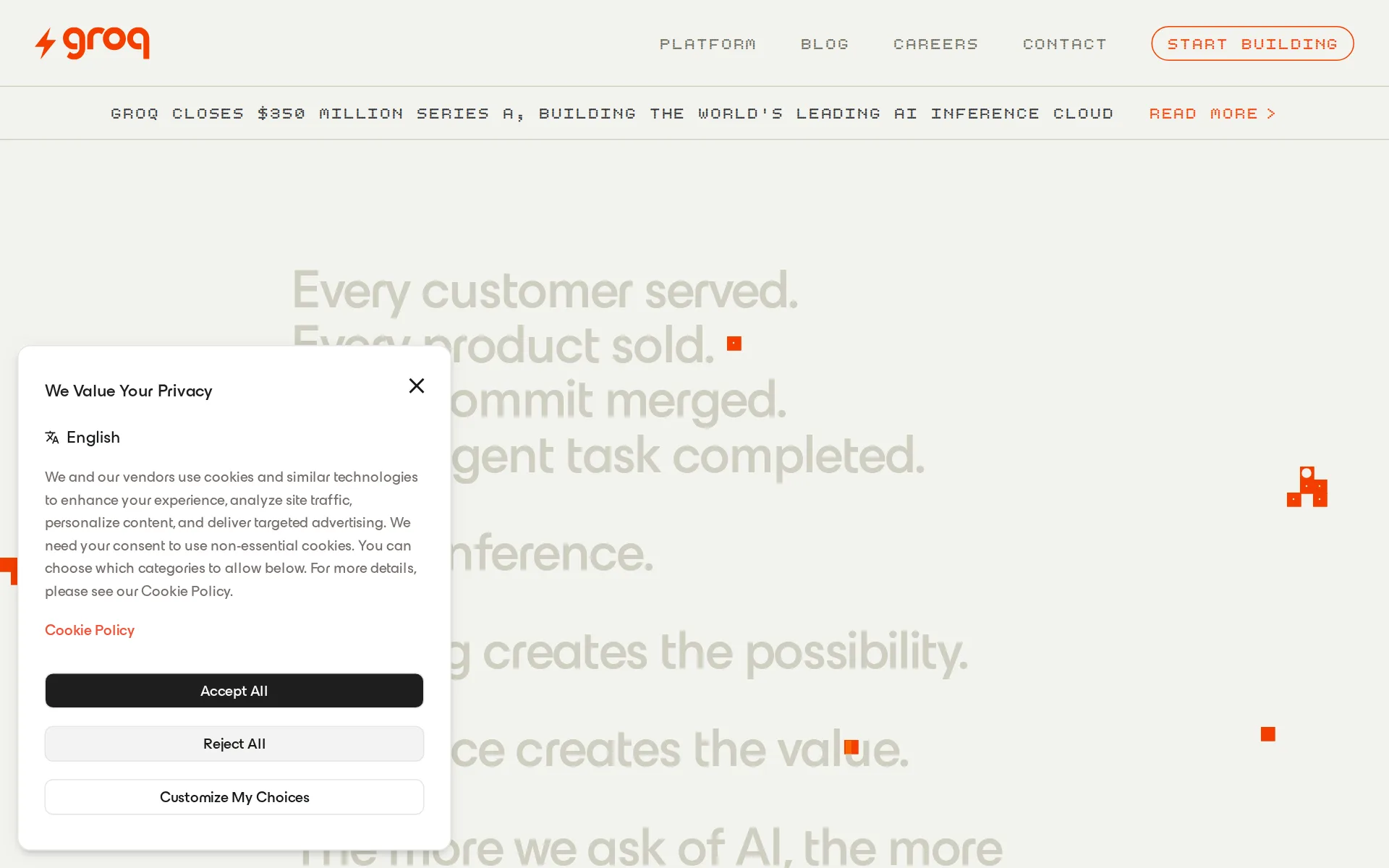
Pricing page, captured
console.groq.com/docs/models, checked
What we checked on Groq
Free to use
A standing Free tier exists and the billing FAQ treats it as the starting point you upgrade from and may return to at any time.
To upgrade from the Free tier to the Developer tier, you'll need to provide a valid payment method (credit card, US bank account, or SEPA debit…
Public API
The product is an API: a documented OpenAI-compatible endpoint with official SDKs, so existing OpenAI client code works after a base URL change.
Fast LLM inference, OpenAI-compatible. Simple to integrate, easy to scale. Start building in minutes.
MCP server
Groq sits on the client side of MCP: the API connects out to remote MCP servers you name and executes their tools, and it publishes no MCP endpoint of its own for an assistant to call.
Groq supports remote tool use via MCP servers, allowing you to simply point to an MCP server URL and the Groq API will start using its tools without…
Open source
The platform is proprietary: Groq keeps all rights in the cloud services and the agreement forbids copying, reverse engineering or redistributing them.
Groq retains all Intellectual Property Rights in the Cloud Services. Customer obtains only a limited right to access and use the Cloud Services.
Groq alternatives
Groq and Fireworks AI
Groq beside its alternatives: the price on each one's site and the day it was checked Tool Price Checked Groq Free, then $0.075 per 1m input tokens Fireworks AI From $0.05 per 1m input tokens

Questions about Groq
- How much does Groq cost?
- Groq has a free plan. From console.groq.com/docs/models, checked 19 October 2026.
- Does Groq have an API or an MCP server?
- Groq has an API. From console.groq.com/docs/overview, checked 19 October 2026. Groq has no MCP server. From console.groq.com/docs/tool-use/remote-mcp, checked 19 October 2026.
- Is Groq open source, and can you host it yourself?
- Groq is not open source. From console.groq.com/docs/legal/services-agreement, checked 19 October 2026. You cannot host Groq yourself. From trust.groq.com/faq, checked 19 October 2026.
- What have we checked on Groq?
- 4 facts, under these headings: What it costs to start, how you build with it.
- How do we check Groq?
- We hold 4 facts on Groq, quoted from 14 pages. Facts and price last checked 19 October 2026. Last change found 1 April 2026.
Sources and changes
Last changed
Sources14
- console.groq.com/docs/legal/services-agreement
- console.groq.com/docs/billing-faqs
- console.groq.com/docs/models
- trust.groq.com/faq
- console.groq.com/docs/tool-use/remote-mcp
- console.groq.com/docs/performance-tier
- console.groq.com/docs/your-data
- trust.groq.com/
- console.groq.com/docs/flutterflow
- console.groq.com/docs/model-permissions
- console.groq.com/docs/overview
- console.groq.com/docs/projects
- console.groq.com/docs/quickstart
- console.groq.com/docs/rate-limits
Groq price history
Groq had a free plan, and paid plans from $0.075 per 1m input tokens, on both of our reads, from 18 October 2026 to 19 October 2026.
| Price | Plan | First seen | Last seen | Readings | Source |
|---|---|---|---|---|---|
| $0.075 per 1m input tokens | Cheapest paid plan | 18 October 2026 | 19 October 2026 | 2 | Pricing page, read 18 October 2026 |
From our research, read twice since 18 October 2026. A date is when we read the page, not when the price changed.
Similar to Groq
- ERIUS PHONERented cloud Android phones, each in its own container, that keep an agent's apps and sign-ins between sessions.
- TinyFishWeb search, page fetching, cloud browsers and goal-driven web automation for AI agents, with search and fetch free.
- SmitheryPublic MCP server registry, now run by Arcade, listing direct vendor MCP URLs after its proxy shut down.
- UI DiscoveryA library of real websites, iOS apps and dashboards with each one's palette, fonts and original build prompt.


Is Groq yours?
Free, and the page then carries the verified owner mark. You confirm it with an email at groq.com. Claim this listing
Report an error if a fact is wrong.