
The same records are served to AI assistants and code through Lusha's hosted connectors.
Lusha sells a data layer, reachable four ways
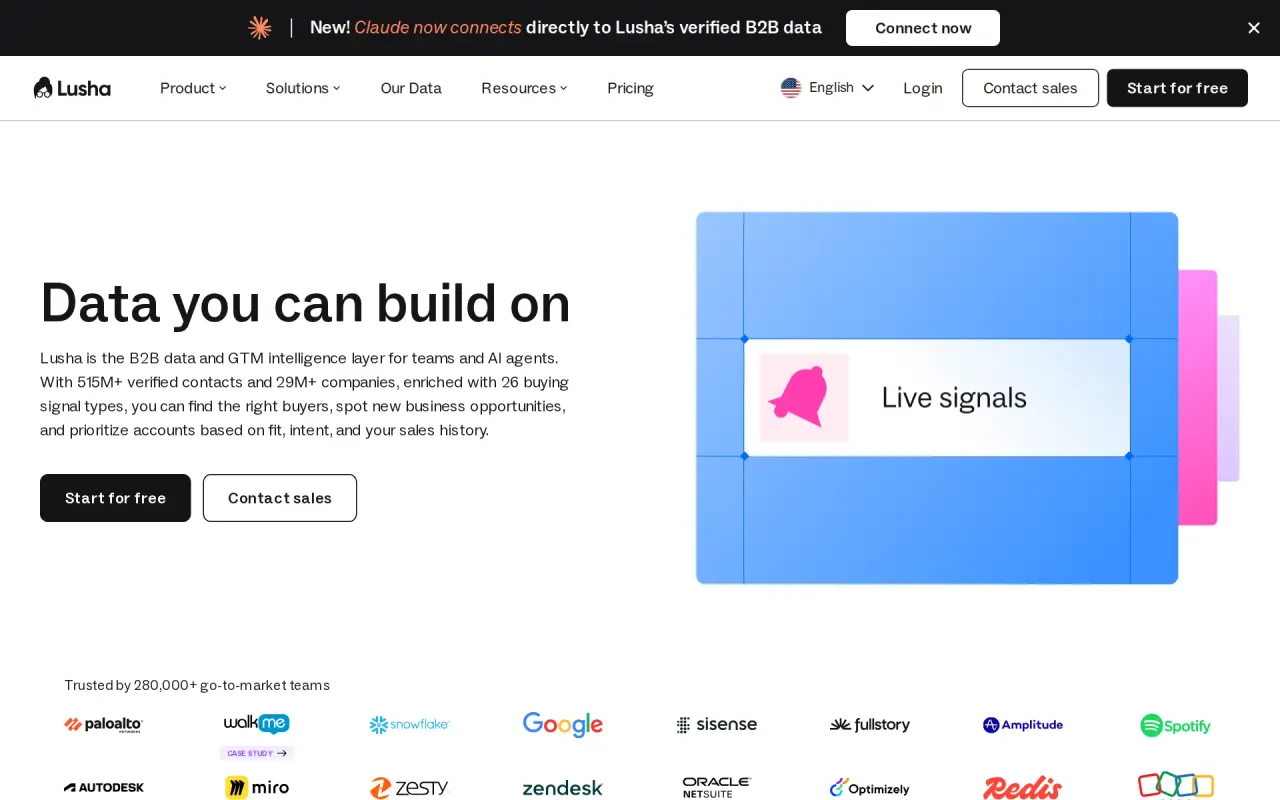
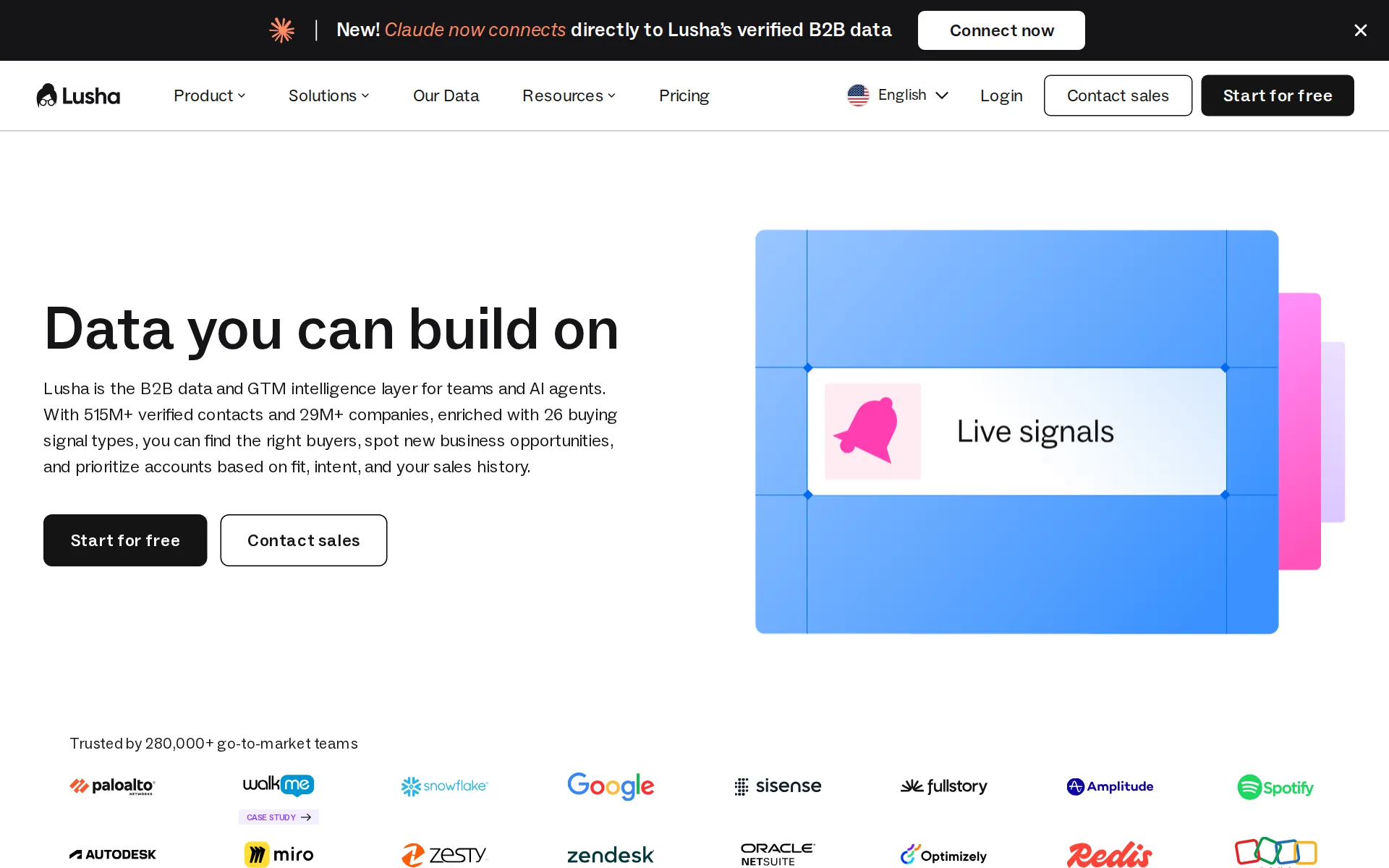
Lusha is a B2B database with retrieval surfaces on top of it. The homepage puts the scale at 515M+ verified contacts and 29M+ companies, with 77 fields on a record, a confidence score on each email and a last-update date on each phone and email. On top of that sit 26 dated buying signal types: job changes, funding rounds, hiring surges and leadership moves, described as "a dated event on a named company, not anonymous intent".
The same records are read from four places: the Lusha Workspace, a Chrome extension, the REST API, and a hosted MCP server. A second layer, which Lusha calls Deep Intelligence, ranks accounts by fit, scores recent signals, maps the buying committee at an account and finds lookalikes of existing customers. There is no outreach engine here beyond email sequence automation and call recording listed in the plan tables; the product's job is to supply records and signals to whatever does the sending.
Credits, not seats, decide what a month costs
Plans are flat subscriptions carrying a credit allowance, and credits are spent per reveal: one credit for an email address and five for a phone number. A list of 500 prospects with direct dials therefore costs five times the same list by email alone, which is the number to model before picking a tier.
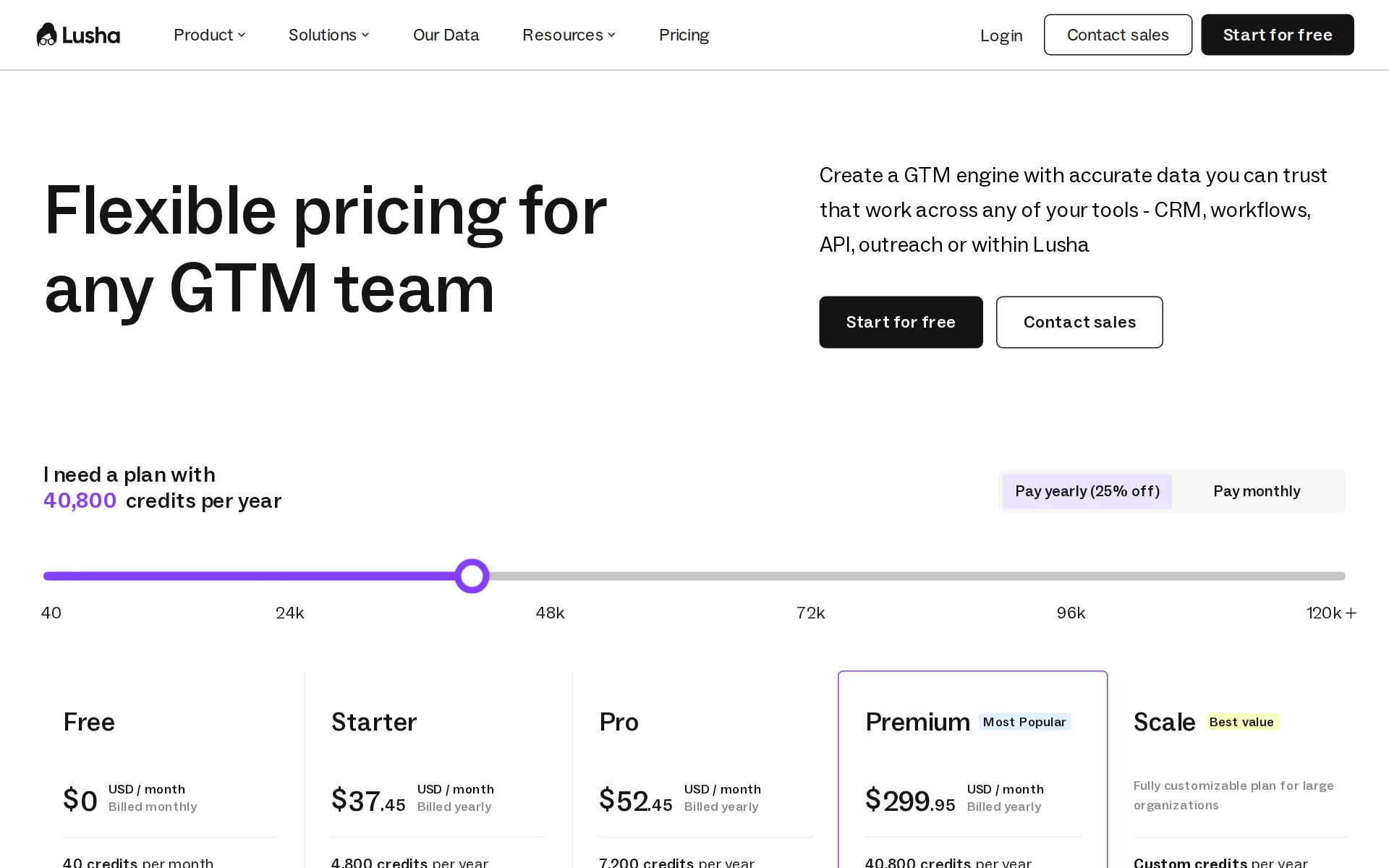
Free is a standing plan at 40 credits a month on one seat, with no card. Starter is $49.90 a month for 400 credits, Pro $69.90 for 600, Premium $399.90 for 3,400. Paying yearly is advertised at 25 percent off and takes Starter to $37.45 a month, billed as a single upfront charge with the whole year's credits granted at once. The difference matters beyond the discount: on monthly plans unused credits "roll over and accumulate up to twice the credit limit", while on annual plans "any unused credits will be reset at the end of the annual cycle".
The pricing page runs a slider from 40 up to 120,000 credits a year, but publishes no per-credit rate and no overage rate. Extra credits are bought in account settings, and Scale, the only quote-priced tier, advertises its credit discount as "50%+ off price per credit" without a base figure. Self-serve purchase stops at five users: "For teams larger than 5 users, please reach out to our Sales team." Cancellation is done in account settings and takes effect at the end of the cycle.
The API and the MCP server are on the free plan
Programmatic access is not gated behind an enterprise tier. The API FAQ answers which plans include it with "Every plan, including Free", and gives each user a key by default. What scales is throughput: 40 requests a minute and 100 a day on Free and Starter, 50 a minute and 1,500 a day on Pro, 300 a minute on Premium and Scale. The comparison table marks the two lower tiers "Strict rate limits", which 100 calls a day earns. Four endpoints are documented: enrichment, prospecting, signals and lookalikes.
The MCP server is hosted at mcp.lusha.com and listed on a connector page covering Claude, a Claude plugin, ChatGPT, Codex, Claude Code, Cursor, VS Code with Copilot, Gemini CLI, Clay, Make, n8n, Gong and Databricks. Balance checks are free and "usage at standard rates", meaning MCP calls draw on the same credit balance as the workspace. There is also a self-hosted server on npm, @lusha-org/mcp, MIT licensed on GitHub, exposing 8 tools including bulk lookup of up to 100 records per call. Outreach, Microsoft Copilot, AWS Bedrock, Grok and Google Cloud Marketplace carry "Coming soon" labels on the same page.
Lusha's own site also ships a WebMCP script that declares three browser tools for an agent reading the page: requestDemo, getPricing and findIntegration. All three navigate, they do not transact, and they register only in a browser that implements navigator.modelContext.
Two uses the API terms rule out
The API FAQ carries two restrictions worth reading before building on it. Resale and embedding are barred without written consent: "Data brokers and other third-party platforms can't embed, expose, or otherwise provide access to the Lusha API, or to data obtained through it, on or through their own website, product, or service." Model training is barred too: "Data obtained through the API can't be used to train or develop AI or ML systems, except where the Terms and Conditions specifically say otherwise."
That second clause sits beside a product sold as a data source for AI agents. Calling Lusha from an agent at query time is the documented use; accumulating its records into a training set or a derived model is not, and a team planning to build an internal dataset should get the exception in writing. Both restrictions are stated on the API page rather than only in the contract.
Certifications are published in full; retention controls are not
The compliance page links a downloadable certificate for each claim rather than naming a badge: SOC 2 Type II, ISO 27001, 27701, 27017, 31700 and 42001, GDPR certification by ePrivacyseal GmbH, CCPA validation by TrustArc, and a TRUSTe Responsible AI letter. A DPA is published for all customers, with SCCs, transfer impact assessments and a subprocessor list. The trust center states a 99.95 percent uptime SLA. SSO/SAML, role-based access control and audit logs are listed as in-product security features, though the plan tables place SSO on the Scale tier only.
On AI handling, the trust center enumerates every model family in use, its type, and whether customer data feeds it. The answer is "No" for search, normalization, technographics, enrichment and chat, and "Yes" for personalized recommendations, where the stated remedy is to contact support: "Yes, customers can opt-out by reaching out to Lusha's Support team." Training on customer data is ruled out, and retention at AI providers is zero.
What is not published is a retention control for the data a customer puts in or pulls down. Residency is described rather than chosen: personal data "mainly stored in EU regions for GDPR compliance" and US data in US regions, which is a policy, not a setting a buyer picks at signup.
Where it fits, and where it does not
This suits a sales or RevOps team that wants one credit balance behind the extension, the CRM sync, a workflow in n8n or Make, and an assistant in Claude or ChatGPT. The free tier is a real evaluation path: 40 credits and a working API key cost nothing and need no card, so coverage in a given region and seniority band can be measured before any money moves.
It fits less well in three cases. A team whose outreach is phone-first pays five credits per number and should price the tier on dials rather than on contacts. A team that needs per-user spend caps finds that control only on Scale, which means a sales conversation and a quote. And a business that wants to resell enriched data, embed the API in its own product, or train a model on what it pulls is outside the published terms and needs written consent first.
The operating company is Lusha Systems Inc., with the address on its own pages given as 800 Boylston St. Suite 1410, Boston, MA 02199. One inconsistency is worth noting for anyone matching plan names across documents: the structured data on the pricing page calls the third tier "Lusha Professional" while the rendered card and the comparison table call it "Pro".
Plans and pricing
Price and terms
- Free plan
- YesYes40 credits a month, one seat, no credit card
The terms in full
credits buy one email reveal each or five per phone number. API included at 40 requests a minute and 100 a day.
- Card to start
- YesNot required
- Sign up without sales
- YesYes
What needs a higher plan
- Scale
- Limits on what it may do, Single sign-on
For AI agents
- MCP server
- Yes
- API
- Yes
Checked .
The facts, with their sources
What it costs to start
- What the price counts
- YesPlans are flat monthly or yearly subscriptions that carry a credit allowance, and the credits are spent per revealed record: one credit for an email, five for a phone number.
Reveal verified email address – 1 credit • Reveal a phone number – 5 credits
lusha.com/pricing - Free tier
- YesA permanent Free plan gives 40 credits a month with one seat, the browser extension and CRM integrations, not a time-limited trial.
The Free plan provides you with up to 40 credits per month.
lusha.com/pricing - Self-serve signup
- YesStarter, Pro and Premium are bought from the pricing page with a credit slider; sales is only needed above five users or for the Scale plan.
You can add credits anytime through your account settings. If you need more seats or access to additional features, simply upgrade to a higher plan…
lusha.com/pricing - Card to start
- NoThe Free plan card on the pricing page states plainly that signing up for it takes no payment details.
No credit card required
lusha.com/pricing - Contract
- YesBoth terms are published on the same toggle: a month-to-month price and a yearly price billed upfront at 25 percent off, with one seat on the entry plan.
Billing period Pay yearly (25% off) Pay monthly
lusha.com/pricing - Cancel any time
- YesCancellation is self-service in account settings and takes effect at the end of the billing cycle, with credits usable until then; no fee is mentioned.
Yes, you can cancel your plan at any time! Simply go to your ‘Account Settings’ and select the option to manage your subscription.
lusha.com/pricing
What it works with
- Works with
- YesNamed CRM and automation integrations include Salesforce, HubSpot, monday, Zoho, Clay, Make, n8n and Zapier, with the Chrome extension exporting straight to a CRM.
Pull contacts, companies and signals into your own code. Send enriched records to Salesforce, HubSpot or your warehouse, schedule the refresh through…
lusha.com - Public API
- YesA documented V3 REST API covers enrichment, prospecting, signals and lookalikes, is on every plan including Free, and rate limits rise by tier.
Every plan, including Free. Each user gets an API key by default. Rate limits scale by plan: 40 requests a minute and 100 a day on Free and Starter,…
lusha.com/lusha-api - MCP server
- YesA hosted MCP server at mcp.lusha.com serves contacts, companies, signals and lookalikes to Claude, ChatGPT, Codex, Cursor and other clients on every plan, with a self-hosted npm option.
The Lusha MCP server gives AI assistants and agents direct access to verified B2B contacts and companies, 26 buying signals, and lookalike…
lusha.com/campus/ai-connectors
What it does on its own
- Acts on its own
- YesLusha publishes plays where enrichment, scoring and routing run on a trigger with no person in the loop, and the Gong connector enriches accounts the moment a rep opens one.
Score, enrich, qualify and route every lead without anyone touching it.
lusha.com - Limits on what it may do
- PartlyPer-user credit limits, the control that caps what a user or an agent key can spend, are confined to the Scale plan; account-level AI opt-outs exist for everyone.
Yes, this feature is available in our Scale plans. We invite you to contact our sales team who will be happy to assist you.
lusha.com/pricing - No code needed
- YesThe workspace, the Chrome extension and the CRM integrations are used without code, and the MCP connectors install from the Claude and ChatGPT directories.
One-click install from the Claude connector directory
lusha.com/campus/ai-connectors
What happens to your data
- No training on your data
- YesThe AI trust page states customer data is not used for model training and that AI providers retain nothing, across every documented model in the platform.
Zero data retention with AI providers. Customer data is never used for public model training.
lusha.com/trust-center/tc-ai - Data stays in your region
- PartlyStorage region follows the customer rather than a setting they pick: mainly EU regions for GDPR, US data in US regions, with SCCs for transfers.
Personal data of customers is mainly stored in EU regions for GDPR compliance US data stored in US regions
lusha.com/trust-center/tc-compliance - Self-hosted
- PartlyOnly the MCP server can run on your own machine, installed from npm with your API key; the data platform itself is hosted by Lusha.
Install with one line: npx @lusha-org/mcp@latest, then set LUSHA_API_KEY
lusha.com/campus/ai-connectors - Open source
- PartlyThe public-API MCP server is published on GitHub under MIT, but the workspace, data pipeline and hosted MCP endpoint are closed.
Open source on GitHub (MIT), listed on Glama and the npm registry
lusha.com/campus/ai-connectors - Take your data out
- YesThe plan comparison table lists CSV export and CRM export as platform features, so revealed records can be taken out of the workspace.lusha.com/pricing
Whether a company can buy it
- Security audits
- YesNamed and individually downloadable: SOC 2 Type II, ISO 27001, 27701, 27017, 31700 and 42001, GDPR certification by ePrivacyseal and CCPA validation by TrustArc.
Lusha maintains SOC 2 Type II, ISO 27001, ISO 27701, ISO 27017, ISO 31700, and TRUSTe Responsible AI certifications.
lusha.com/trust-center/tc-compliance - Single sign-on
- PartlySSO is a product feature but the comparison table and plan cards place it on Scale only, which is quote-priced and sales-sold.
Everything in Premium, plus: 50%+ off price per credit SSO 25 buying intent topics, unlimited results
lusha.com/pricing - Audit log
- YesAudit logs are listed with SSO/SAML and role-based access control among the in-product security features on the trust center.
Lusha provides robust in-product features that keep your organization safe: SSO/SAML Role-Based Access Control (RBAC) Audit Logs
lusha.com/trust-center/tc-security - Uptime promise
- YesThe trust center headlines a 99.95 percent uptime commitment alongside the certifications, with public status and uptime monitoring.
99.95% Uptime SLA
lusha.com/trust-center
Screenshots
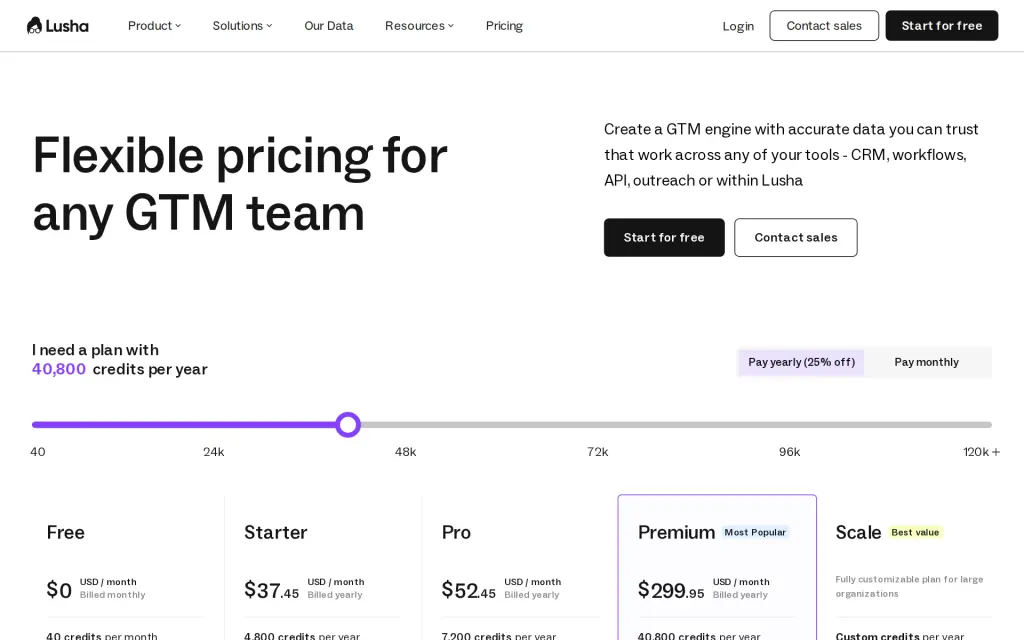
Pricing page, lusha.com, captured
Filed under
Sources and updates
Sources on lusha.com8
Updates1
- Free tier · Price · What it does
Is this yours? AI assistants like ChatGPT, Claude and Perplexity opened AgentsIndex pages 807 times from 17 October to 25 October. Claim it free and edit it in your dashboard, or feature it in AI Prospecting & Data Enrichment.