
MetaMask Agent Wallet
What is MetaMask Agent Wallet?
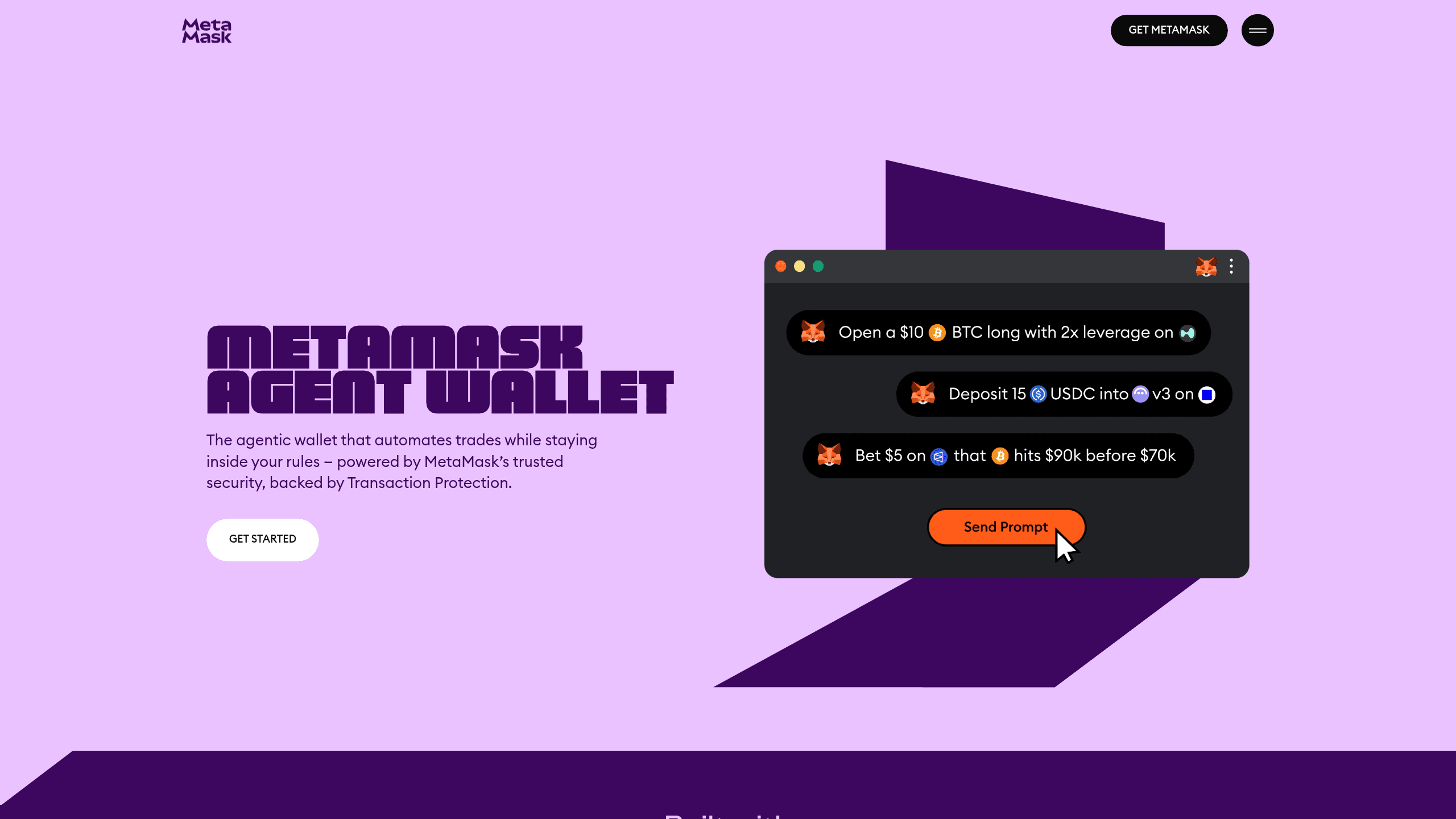
MetaMask Agent Wallet is a self-custodial wallet that AI agents operate through a command-line tool. Once it is installed, an agent such as Claude Code, Codex or Cursor can swap and bridge tokens, trade Hyperliquid perpetuals, place Polymarket predictions and supply to yield vaults, while staying inside the spend limits and allowlists you set. MetaMask runs supported EVM transactions through simulation and Blockaid threat scanning before they execute. It was announced on 8 June 2026 and opened to everyone on 6 August 2026. MetaMask does not publish a price for it.
Last verifiedHow we evaluate
At a glance
- MetaMask Agent Wallet is best for developers and active onchain traders who want a coding agent to execute trades without handing it unchecked control of their funds.
- Yes — through the mm command-line tool, which agents call via installed skills. MetaMask says its output is structured JSON any LLM can parse, and npm plugins can add custom commands.
What it actually is
MetaMask Agent Wallet is a published npm CLI (@metamask/agent-wallet, binary mm) plus a skills package that teaches Claude Code, Codex, Cursor, OpenClaw, Hermes and OpenCode which mm commands to run. It is driven from the terminal: it installs with npm install -g @metamask/agent-wallet@latest, requires Node.js 22.18 or later, and you use it by telling your agent things like "swap 0.1 ETH to USDC" or "open a 5x long on BTC with $100 on Hyperliquid". The browser is used only for sign-in (https://docs.metamask.io/agent-wallet/quickstart/). MetaMask announced it on 8 June 2026 for a limited early-access group, with general availability "coming this summer" (https://metamask.io/news/metamask-launches-agent-wallet-giving-ai-agents-full-defi-access-with-default-security-on-every-transaction), and launched it for everyone on 6 August 2026 (https://metamask.io/news/introducing-metamask-agent-wallet).
Security checks are on by default
Every supported EVM transaction passes three steps before it can sign: transaction simulation (balance changes and approvals shown before you commit), threat scanning powered by Blockaid that auto-rejects malicious transactions and holds flagged ones for your approval, and execution through MetaMask's Smart Transactions, which MetaMask says includes MEV protection (https://docs.metamask.io/agent-wallet/). MetaMask presents this as the default path rather than a setting, and contrasts it with other self-custody agent wallets that, in its words, "can treat transaction security as optional" (https://metamask.io/agent-wallet). One inconsistency to note: the docs list simulation as step one, while the FAQ on the product page describes it as "dry-run simulation (soon)". Guard Mode, the recommended default, adds network, address and token-recipient allowlists and a rolling 24-hour outflow limit; anything outside the policy, and any flagged transaction, pauses the job until you approve it by email link or MetaMask Mobile push (https://docs.metamask.io/agent-wallet/reference/trading-modes/). The product page gives five minutes before an unanswered request is auto-declined (https://metamask.io/agent-wallet).
Custody: two options
At setup you choose a server wallet, whose keys MetaMask says are secured server-side in a trusted execution environment so the agent cannot reach your main wallet, or bring your own BIP-39 seed phrase, supplied through an environment variable so keys stay on your machine (https://docs.metamask.io/agent-wallet/reference/architecture/). MetaMask says the recovery phrase can be exported at any time (https://metamask.io/agent-wallet). Guard Mode and Beast Mode apply to the server wallet only (https://docs.metamask.io/agent-wallet/reference/trading-modes/), so the spend limits and allowlists are not available with your own seed phrase; MetaMask says that path still gets threat scanning and MEV protection (https://metamask.io/agent-wallet). One detail worth knowing before funding: Google, email and MetaMask Mobile QR sign-in each resolve to a different wallet address, even with the same email (https://docs.metamask.io/agent-wallet/troubleshooting/).
What the $10,000 coverage covers
Agent Wallet's docs say transactions deemed safe are "guaranteed against loss up to $10,000/month" through Transaction Protection, and point to Transaction Shield for eligibility and terms (https://docs.metamask.io/agent-wallet/reference/architecture/). MetaMask's Transaction Shield page describes it as a subscription at $9.99 a month or $99 a year, covering up to 100 transactions a month, unavailable in the UK and US-sanctioned countries, and says a transaction "must take place on MetaMask Extension in order to be eligible for coverage" (https://metamask.io/transaction-shield). MetaMask does not say whether trades placed through the Agent Wallet CLI qualify, or whether Agent Wallet users need the subscription. Threat scanning and Transaction Protection also apply only on 14 of the 23 preconfigured mainnets (Ethereum, BNB Smart Chain, Base, Arbitrum, Optimism, Polygon, Avalanche, Linea, Monad, Sei, HyperEVM, MegaETH, Robinhood Chain and Arc). On the other nine, including Unichain, ZKsync Era, Scroll, Blast, Mantle and Celo, MetaMask's docs say Agent Wallet cannot tell you whether a recipient or contract is malicious, and Guard Mode falls back to the address allowlist (https://docs.metamask.io/agent-wallet/reference/supported-chains/).
Licence: inspect-only since version 7.0.0
Every published version through 6.2.1 (14 September 2026) carried a dual MIT/Apache-2.0 licence (https://unpkg.com/@metamask/[email protected]/LICENSE). Version 7.0.0, published on 16 September 2026 and the current latest release, replaced it with a licence to "inspect and study the code" only: no reproduction, distribution, modification or derivative works without MetaMask's consent (https://unpkg.com/@metamask/[email protected]/LICENSE). MetaMask's note in that licence says it is "still working through licensing considerations" and exploring models "all with a significant open component". The GitHub repositories the package names as its homepage and issue tracker, MetaMask/agentic-cli and MetaMask/agentic, are not publicly available (https://registry.npmjs.org/@metamask/agent-wallet). The separate MetaMask/agent-skills repository, which connects the CLI to agent frameworks, is public and MIT-licensed (https://github.com/MetaMask/agent-skills). Anyone redistributing or modifying the CLI should read the current licence before upgrading past 6.2.1.
What it can trade, and documented limitations
Supported operations: transfers, same-chain swaps and cross-chain bridges, Hyperliquid perpetuals, Polymarket prediction markets, yield-vault supply and withdrawal routed through LiFi, and payments to x402-paywalled APIs (https://docs.metamask.io/agent-wallet/, https://docs.metamask.io/agent-wallet/guides/earn-yield-vaults/). MetaMask's docs list some limits worth weighing: outflow tracking, which decides when Guard Mode asks for approval, "can be imprecise if transactions are not submitted through our backend", and signatures such as Permit2 are not counted toward the limit (https://docs.metamask.io/agent-wallet/reference/outflow-policy/). Transfers on Monad, HyperEVM, Sei and MegaETH failed on CLI versions before 6.1.2, a fixed but recent bug (https://docs.metamask.io/agent-wallet/troubleshooting/). Polymarket trading is unavailable in some jurisdictions, and the CLI reports this with dedicated error codes (https://docs.metamask.io/agent-wallet/troubleshooting/).
Frequently asked questions
What is MetaMask Agent Wallet?
A self-custodial wallet that AI agents operate through MetaMask's mm command-line tool. Agents such as Claude Code, Codex and Cursor can swap, bridge, trade Hyperliquid perpetuals and Polymarket predictions, and supply to yield vaults, inside spend limits you set.
Which agents does it work with?
MetaMask lists Claude Code, Codex, Cursor, OpenClaw, Hermes and OpenCode. The quickstart needs an agent that supports skills; MetaMask also documents a command-by-command setup for agents without them.
Is it self-custodial?
MetaMask says so. You choose a server wallet, whose keys MetaMask holds in a trusted execution environment and which your agent uses instead of your main wallet, or your own BIP-39 seed phrase kept on your machine. MetaMask says the recovery phrase can be exported at any time.
How much does MetaMask Agent Wallet cost?
MetaMask does not publish a price for Agent Wallet. The up-to-$10,000-a-month Transaction Protection it advertises belongs to MetaMask's Transaction Shield subscription ($9.99 a month or $99 a year), whose terms say coverage applies to transactions on MetaMask Extension. MetaMask does not say how that applies to Agent Wallet.
Which chains does it support?
MetaMask's docs list 23 preconfigured EVM mainnets, including Ethereum, Base, Arbitrum, Optimism, Polygon, BNB Smart Chain, Linea and Robinhood Chain, and the CLI trades perpetuals on Hyperliquid. Threat scanning and Transaction Protection cover 14 of those mainnets. MetaMask's FAQ also lists Solana.
When did it launch?
MetaMask announced it on 8 June 2026 for a limited early-access group and opened it to everyone on 6 August 2026.
Editor's read
A strong fit if you already work in Claude Code, Codex or Cursor and want onchain execution with security checks on by default. Weigh three things: spend limits and allowlists apply to MetaMask's server wallet only, threat scanning covers 14 of its 23 preconfigured mainnets, and the CLI has carried an inspect-only licence since version 7.0.0.

Explore other Agent Tools & Integrations


