
Relevance AI
What is Relevance AI?
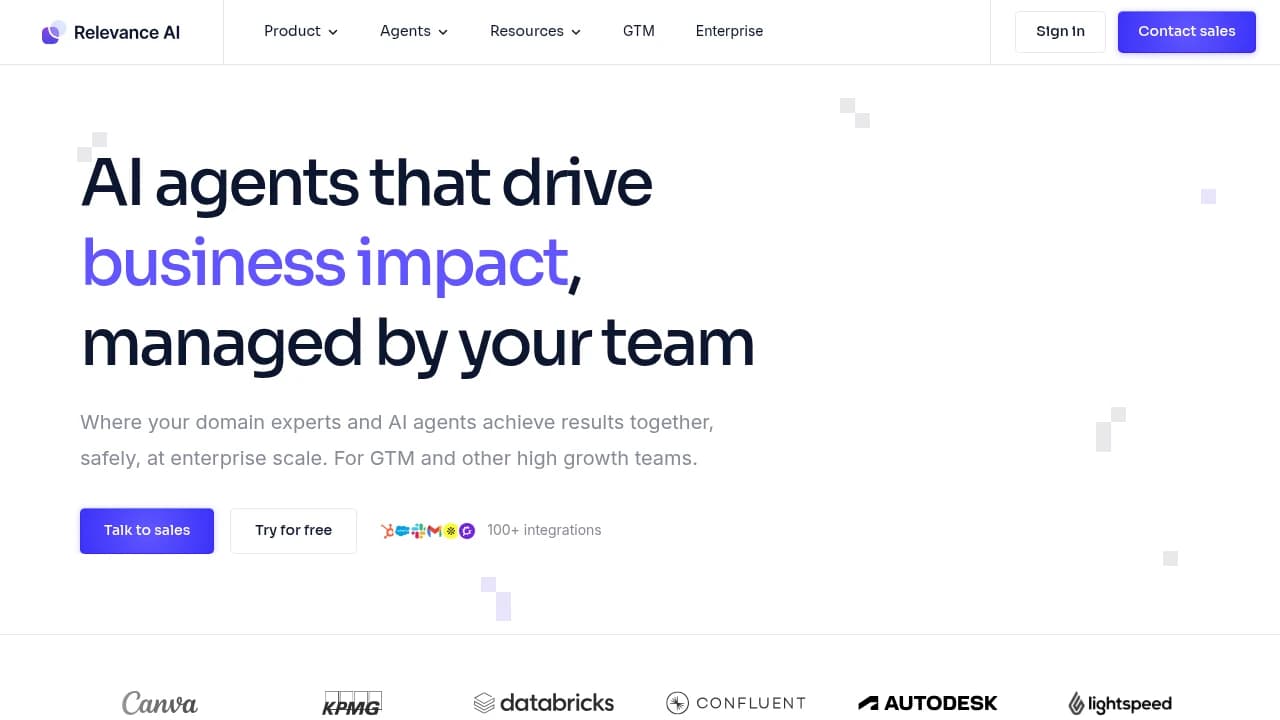
Relevance AI is an AI agent platform for GTM and other high-growth teams that want to automate repetitive work while keeping field experts in control. It centers on AI Agents, AI Workforce, Custom Agent Creation, Integrations, Scheduling, Approvals, Performance Monitoring, and AI-Driven Insights, with a public API for programmatic management. The platform connects with HubSpot, Salesforce, Slack, Gmail, Google Sheets, Jira, Zendesk, and Intercom, and is used by Canva, KPMG, Autodesk, Lightspeed Commerce, and Qualified. Plans run Free Trial, Pro $49/month, and Enterprise custom.
Last verifiedHow we evaluate
At a glance
- Relevance AI is best for GTM operators who need to automate repetitive workflows with governed AI agents.
- Yes — Public API for building, customizing, and managing AI agents programmatically; API and MCP docs are linked from the site.
What does Relevance AI do?
Relevance AI is an AI agent platform for GTM and other high-growth teams that want to automate repetitive work while keeping field experts in control. It helps operators, engineers, sales, marketing, customer support, and research teams build and manage agents that fit existing workflows, with governance and enterprise controls for larger organizations. The platform centers on AI Agents, AI Workforce, AI Tools, and a no-code builder for custom agent creation. It also includes Integrations, Scheduling, Approvals, Knowledge, Collaboration & Sharing, Chat Embed, Phone Agent, Relevance Chat, Version Control, and AI-Driven Insights. Relevance AI says it has 100+ integrations and 2,000+ integrations across plans, and customers such as Canva, KPMG, Autodesk, Lightspeed Commerce, Qualified, Freshworks, Rakuten Advertising, Send Payments, and Zembl use it in production. The company also offers a public API for programmatic agent management, plus enterprise security features like SOC 2 Type II, SSO, RBAC, audit logs, encryption, and flexible deployment.
Why use Relevance AI?
- Strong enterprise governance with SOC 2 Type II, SSO, RBAC, audit logs, encryption, and flexible deployment.
- Broad integration surface includes HubSpot, Salesforce, Slack, Gmail, Google Sheets, Jira, Zendesk, and more.
- Public API lets teams build, customize, and manage agents programmatically instead of only through the UI.
- Customer stories show production use at Canva, KPMG, Autodesk, Lightspeed Commerce, Qualified, Send Payments, and Zembl.
- Supports both no-code agent creation and workflow controls like Scheduling, Approvals, and Version Control.
Who is Relevance AI for?
- GTM operations leaders who want agents embedded in sales and customer workflows.
- Sales engineers who need custom agents for account research and follow-up tasks.
- Customer support teams who want approvals and escalations around routine requests.
- Marketing teams who need automated enrichment, reporting, and personalized outreach.
- Enterprise IT and security teams who need governance, SSO, and auditability.
What are Relevance AI's key features?
Integrations
Connects with 100+ tools, including HubSpot, Salesforce, Slack, Gmail, Google Sheets, Jira, Zendesk, and Intercom, so agents can act inside existing systems.
AI Workforce
Lets teams deploy multiple agents across sales, marketing, support, and operations, turning repetitive work into managed workflows instead of isolated automations.
Performance Monitoring
Tracks agent outcomes and quality so teams can see what is working, compare changes, and improve results over time.
Role-Based Access Control
Limits who can build, edit, and run agents, which matters when field experts and IT share responsibility for automation.
AI-Driven Insights
Surfaces task data and patterns from agent activity, helping teams spot bottlenecks, prioritize follow-up, and improve workflow decisions.
Custom Agent Creation
Builds agents from plain-language descriptions, letting teams tailor behavior to specific sales, support, or operations processes without starting from scratch.
Scheduling
Controls when agents run and how much work they do, useful for recurring tasks like reports, follow-ups, and enrichment jobs.
Approvals
Adds human review points before an agent takes action, which helps teams keep control over sensitive or customer-facing workflows.
What are Relevance AI's use cases?
Sales workflow automation
Sales operations leaders use Relevance AI to automate CRM updates, meeting follow-ups, and account research with AI Agents and Integrations. They can keep reps inside Slack and Salesforce while agents handle repetitive work and surface next actions.
Support escalation handling
Customer support teams use Relevance AI to route routine requests through Approvals and Smart Escalations, then deploy agents in Relevance Chat or Chat Embed for faster responses. The result is quicker resolution without losing human oversight.
Marketing enrichment loops
Marketing teams use Relevance AI to enrich lead data and personalize outreach with Custom Agent Creation and Data Enrichment. They can connect HubSpot, Gmail, and Google Sheets to keep campaign lists current and reduce manual cleanup.
How does Relevance AI work?
- Connect your first tools from the Integrations page, starting with systems like HubSpot, Salesforce, Slack, Gmail, or Google Sheets so agents can work inside existing workflows.
- Create your first agent in the no-code Invent builder by describing the job it should do, then add Knowledge and Custom Actions for your process.
- Set Scheduling, Approvals, and Role-Based Access Control so the agent runs at the right time and only escalates work that needs human review.
- Deploy the agent into Relevance Chat, Chat Embed, or connected apps, then use the public API to trigger and manage it programmatically.
- Monitor Performance Monitoring, A/B Testing & Analytics, and Version Control to track outcomes, compare changes, and refine the agent over time.
How much does Relevance AI cost?
| Plan | Price | What's included |
|---|---|---|
| Free Trial | Free |
|
| Pro | $49/month |
|
| Enterprise | Custom |
|
Frequently asked questions
What integrations does Relevance AI support?
Relevance AI supports 100+ integrations, and its site shows HubSpot, Slack, Salesforce, Gmail, Apollo, Gong, Google Sheets, Jira, Zendesk, Intercom, Databricks, Airtable, Notion, and more. That makes it practical for teams that want agents to work inside their current stack rather than replace it.
Does Relevance AI have an API?
Yes. Relevance AI offers a public API to build, customize, and manage AI agents programmatically. The site also points to API and MCP documentation, so teams can trigger agents and connect them to external systems beyond the no-code interface.
Can I self-host or control deployment?
Relevance AI says it supports flexible deployment, which is part of its enterprise security story. The company also shows governance features like SSO, RBAC, audit logs, encryption, and compliance controls for teams with stricter security requirements.
What security features does it offer?
Relevance AI lists SOC 2 Type II, SSO, RBAC, audit logs, data encryption and privacy, and flexible deployment. Its enterprise page frames these as the controls needed to pass security review while letting field experts deploy agents.
How does pricing work?
The pricing page also distinguishes plans by actions, integrations, support, and governance features.
Can I customize the AI agents?
Yes. Relevance AI says you can build custom AI agents tailored to specific business processes, and its Invent builder is designed for describing the job in plain language. The platform also supports Custom Actions and Version Control for more advanced setups.
How do I get started?
The vendor says to sign up for an account, connect your tools, and create your first agent. From there, you can integrate it into workflows, set benchmarks, and monitor performance as it starts automating tasks.
Which teams use Relevance AI?
Relevance AI is positioned for sales, marketing, customer support, research, and operations teams. Its customer stories also show GTM use at Canva, KPMG, Autodesk, Lightspeed Commerce, Qualified, Send Payments, and Zembl.
Editor's read
Check whether the integrations you rely on are covered on Pro, since the Free Trial only includes limited integrations. If you need custom integrations or advanced security features, confirm those are included in Enterprise before committing.

Where we've written about Relevance AI
Explore other Workflow Automation


