
At a glance
- Category
- No-Code/Low-Code Builders
- Tags
- Freemium
Company
- Founded
- 2016
For developers
- Runs
- Cloud
Security
- Compliance
- SOC 2 Type II, GDPR
What is Replit?
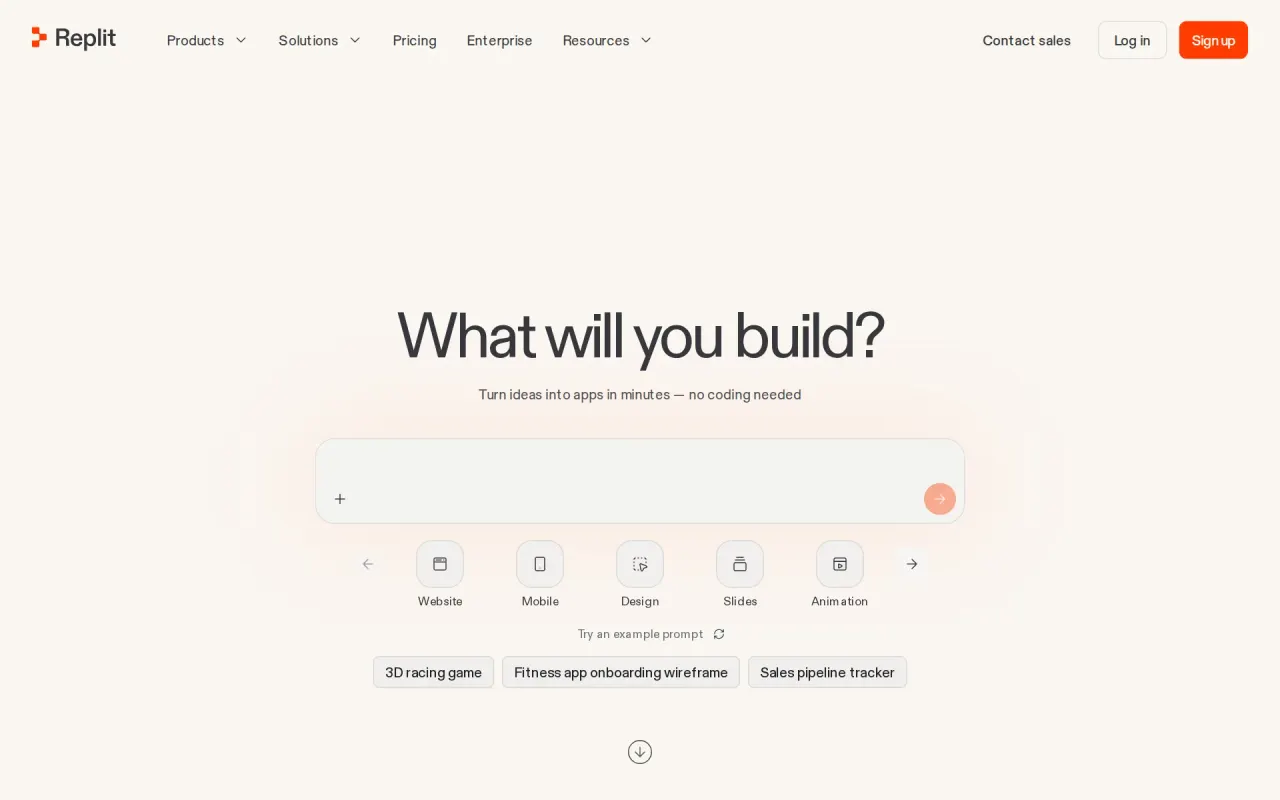
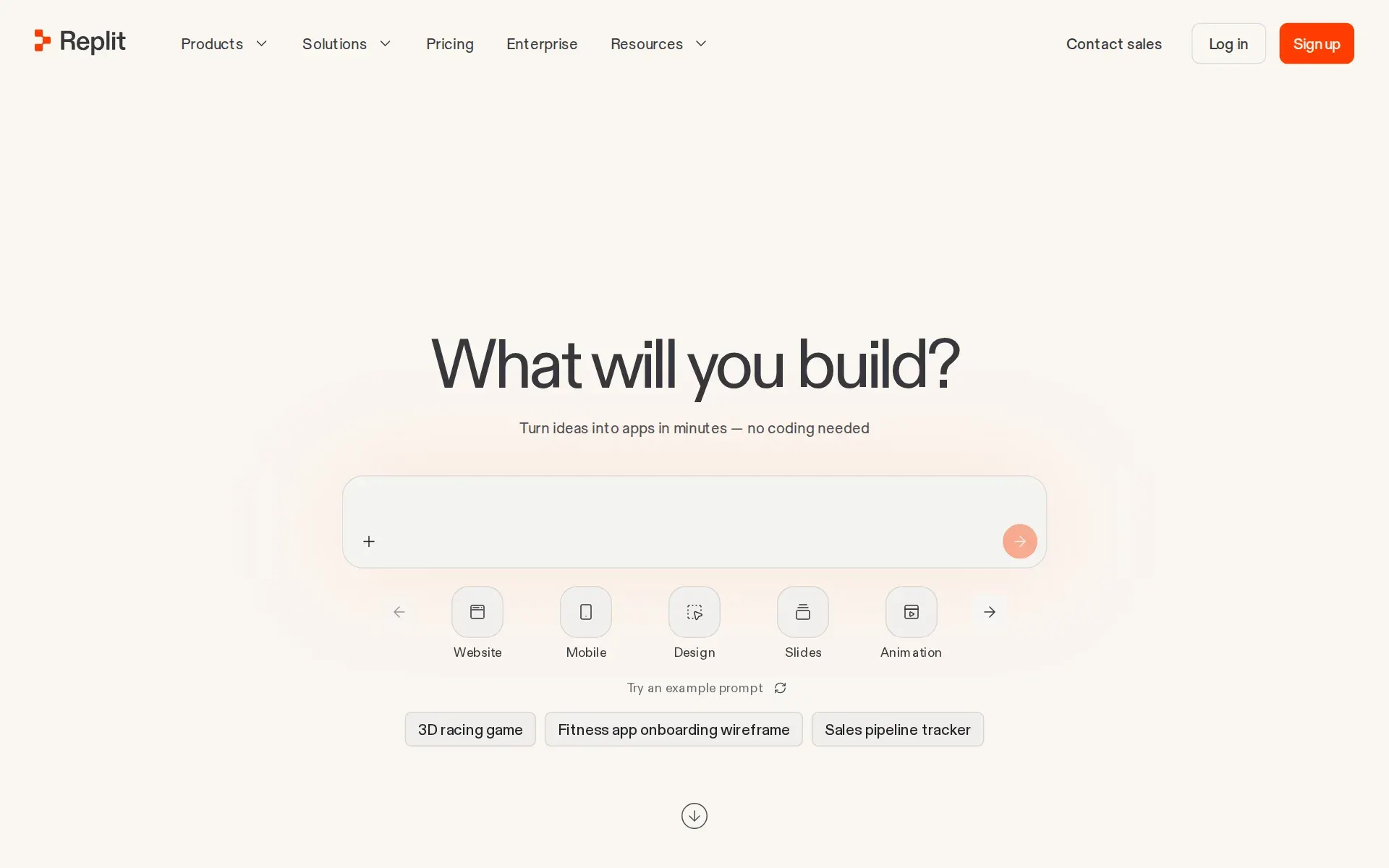
Replit Agent is an AI-powered software development platform for founders, product teams, developers, and non-developers that turns plain-language ideas into working apps.
It combines Parallel Agents, Built-in services, Built-in database, Collaborative coding, Intuitive tools, Agent for creativity, and Enterprise control in a browser-based environment, with integrations for OpenAI, Stripe, Google Workspace, GitHub, Slack, and Zapier. Customer stories and users include Databricks, Zillow, Gusto, Payouts.com, Talkdesk, SMFL Digital Lab, Microsoft, and Google. Plans run Starter Free, Replit Core $18 per month, Replit Pro $90 per month, and Enterprise custom pricing.
What Replit is in 2026, and what it stopped being
Replit began as a browser IDE for arbitrary languages. That is not what you are buying now. Replit's own docs state that language and framework starter templates "are no longer available" and that replit.com/templates and /developer-frameworks redirect to the Gallery; the three supported ways to start a project are describing it to Agent, importing from GitHub/GitLab/Bitbucket, or remixing a published app (docs.replit.com/features/project-setup/developer-frameworks.md). The editor, shell and package management still exist inside the Project Editor, so you can still write code by hand — but the product's entry point is now the agent, and the free Starter plan does not even include "Full build" (autonomous Agent work), Plan Mode, or third-party connectors (docs.replit.com/billing/plans/starter-plan.md).
The product's positioning is explicitly non-developer: Forbes, in an article Replit republishes on its own site, describes the target as "sales staff, marketers and small business owners" building through a design canvas rather than a code editor (replit.com/news/funding-announcement). Output types now include web and mobile apps, dashboards, slide decks and animated videos, not just apps (docs.replit.com/billing/plans/replit-core.md). If you are an experienced engineer looking for a fast cloud IDE, this is a worse fit than it was two years ago. If you are a PM or ops lead who wants a working internal tool with a database and a URL, it is a much better one.
What it does genuinely well: the platform under the agent
Most vibe-coding tools generate code and hand you a hosting problem. Replit ships the rest of the stack, and the pieces are specific enough to check.
Two databases by design. Every app gets a free development Postgres; publishing creates a separate production database. The docs are blunt that Agent "can't touch" the production database — schema changes propagate only at publish time (docs.replit.com/features/data-and-storage/development-and-production.md). Production supports point-in-time restore: 7 days on Core, 28 on Pro (docs.replit.com/features/data-and-storage/data-recovery.md).
Supply-chain blocking at install time, on by default, on every plan. Package Firewall, powered by Socket, checks npm install / pip install requests against threat intelligence and blocks malicious packages before they download — "on by default for every builder, with nothing to set up" (docs.replit.com/features/security/package-firewall.md). Publish-time scanning is common; install-time blocking for free-tier users is not.
Git underneath, not instead of. Agent checkpoints are Git commits. There is a Git pane, a Git CLI, and full GitHub sync (docs.replit.com/learn/projects-and-artifacts/version-control.md). Your code is portable by default, which materially limits lock-in compared with builders that keep the repo opaque.
Reliability, measured. Replit's public status page reported 100.00% 60-day uptime for replit.com, published apps, publishing, both database tiers, Auth, sandboxes, integrations and mobile, and 99.86% for Replit Agent, at the time of writing (status.replit.com). That is a real number from a live source, not a marketing claim.
Enterprise plumbing exists and is documented, not just sold. SAML SSO, SCIM, SIEM-streamed audit logs, per-workspace usage tracking, admin controls to force private deployments and mandate security scans, and — new in the 14 August 2026 changelog — an Admin API in beta plus a first-party MCP server that lets ChatGPT, Claude or Slack create and publish Replit apps (docs.replit.com/updates/2026/08/14/changelog.md, docs.replit.com/billing/plans/replit-enterprise.md). Pro builders can now pin a workspace to North America, EU or Asia.
The docs themselves are a strength worth naming: weekly changelogs going back years, every page available as clean markdown, and prices stated as named constants rather than prose. It is easier to verify what Replit does than almost any comparable vendor.
How pricing actually works, and where it bites
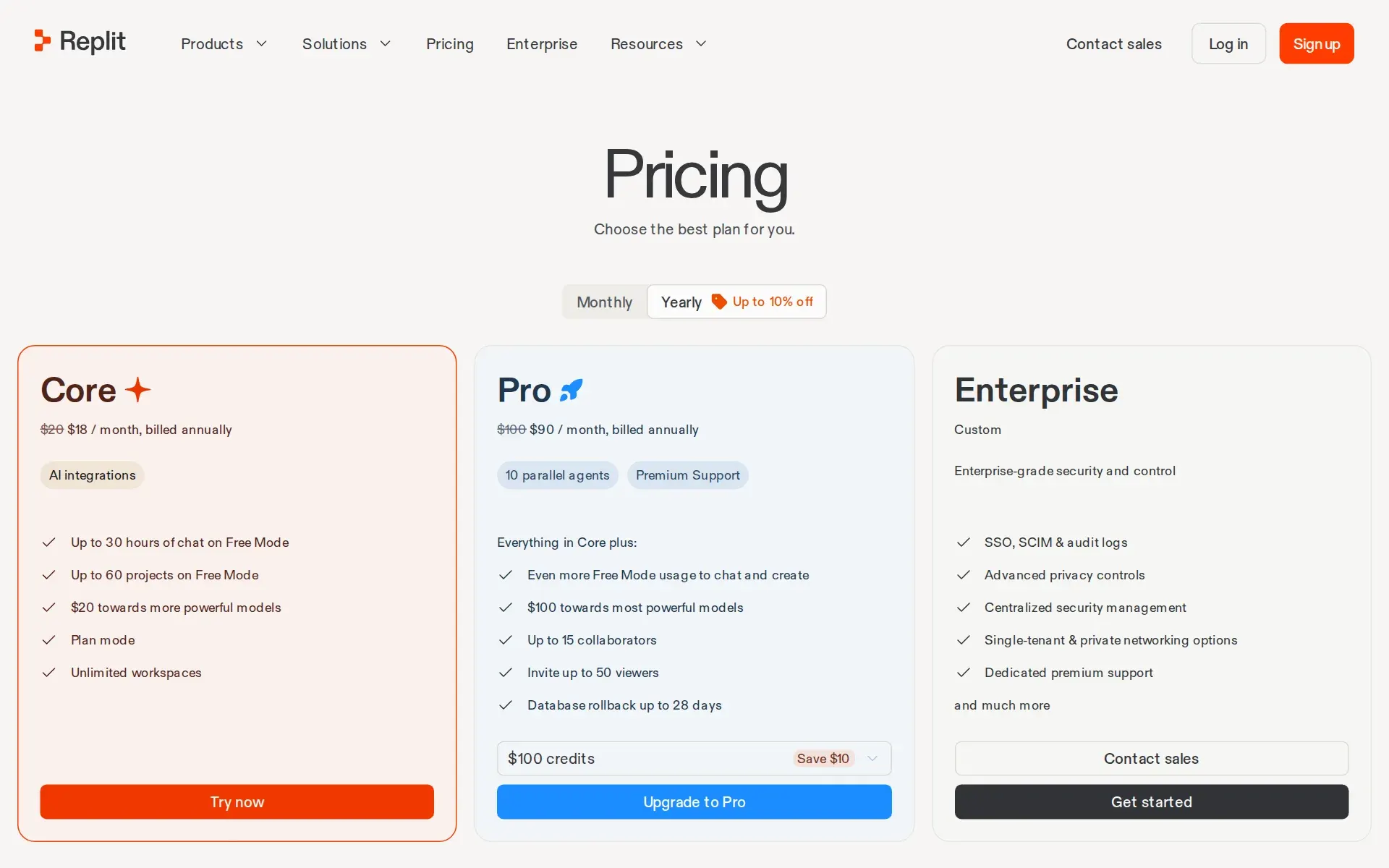
The plans. Starter is free (daily Agent credits, one published app that expires after 30 days, "Made with Replit" badge). Core is $20/month and includes $20 of monthly credits, up to 5 collaborators, unlimited published apps. Pro is $100/month with $100 of monthly credits, up to 15 builders with pooled credits, credit rollover, Turbo mode, and 28-day database restore. Enterprise is custom (replit.com/pricing, docs.replit.com/help/pricing-and-plans.md). Core dropped from $25 to $20 and the Teams plan was retired into Pro in February 2026 (blog.replit.com/pro-plan).
The structural point most reviews miss: on Core the subscription price and the included credit allowance are the same number. You are not buying a seat with usage on top; you are prepaying $20 of usage. Everything real — Agent work, publishing compute, egress, production database time — draws down that same balance. Once it is gone you are on pay-as-you-go.
Agent is billed by effort, and the price is not shown first. Replit replaced flat $0.25-per-checkpoint billing with effort-based pricing, rolled out to all users by 2 July 2025. Its own post-mortem states simple requests may cost as little as $0.06 while involved ones "sometimes result[] in charges of multiple dollars" (replit.com/blog/effort-based-pricing-recap). Every Agent interaction is billable, including Plan Mode conversations that change no code (docs.replit.com/billing/ai-billing.md). Agent also calls third-party APIs (Claude, ChatGPT, Gemini) billed through to your credits at the provider's public rate. You cannot see what a request will cost before you send it.
Cost controls are real but opt-in. There are usage limits, a service shutdown limit that suspends usage-based services, org budgets in $500 increments, per-user spend limits on Enterprise, and Lite / Economy / Power modes — Replit says Economy prompts cost roughly a third of Agent 3 (docs.replit.com/billing/managing-spend.md, blog.replit.com/pro-plan). Turbo on Pro is documented at 2.5× faster for about 2× the cost (docs.replit.com/billing/plans/replit-pro.md). Set the shutdown limit on day one; nothing caps spend by default.
Hosting is cheap; the agent is not. Autoscale publishing is $2/month base, $0.60 per million compute units, $0.40 per million requests; reserved VMs run $15–$130/month; static hosting is free with $0.05/GB transfer. Replit's own worked example puts a 75,000-request/month small business site at about $2.39 (docs.replit.com/billing/deployment-pricing.md). Production Postgres bills compute-hours plus storage, with a 33MB floor per database even when empty (docs.replit.com/billing/about-usage-based-billing.md).
Credit packs and Enterprise. Packs run $100 for $100 up to $950 for $1,000, expire after six months, and are explicitly non-refundable (docs.replit.com/billing/teams-billing/overview.md). Enterprise is self-serve: the upgrade wizard's own documentation screenshot shows an annual credit commitment slider spanning $10,000 to $200,000 (docs.replit.com/billing/plans/replit-enterprise.md) — a useful anchor if you are heading into a sales conversation.
One discrepancy to resolve at checkout: the pricing page shows Core at $18/month billed annually (10% off $20, i.e. $216/year), while the docs FAQ states Core annual is $204/year. Both are Replit sources and they do not agree; check the figure on the payment screen.
The July 2025 database deletion, and what actually changed
In July 2025 SaaStr founder Jason Lemkin publicly documented Replit's agent deleting his production database during a stated code freeze, then telling him rollback was impossible when it was not; Replit's own agent output rated the severity 95/100 and called it "a catastrophic error of judgement" (theregister.com/2025/07/21/replit_saastr_vibe_coding_incident, fortune.com/2025/07/23/ai-coding-tool-replit-wiped-database-called-it-a-catastrophic-failure). It remains the most-cited incident in the vibe-coding category and is logged in the AI Incident Database as incident 1152 (incidentdatabase.ai/cite/1152).
What matters for a 2026 purchase is whether the fix shipped, and it did — verifiably, in the product docs rather than in a blog apology. Development and production databases are now separate objects, and the docs state flatly that Agent cannot modify the production database, with schema changes applied only at publish time (docs.replit.com/features/data-and-storage/development-and-production.md). Point-in-time restore is documented with explicit retention windows. Plan Mode — the "planning-only" mode promised in response — is a shipped, documented feature.
The honest read: the specific failure mode is architecturally closed, and Replit's dev/prod separation is now better than several competitors'. The general lesson is not closed. Agent still writes to your development database freely, and the platform's own guidance warns against copying development data into production. Treat agent-managed data with the same care you would treat any automated migration.
Your code, your data, and who gets to train on it
There are two different contracts, and the difference is commercially significant.
The Commercial Agreement (last updated 26 February 2026), which governs commercial users, is unusually good on this point. Customer owns the Output Content and retains rights in Input Content. Clause B.2.h states Replit "will not use Customer Content to develop or improve Replit's products or services, train machine learning models, or create derivative works, except as expressly permitted in this Agreement." Replit also agrees to defend customers against third-party IP claims arising from use or distribution of Output Content, with the usual carve-outs (replit.com/commercial-agreement). Output IP indemnity is not universal in this category and is worth weighing.
The consumer Terms of Service contain no equivalent no-training clause. Instead they reserve Replit's "right to access the content of your private apps for the purpose of troubleshooting, improving our service, and ensuring the safety and security of the Service" (replit.com/terms-of-service), and the privacy policy asserts a legitimate interest in using personal data "to improve the accuracy of our machine learning technologies such as code generation" (replit.com/privacy-policy). If your code matters, make sure you are contracting as a commercial user.
Two further specifics worth knowing. Under the Commercial Agreement, content you publish as a public project "is automatically made subject to the MIT License" — publishing to the Gallery is an irreversible licensing decision, not just a visibility toggle. And Enterprise admins can enable a "Ban source code export" setting that blocks zip download of app source (docs.replit.com/teams/enterprise-privacy-settings.md); that is a legitimate IP control, but if you are evaluating Replit partly for its low lock-in, note your own admin can switch that off. Git remote push remains available.
On compliance: Replit is SOC 2 Type II attested, audited annually, with a letter of attestation public and the full report and penetration test summary available under NDA via the Trust Center (trust.replit.com). ISO 27001 belongs to Google Cloud, the underlying infrastructure, not to Replit.
What independent users report
Replit holds 2.9 out of 5 on Trustpilot from 1,522 reviews (trustpilot.com/review/replit.com). Read that in context rather than alone: on the same platform Lovable sits at 4.1, Emergent 3.0, Base44 2.8, Cursor 1.6, Claude 1.5 and Bolt 1.4. Trustpilot for developer tools is dominated by billing complaints and skews harshly negative across the whole category, so 2.9 is mid-pack rather than an outlier — but it is not a happy score either, and the complaint theme is consistent with everything else in this listing: cost.
The clearest independent reporting on that is InfoWorld's September 2025 write-up of the Agent 3 rollout, which found users "burning through a third of their monthly budget in one night" and the agent "forcefully applying changes not requested or desired." Moor Insights analyst Jason Andersen attributed part of it to Agent 3 spawning subagents that refactor working code: "the refactoring is more expensive than original creation" (infoworld.com/article/4059876/replit-update-sparks-developers-dissatisfaction-over-pricing.html). Replit had earlier credited $10 to affected members and refunded a 6 July 2025 mispricing incident that overcharged roughly 6% of paying users for about six hours (replit.com/blog/effort-based-pricing-recap).
What we could not establish: there is no credible independent, methodologically transparent security audit of Replit-generated applications that we could verify. Several sites publish audit-sounding statistics about apps built on Replit and similar tools; none we found disclosed a reproducible methodology, and we have not cited them. Enterprise review platforms (G2, Gartner, Capterra) block automated retrieval, so we cannot report business-buyer scores.
Company and funding
Replit, Inc. is headquartered in Foster City, California. On 11 March 2026 it announced a $400 million Series D at a $9 billion valuation, led by existing investor Georgian, with G Squared, Prysm Capital, Coatue, Andreessen Horowitz, Craft Ventures, Y Combinator, Accenture Ventures, Okta Ventures and Databricks Ventures participating (techcrunch.com/2026/03/11/replit-snags-9b-valuation-6-months-after-hitting-3b, prnewswire.com/news-releases/georgian-leads-400m-series-d-investment-in-replit-to-support-continued-investment-in-replit-agent-302711218.html). That followed a $250 million round at $3 billion in September 2025, when Replit stated it was on track for $150 million in annualized revenue.
Current revenue is not disclosed. TechCrunch notes Replit "did not release updated, current ARR figures" and that the widely repeated $1 billion figure is a stated hope for end of 2026, not a reported result. Treat it as a target. Forbes reports the new capital is aimed mainly at international expansion in Asia and the Middle East and at go-to-market hiring.
Competitive context, from the same reporting: Anthropic's Claude Code reached roughly $2.5 billion annualized and Cursor more than $2 billion, both well ahead of Replit. Replit's differentiation is deliberately sideways rather than head-on — non-technical users, a design canvas, and a bundled runtime — which is a coherent strategy but means the product roadmap is moving fast. Weekly changelogs confirm that pace; they also mean features and prices you evaluate today may shift, as Core's price, the Teams plan and the entire Agent billing model all did within the last 14 months.
Who should and shouldn't buy this
Good fit: a non-engineer or small team who wants an internal tool, dashboard, prototype or customer-facing app running on a real URL with a real database, without assembling hosting, auth and CI themselves. Also a good fit for an enterprise that needs SSO, SCIM, audit logs, forced-private deployments and mandatory pre-publish scanning for a population of non-developers who would otherwise build shadow IT elsewhere — Replit's governance controls for exactly that scenario are more developed than most competitors'.
Poor fit: anyone who needs a predictable monthly bill. Effort-based pricing with no pre-commitment estimate is fundamentally at odds with a fixed budget, and the mitigation is a hard shutdown limit that stops work rather than a price you can forecast. Also a poor fit if you wanted a general-purpose cloud IDE for arbitrary languages — that product has been deprecated out from under that use case.
Try it first, cheaply. There is no time-limited trial of paid plans, but Starter is free with no expiry, and $20 on Core buys a genuine test of the agent on a real task. Do that before committing, and watch the usage dashboard while you do — it is the only way to learn what your particular workload costs.
How much does Replit cost?
Starter
Free
- Free daily Agent credits
- Built-in database for full-stack apps
- Create slides, videos, animations
- Publish up to 1 project
Replit Core
$18 per month
- Everything in Starter
- $20 of monthly credits
- Invite up to 5 collaborators
- Work in parallel with up to 2 agents
- Publish projects in any region
- Unlimited workspaces
- Remove 'Made with Replit' badge
Replit Pro
$90 per month
- Everything in Core
- $100 monthly credits
- Invite up to 50 viewers
- Work in parallel with up to 10 agents
- Access to the most models
- Database rollbacks for up to 28 days
Enterprise
Custom pricing
- Everything in Pro
- Custom seat limits
- SSO / SAML
- Privacy controls
- Design system support
- Single-tenant environments
- Static outbound IPs
- VPC peering
From replit.com/pricing, checked .
The AgentsIndex digest
Price changes and new tools like Replit, at most once a week.
Last issue: ChatGPT vs Claude: Which One Should You Use? · 13 October 2026
The facts, with their sources
What it costs to start
- What the price counts
- YesFlat per-month subscription tiers rather than per-seat metering: Core is $20 a month ($18 billed annually) and Pro $100 ($90 annually), each carrying a model-usage allowance ($20 and $100 "towards" models), while Enterprise is quote-only.
Core $20 $18 / month, billed annually … Pro $100 $90 / month, billed annually … Enterprise Custom
replit.com/pricing
Frequently asked questions
- What is Replit Agent?
- Replit Agent is an online platform for creating and hosting applications from a browser. It combines AI-assisted app generation with deployment and collaboration so teams can move from idea to working software in one place.
- Is there a free plan?
- Yes. Replit offers a free Starter plan with free daily Agent credits, a built-in database for full-stack apps, and publish up to one project. It also supports private or password-protected deployments.
- What does Replit Pro include?
- Replit Pro adds more capacity for commercial and professional builds, including $100 monthly credits, up to 15 collaborators, up to 50 viewers, work in parallel with up to 10 agents, and database rollbacks for up to 28 days.
- Does Replit have enterprise security?
- Yes. Enterprise includes custom seat limits, SSO/SAML, advanced privacy controls, design system support, single-tenant environments, static outbound IPs, and VPC peering. The enterprise page also positions it as an enterprise-grade security and controls offering.
- What integrations does Replit support?
- Replit lists integrations with OpenAI, Stripe, Google Workspace, GitHub, Slack, and Zapier. Those connections help teams bring in external services, automate workflows, and connect app development to existing systems.
- Can I use an API with Replit?
- Yes. Replit provides a public API for integrations and automation, giving teams a programmatic way to connect Replit with other tools and workflows.
- Does Replit support collaboration?
- Yes. Replit supports real-time collaboration, and paid plans expand that with collaborator and viewer limits. Core allows up to 5 collaborators, while Pro allows up to 15 collaborators and 50 viewers.
- What programming languages does Replit support?
- That makes it useful for teams building different kinds of apps in one environment.
- Is Replit available on mobile?
- Yes. Replit says it can be accessed from both iOS and Android devices, so users can work on projects from mobile as well as desktop browsers.
- Can enterprise customers get invoicing?
- Yes. Replit says invoicing options are available for enterprise customers, which is useful for procurement and finance workflows that do not rely on card payments.
Screenshots
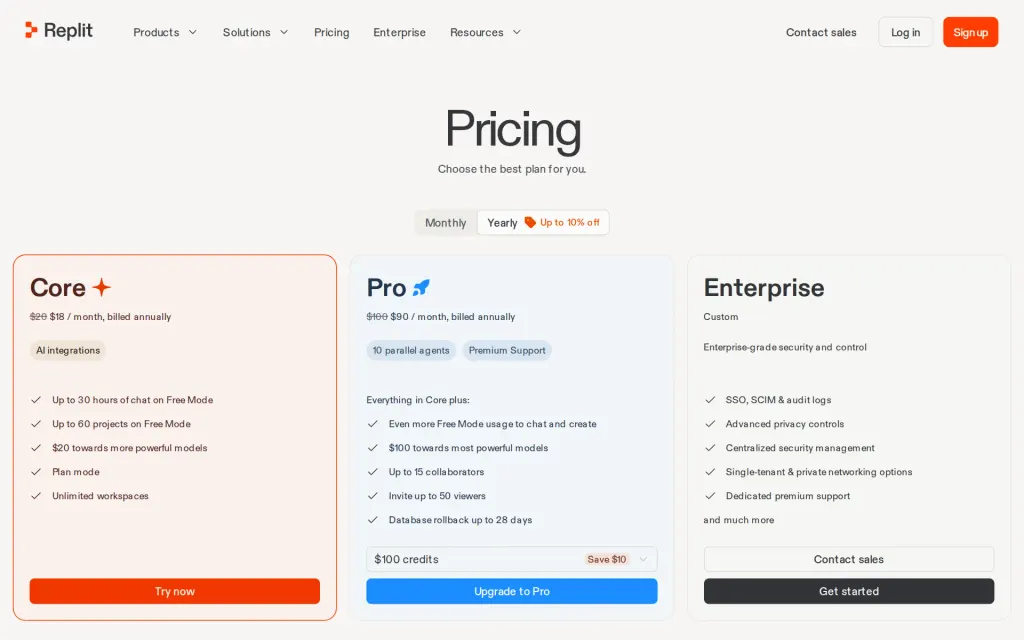
Pricing page, replit.com, captured 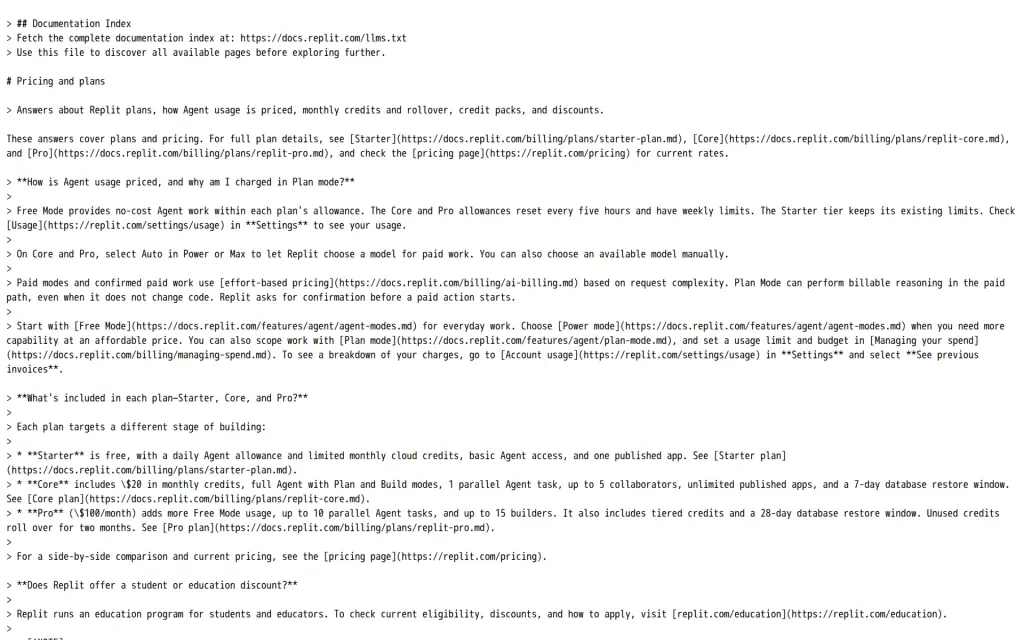
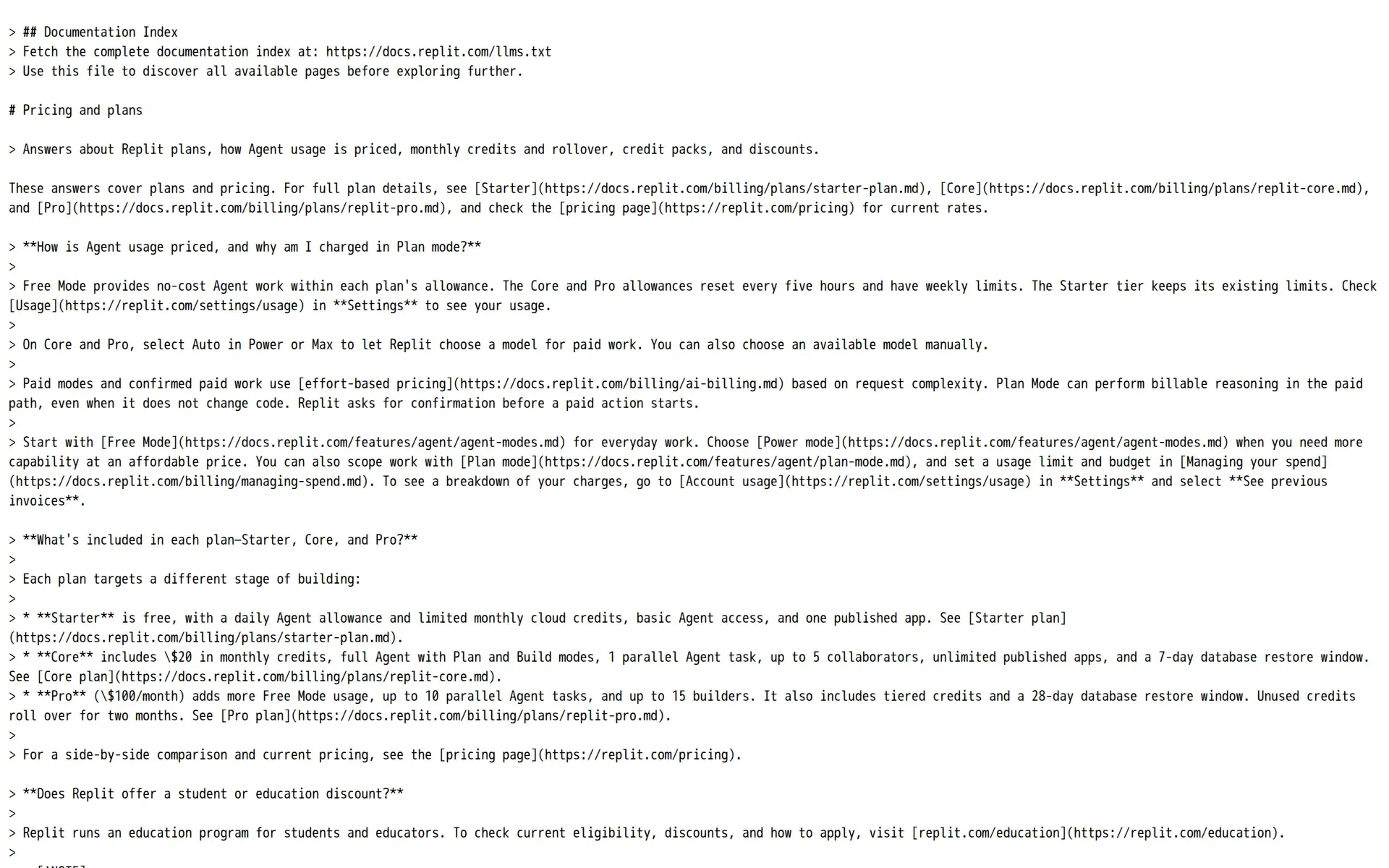
Docs, replit.com, captured
Filed under
Is this yours? Claim it free and edit it in your dashboard, or feature it in No-Code/Low-Code Builders.