
Sandbox0 in our research
All researchStudy
AI Tool Pricing Index, November 2026
Pricing
Usage-based
43 of the 361 tools we checked bill by usage.
Edition price, checked 22 October 2026.
Pricing pages of the AI tools, November 2026 editionas of n = 361 tools checked
The product is a cloud computer that keeps its whole root filesystem
Sandbox0 claims an isolated gVisor-based sandbox from a template and hands the agent a full Linux system it can write to anywhere. The persistence claim is specifically about the whole writable root filesystem, not a project folder: system configuration, installed tools, dependencies, and user files share the same durable RootFS, including paths outside the project directory. On growth-enabled templates the device expands online within a configured ceiling while the agent keeps running.
The lifecycle has three states that matter. A sandbox runs, pauses with a block-copy-on-write checkpoint of the filesystem, and resumes into a fresh carrier that reads blocks on demand rather than downloading the accumulated filesystem first. Two timers drive it: ttl auto-pauses, hard_ttl deletes the identity and its checkpoints. Both default to 0, meaning disabled.
One limit is stated plainly and is easy to miss. The default pause is filesystem only: it does not preserve running processes, memory, sockets, PID state, or live REPL sessions. Keeping process state needs the experimental memory checkpoint, requested explicitly with memory: true.
Pricing is two meters with no plan fee
Compute is billed by the second against the configured memory limit at $0.015 per GiB-hour, stated as roughly $0.000004167 per GiB-second, with no one-hour minimum and no separate CPU charge. Retained storage is $0.02 per GiB-month of changed RootFS blocks and retained memory checkpoints, prorated over a 730-hour month, with shared base images and the vendor's own recovery copies excluded. Ingress, object-store GET and object-store PUT are free, and egress is marked free "for now", which is a rate that is explicitly provisional.
The vendor publishes its own worked example: 4 GiB for 10 hours plus 20 GiB retained for a month totals $1.00. Pausing stops the compute meter; storage keeps accruing until the last sandbox, snapshot or fork releases the data.
The pricing page also carries a comparison table of competitors, normalized to compute per GiB-month, which puts Sandbox0 at $10.95 against E2B and Daytona at $30.22 and Modal Sandbox at $43.43, checked September 21, 2026. Those are the vendor's own calculations from other vendors' list rates, with plan fees, credits and storage excluded, so they are a sales argument rather than an independent benchmark. The useful fact underneath it is structural: Sandbox0 charges no monthly plan fee, while several of the compared platforms do.
Network control is the strongest part of the sheet
Egress is policy-driven at the node. A SandboxNetworkPolicy sets a block-all or allow-all default and ordered traffic rules on domains, CIDRs, ports and classified protocols, where the first match wins. Cloud metadata and host credential endpoints cannot be reached even under an allow-all policy.
Above that sit protocol rules. HTTP rules restrict methods and paths, and MCP rules read params.name on a JSON-RPC tools/call and allow or deny individual tools by name, which is an unusual control to find published. Both need tlsMode: terminate-reoriginate so the runtime can read the request, which means accepting a vendor-operated interception CA inside the sandbox. Matched MCP bodies must fit within 1 MiB, and a batch containing one denied call rejects the whole request.
Secrets stay outside the workload: credential sources are write-only, hold static headers, mTLS certificates, username and password pairs or an SSH key, and are injected into matching outbound traffic rather than placed in the sandbox process.
Observability includes a signed ledger, behind an enterprise flag
Runtime metrics, historical logs and audit events are read without waking a paused sandbox. The metric catalog is concrete: CPU utilization and limit, memory usage and working set, network bytes and errors, process count, and writable-layer usage where the runtime reports it, sampled every 15 seconds, with a 30-day maximum query span.
The audit ledger is the part a security reviewer will want. Each fact carries actor, action, resource, a SHA-256 payload hash and an Ed25519 signature, and state-changing API calls wait for canonical acknowledgement before executing, returning 503 rather than succeeding unrecorded. It is gated: audit ingestion and the event API require the enterprise sandbox_audit feature and otherwise return 403 feature_not_licensed. Pricing for that feature is not published, and the coverage limits are documented honestly, including that per-row signatures do not prove a privileged administrator never deleted a row.
Lougao, LLC operates it from Delaware, for US customers only
The service is run by Lougao, LLC, a Delaware limited liability company doing business as Sandbox0, with a registered office at 651 N Broad St, Suite 201, Middletown, DE 19709. Terms are governed by Delaware law, and liability is capped at fees paid in the preceding 12 months or $100 where nothing was paid.
Hosting is United States only. Account and operational data sit in US infrastructure and sandbox runtime data in a US East region, and the terms repeat that the hosted service is currently intended for US-based customers. The acceptable use policy excludes protected health information, payment card data and export-controlled technical data unless agreed in writing.
No SOC 2 report, ISO 27001 certificate or DPA is published, and no identity-provider sign-in is documented. Support and quota requests both go to one address, contact@sandbox0.ai.
Self-hosting was withdrawn and the runtime is now closed
This is the clearest recent change and it cuts both ways. Self Host support ended on October 16, 2026, the historical Apache-2.0 repository is a read-only archive receiving no security fixes, and current runtime development is closed source. Bring Your Own Cloud is named as planned with no announced date. The CLI and the Go, JavaScript and Python SDKs remain open source, so the clients can be inspected and forked while the platform cannot.
A buyer who adopted the open-source edition has no supported upgrade path, and a buyer who needs the workload inside their own cloud account has nothing to buy today.
Where it fits, and who should look elsewhere
It fits a product that gives every end user their own agent workspace and does not want to pay for idle virtual machines: coding agents, hosted agent harnesses such as OpenClaw or Hermes, browser automation behind Steel, and Docker-in-sandbox test workflows all have worked configurations in the docs, alongside adapters for LangChain Deep Agents, the OpenAI Agents SDK and Vercel Eve.
It does not fit three cases. A team needing data outside the United States has one region. A team needing a contractual uptime number gets the opposite, since the service is sold as is and as available. A non-technical buyer gets nothing, because the product is an API, three SDKs and a CLI.
Capacity planning deserves attention before committing. Resume is subject to available capacity and compute credit, wake-up time depends on the read working set, and the default quotas stop at 20 running sandboxes per team, which is low for a consumer-scale product and raised only by email.
Sandbox0 price and terms
Terms
- Free to start
- PartlyLimited free useOne-time $5 usage credit for eligible new users after saving a credit card
- Card to start
- YesNot required
- Sign up without sales
- YesYes
The terms in full
adding funds is required once it is spent. No standing free plan.
For AI agents
- MCP server
- Nosandbox0.ai,
- API
- Yessandbox0.ai,
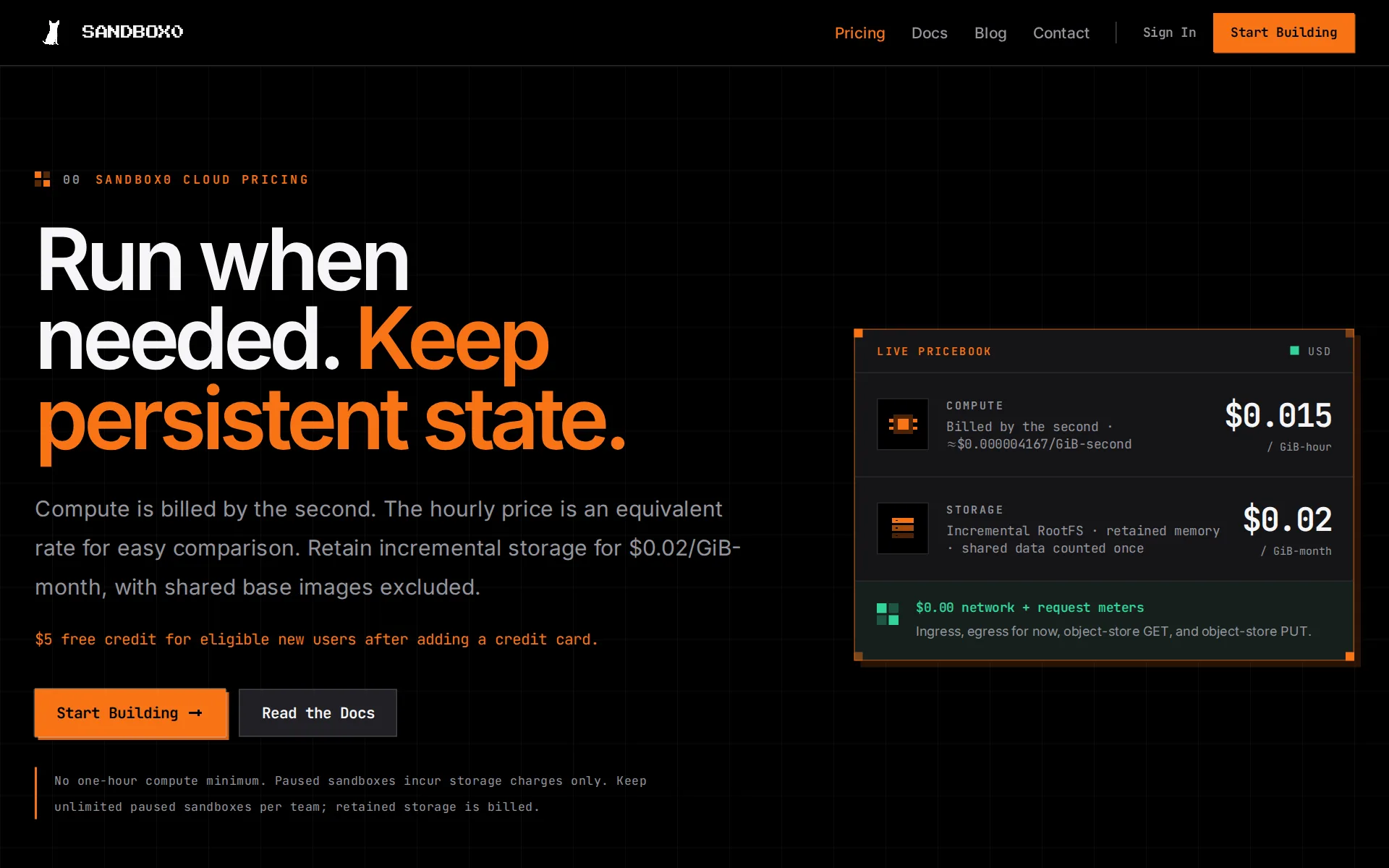
Pricing page, captured
sandbox0.ai/pricing, checked
What we checked on Sandbox0
What the price counts
Priced per use with no plan fee: compute is billed by the second against the sandbox memory limit, and retained incremental storage is billed per GiB-month.
Compute is billed by the second using the sandbox memory limit and running time. The GiB-hour price is an equivalent rate for comparison, not a…
sandbox0.ai/pricingChecked
Free to use
There is no standing free plan: new users get a one-time $5 usage credit, once per user and team, and must add prepaid funds once it is spent.
Eligible new users receive a one-time $5 usage credit after Stripe confirms a saved credit card. Each user and team can receive the welcome credit…
sandbox0.ai/pricingChecked
Public API
A documented public HTTP API at api.sandbox0.ai covers sandboxes, templates and credentials, and the same service is reachable through Go, JavaScript and Python SDKs and the s0 CLI.
Sandbox0 Cloud uses https://api.sandbox0.ai for sandboxes, templates, and credentials.
MCP server
MCP appears only as something Sandbox0 polices in a sandbox's outbound traffic. Its own agent entry point directs assistants to install the s0 CLI, and the complete docs index publishes no MCP server for the control plane.
When a user asks you to set up Sandbox0, install the s0 CLI if it is not already available, use it for Sandbox0 operations, and consult the…
sandbox0.ai/llms.txtChecked
Open source
Apache-2.0 licence in its public repository
Apache License Version 2.0
github.com/sandbox0-ai/sandbox0/blob/ma…Checked by us,
Sandbox0 alternatives
Sandbox0 and its 3 alternatives
All 3 show a price.
Sandbox0 beside its alternatives: the price on each one's site and the day it was checked Tool Price Checked Sandbox0 From $0.015 per gib hour Automater Free, then $15 a year ClineFlow Free The Colony Free


Questions about Sandbox0
- How much does Sandbox0 cost?
- Sandbox0 costs $0.015 per gib hour. From sandbox0.ai/pricing, checked 17 November 2026.
- Does Sandbox0 have an API or an MCP server?
- Sandbox0 has an API. From sandbox0.ai/docs/sandbox/get-started, checked 17 November 2026. Sandbox0 has no MCP server. From sandbox0.ai/llms.txt, checked 22 October 2026.
- Is Sandbox0 open source, and can you host it yourself?
- Sandbox0 is open source. We checked github.com/sandbox0-ai/sandbox0/blob/main/LICENSE ourselves on 15 November 2026. You cannot host Sandbox0 yourself. From sandbox0.ai/docs/sandbox/deployment.md, checked 22 October 2026.
- What have we checked on Sandbox0?
- 5 facts, under these headings: What it costs to start, how you build with it.
- How do we check Sandbox0?
- We hold 5 facts on Sandbox0, quoted from 15 pages. Facts and price last checked 17 November 2026, when we also found the last change.
Sources and changes
Last changed
Sources on sandbox0.ai14
What changed2
- What it does
- What it does
Sandbox0 price history
Plans for Sandbox0 started at $0.015 per gib hour on both of our reads, from 22 October 2026 to 17 November 2026.
| Price | Plan | First seen | Last seen | Readings | Source |
|---|---|---|---|---|---|
| $0.015 per gib hour | 22 October 2026 | 17 November 2026 | 2 | Pricing page, read 22 October 2026 |
From our research, read twice since 22 October 2026. 3 more of our checks could not pick this price out of the page and are left out. A date is when we read the page, not when the price changed.
Similar in Agent tools and integrations
See all in Agent tools and integrations
- ERIUS PHONERented cloud Android phones, each in its own container, that keep an agent's apps and sign-ins between sessions.
- TinyFishWeb search, page fetching, cloud browsers and goal-driven web automation for AI agents, with search and fetch free.
- SmitheryPublic MCP server registry, now run by Arcade, listing direct vendor MCP URLs after its proxy shut down.
- UI DiscoveryA library of real websites, iOS apps and dashboards with each one's palette, fonts and original build prompt.


Is Sandbox0 yours?
Free, and the page then carries the verified owner mark. You confirm it with an email at sandbox0.ai. Claim this listing
Report an error if a fact is wrong.