
At a glance
- Category
- Voice AI agents
- Tags
- BYOK, No training on your data
For developers
- Works with
- Meta, Soniox, xAI, Cartesia, Deepgram, ElevenLabs and 2 more
Talkif in our research
All researchStudy
AI Tool Pricing Index, November 2026
Pricing
Usage-based
43 of the 361 tools we checked bill by usage.
Edition price, checked 20 October 2026.
Pricing pages of the AI tools, November 2026 editionas of n = 361 tools checked
Talkif is a phone agent you draw, not a script you write
Talkif puts an AI agent on a business phone line: it answers inbound calls, places outbound ones, looks things up in your systems while the caller waits, and hands over to a colleague when a person is needed. A flow is the unit of design, holding agents with their prompts, the providers they use and the functions they may call, versioned so only a published version takes calls. The agent follows no decision tree. It decides each reply itself from a System Prompt carrying the persona for the whole call and an Agent Prompt carrying the current step's job, and both are templates resolved when the phone rings, so a contact's name and CRM notes are in the prompt on the first word.
Transfers get the most space on the marketing site. The agent picks the team from the conversation, rings only teammates within their hours, briefs the colleague first or connects immediately, and takes a message when nobody is free. Agencies can take the transfer into their own software instead: a signed webhook offers the call and the app accepts it with an API key, then takes the audio over a websocket.
Pricing is a per-minute bill of materials with one Talkif line
There are no plans. The vendor prints "No seats. No minimums." and "No sales call." on its pricing page, and the docs repeat that "There are no plans to pick and no per-seat fees". You prepay a USD balance and each call is itemised: telephony per started minute, speech-to-text per second, the language model per token, the voice per character, and a flat Talkif infrastructure fee of $0.05 a minute. The cheapest live stack comes to $0.0673 a minute. Swapping Claude Opus 5 in for GPT-4o Mini moves the model line by an order of magnitude, which is why every per-unit rate is published.
Two details change the arithmetic. Telephony already rounds up to the next whole minute and from November 15, 2026 the platform fee does too, so the vendor's own worked example takes a 61-second call from $0.0508 to $0.10 on that line. Calls to your own endpoints are free; you pay the model tokens around them. Numbers cost $1.15 to buy plus country-dependent rental, and recording storage is $0.50 per GB-month.
The balance is four buckets spent expiring-first, and the one that bites is that bonus credit cannot buy or rent a number. A call needs $1.00 available to start, is never cut off once running, and an account settling below zero is suspended for spending while the dashboard and data stay reachable.
Free means five dollars of credit, not a free plan
Sign-up carries a $5.00 welcome credit as bonus balance, and a demo agent can be called in the browser from the home page without an account. That is enough to build a flow and talk to it over your microphone, and not enough to rent a line. No tier stays usable at zero.
Default account limits matter before a launch: 10 concurrent calls, a queue depth of 100, 60 placements a minute. Inbound calls beyond capacity are refused rather than queued, and the vendor says raising a limit is routine on request.
Model choice is central, and none of the models are Talkif's own
Talkif trains nothing. Its pricing page says the transcriber, the language model and the voice are "passed through untouched", and what you pay Talkif for is noise cancellation, voice-activity detection, the turn model and a warm container held open for that one call. The live catalogue is generated from the platform's model list and carries 24 language models from Anthropic, Google, OpenAI and xAI, 10 speech-to-text models and 9 voices, each priced per unit. All are hosted proprietary models, with no open-weight option and no self-hosting path. You can enter your own provider key, and the privacy policy is explicit that the provider then contracts with you rather than becoming a Talkif sub-processor. Selection is per agent, so one step can run a cheap model and another a careful one.
The developer surface is a REST API and signed function calls
The API covers everything after design time: place a call, run campaigns, manage numbers and contacts, read transcripts and cost breakdowns, publish and roll back flows. Authentication is a Bearer key with scopes, IP allowlists and expiry, with official TypeScript and Python clients.
The interesting half runs the other way. Flow functions let the model call your endpoints mid-conversation, with arguments either extracted by the model or bound by Talkif to static values or live call context the model never sees. A binding can remove the function from the model's tools when its value is missing, which is a guardrail rather than a prompt instruction. Those requests carry an HMAC-SHA256 Talkif-Signature header, but signing is opt-in per account: until you create a secret, requests arrive unsigned. Call lifecycle events come over a WebSocket stream with replay for late joiners, so there is no subscribe-and-receive event webhook in the usual sense. An MCP server exists at docs.talkif.ai/_mcp/server, and it serves the documentation to coding assistants; it cannot place a call or read a transcript.
Compliance sits with the customer, and the terms say so repeatedly
Talkif, Inc. is a Delaware corporation registered at 1111B S Governors Ave STE 23788, Dover, DE 19904. Its trust centre publishes dated terms, a privacy policy, a GDPR Article 28 processing agreement, an acceptable use policy and a Communications Compliance Addendum. No SOC 2 report, ISO 27001 certificate or penetration test summary is published anywhere on the site; the terms list measures such as AES-256 at rest and audit logging for security-sensitive operations without naming an audit.
The terms are direct about where liability sits: the customer "is the caller or initiator of every call", responsible for consent, do-not-call scrubbing, calling hours, recording notices, and telling people they are talking to an AI. The platform supplies tools for that work, with a do-not-call list checked before every outbound call and per-campaign calling windows in each contact's timezone, but the docs state plainly that Talkif does not announce recording for you. Liability is capped at the greater of twelve months of fees or $100, against a form of calling the same document notes carries uncapped per-call statutory damages in the United States. Availability is "commercially reasonable efforts", and Section 3.3 defers any commitment to "the applicable Service Level Agreement", which the document list does not contain.
Connectors, which lets an agent reach the customer's own coding sessions and knowledge folders during a call, is marked experimental in the terms: no uptime commitment, excluded from any SLA, withdrawable at any time.
Where it fits, and where it does not
The fit is a business with phone traffic it wants answered or returned fast, some appetite to point the agent at an internal API, and a willingness to own calling compliance. Lead response is the use case the site leans into hardest, with Meta lead ads called inside your hours and the outcome written back to Meta.
It is a poor fit where a predictable monthly invoice matters, since a bill across five metered lines with two round-up rules cannot be forecast from the rates alone without modelling call length. It is also a poor fit for buyers needing a signed uptime commitment, a SAML connection to their identity provider, a customer-visible trail of who changed a flow, or a region they pin themselves rather than one chosen by the caller's location.
Talkif price and terms
Terms
- Free to start
- PartlyLimited free use$5.00 welcome credit as bonus balance, plus a demo agent callable in the browser without an account
- Card to start
- YesNot required
- Sign up without sales
- YesYes
The terms in full
Bonus credit cannot buy or rent a phone number, and no call starts below a $1.00 available balance.
For AI agents
- MCP server
- Partlydocs.talkif.ai,
- API
- Yesdocs.talkif.ai,
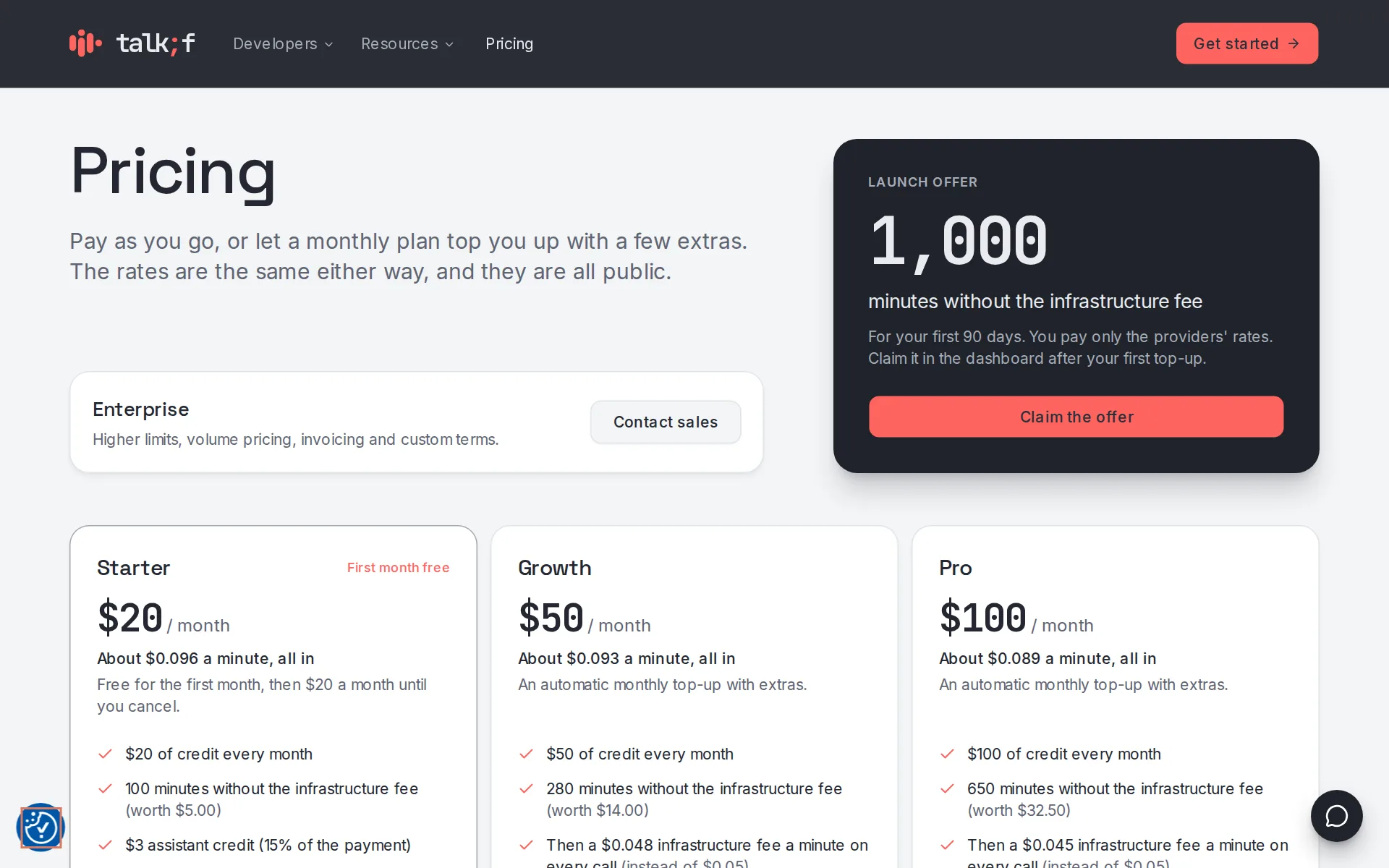
Pricing page, captured
talkif.ai/pricing, checked
What we checked on Talkif
Free to use
New accounts get a 5 dollar welcome credit and a demo agent is callable in the browser, but there is no standing free plan and calls stop below a 1 dollar balance.
You sign up, get the $5.00 welcome credit (bonus), and add $50.00 by card (purchased).
Self-serve signup
Sign-up, top-up, numbers and publishing are all self-service at published rates, with the vendor stating outright that no sales conversation is needed.
No sales call.
talkif.ai/pricingChecked
Card to start
You can register, build a flow and talk to it in the browser on the welcome credit; a card is needed only to buy a phone number or top up.
This is why a new account with only its welcome credit can build and test but must top up before buying a line.
Cancel any time
Prepaid pay-as-you-go with no plan to end: you delete the account yourself, and remaining balance can be refunded within 30 days of closure.
Customer may terminate this Agreement at any time by requesting Account deletion through the Service.
trust.talkif.ai/termsChecked
Public API
A documented REST API with key authentication covers calls, campaigns, contacts, numbers, flows and billing, plus Node and Python clients.
Everything the dashboard does after design time is available over a REST API at https://api.talkif.ai
MCP server
An MCP server is published, but it serves the documentation to coding assistants rather than letting an assistant place calls or read call records.
For AI client integration (Claude Code, Cursor, etc.), connect to the MCP server at https://docs.talkif.ai/_mcp/server
docs.talkif.ai/llms.txtChecked
Acts on its own
The agent holds the whole call itself, deciding each reply and calling your endpoints mid-conversation with nobody approving turns.
The agent decides each reply itself, from two prompts
Limits on what it may do
Arguments can be pinned to fixed or call-context values the model never sees, and a missing value can remove the tool from the call entirely.
Anything you bind to a fixed value or to call context (the caller's contact ID, say) is filled in by Talkif and never shown to the model
No code needed
Flows are designed in a visual builder and tested over the microphone in the browser, with the dashboard covering numbers, contacts and billing.
If you never write code, the dashboard is the whole product.
No training on your data
The policy rules out training general-purpose models on customer data and states that provider API data is not used for training either.
Training general-purpose AI models (your data is not used to train the AI models of our third-party providers beyond the scope of processing your…
trust.talkif.ai/privacyChecked
Retention you control
Recording is off until enabled, and an account-level compliance setting deletes transcripts and recordings automatically after a period you choose.
Delete transcripts and recordings after Applied automatically. You set the period. 90 days
talkif.aiChecked
Data stays in your region
Calls run from the EU or US region nearest the caller rather than a region you pin, and the vendor says you do not choose per call.
You don't pick a region per call
Self-hosted
Talkif is a hosted platform in its own two regions; the agreement grants use rights only, and the self-managed part is your carrier, not the software.
Nothing in this Agreement grants Customer any rights in the Service except the limited use rights expressly set forth herein.
trust.talkif.ai/termsChecked
Open source
The platform code is the vendor's property under the terms of service, and no repository or license is published anywhere on its site.
Talkif and its licensors own all right, title, and interest in and to the Service, including all software, algorithms, interfaces, documentation, and…
trust.talkif.ai/termsChecked
Take your data out
A self-service export returns one JSON file across 13 categories including calls with transcripts, flows and billing, in the same shapes the API uses.
One request produces a single JSON file with every category of data the account holds
Single sign-on
Sign-in covers Google, Apple, passkeys and TOTP two-factor, but there is no SAML or OIDC connection to a company identity provider.
Email and password. Continue with Google. Continue with Apple. Passkey.
Audit log
Security-sensitive operations are logged on the vendor's side and sign-in events are retained, but no customer-facing activity log of who did what is documented.
Audit logging for security-sensitive operations
trust.talkif.ai/termsChecked
Uptime promise
Availability is a commercially reasonable efforts promise; the terms defer any commitment to an SLA that the trust center's document list does not contain.
Service availability commitments, if any, are set forth in the applicable Service Level Agreement.
trust.talkif.ai/termsChecked
Its own model
Talkif trains no model of its own: the transcriber, language model and voice all come from outside vendors and are billed through at their rates.
The transcriber, the language model and the voice are metered by their vendors and passed through untouched.
talkif.ai/pricingChecked
You pick the model
You pick the speech-to-text, language and voice model per flow, and each agent inside a flow can run a different one.
The User selects which provider is used per flow.
trust.talkif.ai/privacyChecked
Talkif alternatives


Questions about Talkif
- How much does Talkif cost?
- Talkif costs $0.0673 per minute. From talkif.ai/pricing, checked 20 October 2026.
- Does Talkif have an API or an MCP server?
- Talkif has an API. From docs.talkif.ai/getting-started/introduction, checked 20 October 2026. Talkif has a limited MCP server. From docs.talkif.ai/llms.txt, checked 20 October 2026.
- Is Talkif open source, and can you host it yourself?
- Talkif is not open source. From trust.talkif.ai/terms, checked 20 October 2026. You cannot host Talkif yourself. From trust.talkif.ai/terms, checked 20 October 2026.
- What have we checked on Talkif?
- 20 facts, under these headings: What it costs to start, what it works with, what it does on its own, what happens to your data, whether a company can buy it, models it can use.
- How do we check Talkif?
- We hold 20 facts on Talkif, quoted from 15 pages. Facts and price last checked 20 October 2026. Last change found 14 November 2026.
Sources and changes
Last changed
Sources15
- docs.talkif.ai/getting-started/introduction
- talkif.ai/pricing
- trust.talkif.ai/terms
- trust.talkif.ai/privacy
- docs.talkif.ai/concepts/credits-and-pricing
- talkif.ai/
- docs.talkif.ai/account/credits-and-payment
- docs.talkif.ai/account/data-export-and-deletion
- docs.talkif.ai/account/security
- docs.talkif.ai/build/call-your-backend
- docs.talkif.ai/integrate/authentication
- docs.talkif.ai/integrate/webhooks
- docs.talkif.ai/llms.txt
- docs.talkif.ai/reference/models-and-voices
- docs.talkif.ai/skills/agent-skills
Talkif price history
Plans for Talkif started at $0.0673 per minute on both of our reads, from 17 October 2026 to 20 October 2026.
| Price | Plan | First seen | Last seen | Readings | Source |
|---|---|---|---|---|---|
| $0.0673 per minute | 17 October 2026 | 20 October 2026 | 2 | Pricing page, read 17 October 2026 |
From our research, read twice since 17 October 2026. 2 more of our checks could not pick this price out of the page and are left out. A date is when we read the page, not when the price changed.
Similar to Talkif
- DialNexaIndian calling agents for sales and collections in 22 Indian languages, switching between Hindi and English mid-call.
- AissistMulti-agent AI that resolves support and sales tickets in your existing helpdesk, billed per interaction.
- BotpressAI support agents and helpdesk priced per conversation, with no per-seat fees and AI usage included in plans.
- ChatbaseBuild sales and support agents from your own content without code, on a flat monthly plan with message credits.


Claimed by the Talkif team.
We check its facts against the Talkif site.Facts checked 20 October 2026
Report an error if a fact is wrong.