
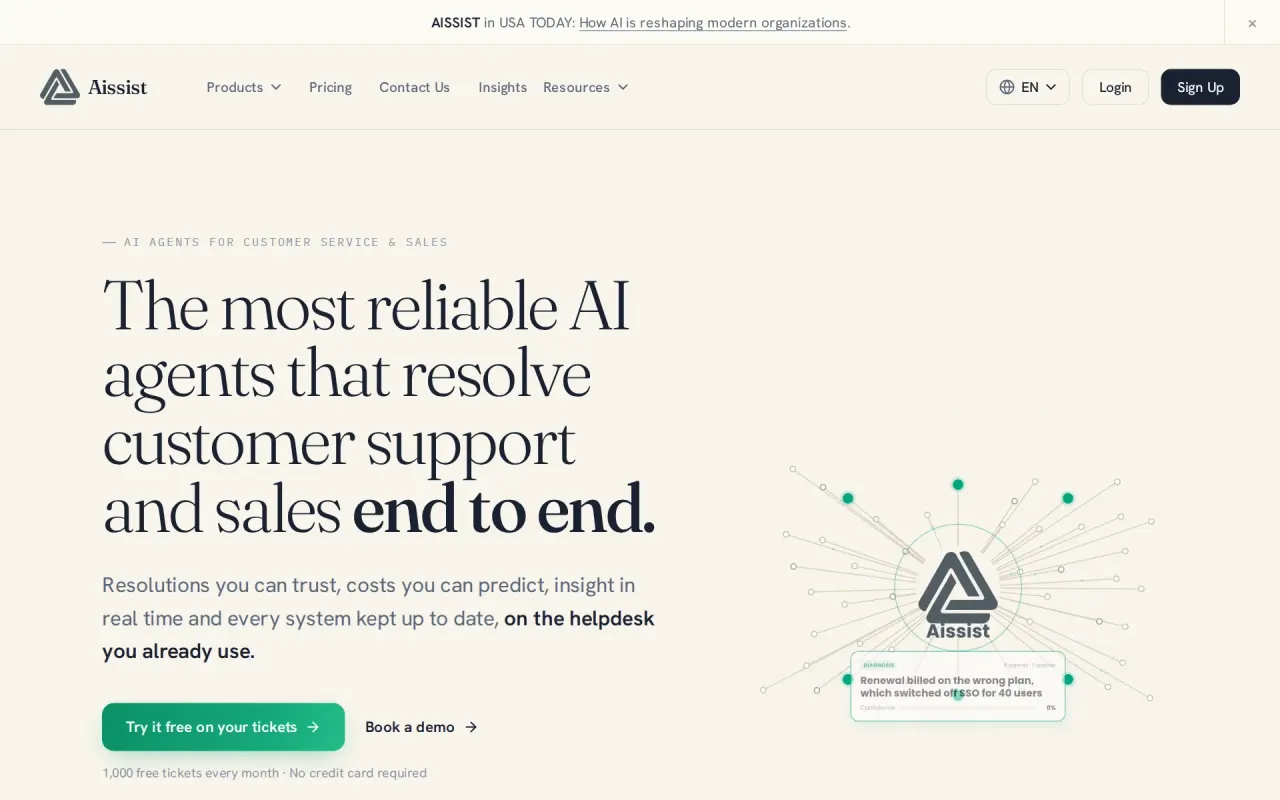
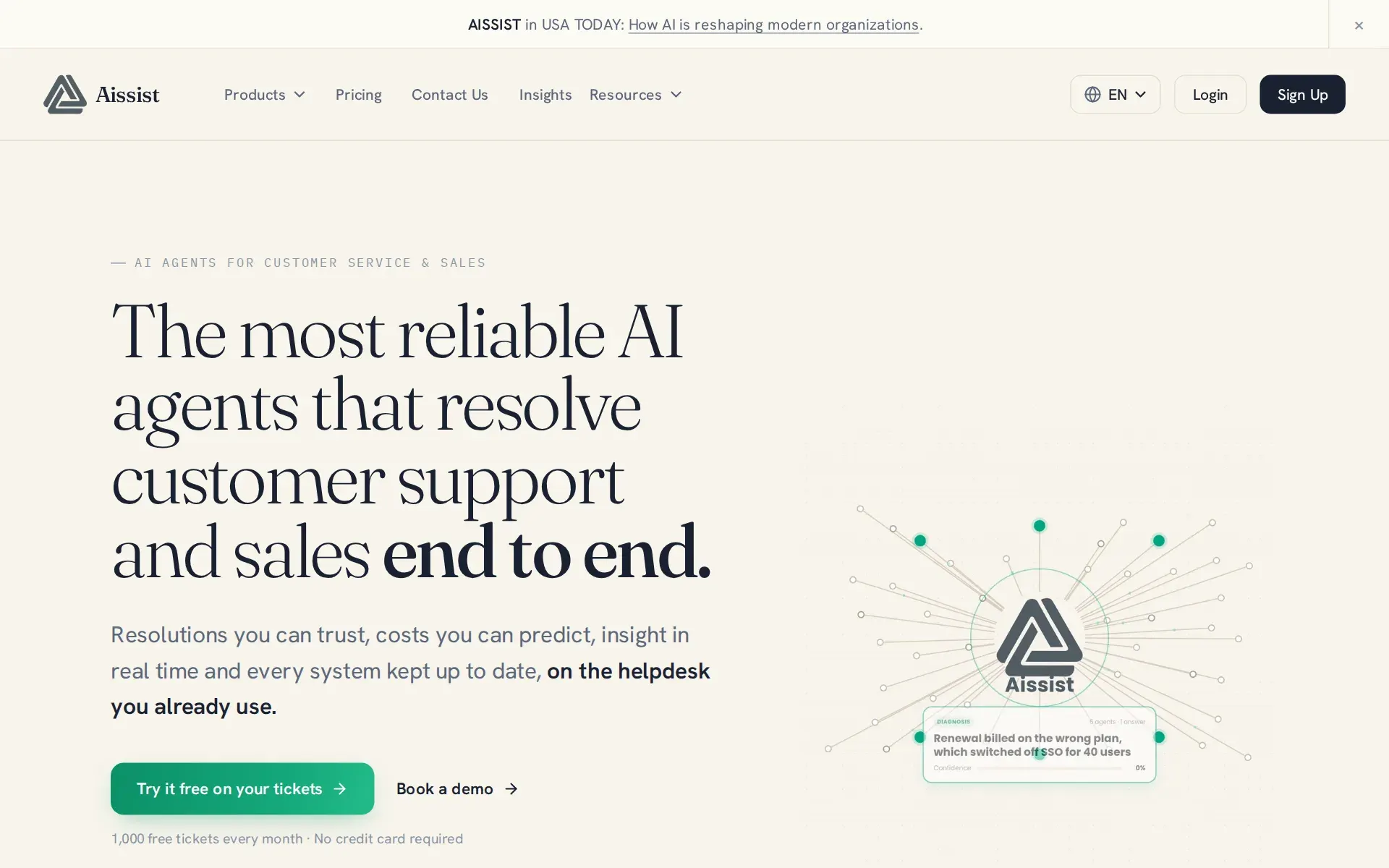
Aissist.io runs AI agents on top of a helpdesk a team already uses, where specialist sub-agents read connected systems, reply in 65+ languages and hand hard cases to staff. Alongside the automation it ships Pulse for conversation analysis and Evolve for tuning agent behavior.
It automates tickets inside a helpdesk rather than replacing it
Aissist.io is a layer that sits on the helpdesk a team already pays for. It watches the queue, picks up conversations by priority, by assignment to the AI agent, or when someone @mentions it in a note, then answers and closes the case in that system. Deployment points are called gateways, one workspace per gateway, and the configuration unit is a workspace holding instructions, knowledge assets, actions and sub-agents.
The architecture is the selling point. On each run a super agent plans the work and activates specialist sub-agents for refunds, shipping, warranty or whatever domains a business defines, which then return facts and check each other before one reply goes out. The vendor is explicit that it rejected the flow-builder approach: "No Flow. No Tree. No Rules. No Code", stated in its own post about OpenAI's AgentKit.
Input handling covers text, images, documents, voice notes and video across chat, email, WhatsApp, SMS and social, in 65+ languages with automatic detection. Two further products ride on the same platform: Pulse reads every conversation, human or AI, for contact drivers and per-agent scoring, and Evolve runs changes as measured experiments on live traffic with policy and brand changes held back for sign-off.
The meter counts AI interactions and stops at a per-resolution cap
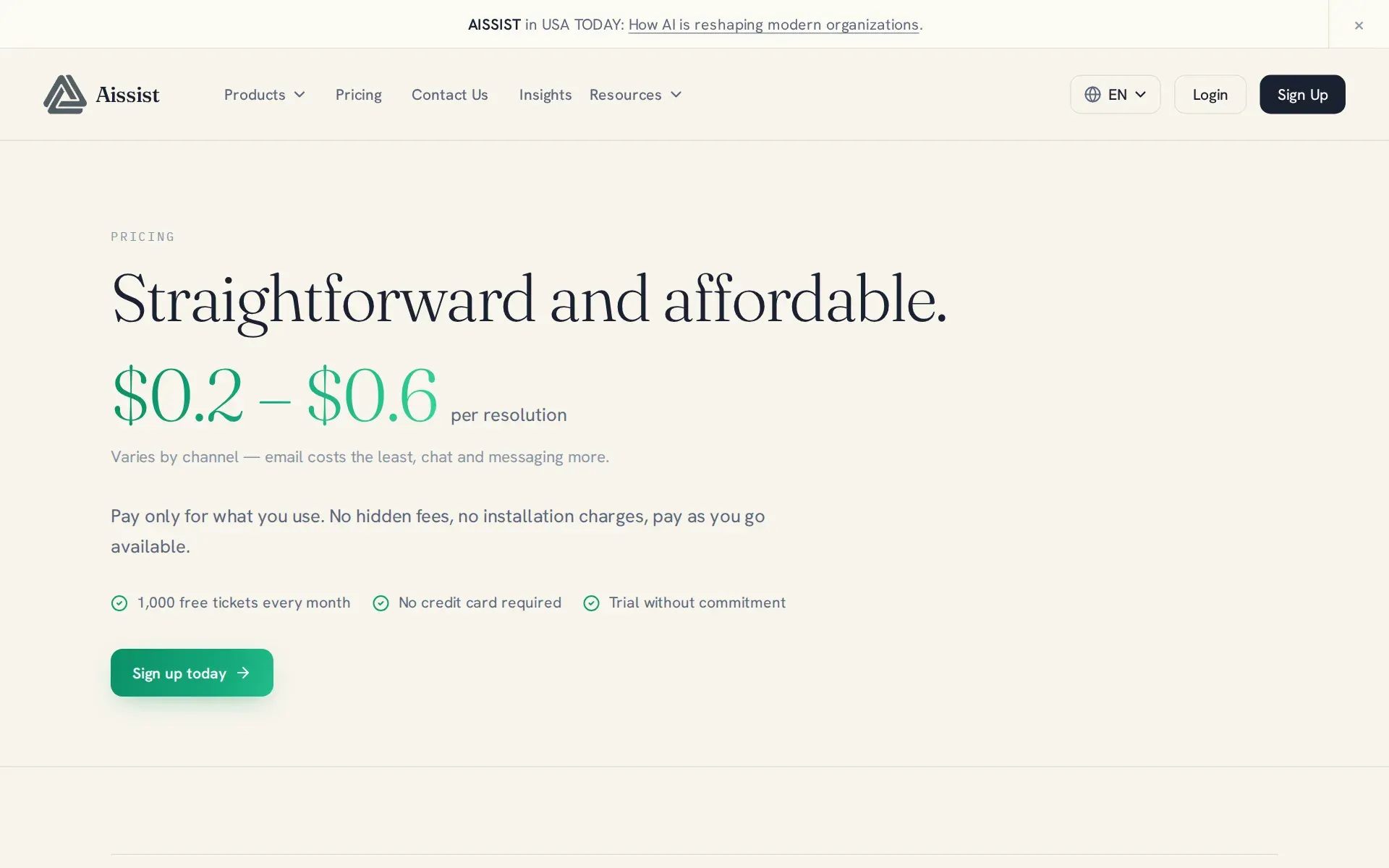
The list rate is $0.09 per AI interaction, capped at about $0.60 per resolution, and the buyer pays the lower of the two. An interaction is one automation cycle from a customer message to the AI response, including every task inside it, so tagging, a system update and a reply can all fall inside one charge. Escalations are free: the pricing page states that "Cases handed over to a human are not charged."
Channel decides where a buyer lands. Email, web forms and social average about two interactions per session and roughly $0.25 per resolution; web chat, WhatsApp and SMS average five and reach the $0.60 cap. The vendor labels both figures "Estimates, not a quote" and publishes a calculator for your own volume. Billing is always after usage, never prepaid, and the Growth tier carries no contract.
The history is documented rather than hidden. The Straight Answers page records the per-interaction rate falling from $0.15 to $0.09 in late 2025 and the $0.60 cap arriving in mid-2026. Free covers 1,000 tickets a month, but only on the base engine, and free replies carry an aissist.io footer per the docs FAQ. Four Pulse and Evolve modules are priced "By contract" with no figure attached.
Two pages disagree about which helpdesks are live
The homepage lists Zendesk, Intercom, Freshdesk, Salesforce, HubSpot, Kustomer, Front and Gorgias under "Works inside". The Gateways page then marks Salesforce, Kustomer, Freshdesk and Freshchat as "Coming Soon" while Intercom, Zendesk, Front, Gorgias and HubSpot read "Available Now".
The Straight Answers page takes the opposite position and names all eight as "Live today: Intercom, Zendesk, Freshdesk, Kustomer, Front, Gorgias, Salesforce, and HubSpot", adding that "Anything still in build is labeled as such". Separate setup guides do exist in the documentation for Salesforce, Kustomer and Freshdesk Omni, with Freshchat marked deprecating. Four helpdesks therefore carry three different statuses across three of the vendor's own pages, which is worth settling in writing before a buyer commits to one of them.
Beyond helpdesks, actions reach Shopify, WooCommerce, Adobe Commerce, ShipStation, ParcelPanel, AWS Lambda and any REST endpoint a buyer exposes.
Programmatic access runs one way only
The REST integration is for Aissist calling systems you own: order lookup, booking retrieval, inventory checks, refunds. Actions are configured in the console with a method, endpoint, parameters and linked sub-agents, and tested in an Action Debugger. That is the whole of the API surface in the documentation index.
There is no published API for reading or configuring Aissist from outside, and no MCP server for an AI assistant to call. Outbound notification is email per team member plus Slack incoming webhooks at workspace level, carrying event alerts, hourly alerts and daily or weekly reports. A team wanting a workspace managed from its own code, or conversation data piped into a warehouse, has nothing documented to work with.
ISO 27001 is certified, SOC 2 is not, and hosting is US-only
The security page answers its own SOC 2 question with a refusal to blur it: "Aissist.io is SOC 2 aligned, not SOC 2 certified, and we say so rather than blurring the two." ISO 27001 certification is claimed with the certificate published in a trust center linked from that page, GDPR compliance is claimed, and a DPA is published. Encryption is AES-256 at rest and TLS 1.2 or higher in transit, infrastructure is AWS and Azure, PII is masked automatically, and audit logs cover access and changes.
Residency is the constraint a European buyer will meet first. The privacy terms state that all processing and storage are "hosted exclusively in the United States" and that the company commits to "complying with applicable United States data protection laws and regulations", which sits awkwardly beside the GDPR claim on the marketing page and deserves a question to the vendor. Those terms are also dated October 2023, well behind the rest of the site.
Nothing published covers single sign-on, a configurable retention period, or an uptime percentage. Deletion and restriction are handled by request to the vendor. What is contractual is the error budget: all errors of severity S0 to S2 combined under 1%, S0 under 0.01%, with the severity scale set out in the vendor's own reliability benchmark.
Who it suits, and the three cases the vendor turns away
The vendor positions itself at SMB and mid-market support and sales teams that want agentic depth without an enterprise sales cycle, and it names three buyers it does not want. Fully automated inbound phone calls go elsewhere, since Aissist handles voice messages rather than live calls. Anyone looking to replace a ticketing system is in the wrong place, because the product layers on top of one. And a team whose volume is covered by a knowledge-base bot is told the deeper system is more than it needs.
Performance figures are self-reported and should be read that way: 83% average resolution, 4.8 out of 5 CSAT and $0.20 to $0.60 per resolution across all projects through Q1 2026. Independent signal is thinner, mostly a G2 profile the vendor cites at 4.9 from 45 reviews, where the recurring criticism is that answers are only as good as the documentation behind them. The company publishes a co-founder under the initials M.W. with a marketing contact address, and no registered entity, head office or funding history appears on the site.
Plans and pricing
Price and terms
- Free plan
- YesYes
The terms in full
1,000 tickets per month, on the base engine only, with an aissist.io footer added to replies and no credit card required. Paid accounts drop the footer and the volume limit.
- Card to start
- YesNot required
- Sign up without sales
- YesYes
What needs a higher plan
- Enterprise
- Uptime promise
For AI agents
- API
- No
Checked .
The AgentsIndex digest
Price changes and new tools like Aissist.io, at most once a week.
Last issue: ChatGPT vs Claude: Which One Should You Use? · 13 October 2026
The facts, with their sources
What it costs to start
- Free tier
- YesA standing free plan carries 1,000 tickets a month on the base engine, with the vendor's footer added to replies.
Aissist.io offers a Free Program that includes 1,000 free tickets every month. The Free Program runs on the "free" engine, which is sufficient to…
aissist.io/pricing - Self-serve signup
- YesSign-up and setup run without a sales call, and the vendor puts the console path at about ten minutes with no implementation contract.
Pricing is public (you're reading it), setup is self-serve in about 10 minutes, and there's no mandatory implementation contract or sales gate to get…
aissist.io/product/aissist-straight-ans… - Card to start
- NoThe free plan needs no card; a card is added later in Billing only when activating the paid Growth tier.
1,000 free tickets every month — no credit card, no commitment.
aissist.io/pricing - Cancel any time
- YesThe Growth tier is month-to-month with no contract and billing after usage, so stopping costs nothing; Enterprise is contracted separately.
No contract needed, stop any time.
aissist.io/pricing
What it works with
- Public API
- NoThe one API page in the docs runs the other way: Aissist calls endpoints you own. No API for driving Aissist itself is published.
Connect Aissist to your own API endpoints. Use this integration when you want Aissist to read live data or trigger actions in your internal systems.
doc.aissist.io/integrations/restful-api…
What it does on its own
- Acts on its own
- YesAuto-Pilot mode has the agent reply and act on its own, with Co-Pilot as the opt-in mode where a human triggers help instead.
Use Auto-Pilot when Aissist should reply automatically. Use Co-Pilot when agents should trigger AI help on demand inside the platform.
doc.aissist.io/faq.md - Limits on what it may do
- YesReply scope can be narrowed to recognized sub-agents, and refund limits plus verification steps are applied per execution rather than per campaign.
Create separate sub agents for each supported workflow. Then enable the setting that limits replies to recognized sub agents.
doc.aissist.io/faq.md - No code needed
- YesConfiguration is written as instructions, assets and sub-agents in a console rather than drawn as flows, and the vendor states no code is involved.aissist.io/insights/no-flows-no-trees-n…
What happens to your data
- No training on your data
- PartlyClient data is never sold or leased, but the same clause permits use to improve the services, and no model-training opt-out is offered.
The data will not be used for any purposes outside of those necessary to provide and enhance the services agreed upon, except as required by law.
console.aissist.io/md/privacy - Retention you control
- PartlyDeletion and restriction happen on request to the vendor; no configurable retention window or switch is published anywhere.
Clients have rights regarding their data, including the right to access, correct, delete, or restrict the processing of their data.
console.aissist.io/md/privacy - Data stays in your region
- NoProcessing and storage sit in the United States only, so a buyer needing EU or other regional hosting has no option to pick.
Hosting Location: All services provided by Aissist.io, including data processing and storage, are hosted exclusively in the United States.
console.aissist.io/md/privacy - Open source
- NoThe orchestration layer is described as proprietary, and no repository, license or source distribution appears on the site or in the docs.
Aissist uses a proprietary orchestration layer that can work with multiple LLM providers.
doc.aissist.io/faq.md - Take your data out
- PartlyConversation history stays in the buyer's own helpdesk, so leaving needs no migration, but no export of the Aissist workspace or analytics is documented.
Your helpdesk remains the record of the conversation, which means an exit from Aissist does not require a data migration
aissist.io/security
Whether a company can buy it
- Security audits
- PartlyISO 27001 certification is claimed with a trust center to verify it, while SOC 2 is explicitly alignment rather than an audited report.
No — Aissist.io is SOC 2 aligned, not SOC 2 certified, and we say so rather than blurring the two.
aissist.io/security - Audit log
- YesAccess and changes are logged across the system and the logs can be produced for a compliance review on request.
Comprehensive audit logs track all access and changes to your system, providing full transparency for compliance requirements.
aissist.io/security - Uptime promise
- PartlyContractual targets cover AI error rate by severity and Enterprise adds an unspecified higher SLA, but no uptime percentage is published.
Volume discount, higher SLA, and dedicated AI engineer support, plus customized solutions and premium features.
aissist.io/pricing
Which models it runs on
- Its own model
- NoThe orchestration layer is the vendor's own, but the reasoning runs on third-party foundation models from four named providers.
Aissist uses a proprietary orchestration layer that can work with multiple LLM providers. Aissist currently works with OpenAI, Grok, Claude, and…
doc.aissist.io/faq.md - You pick the model
- PartlyA buyer picks between the base and advanced engine, and the paid tier reaches both, but which provider serves a request is the vendor's call.
Paid accounts can use both the base engine and the advanced engine with no usage limit.
doc.aissist.io/faq.md
Screenshots
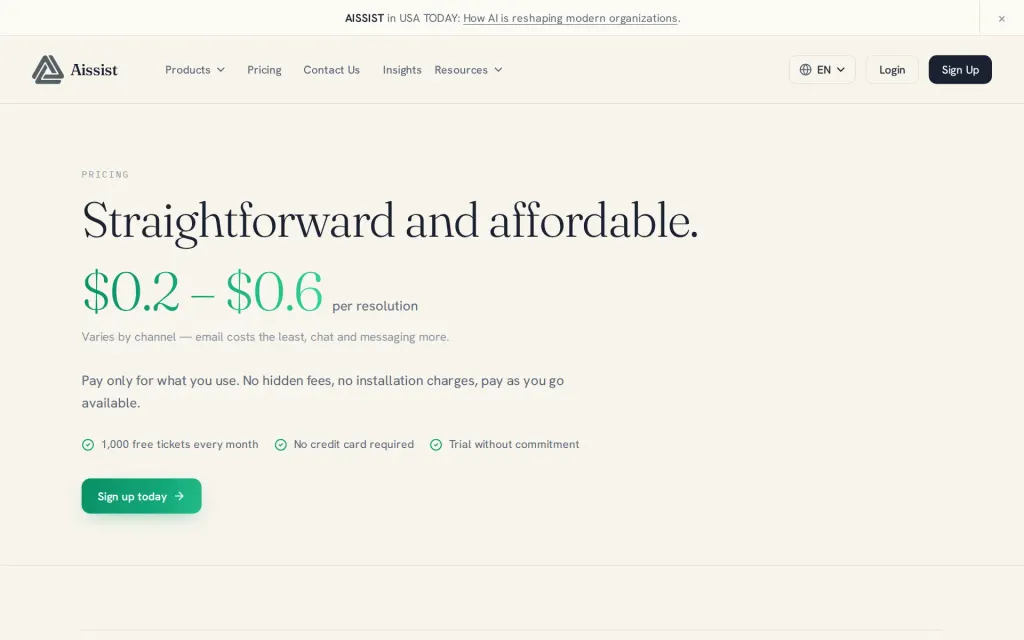
Pricing page, aissist.io, captured
Filed under
Sources and updates
Sources10
- doc.aissist.io/faq.md
- aissist.io/pricing
- console.aissist.io/md/privacy
- aissist.io/security
- aissist.io/product/aissist-straight-answers
- doc.aissist.io/aissist-docs.md
- aissist.io/insights/no-flows-no-trees-no-rules-no-code
- doc.aissist.io/integrations/restful-api.md
- aissist.io/technology/multi-agent-platform
- doc.aissist.io/tutorial/configure-notifications.md
Updates1
- Free tier · Price · What it does