
What is Tidio?
Tidio is a cloud-based customer support and sales platform for support and ecommerce teams that combines Live Chat, Help Desk, Flows, and the Lyro AI Agent. It also includes Analytics, Shared inbox, and the AI Copilot Chrome Extension, and integrates with Shopify, WordPress, WooCommerce, HubSpot, Salesforce, Zapier, and OpenAPI. Named customers include Cove, Wulff Beltton, and The Body Shop.
Tidio sells one inbox with an AI agent in front of it
Tidio is a support platform with three parts that are also sold separately. The help desk holds live chat, email, Instagram, Messenger and WhatsApp in a shared inbox with ticketing, macros and routing. Flows is the rules-based chatbot, built on a drag-and-drop canvas from ecommerce templates, triggered by visitor behaviour such as an abandoned cart. Lyro is the AI agent: it answers from uploaded FAQs, scraped site content and imported Zendesk articles, recommends products from a connected catalogue, and performs Smart Actions such as order lookups against external systems.
The vendor's own distinction between the two automation layers is worth reading before buying: Flows "follow the rules and conversational paths you set", while Lyro "uses machine learning to understand questions and draws on your support content to create detailed responses". Both are metered separately, and a buyer can subscribe to either alone.
Lyro is also sold detached from the inbox, to sit in front of Zendesk, Salesforce or another help desk through Lyro Connect. That configuration is restricted to the Plus and Premium plans.
Pricing meters conversations, not seats, on three counters
A seat count is not the billing unit here. Every plan includes up to 10 agents and bills instead on a billable conversation, defined on the pricing FAQ as any chat, ticket, email or social conversation "that includes a message from a human agent (you)". Unanswered visitor messages and replies made only by Flows or Lyro do not count, and a thread counts once however long it runs.
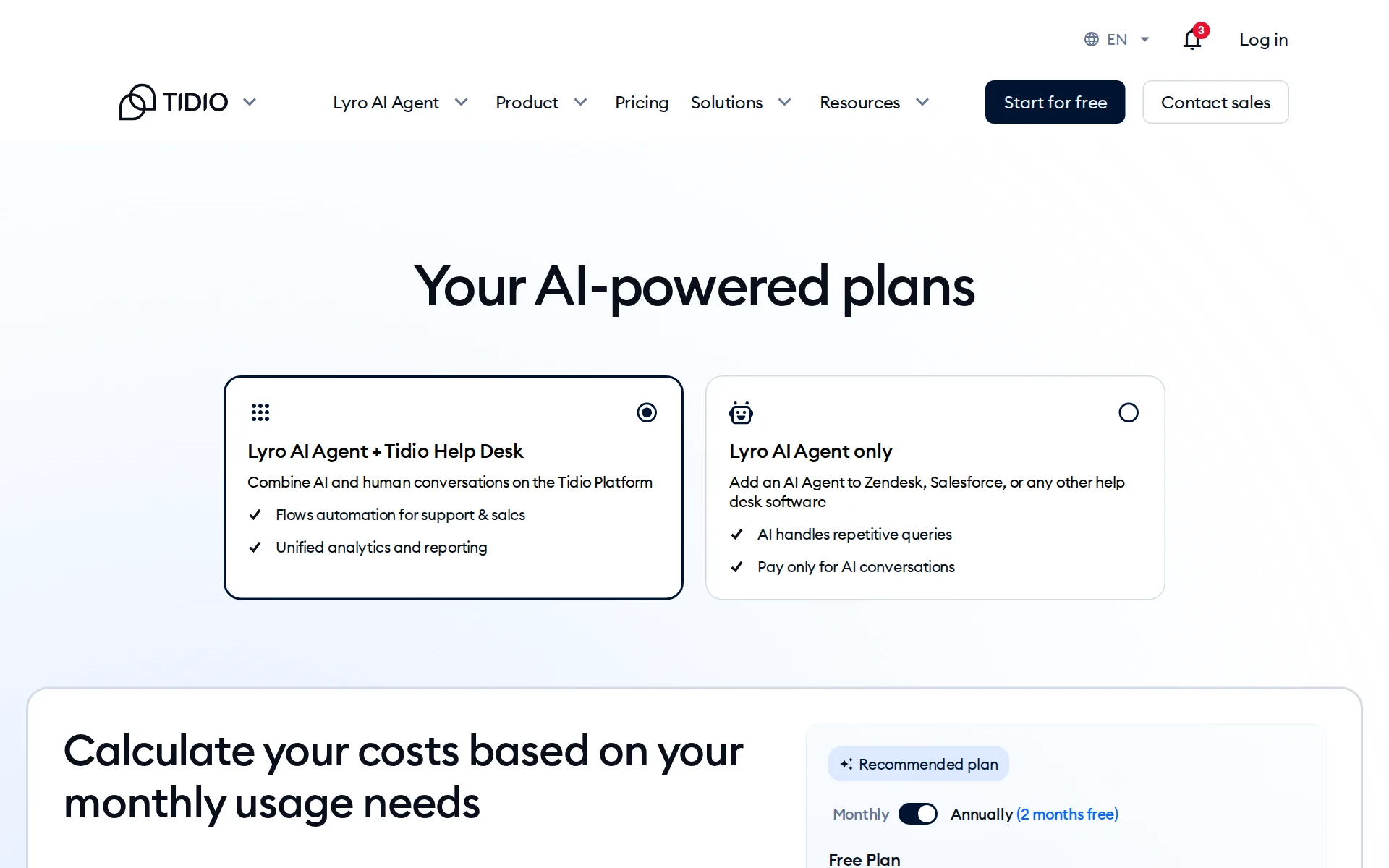
Starter is $29 a month month-to-month for 100 billable conversations, or $24.17 a month billed annually, the page's annual option being stated as two months free. Growth starts at $59 monthly and $49.17 annually from 250 conversations. The toggle on that page opens in the annual position, so the first figure a visitor sees is the discounted one. Plus is "Starts at $300/mo. + monthly usage" and Premium is quoted.
Lyro conversations are a second counter, from $32.50 a month for 50, with the agent page quoting "Pay just $0.5 per conversation". Flows visitors reached are a third, from $24.17 a month for 2,000. Removing Tidio branding is an add-on at 16.67 USD a month on Growth and included above it. The Free plan is a real standing plan at $0, but its 50 Lyro conversations are a lifetime grant: "Every Tidio account starts with 50 Lyro conversations, but you need to upgrade to the Lyro AI Agent plan to refresh it monthly."
Programmatic access and an MCP server start at the Plus plan
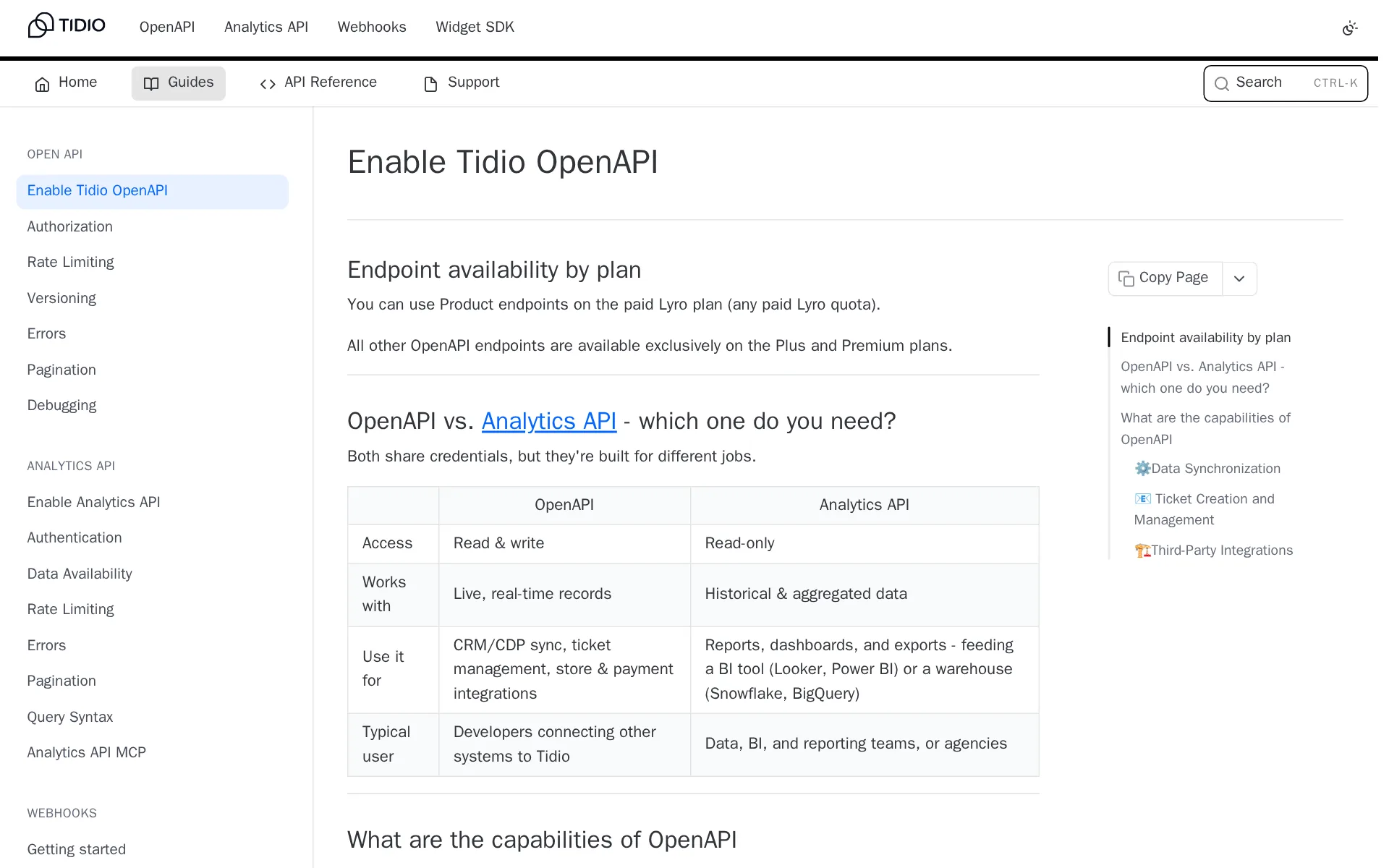
There are two documented APIs. The OpenAPI reads and writes live records: contacts, conversations, tickets, operators and product data, authenticated with a client ID and secret generated in the panel. The Analytics API is read-only and tabular, intended for a warehouse or BI tool. Plan gating differs between them: product endpoints work on any paid Lyro quota, while "All other OpenAPI endpoints are available exclusively on the Plus and Premium plans", and the Analytics API is Plus and Premium only.
The Analytics API is also exposed as a hosted MCP server at taa-mcp.data.tidio.com/mcp, with setup instructions for Claude Code, Claude Desktop, Cursor and ChatGPT. The documentation is explicit about its limits: "Read-only. These tools can only read your analytics data. They can't send messages, change settings, or modify anything in your account." Revoking the client secret in the panel disconnects every tool at once. Webhooks and a widget SDK are documented alongside, with the mobile SDK listed as a Premium feature.
Security publishes a SOC 2 report, and little about AI data use
The trust center records a 2026 SOC 2 Type II audit covering Security, Availability and Confidentiality, with the report available on request, plus a 2026 penetration test letter, a HECVAT Lite self-assessment and a subprocessor list. Compliance badges cover GDPR, CCPA, CPRA, the EU-US Data Privacy Framework, the EU AI Act, NIST AI RMF and the AI Pact. No ISO 27001 or ISO 42001 certificate is published. The security page adds TLS in transit, encryption at rest, hashed credentials, AWS hosting, two-factor authentication and roles and permissions.
Two gaps matter for an AI buyer. No page states whether customer conversations are used to train models: the only training sentence in the privacy policy is narrow, covering Google Workspace APIs alone. And retention is described by policy rather than by control, with personal data processed "no longer than until the account is deleted" and no customer-side retention setting documented. Data residency is similarly unaddressed, with hosting recorded only as a major cloud provider. The help center, which may hold more, is served behind a bot check and could not be read.
Company: Polish-founded, Series B, 300,000 customers claimed
Tidio was founded in 2013 in Szczecin, Poland by CEO Tytus Gołas, and says it has more than 180 employees across San Francisco, Warsaw and Szczecin, backed by $25M in Series B funding. The about page names five executives. The commercial entity in the US privacy policy is Tidio LLC, which self-certifies under the EU-US Data Privacy Framework.
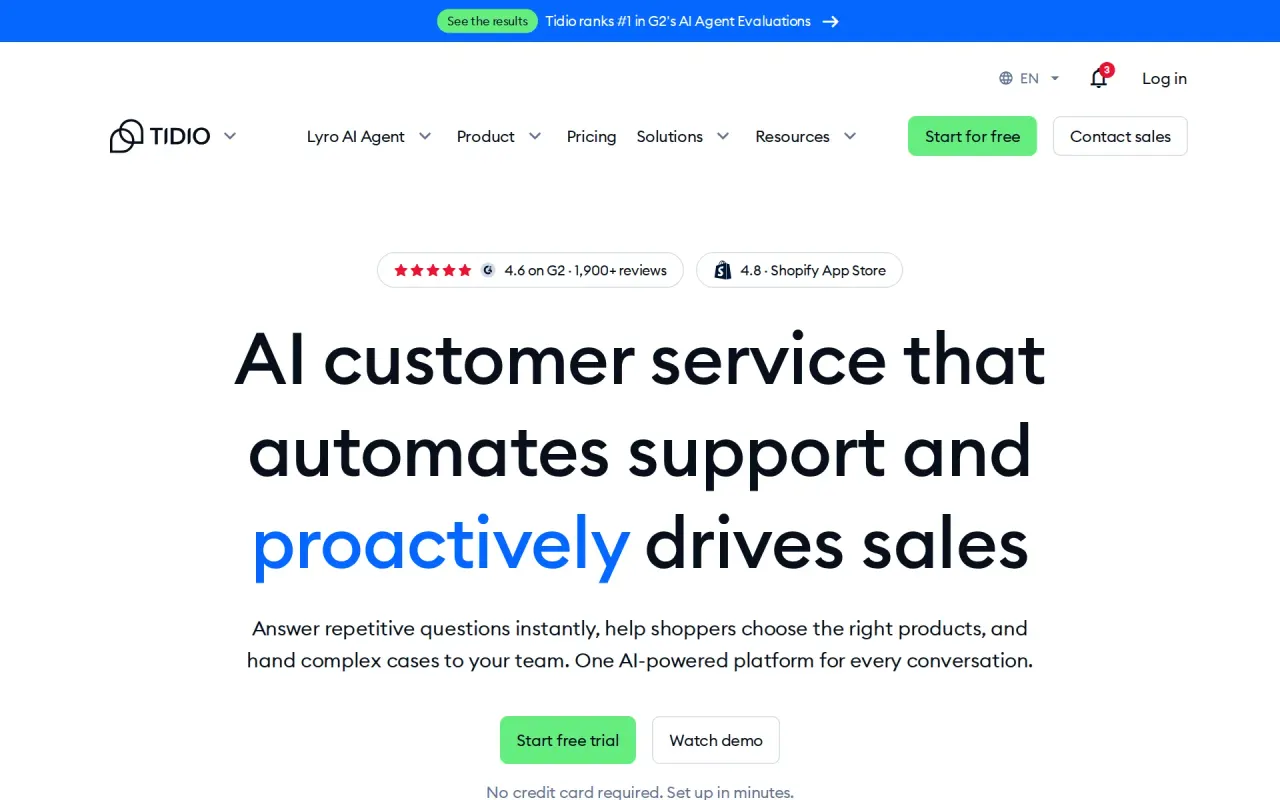
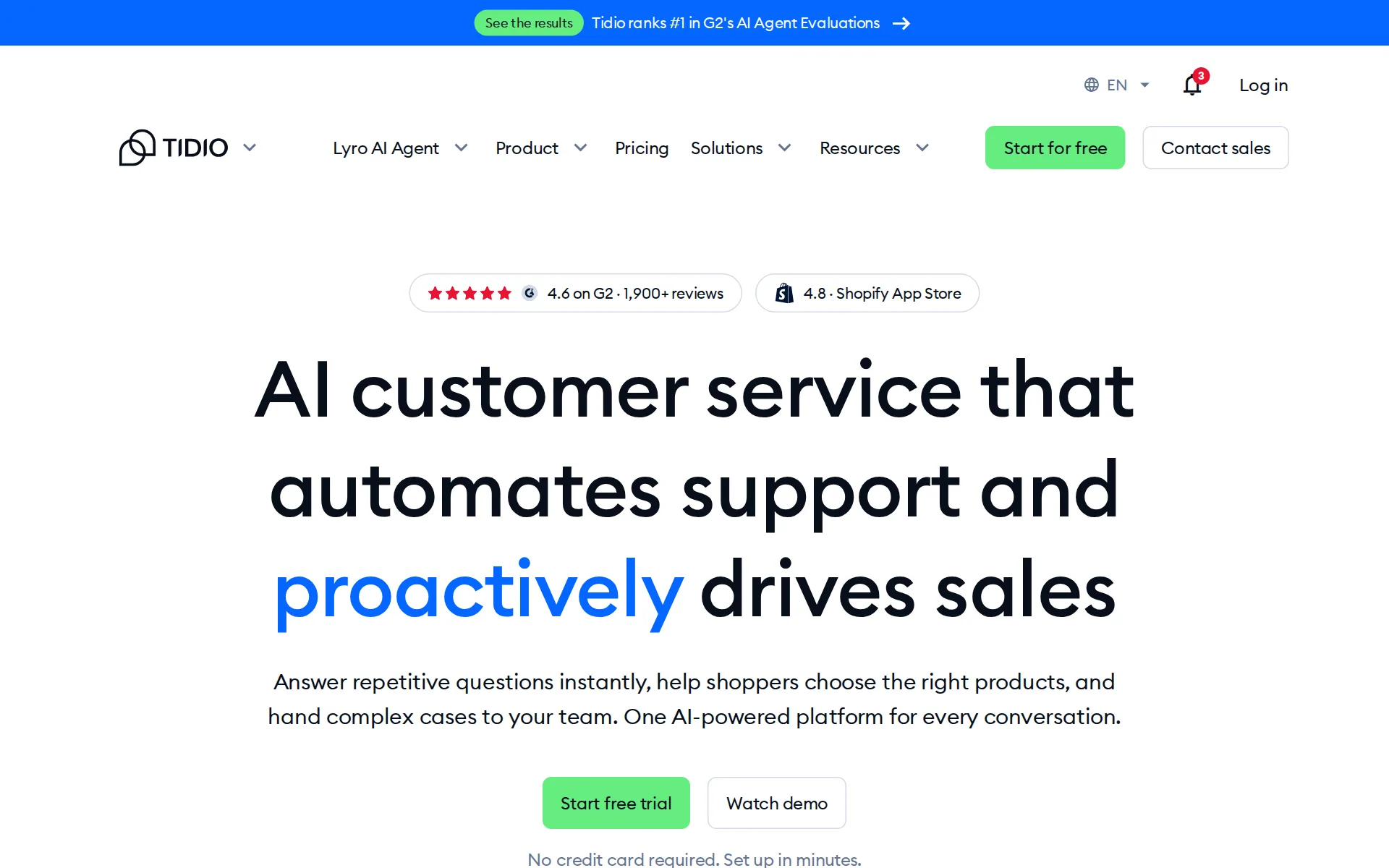
The site claims 300,000 businesses, a 4.6 G2 rating across more than 1,900 reviews, and a 4.8 rating on the Shopify App Store. Logos shown include Under Armour, The Body Shop, Dermalogica, Stanley and ADT. The headline performance claim, a 75% average Lyro resolution rate, is the vendor's own measurement across its customers, as are the case study figures such as $66K in attributed revenue. The company also operates adjacent products under separate brands, Ayro, Tidio Agents and Hubi AI, which are linked from its product switcher but priced elsewhere.
Where it fits, and where it does not
The fit is an ecommerce or small service business that wants chat, email and social support in one place with AI answering the repetitive part, installed on Shopify, WordPress or Wix without a developer. The conversation meter suits a team whose human reply volume is modest but whose traffic is not, since unanswered visitor messages are free.
It fits less well in three cases. A team larger than 10 agents cannot stay on a self-serve plan, since seats are capped at 10 below Plus. A buyer who needs SSO, the full OpenAPI, the Analytics API or an outside help desk behind Lyro has to reach Plus at $300 a month plus usage, or Premium with no published price at all. And a regulated buyer who needs a stated uptime figure, a documented retention control, a region choice or a written assurance on model training will not find those on the public pages and will have to ask. HIPAA and a custom-trained model are mentioned only for the bespoke agent service sold through Tidio's custom AI team, not for the self-serve product.
How much does Tidio cost?
Free Plan
$0/mo.
- 50 Billable conversations
- 100 visitors reached
- Total price
Starter
$24.17/mo.
- 50 Lyro AI Agent conversations (one-off)
- 100 Flows visitors reached
- Live chat & Ticketing
- Live visitors list
- Operating hours
- Basic analytics
- Live chat channels
Growth
$49.17/mo.
- Analytics
- User permissions
- Automatic chat assignment
- Automatic reply
- Live typing preview
- Viewed pages history
- Macros
Plus
$749/mo.
- Departments
- Multiproject
- Custom branding
- Ticketing automations
- Live chat support
- Dedicated Success Manager
- OpenAPI
- Custom limits
- Custom number of seats
- Larger attachments
Premium
Contact for pricing
- From 3 000 Lyro AI conversations
- Guaranteed 50% Lyro AI resolution rate
- Pay-per-resolution billing
- Mobile SDK
- AI insights & CSAT
- Super admin role
- Custom analytics
- Copilot
- Lyro AI as a managed service
- Slack support
- Compliance
- SSO
Price and terms
- Card to start
- YesNot required
- Sign up without sales
- YesYes
What needs a higher plan
- Plus
- Public API, MCP server, Take your data out
- Premium
- Single sign-on
- Plus and Premium
- Uptime promise
From tidio.com/pricing, checked .
Works with
- YesShopify
- YesWordPress
- YesWhatsapp
- YesInstagram
- YesMessenger
- YesWooCommerce
- YesAdobe Commerce
- YesShopware
- YesKlavyio
- YesMailchimp
- YesHubSpot
- YesAgile CRM
- YesZoho CRM
- YesGoogle Tag Manager
- YesGoogle Analytics
- YesZendesk
- YesPipedrive
- YesZapier
- YesSalesforce
- YesMicrosoft Dynamics
- YesActiveCampaign
- YesMagento
- YesBigCommerce
- YesBrevo
 ChatGPT
- YesCopper
- YesDiscord
- YesDrupal
- YesEcwid
- YesWix
For AI agents
- MCP server
- PartlyPlus
- API
- PartlyPlus
The facts, with their sources
What it costs to start
- What the price counts
- YesPlans are metered on conversation volume rather than seats: quotas for billable human conversations, Lyro AI conversations and Flows visitors, with Premium quoted only.
"Billable conversation" refers to any live chat, ticket, email or social media channel conversation that includes a message from a human agent (you).
tidio.com/pricing - Free tier
- YesA standing Free plan costs nothing and carries 50 billable conversations, 100 Flows visitors and a one-time grant of 50 Lyro AI conversations.
Every Tidio account starts with 50 Lyro conversations, but you need to upgrade to the Lyro AI Agent plan to refresh it monthly.
tidio.com/pricing - Self-serve signup
- YesYou can register, run the 7-day trial and buy Starter or Growth without sales contact; only the Plus and Premium plans route to a sales form.
During the free 7-day trial, you can test all Tidio features and plans and see how to improve customer service and accelerate sales.
tidio.com/pricing - Card to start
- NoThe pricing FAQ states plainly that no card is needed for the trial, and the homepage calls to action repeat "No credit card required".
You don’t need to provide us with your credit card information to access the free trial.
tidio.com/pricing - Contract
- YesMonth-to-month billing is offered beside an annual option that gives two months free, and plan changes take effect at the next billing cycle.
Yes, you can. You can downgrade or upgrade your subscription at any time.
tidio.com/pricing - Cancel any time
- PartlyCancellation is self-service at any time and stops future charges, but the terms refuse refunds for the remainder of a period already paid for.
You can cancel your recurring subscription at any time to stop further charges to your account. You will maintain access to all of the features in…
tidio.com/terms
What it works with
- Works with
- YesThe integrations directory names Shopify, WordPress, Wix, Zendesk, Salesforce, HubSpot, Intercom, Microsoft Dynamics, Pipedrive, Zapier, WhatsApp, Instagram and Messenger, with over 120 claimed in total.
Seamlessly integrate your favorite apps like Salesforce, Zendesk, and Shopify to streamline support, automate workflows, and deliver exceptional…
tidio.com/integrations - Languages
- YesLyro detects the customer's language and replies in it across chat and email, and Multilanguage is ticked for every plan including Free in the comparison table.
Lyro detects each customer’s language and answers naturally in it, across chat and email.
tidio.com - Public API
- PartlyThe OpenAPI and read-only Analytics API are publicly documented, but only Product endpoints work on a paid Lyro quota; everything else needs the Plus or Premium plan.
You can use Product endpoints on the paid Lyro plan (any paid Lyro quota). All other OpenAPI endpoints are available exclusively on the Plus and…
developers.tidio.com/docs/openapi-enable - MCP server
- PartlyA hosted MCP server exposes the Analytics API to Claude, Cursor and ChatGPT, but it is read-only and the underlying API is restricted to the Plus and Premium plans.
The Analytics MCP server lives at: https://taa-mcp.data.tidio.com/mcp
developers.tidio.com/docs/analytics-api…
What it does on its own
- Acts on its own
- YesLyro Smart Actions carry out order updates and lead qualification without a person approving each step, calling external systems in real time.
Lyro handles tasks like order updates or lead qualification without human assistance. It integrates with your external systems to take real-time…
tidio.com - Limits on what it may do
- YesLyro is confined to the knowledge and guidance the customer supplies, with configurable handoff and escalation rules deciding when it stops and asks.
Set flexible handoff and escalation rules to chat personally with high value customers or discuss sensitive topics. Monitor conversations in real…
tidio.com/ai-agent - No code needed
- YesLyro is added to a site in a few clicks and trained on existing content, and Flows are built on a drag-and-drop canvas from ecommerce templates.
Add Lyro to your website in a few clicks, without technical knowledge. Feed him with your support content and get resolutions from day one.
tidio.com/ai-agent
What happens to your data
- Take your data out
- PartlyA read-only Analytics API exports conversations, tickets, ratings and Lyro threads into a warehouse or BI tool, but it is sold only with the Plus and Premium plans.
The Analytics API exposes your project's Tidio data as read-only tabular endpoints - conversations, tickets, ratings, Lyro threads and daily…
developers.tidio.com/docs/enable-analyt…
Whether a company can buy it
- Security audits
- PartlySOC 2 Type II is completed and refreshed in 2026 with a report on request, alongside GDPR, CCPA and the EU AI Pact; no ISO 27001 or ISO 42001 certificate is published.
We are pleased to announce that Tidio has successfully completed its 2026 SOC 2 Type II audit, conducted by an independent third-party firm.
trust.tidio.com - Single sign-on
- PartlySingle sign-on appears only in the Premium column of the plan comparison table; the four cheaper plans carry a cross, with two-factor authentication offered instead.
SSO
tidio.com/pricing - Audit log
- YesAudit logs are listed beside Lyro's guardrails as part of the AI oversight set, and role-based access control is recorded in the trust center.
Guardrails and audit logs
tidio.com - Uptime promise
- PartlyPriority SLAs are offered as part of scaling into the top plans and the custom agent service names a priority SLA, but no uptime percentage is published anywhere.
Scale into custom AI Agents, priority SLAs, and deep integrations with your stack.
tidio.com
Frequently asked questions
- What is Tidio?
- Tidio is a cloud-based customer support and sales platform for support and ecommerce teams that combines live chat, help desk ticketing, chatbot automation flows, and the Lyro AI Agent. It includes Flows, Analytics, Shared inbox, and the AI Copilot Chrome Extension, and integrates with Shopify, WordPress, HubSpot, Salesforce, Zapier, and OpenAPI.
- How much does Tidio cost? Is it free?
- A 7-day free trial is available.
- What is Tidio used for? Who is it for?
- Tidio is used for Live Chat, Lyro AI Agent, and Help Desk. It's built for Support teams that want to automate repetitive questions without losing human handoff, Ecommerce operators that need chat, ticketing, and proactive sales flows in one place, and Customer experience managers that want faster replies and clearer conversation routing.
- Does Tidio have an API and what does it integrate with?
- Developers can connect to Tidio via API and lists OpenAPI in Integrations. It integrates with Shopify, WordPress, Whatsapp, Instagram, Messenger, and 25 more.
Screenshots
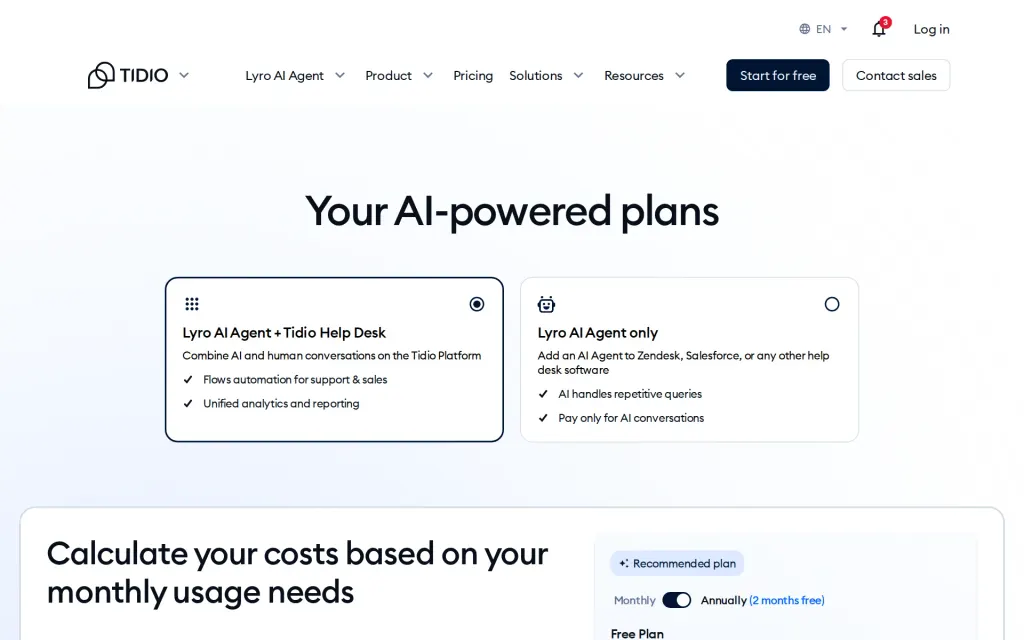
Pricing page, tidio.com, captured 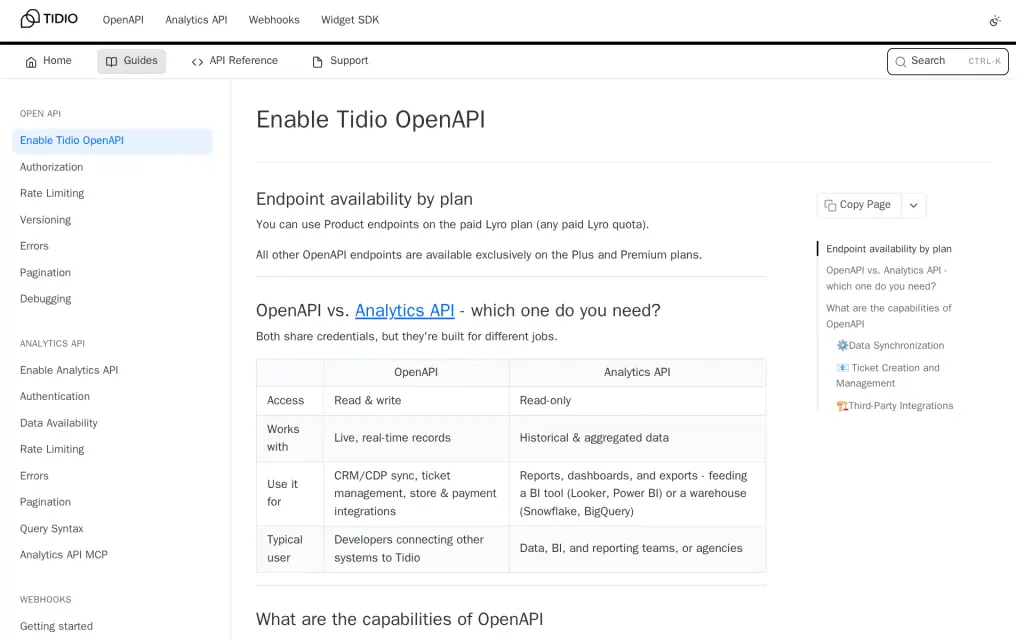
Docs, tidio.com, captured
Filed under
Sources and updates
Last changed
Is this yours? AI assistants like ChatGPT, Claude and Perplexity opened AgentsIndex pages 807 times from 17 October to 25 October. Claim it free and edit it in your dashboard, or feature it in Customer Service Agents.