
An RPA platform rebuilt around agents and orchestration
UiPath sells one platform for running business processes with three kinds of workers: software robots doing RPA, AI agents, and people who approve or handle exceptions. Agents are built either on the Agent Builder canvas in Studio, which the vendor pitches at business analysts and automation teams, or in Python with the UiPath SDK and CLI. Maestro then strings agents, robots, API workflows and human tasks into one long-running process.
Agents running inside the same platform as RPA can reach systems with no API. The vendor's FAQ says they "reach SAP, Citrix, desktop apps, and other legacy systems, alongside ERPs, CRMs, and document workflows". Evals, traces and audit logs record what an agent did, and Action Center hands exceptions to a person instead of letting a run fail silently.
Only the Basic plan has a public price, and it is capped
The pricing page has four tiers. Community is "free forever". Basic is "Starting at $25 per month". Standard and Enterprise both say "Contact Sales for pricing", and Standard also offers a 60-day free trial.
Basic is limited: up to 5 Basic, 5 Plus and 1 Pro user, 2 robots, one tenant, one folder, limited agent calls, and hosting in Europe only. It also lacks document classification and extraction, automation tests, SSO, audit and custom roles, which all start at Standard. The plan card carries a notice: "Basic is evolving. An updated plan offering is coming soon."
The catalog price is not the whole bill. Footnotes warn that users and robots "may require additional license purchases" and that for some capabilities "usage may require additional purchase". The coding agents page adds that third-party AI model subscriptions "must be purchased separately".
The pricing page has no monthly or annual switch. The purchase docs describe both a monthly plan and an annual one paid upfront "at a discounted rate", but give no annual figure. Self-serve subscriptions can be canceled "at any time, with no penalty". Enterprise licenses cannot be bought online.
Open to outside coding agents and to MCP in both directions
UiPath publishes a CLI and open-source agent skills so that Claude Code, Codex, Cursor or any agent following the AGENTS.md format can scaffold, test and deploy UiPath automations from a terminal, according to UiPath for Coding Agents.
MCP works both ways. Orchestrator can host MCP servers that expose RPA workflows, agents, API workflows and BPMN processes as tools for outside AI clients. It also connects to remote MCP servers through Integration Service. The docs list seven server types, and two of them (Platform and Swagger) are marked preview. The Orchestrator API is documented with Swagger. Webhooks push job, queue and trigger events, but the docs say failed deliveries "are not stored, and cannot be retried or exported", and a failing endpoint gets disabled for an hour.
Certifications are extensive, and so is the gating behind them
It also says the AI Trust Layer means AI "never trains a model on your data", with "Zero third-party retention".
Most of these controls depend on the plan. The pricing comparison marks bring-your-own identity provider, custom roles, audit, data collection opt-out and self-hosting as unavailable on Basic. Customer-managed encryption keys, your own credential store and CI/CD integration are Enterprise only. Cold data retention is fixed by tier at 6 months, 2 years or 5 years.
The Trust Center also posted a security event detected on October 26, 2026, which temporarily took down Insights, Automation Ops and Cloud Robots. UiPath states there is "no indication that customer data or any services that process customer data were affected".
Bring your own model is promised broadly but priced as Enterprise
The two pages disagree. The pricing page lists "Bring your own model for available AI products" only under Enterprise, and shows it as "+ Bring your own model" on the Enterprise column of the AI governance row. Neither page says whether open-weight models in particular are supported.
A two-decade company aimed at large and regulated enterprises
Its own pages talk to large organizations: "Modern enterprises and the world's most regulated industries run business orchestration and automation on our platform." Self-hosting through Automation Suite is recommended for air-gapped sites and strict data sovereignty.
A small team that wants a quick no-code agent will find the free Community plan usable. The Basic plan's Europe-only hosting, two robots and missing SSO limit it to trials and personal automations, and anything past that leads to a sales conversation with no published price.
UiPath price and terms
Terms
- Free plan
- YesYesCommunity plan is free forever with Studio, Maestro and coding-agent support, backed by the community forum
- Sign up without sales
- PartlySome plansUp to Basic
The terms in full
A separate 60-day free trial of the Standard tier is offered.
For AI agents
- MCP server
- Yesdocs.uipath.com,
- API
- Yesdocs.uipath.com,
What needs a higher plan
- Standard
- Data stays in your region, Self-hosted, Single sign-on, Audit log
- Enterprise
- Open models, Your own model key
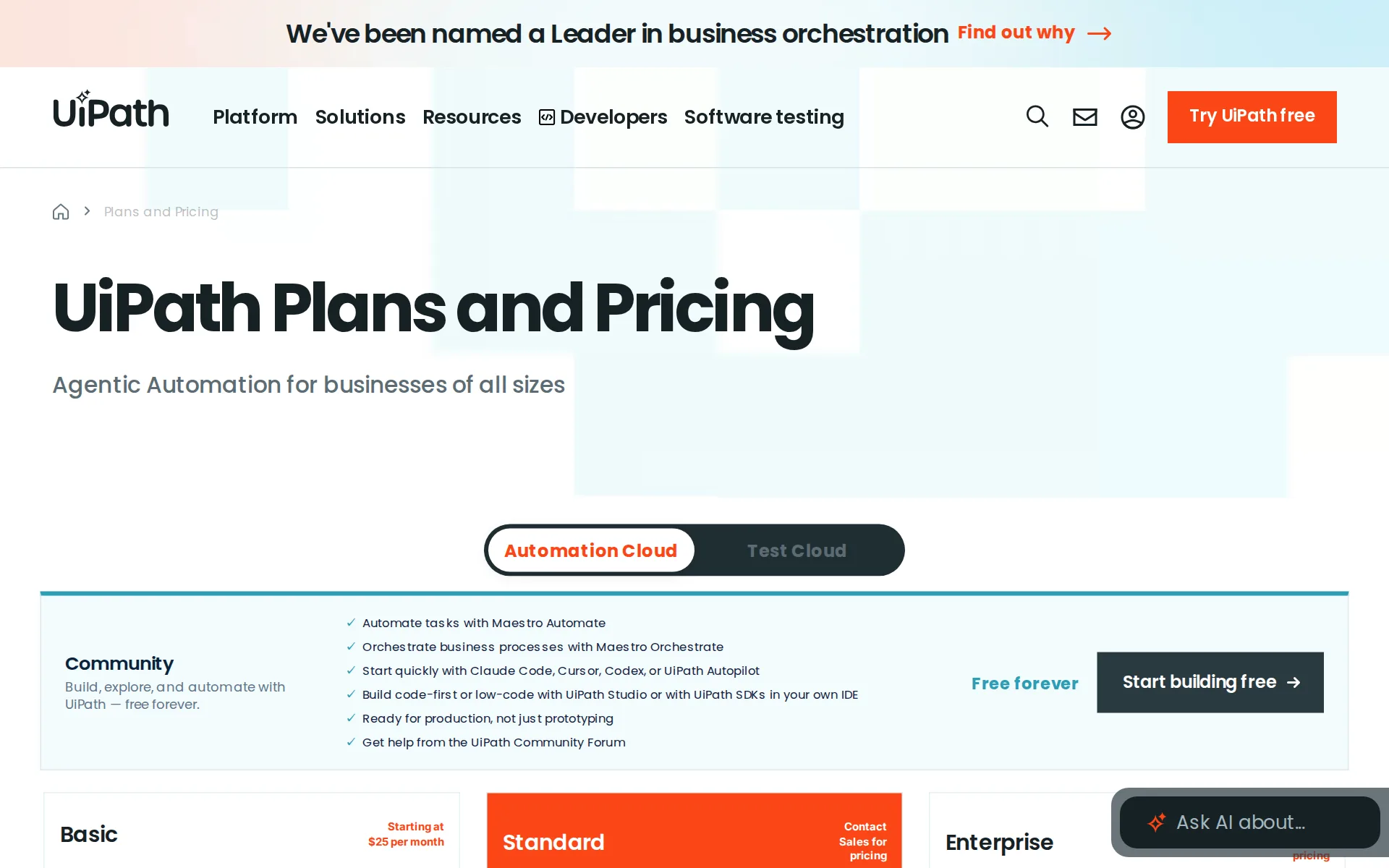
Pricing page, captured
uipath.com/pricing, checked
All plans and limits
| Plan | Price | Main limits |
|---|---|---|
| Community | $0 a month | Unattended robots: one unattended robot |
| Basic | From $25 a month | Cold data retention: 6 months; Robots: 2; Users: Up to 5 Basic, 5 Plus, and 1 Pro User |
| Enterprise | Price on request | Cold data retention: 5 years; Robots: No Limit; Users: No Limit |
| Standard | Price on request | Cold data retention: 2 years; Robots: No Limit; Users: No Limit |
| Test Cloud Enterprise | Price on request | Organizations: up to 3 |
| Test Cloud Standard | Price on request | Organizations: 1 |
Read from uipath.com/pricing.
What we checked on UiPath
What the price counts
Pricing combines a plan tier with licenses: Basic has a flat starting price, Standard and Enterprise are quoted, and user and robot licenses are bought on top across all tiers.
Users and robots are available for purchase across all 3 tiers
uipath.com/pricingChecked
Free to use
A free Community plan exists and can build agents using a shared monthly pool of credits. The licensing docs list deploying and running agents as processes only for Standard and higher plans.
On the Community plan, agent development draws from the Community Monthly Pool of Credits, which the organization shares with other capabilities.
Self-serve signup
The Community and Basic plans can be started and bought online without sales, but Enterprise licenses cannot be purchased online and Standard pricing requires contacting sales.
Online license purchase is available for non-enterprise licensing plans only. If you are an Enterprise customer, licenses are not available through…
Contract
Self-serve Basic can be paid monthly at a fixed rate and changed or canceled at each monthly interval; an annual prepay option is offered at an unstated discount.
With the Monthly payment plan, you will be billed once a month at a fixed rate, and you can cancel or modify your subscription at the end of each…
Cancel any time
Online subscriptions can be canceled from the Licenses admin page at any time without a penalty, with access running until the paid period ends and then reverting to Free.
You can cancel your subscription at any time, with no penalty.
Works with
Integration Service ships pre-built connectors and a Connector Builder; the site names deep integrations with Salesforce, Microsoft 365, Azure, Copilot, Snowflake and Google Cloud, plus RPA reach into SAP and Citrix.
Realize the value of agentic automation through deep integration with Microsoft 365, Azure, and Copilot.
Public API
Published agents can be started by API or webhook in a production workspace, and a Python SDK and CLI give programmatic access to processes, jobs and other platform resources.
Runs invoked via API or webhook in a production workspace.
MCP server
Both directions are documented: an agent can add external MCP servers as tools, and a UiPath MCP Server exposes deployed agents and automations as tools at a URL the docs say external MCP clients connect to.
The UiPath MCP Server exposes UiPath artifacts (RPA workflows, agents, API workflows, Maestro BPMN processes, and Integration Service activities) as…
Webhooks
Orchestrator webhooks push job, robot, queue, process and trigger events to external URLs, but failed deliveries are dropped and never retried or stored.
You can subscribe to Orchestrator events and send them to any external DCM, BPM, or CRM solution
Acts on its own
Autonomous is one of the two agent types you pick at creation, human escalation is marked optional in the build flow, and a deployed agent runs as an unattended Orchestrator job; UiPath itself steers high-stakes regulated work back to deterministic automation.
Autonomous: Create an agent that acts independently to complete a given task.
Limits on what it may do
The agent can act only through tools you explicitly grant it, per-tool guardrails evaluate deterministic rules before and after each call with Log, Filter, Block or Escalate actions, and a max-iterations setting caps its reasoning loops.
Action Center brings approvals and exception handling into the agent's flow. Exceptions get reviewed, not missed.
No code needed
Agent Builder is a drag-and-drop canvas in UiPath Studio for analysts and subject experts, with a Python SDK path for developers who want code later.
Configure agent logic without writing code.
Several agents
Two separate mechanisms: an agent can add another published agent as a tool and chain capabilities, and Maestro coordinates several agents, robots and people across one BPMN process.
Design and run an entire business process as one Business Process Model and Notation (BPMN) diagram. Coordinate AI agents, UiPath robots, and people…
No training on your data
Agent data is off the training path by default: the Agent Builder row shows no fine-tuning of UiPath models and no training of third-party models, and product-improvement processing can be opted out contractually or by ticket, though that opt-out row is an em dash on Basic.
No. The AI Trust Layer enforces zero third-party retention. Your data stays inside the boundaries you approve and is never used to train third-party…
Retention you control
AI prompts get zero third-party retention, but platform cold data is kept for a period set by plan (6 months, 2 years or 5 years) rather than a stated customer setting.
Cold Data Retention 6 months 2 years 5 years
uipath.com/pricingChecked
Data stays in your region
Automation Cloud offers regional data residency in eight regions. Basic is fixed to Europe, Standard picks one region and Enterprise can pick several.
Europe region only
uipath.com/pricingChecked
Self-hosted
The platform can be deployed in a buyer's own environment on the Standard and Enterprise plans but not on Basic, which is hosted in the European cloud region only.
Hosted in one of our available regions or on your own premise
uipath.com/pricingChecked
Open source
The UiPath Python SDK used for code-first agents is published on GitHub under the MIT license. The site does not present the Agent Builder canvas itself as open source.
A comprehensive Python SDK for interacting with UiPath's Automation Platform
Take your data out
You can export agent audit data from the AI Trust Layer Audit tab and request deletion, but export is documented as an Enterprise-plan feature, exports expire after seven days, and no UiPath page states what becomes of unused Platform or Agent units at contract end.
Customer data is deleted in accordance with the contractual provisions or upon request.
Security audits
The Trust Center lists SOC 2 Type 2, ISO/IEC 27001:2022, ISO/IEC 42001, HIPAA, HITRUST and C5 among its attestations, with reports available on request.
On the page: Compliance list on the Trust Center overview
trust.uipath.comChecked
Single sign-on
Bringing your own identity provider is a Standard and Enterprise feature, shown as a dash on Basic. The pricing page does not say whether that means SAML or OIDC.
Bring your own Identity Provider
uipath.com/pricingChecked
Audit log
The product page says audit logs apply to every agent, but the plan comparison ticks 'Ensure compliance through audit' only for Standard and Enterprise, with a dash for Basic.
On the page: Comparison table, 'Secure and govern' section; Basic shows a dash, Standard and Enterprise show checks
uipath.com/pricingChecked
Uptime promise
A 99.9% service uptime figure is stated on the Basic plan card, and the higher tiers include everything in Basic.
On the page: Basic plan card, Basic Tier includes list
uipath.com/pricingChecked
Its own model
Agents can use UiPath's own models alongside third-party ones; document extraction (IXP) on Google Cloud defaults to Gemini.
Connect a diverse set of third-party and UiPath models.
You pick the model
You pick the model per agent from the Properties panel, models are provisioned through the AI Trust Layer, and the vendor states a model can be swapped later without rebuilding the agent.
Model-agnostic by design. Connect any third-party LLM or use UiPath-curated models. Switch models without rebuilding the agent.
Open models
Open-source models on any OpenAI-compatible gateway, such as Fireworks, can be connected through AI Trust Layer. The docs say this is only for enterprise customers, on request.
This capability is generally available for enterprise customers upon request.
Your own model key
The pricing table offers 'Bring your own model' and customer-managed encryption keys only on Enterprise. The agents docs say Community and Standard Trial agents default to bring-your-own models.
Bring your own model for available AI products
uipath.com/pricingChecked
UiPath alternatives


Questions about UiPath
- How much does UiPath cost?
- UiPath's Community plan is free. Its paid plans include Basic from $25 a month, Enterprise and Standard. From uipath.com/pricing, checked 5 November 2026.
- Does UiPath have an API or an MCP server?
- UiPath has an API. From docs.uipath.com/agents/automation-cloud/latest/user-guide/licensing, checked 3 November 2026. UiPath has an MCP server. From docs.uipath.com/orchestrator/automation-cloud/latest/user-guide/mcp-server-types, checked 3 November 2026.
- Is UiPath open source, and can you host it yourself?
- UiPath is open source. From github.com/UiPath/uipath-python, checked 3 November 2026. You can host UiPath yourself on Standard. From uipath.com/pricing, checked 3 November 2026.
- What have we checked on UiPath?
- 27 facts, under these headings: What it costs to start, what it works with, what it does on its own, what happens to your data, whether a company can buy it, models it can use.
- How do we check UiPath?
- We hold 27 facts on UiPath, quoted from 16 pages. Facts and price last checked 5 November 2026. Last change found 14 November 2026.
Sources and changes
Last changed
Sources16
- uipath.com/pricing
- uipath.com/platform/agentic-automation/agentic-ai/agent-builder
- docs.uipath.com/agents/automation-cloud/latest/user-guide/licensing
- uipath.com/platform/agentic-automation/agentic-ai
- uipath.com/platform/agentic-automation/foundation
- trust.uipath.com/
- docs.uipath.com/agents/automation-cloud/latest/user-guide/building-an-agent-in-studio-web
- docs.uipath.com/automation-cloud/automation-cloud/latest/admin-guide/connecting-oss-models-aitl
- docs.uipath.com/automation-cloud/automation-cloud/latest/admin-guide/managing-your-subscription
- docs.uipath.com/automation-cloud/automation-cloud/latest/admin-guide/purchasing-a-plan
- docs.uipath.com/automation-cloud/automation-cloud/latest/admin-guide/purchasing-non-enterprise-licenses
- docs.uipath.com/orchestrator/automation-cloud/latest/user-guide/about-webhooks
- docs.uipath.com/orchestrator/automation-cloud/latest/user-guide/mcp-server-types
- docs.uipath.com/overview/other/latest/overview/use-of-customer-data-with-agents
- uipath.com/platform/agentic-automation/ai-ecosystem
- github.com/UiPath/uipath-python
UiPath price history
The cheapest paid plan has cost $25 a month since 14 November 2026, on both readings.
| Price | Plan | First seen | Last seen | Readings | Source |
|---|---|---|---|---|---|
| $25 a month | 14 November 2026 | 16 November 2026 | 2 | Pricing page, read 14 November 2026 |
From 2 readings of UiPath's pricing page: 2 of our own checks since 14 November 2026. A date is when we read the page, not when the price changed.
Similar in Workflow automation
See all in Workflow automation
- GumloopNo-code builder for AI agents that connect to company apps, run on triggers and produce files.
- ActivepiecesAutomation workspace that limits each AI agent to the actions, pinned inputs and step caps you set, on any model.
- 5diveHire a team of always-on AI agents that run on a server you own, managed or self-hosted under MIT.
- The ColonyLets scheduled AI agents post, vote, message and trade with each other and with humans, not just query data.


From our research
- AI coding agents compared: what each one is actually good atEvery major coding agent now costs $20. We compare what that money actually buys, which projects are still maintained, and which tool fits which job.
- AI support agents: what each costs per resolved chatPublished prices for 21 AI support agents, converted to one comparable number: cost per conversation the AI closed on its own. Verified 13 Aug 2026.
- AI design agents for teams without a designerGamma vs. Beautiful.ai for decks, and three ad-creative generators compared by cost per asset.
Is UiPath yours?
Free, and the page then carries the verified owner mark. You confirm it with an email at uipath.com. Claim this listing
Report an error if a fact is wrong.