


What is Hume AI?
Hume AI is a voice AI platform for researchers, product teams, developers, and enterprises that need data, evaluation, and generation in one stack. It combines Human Feedback API studies, curated training-data libraries, and models such as TADA, Octave, and EVI for expressive synthesis, voice cloning, and speech-to-speech interaction. The platform spans 50+ languages, 48+ emotions, and customers including Snap Inc., Niantic Spatial, GAF, and Coconote.
What you're actually buying
Hume sells two developer-facing voice APIs — Octave (text-to-speech) and EVI (Empathic Voice Interface, real-time speech-to-speech) — priced on a self-serve ladder from free to $500/month plus custom Enterprise. Both are built on Hume's own speech-language model work rather than being a wrapper around someone else's TTS/ASR. Alongside these, Hume runs a separate B2B line: Kairos (a voice-AI evaluation/simulation platform), an Expression Measurement API, a Human Feedback API, and public leaderboards (Real World VoiceEQ, SLM Judge) that benchmark voice models by human judgment. As of August 2026 the homepage leads with the second line, not the APIs.
The January 2026 leadership exit — the fact that changes how you should read everything else
On January 22, 2026, Hume co-founder and CEO Alan Cowen and roughly seven of the company's top engineers moved to Google DeepMind under a non-exclusive technology-licensing deal, to work on Gemini's voice capabilities. Hume named Andrew Ettinger — previously Chief Revenue Officer at Appen, a data-labeling/LLM-evaluation company — as the new CEO. Ettinger told TechCrunch and stated in Hume's own press release that the company is 'on track to generate more than $100M in revenue this year from research partnerships with frontier AI labs,' driven by voice data, annotation, evaluation and RL-infrastructure work rather than the consumer-facing developer API. That $100M figure is Ettinger's own statement to press, not an audited number — treat it as a vendor claim.
Is the developer API still a going concern?
Yes, on the evidence available: Hume shipped Octave 2 and EVI 4-mini in 2026, and both the Python and TypeScript SDKs on GitHub were pushed as recently as 9 July 2026 (six months after the Google deal), each with low open-issue counts. The API status page shows 99.53% uptime across APIs for the May–Aug 2026 window and no active incidents at the time of writing. So the product is maintained, but it is no longer the thing the company's homepage or growth narrative is built around — a buyer betting on Hume as a long-term voice-API vendor should weigh that the founding research team that built EVI/Octave is now at Google.
How pricing works, and where the free/cheap tiers bite
Verified directly from the live pricing page (Aug 2026): Free ($0), Starter ($3/mo), Creator ($7/mo first month, $14/mo after), Pro ($70/mo), Scale ($200/mo), Business ($500/mo), and Enterprise (custom). Octave TTS includes a monthly character allowance (10k on Free up to 10M on Business) with usage-based overage from $0.15 down to $0.05 per 1,000 characters on paid tiers — Free and Starter have no overage, meaning you're hard-capped once the allowance runs out. EVI (speech-to-speech) gives 5 minutes/month free, scaling to 12,500 minutes on Business, with per-minute overage from $0.07 down to $0.04. Two trade-offs worth flagging plainly: a commercial license for Octave-generated audio is only granted from the Creator tier up — Free and Starter users cannot legally use the speech they generate commercially. And SOC 2 Type II / GDPR / HIPAA compliance is Enterprise-only (custom pricing), so regulated use cases (e.g. healthcare voice apps) skip the self-serve tiers entirely.
Company and funding
Hume raised a $50M Series B led by EQT Ventures in March 2024 (joined by Union Square Ventures, Nat Friedman & Daniel Gross, Metaplanet, Northwell Holdings, Comcast Ventures, and LG Technology Ventures), per Hume's own announcement. Third-party aggregators (Crunchbase, Tracxn) cite a ~$219M valuation at that round and total funding in the $75–80M range, but Hume has not published a valuation or cumulative-funding figure itself, so treat those numbers as unverified secondary-source estimates rather than confirmed fact. The company's post-Google-deal ownership and structure (independent, per its own statements) has not been independently corroborated beyond the press coverage of the CEO transition.
Independent user feedback: thin
We could not read Hume's G2 reviews page, so no rating is verified there. No Gartner Peer Insights listing was found for Hume. General sentiment surfaced in search (Reddit/press quotes) describes EVI's voice as realistic and fast but notes it can misread emotional tone — these are secondhand snippets, not something independently verifiable at scale. There is no Trustpilot presence for Hume AI (a same-named but unrelated company, 'Hume Health,' makes fitness scales and should not be confused with this listing).
Open-source footprint
The core EVI/Octave models are closed and API-only — there's no open-weight release for either. Hume does maintain open-source SDKs (Python, TypeScript, Swift, .NET — all MIT licensed) and separately open-sourced TADA (Text-Acoustic Dual Alignment), a small speech-language model (1B/3B parameters) released on GitHub, which had 1,008 stars and was last pushed 11 May 2026.
Works with
- Hugging Face
 Claude
- YesGPT
- YesGemini
- YesGrok
- YesKimi K2
- YesLlama

Frequently asked questions
- What is Hume AI?
- Hume AI is a voice AI platform for researchers, product teams, developers, and enterprises that need data, evaluation, and generation in one stack. It combines Human Feedback API studies, curated training-data libraries, and models such as TADA, Octave, and EVI for expressive synthesis, voice cloning, and speech-to-speech interaction. The platform spans 50+ languages, 48+ emotions, and customers including Snap Inc., Niantic Spatial, GAF, and Coconote.
- What is Hume AI used for? Who is it for?
- Hume AI is used for Human Feedback API, Conversational Audio, and Emotional Reproduction. It's built for Voice AI researchers, Product teams building conversational agents that need natural turn-taking and emotional understanding, and Developers shipping text-to-speech experiences that need voice cloning and expressive delivery.
- Does Hume AI have an API and what does it integrate with?
- Hume AI doesn't publish a public API. It integrates with Hugging Face, Claude, GPT, Gemini, Grok, and 2 more.
Screenshots

Pricing page, hume.ai, captured 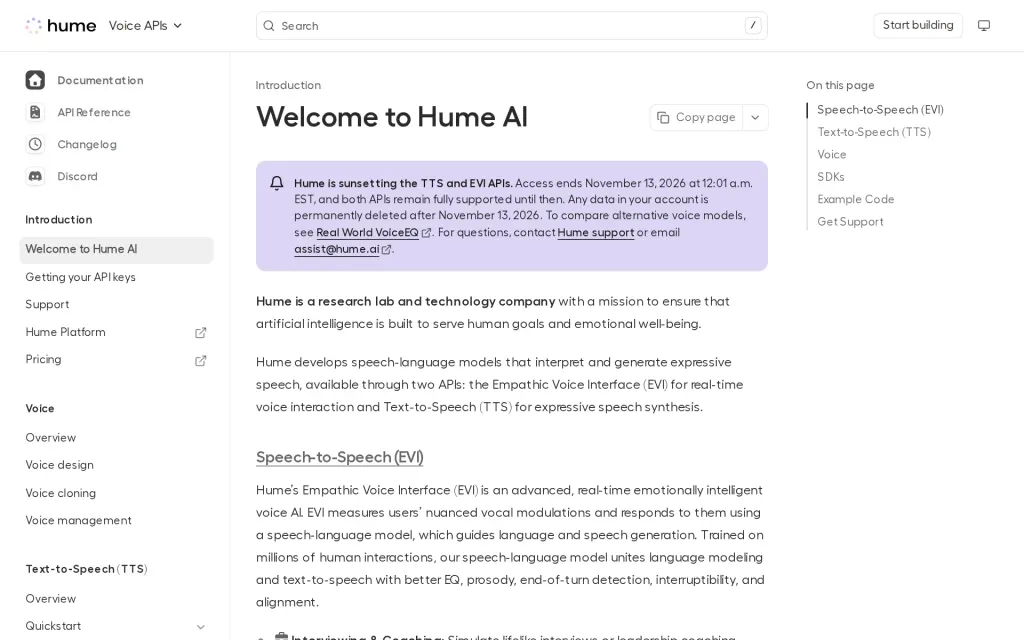
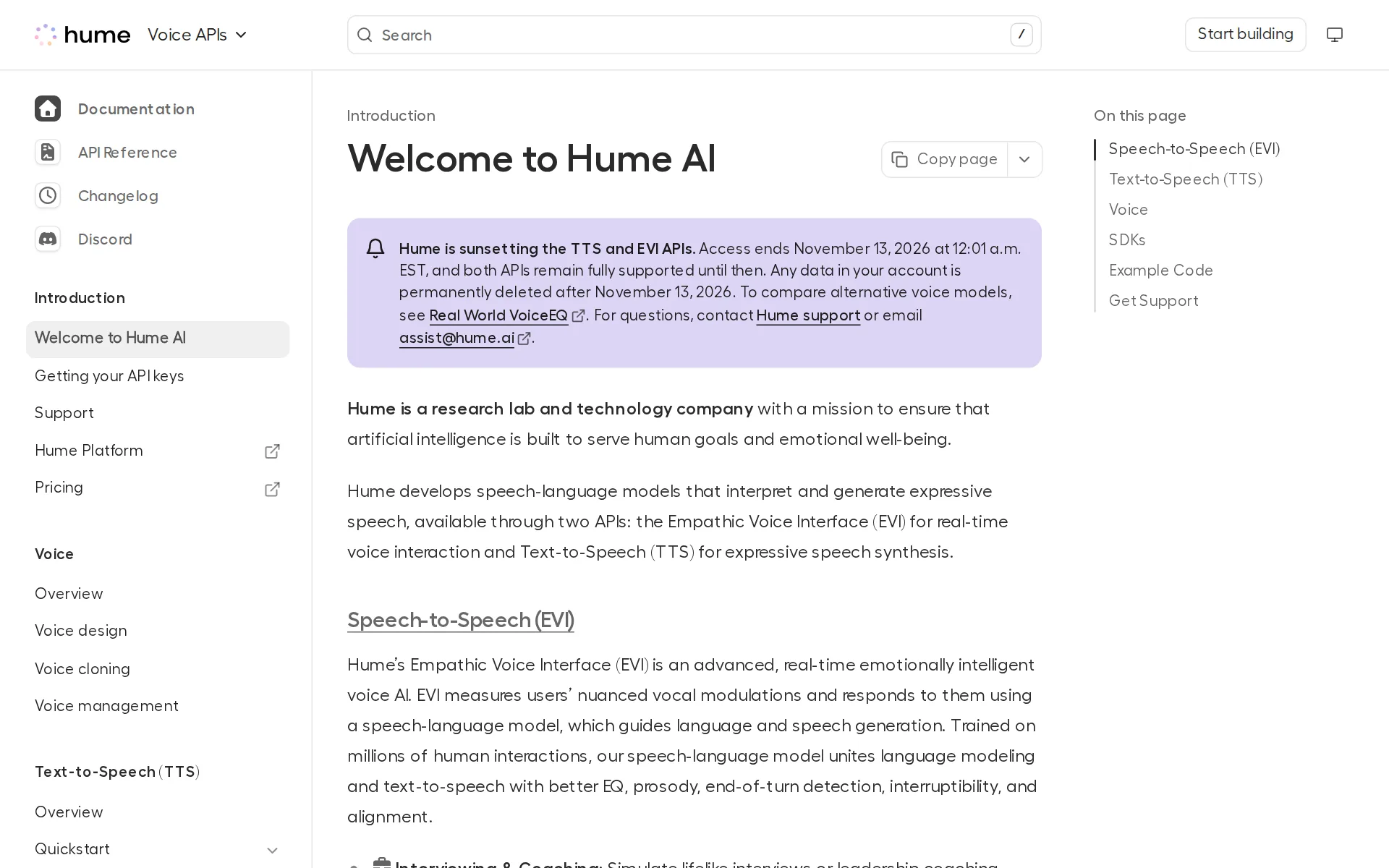
Docs, hume.ai, captured

Sources
Based on Hume AI's own pages, not a hands-on trial. Checked against hume.ai on .
- hume.ai/pricing
- hume.ai
- hume.ai/empathic-voice-interface
- dev.hume.ai/docs/voice/overview
- techcrunch.com/2026/01/22/google-reportedly-snags-up-team-behind-ai-voice-startup-hume-ai
- prnewswire.com/news-releases/hume-ai-appoints-new-ceo-302668103.html
- hume.ai/blog/series-b-evi-announcement
- crunchbase.com/funding_round/hume-ai-series-b--104433f9
- api.github.com/repos/HumeAI/hume-python-sdk
- api.github.com/repos/HumeAI/hume-typescript-sdk
- api.github.com/repos/HumeAI/tada
- status.hume.ai
- hume.ai/subprocessors
- g2.com/products/hume-ai/reviews
- dev.hume.ai/changelog
Filed under
Is this yours? AI assistants like ChatGPT, Claude and Perplexity opened AgentsIndex pages 807 times from 17 October to 25 October. Claim it free and edit it in your dashboard, or feature it in Voice AI Agents.