
At a glance
- Category
- AI model providers
- Tags
- BYOK
For developers
- Works with
- SAP, Salesforce, Dynamics 365, Visual Studio Code, GitHub Copilot, Microsoft Copilot Studio and 12 more
What is Microsoft Phi?
Microsoft Phi is part of Microsoft's Foundry stack for developers who need to benchmark, route, and govern model use in one platform. It offers more than 11,000 models, fine-tuning, distillation, and real-time routing, plus agent orchestration, Foundry IQ retrieval, and tools for OCR, translation, speech, and object detection. It connects with Microsoft Defender and Entra ID, and is used by ACOM Foundry.
Phi itself is a family of open-weight models: Microsoft publishes the weights for download and bills Azure AI Foundry inference as you use it.
What does Microsoft Phi do?
Microsoft Phi runs as part of Microsoft's Foundry stack, where teams can access more than 11,000 models, benchmark them for a use case, and route requests in real time to the most suitable model. The surrounding platform also supports fine-tuning, distillation, and model upgrades with minimal coding, so Phi fits into a broader workflow rather than a standalone model drop-in.
On the agent side, Foundry pairs model access with agent orchestration, grounded retrieval through Foundry IQ, and pre-built or customizable tools for OCR, translation, speech, and object detection. At scale, the platform is used by more than 80,000 enterprises and digital natives, with 80% of Fortune 500 companies represented among Azure customers.
Microsoft also points to 3B daily enterprise search queries and over 60 million downloads across its ecosystem. ACOM Foundry is cited among customer stories, and the platform connects with Microsoft Defender and Entra ID for governance and access control.
Why use Microsoft Phi?
- It combines model access, agent orchestration, tools, and governance in one platform, reducing the need to assemble separate services.
- Real-time model routing helps teams balance quality and cost without manually switching models.
- Built-in user access permissions and Microsoft Defender and Entra ID integration support org-wide control over AI usage.
- Serverless hosting and event-driven functions make it easier to scale agentic apps without managing infrastructure directly.
- The platform spans cloud and edge scenarios, so teams can keep workloads close to where they run.
- More than 11,000 models give teams broad choice for benchmarking and specialization without leaving the platform.
Who is Microsoft Phi for?
- AI developers who need to benchmark and route models without stitching together separate tools.
- Platform teams who want governed model access, agent orchestration, and shared controls.
- Data scientists who fine-tune and distill models as part of an Azure-based workflow.
- Enterprise architects who need retrieval, tools, and access permissions in one stack.
What are Microsoft Phi's key features?
cost-effective
Runs on a pay-as-you-go model with 11K+ Foundry Models, helping teams control spend while testing production use cases.
high-performance
Delivers low-latency inference for more than 11,000 foundational, open, reasoning, multimodal, and industry-specific models, which matters for responsive apps and agents.
at the edge
Supports local and edge deployment for on-device or nearby inference, reducing round trips and keeping AI available in constrained environments.
The AI app and agent factory
Provides a single place to build AI apps and agents with Microsoft Agent Framework, Azure App Service, and Microsoft Copilot Studio, speeding delivery.
Models
Offers more than 11,000 Foundry Models, including open, reasoning, multimodal, and industry-specific options, so teams can match model choice to each workload.
Agent Service and frameworks
Connects agent workflows to Microsoft Agent Framework, LangChain, CrewAI, and LlamaIndex, helping teams assemble agents with familiar development tools.
Knowledge and Tools
Links agents to SAP, Salesforce, Dynamics 365, Azure Cosmos DB, and Azure AI Search, so they can use business data and external systems.
Observability and trust
Adds fleet-wide monitoring, Microsoft Defender, Microsoft Security, and customizable guardrails, giving teams visibility and control over model behavior.
What are Microsoft Phi's use cases?
Model routing for AI developers
AI developers use Microsoft Phi to benchmark and route models without stitching together separate tools, using real-time model routing to send each request to the right model for latency, cost, or quality. They can compare options in Models and keep production behavior consistent as workloads change.
Governed agents for platform teams
Platform teams use Microsoft Phi to stand up shared agent workflows with The AI app and agent factory, then manage access through built-in user access permissions. They also rely on Observability and trust to monitor usage and apply customizable guardrails across teams.
Fine-tuning workflows for data scientists
Data scientists use Microsoft Phi to fine-tune and distill models inside an Azure-based workflow, starting with Models and then validating results through fleet-wide monitoring. They can iterate faster with high-performance models while keeping experiments aligned to deployment needs.
Retrieval and tools for architects
Enterprise architects use Microsoft Phi to assemble retrieval, tools, and permissions in one stack, combining Knowledge and Tools with pre-built and customizable tools. They can connect governed data sources and services while keeping agent behavior visible through Observability and trust.
How does Microsoft Phi work?
- Start with Models and choose a Phi option that fits your workload, then compare cost-effective and high-performance choices before you wire it into development or production.
- Connect your first app or agent flow in The AI app and agent factory, using Agent Service and frameworks to shape orchestration without assembling separate point solutions.
- Add Knowledge and Tools to ground responses in your data and actions, then plug in pre-built and customizable tools for retrieval, workflows, and external system calls.
- Set built-in user access permissions and customizable guardrails so teams can safely share the stack, while Observability and trust keeps behavior visible during testing and rollout.
- Monitor usage with fleet-wide monitoring, then refine routing and deployment choices over time so the same setup stays reliable as demand, models, and agents evolve.
Microsoft Phi price and terms
Terms
- Free plan
- YesYesMicrosoft says Phi models can be used for free for real-time deployment through Microsoft Foundry or Hugging Face
The terms in full
Hosted inference through MaaS is billed pay-as-you-go. The linked pricing page names no Phi per-token rate as of 2026-11-18. Separately, a new Azure account gets a $200 credit for 30 days, which is a credit grant and not a price.
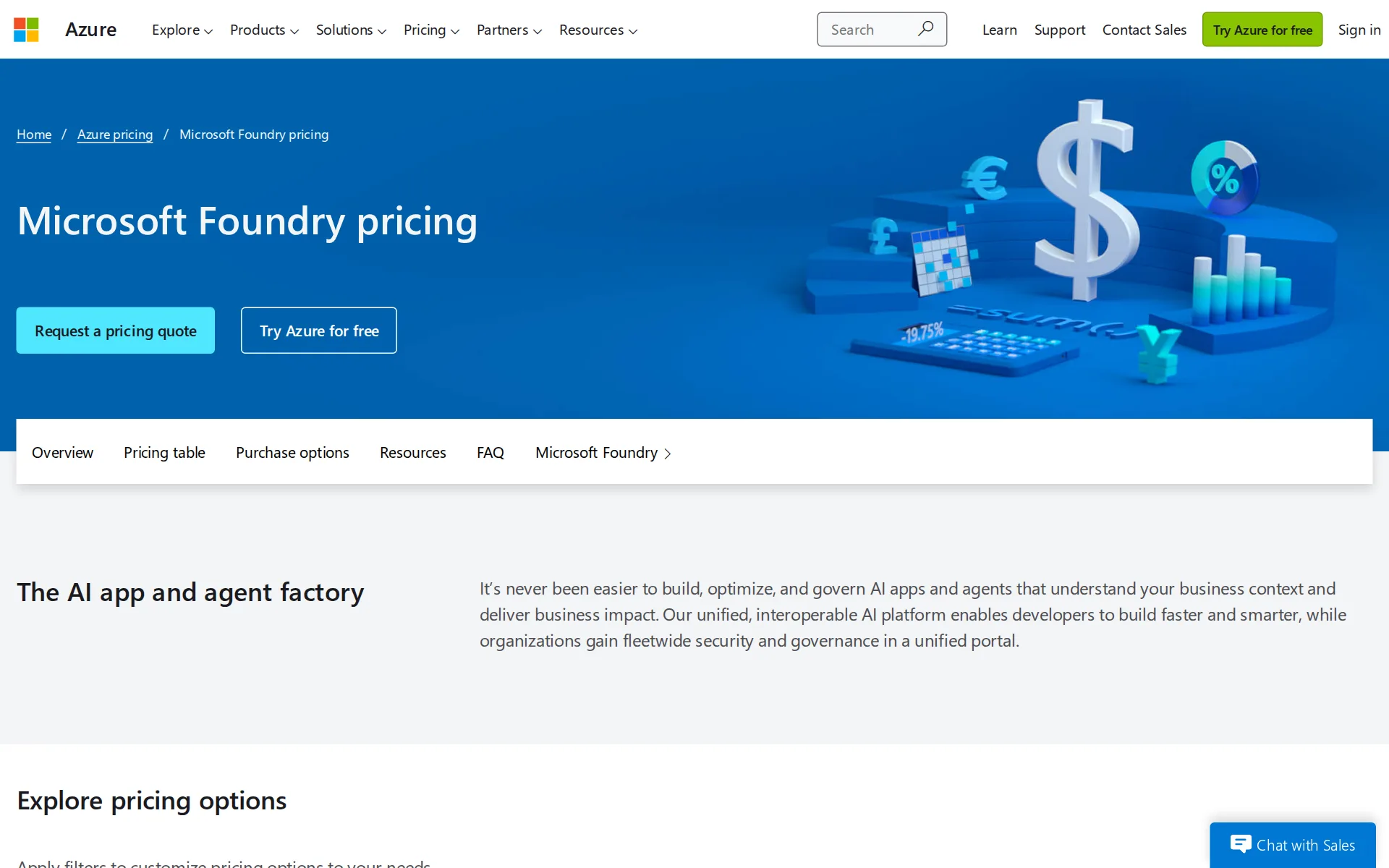
Pricing page, captured
azure.microsoft.com/en-us/pricing/details/microsoft-foundry, checked
What we checked on Microsoft Phi
What the price counts
Hosted Phi is billed per use, pay-as-you-go through inference APIs. The Foundry Models pricing page that the Phi pricing link redirects to has no Phi per-token rates, so no figure is published.
Phi models are available through model as a service (MaaS) with pay-as-you-go billing via inference APIs.
Free to use
Microsoft says Phi open models can be deployed free for real-time use through Microsoft Foundry or Hugging Face. Only the hosted MaaS inference API is billed by use.
Users can also access Phi models for free for real-time deployment through Microsoft Foundry or Hugging Face.
Questions about Microsoft Phi
- How much does Microsoft Phi cost?
- Microsoft Phi has a free plan. From its own pages, checked 18 November 2026.
- What have we checked on Microsoft Phi?
- 2 facts, under one heading: What it costs to start.
- How do we check Microsoft Phi?
- We hold 2 facts on Microsoft Phi, quoted from 3 pages. Facts and price last checked 18 November 2026, when we also found the last change.
Sources and changes
Last changed
Sources on azure.microsoft.com3
What changed1
- What it does
Microsoft Phi price history
We have read the price once so far, on 18 November 2026: free.
| Price | Plan | First seen | Last seen | Readings | Source |
|---|---|---|---|---|---|
| Free | 18 November 2026 | 18 November 2026 | 1 |
From our research on 18 November 2026. A date is when we read the page, not when the price changed.
Similar to Microsoft Phi
- Fireworks AIInference, model routing and fine-tuning for open models on one OpenAI-compatible endpoint, serverless or in your cloud.
- ERIUS PHONERented cloud Android phones, each in its own container, that keep an agent's apps and sign-ins between sessions.
- TinyFishWeb search, page fetching, cloud browsers and goal-driven web automation for AI agents, with search and fetch free.
- SmitheryPublic MCP server registry, now run by Arcade, listing direct vendor MCP URLs after its proxy shut down.


From our research
- Hyper review (2026): an autonomous coding agent that ships verified pull requestsHyper plans, tests and delivers pull requests to your GitHub repository from an isolated cloud sandbox, with a verification check on each one and a hard spending cap on every run.
- superbot review (2026): pricing, pros and cons, alternativessuperbot runs errands, admin and scheduled tasks on your computer, free to start with paid credit plans, for busy people, but promises no uptime.
- TinyFish review: one API for search, extraction and agentsTinyFish: one API for live web search, page fetching, cloud browsers and multi-step agents. What it does, how its pay-as-you-go pricing works, who it fits.
Is Microsoft Phi yours?
Free, and the page then carries the verified owner mark. You confirm it with an email at azure.microsoft.com. Claim this listing
Report an error if a fact is wrong.