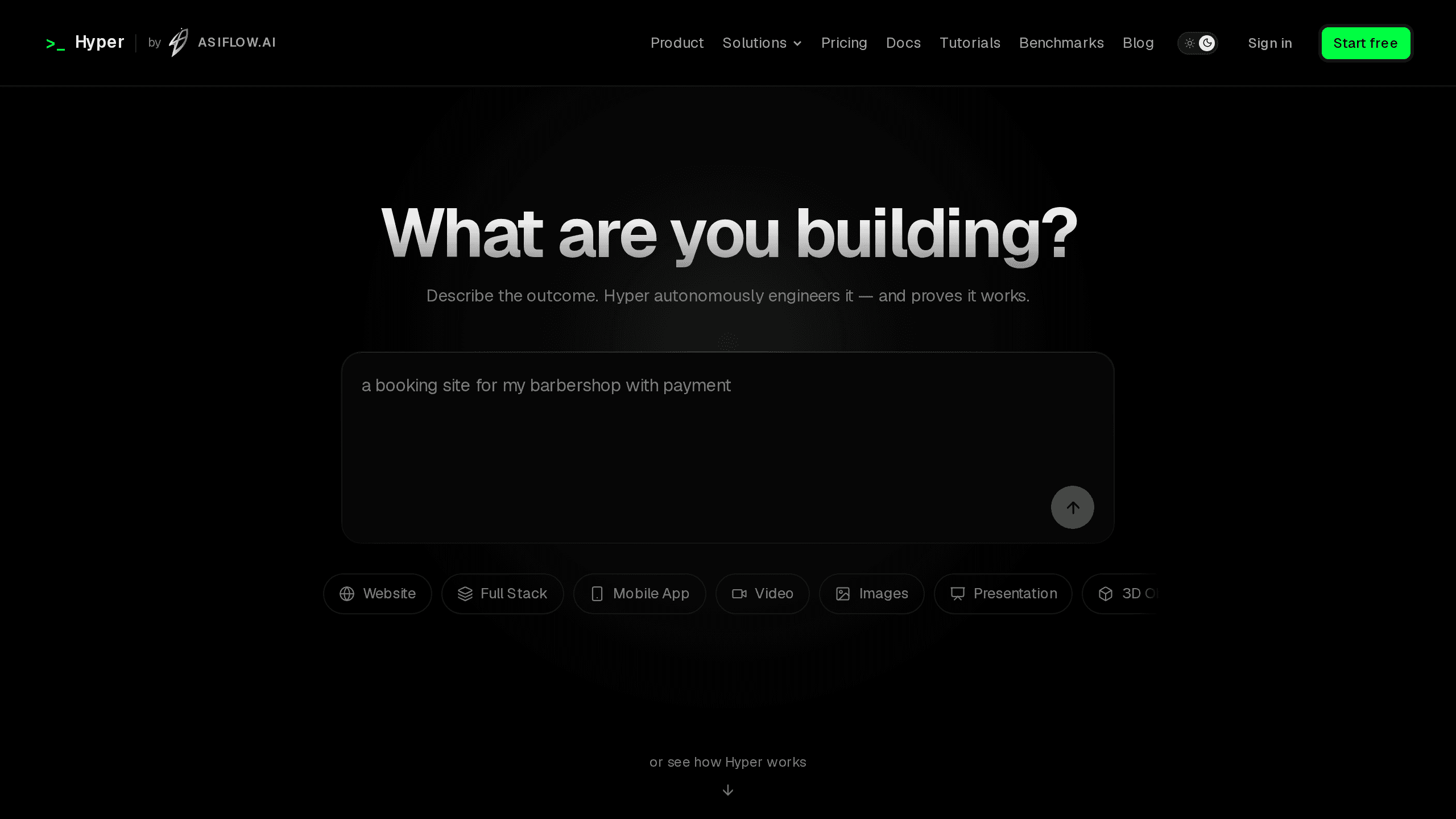
Hyper review (2026): an autonomous coding agent that ships verified pull requests
Hyper plans, tests and delivers pull requests to your GitHub repository from an isolated cloud sandbox, with a verification check on each one and a hard spending cap on every run.

Written by AgentsIndex
Hyper is a Featured listing on AgentsIndex. This post was commissioned as part of that tier. Every claim in it is sourced and independently checked.
Before you hand real work to a coding agent, you want a change you can review, proof that it works, and a bill that cannot run away.
Hyper, from ASI Flow, gives you all three. You connect a GitHub repository and describe an outcome. Hyper plans the work, waits for your approval, then edits, installs and tests in an isolated cloud sandbox and hands the result back as an ordinary pull request, with a verification check attached. Every run stops at a spending cap you set before it starts.
Key takeaways
- Hyper is a hosted coding agent: each session runs in its own cloud sandbox and delivers branches, commits and pull requests to your GitHub repository.
- Each pull request its GitHub App opens carries a "Hyper verification" check built from the test and browser runs Hyper recorded, and its Autopilot only counts a task as done when there is evidence.
- Spending is capped by design: a run stops at the cap you set, and Hyper's terms say you cannot be charged past your limits without opting in.
- The free plan runs the real agent, in the cloud, with $5 of model credit a month and no card. Paid plans start at $20 a month.
- Hyper never merges a pull request itself, and every turn can be rewound.
Hyper at a glance
| What it is | A hosted autonomous coding agent with an in-browser IDE, from ASI Flow, Inc. |
| Best for | Founders and small teams who want to hand GitHub work to an agent and review the result as a pull request |
| Where it runs | One isolated cloud sandbox per session; nothing to install |
| What it hands back | Branches, commits and pull requests on your GitHub repository, with a verification check |
| Models | Routes each turn across Anthropic, OpenAI and Google models; no API keys of your own needed |
| Pricing | Free $0 with $5 credit a month; Pro $20, Team $30, Max $70, Ultra $100 and Apex $200 a month |
| Spend control | A hard cap per run, on by default |
| Coding agents on AgentsIndex | Claude Code, Devin, OpenHands, GitHub Copilot, Cursor |
What Hyper does best
It shows its work. Each pull request Hyper's GitHub App opens carries a "Hyper verification" check: it passes when every test or browser-flow run Hyper recorded passed, fails when one did not, and stays neutral when nothing was recorded. A reviewer sees at a glance what the agent proved before reading a line of the diff. Autopilot, which works through a whole project plan, goes further: a task only counts as verified when its evidence resolves against Hyper's verification ledger, a pull request's checks or a file that exists, and critical tasks are re-checked by a separate verifier session from a clean workspace.
It cannot run away with your money. Hyper puts a cost estimate in front of the plan, shows the model and exact cost on every reply, and sets a hard cap before each run. Sessions stop at the cap. Its terms make this contractual: hard spend caps are on by default, "so you cannot be charged past your configured limits without opting in". Autopilot adds a cap per task on top, by default $10, with a $50 cap for the whole run.
It keeps you in charge. Hyper plans first and waits for your approval before it executes. It never merges a pull request; deploys, publishes, writes to outside systems and secrets need your approval. Every turn that changes the workspace is checkpointed first, so you can rewind to any point or discard changes file by file.
It starts free, for real. The free plan is the actual product: hosted sessions on your own GitHub repositories, with $5 of model credit a month and no card. That is enough to judge Hyper on your own code rather than on a demo.
Your code stays yours. Hyper's privacy policy says it does not train models on your private code, on any plan, and its terms leave you all rights to your code and say the output Hyper generates for you is yours.
How it works
The core loop is three steps. You describe an objective; Hyper turns it into a reviewable plan with goals, tasks and acceptance criteria; once you approve it, the agent works in a sandbox and returns pull requests.
One sandbox per session. Each session runs in its own container with full Linux isolation, never shared or reused across users, and the container and its clone of your repository are destroyed at teardown. Your GitHub token never sits inside the sandbox: Hyper injects it for each git operation through a short-lived credential helper, so code the agent runs cannot read it.
From a GitHub issue to a pull request. With the GitHub App installed, you label an issue "hyper" or mention @hyper, and Hyper opens a session, implements the change with tests, runs the suite and opens a pull request that closes the issue. You can steer it with comments on the pull request:
/hyper also cover the empty-input case in the tests
Review comments and failing CI checks flow back into the session, so the agent picks them up without being asked again.
Autopilot and Pro Active Mode. On paid plans, Autopilot runs a project plan server-side, with each task as its own session. Pro Active Mode watches connected repositories for new issues, CI failures on main, Dependabot and code-scanning alerts, and can investigate them or, at its "fix" level, write a reproduction test first and open a pull request. Findings that touch security, authentication, billing, payments, migrations or infrastructure stay investigate-only even at that level.
Parallel work. A session can be forked, or fan out up to five sub-agents, each in its own git worktree. /attempts 3 runs three approaches and keeps the best.
Other agents can hand it work. Hyper's Agent API (OAuth 2.1, REST with an OpenAPI 3.1 description, an MCP server and an A2A endpoint) lets Claude, ChatGPT, Claude Code, Cursor or your own agents delegate a task to Hyper under scoped permissions and a budget. The SDKs are on PyPI and npm:
pip install asiflow-hyper
npm install @hyper-asiflow/sdk
Key features
- Verified pull requests. A "Hyper verification" check on each pull request from the GitHub App, built from recorded test and browser runs.
- Hard spend caps. A cap per run, on by default, with the model and cost shown on every reply.
- Plan before code. A reviewable plan with acceptance criteria, executed only after you approve it.
- Checkpoints and rewind. Every workspace-changing turn is snapshotted; rewind to any point or discard single files.
- Model routing. Each turn is routed across Anthropic, OpenAI and Google models, with fallback if a provider fails; you can pin a model per session, and you need no API keys of your own.
- GitHub App. Issue label or mention to start,
/hypercomments to steer, CI failures fed back to the agent. - Autopilot and scheduled missions. Server-side runs of a whole plan or a recurring job, within budget caps.
- A full workspace. An in-browser editor, an interactive shell into the sandbox, live preview, and access from a phone.
- Connected apps. Hosted sign-in to apps such as Slack, Notion, Gmail, Sheets, Stripe and Linear, plus remote MCP servers with secrets kept in an encrypted vault.
- Build from scratch. Websites, apps and dashboards built in a blank sandbox and published with a share link.
Is Hyper right for you?
Hyper fits best when you want to hand a piece of work to an agent and get back something you can review and trust:
- Founders and small teams who want features, fixes and tests delivered as pull requests while they do other work.
- Developers who review more than they type, and want each change to arrive with its evidence attached.
- Teams that need to keep agent spending predictable, with a cap on every run and on every Autopilot task.
- People who already use an agent, such as Claude or Cursor, and want it to delegate longer jobs to Hyper over MCP or REST.
Hyper is a young product from a small, founder-led team: it went standalone on 12 July 2026 and launched on 23 July. It works with GitHub repositories, stores data in the United States and its infrastructure providers' regions, and lists SOC 2 and ISO 27001 as on its roadmap rather than held, which its compliance page states in plain words.
Hyper pricing
Hyper's pricing page shows monthly prices by default, with an annual option that charges ten months for twelve:
| Plan | Monthly | Billed annually | Included each month |
|---|---|---|---|
| Free | $0, no card | n/a | $5 of model credit |
| Pro | $20 | $200 a year | $20 of model credit |
| Team | $30 | $300 a year | $30 of model credit, one subscription and one invoice for a small team |
| Max | $70 | $700 a year | $70 of model credit |
| Ultra | $100 | $1,000 a year | 10 times Pro's usage on rolling 5-hour and weekly windows; 15 parallel sandboxes |
| Apex | $200 | $2,000 a year | 20 times Pro's usage on the same windows; 25 parallel sandboxes |
The arithmetic the page invites: Hyper estimates an average model cost of about $0.30 per shipped pull request, which it calls an estimate rather than a guarantee. On that figure Free covers about 16 pull requests a month and Pro about 66, and because the plan's price is also its credit, a Pro month is model usage you would pay for anyway, with the sandbox, the verification and the GitHub workflow on top.
- Models are metered at the provider's price on every plan, and included credit renews each month; credit you buy separately does not expire with the month.
- A new free account can spend up to $1.50 a day until it is verified by a $0 card check, a GitHub connection or 48 hours of normal use.
- Paid plans are billed in advance through Stripe and end at the close of the billing period when cancelled.
- Referrals give $10 of credit to both sides.
How it compares
| Product | Free hosted agent | Free model credit | Hands back | Best for |
|---|---|---|---|---|
| Hyper | Yes, no card | $5 a month, included | Pull requests with a "Hyper verification" check | Founders and small teams handing off GitHub work |
| Claude Code | No; included from Claude Pro ($20/month) | No; Claude Code is not on the free plan | Local edits; pull requests from cloud sessions | Developers who want one subscription for chat and coding |
| Devin | No; Devin Cloud starts on Pro ($20/month) | A light quota with limited models | Pull requests from Devin Cloud | Teams with ticket-driven work across several git hosts |
| OpenHands | Yes, 10 conversations a day | None; bring a key or pay model costs | Pull requests from GitHub issues | Teams that want to self-host or audit the agent |
Where Hyper stands out: of these four, it is the only one whose free plan runs the agent in the cloud with the model credit included, and each pull request its GitHub App opens carries a check that shows what the agent verified.
Sources: Hyper pricing, Hyper GitHub App; the Claude Code, Devin and OpenHands figures are from their own pricing and product pages, checked on 13 October 2026, and summarised on our listings for Claude Code, Devin and OpenHands.
If you mostly write code yourself in an editor, an IDE assistant such as GitHub Copilot or Cursor does a different job, and pairs well with an agent like Hyper that takes whole tasks off your hands.
Questions to ask before you buy
- Can I try it on a real repository without a card?
- Can an autonomous run cost more than the cap I set?
- How do I know a pull request actually works?
- Will it merge or deploy anything without my approval?
- Is my code used to train models?
- What happens if a change goes wrong halfway through?
- Can the agents I already use hand work to it?
Company and maturity
Hyper is made by ASI Flow, Inc., a Delaware corporation whose launch announcement is datelined Cairo and Wilmington. The about page describes a founder-led, deliberately small team and lists four co-founders: Sherief Attia (CTO), Khaled El Azab, Hossam Hegazy and Muadh Alsaadi. Support runs through email, a Discord community and a "talk to a human" hand-off inside a session.
The changelog is busy: 41 dated entries between 12 July and 7 October 2026, from new models to agent access over MCP, REST and A2A. Hyper also publishes how it measures itself. On its own six-task AppBench, whose harness is open source under the MIT licence, the vendor reports that the Hyper agent passed 6 of 6 tasks against 4 of 6 for the same model answering once without tools, and it labels that result as small and its own. Its SWE-bench Verified run is listed as pending.
The verdict
Hyper suits anyone who wants to delegate coding work and review the result with confidence. Three things set it apart: a pull request that arrives with its verification attached, a spending cap that the terms make binding, and a free plan that runs the real agent on your own repository. The plan-first workflow, the checkpoints and the refusal to merge on its own keep you in control throughout.
The easy way to judge it is on your own code: connect a repository on the free plan, give Hyper a real issue, and read the pull request and its check. Start at hyper.asiflow.ai, or read our Hyper listing for the structured profile.
Frequently asked questions
What is Hyper?
Hyper is a hosted autonomous coding agent from ASI Flow. You connect a GitHub repository and describe an outcome, and Hyper plans the work, executes it in an isolated cloud sandbox once you approve the plan, and returns branches, commits and pull requests.
How much does Hyper cost?
Hyper has a free plan at $0 with $5 of model credit a month and no card. Paid plans are Pro at $20 a month, Team at $30, Max at $70, Ultra at $100 and Apex at $200, and annual billing charges ten months for twelve.
Can Hyper charge me more than I expect?
Hyper sets a hard spending cap before each run and stops the session when it is reached. Its terms say spend caps are on by default and that you cannot be charged past your configured limits without opting in.
Does Hyper merge pull requests on its own?
No. Hyper opens pull requests and never merges them. Deploys, publishing, writes to outside systems and secrets also need your approval.
How does Hyper show that a change works?
Each pull request from Hyper's GitHub App carries a Hyper verification check that passes only when every test or browser-flow run Hyper recorded passed. Autopilot counts a task as verified only when there is evidence, and re-checks critical tasks in a separate session.
Do I need my own model API keys?
No. Hyper routes each turn across Anthropic, OpenAI and Google models and meters the cost against your plan's credit. Bringing your own keys is optionally supported.
Does Hyper train on my code?
No. Hyper's privacy policy says it does not train models on your private code.
Which code hosts does Hyper work with?
Hyper works with GitHub repositories. Its GitHub App starts sessions from labelled issues and opens pull requests in your repository.
Sources
- Hyper, homepage: product, plan-first workflow, cost estimates, parallel attempts
- Hyper, pricing: plans, monthly and annual prices, included credit, caps, estimated cost per pull request (checked 13 October 2026)
- Hyper, FAQ: sandboxes, checkpoints, sub-agents, models, interfaces
- Hyper docs: GitHub App, Autopilot, Pro Active Mode, models, sandboxing, connecting a repository
- Hyper, security and compliance
- Hyper, terms and privacy policy
- Hyper, about, changelog, launch announcement and benchmarks
- Hyper's machine-readable facts file and the AppBench harness
- The SDKs on PyPI and npm
Capabilities, plans and test results described here are as documented by Hyper. Checked 13 October 2026.

More posts
BlogChatGPT vs Claude: Which One Should You Use?
AI Marketing Agents: Which Ones Produce Work You Can Actually Ship