
At a glance
- Category
- Agent Tools & Integrations
- Tags
- EU AI Act, GDPR, Open Source, Self-Hosted
Code
- Last push
- 10 October 2026
What is Open WebUI?
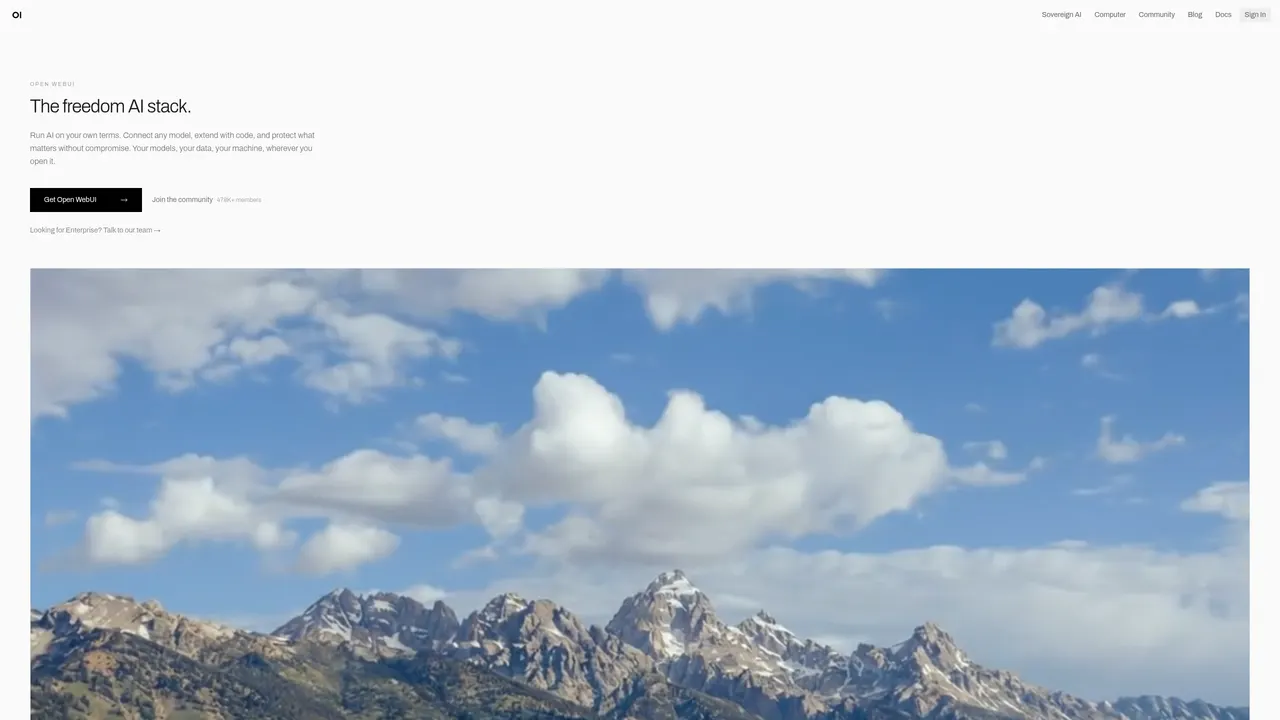
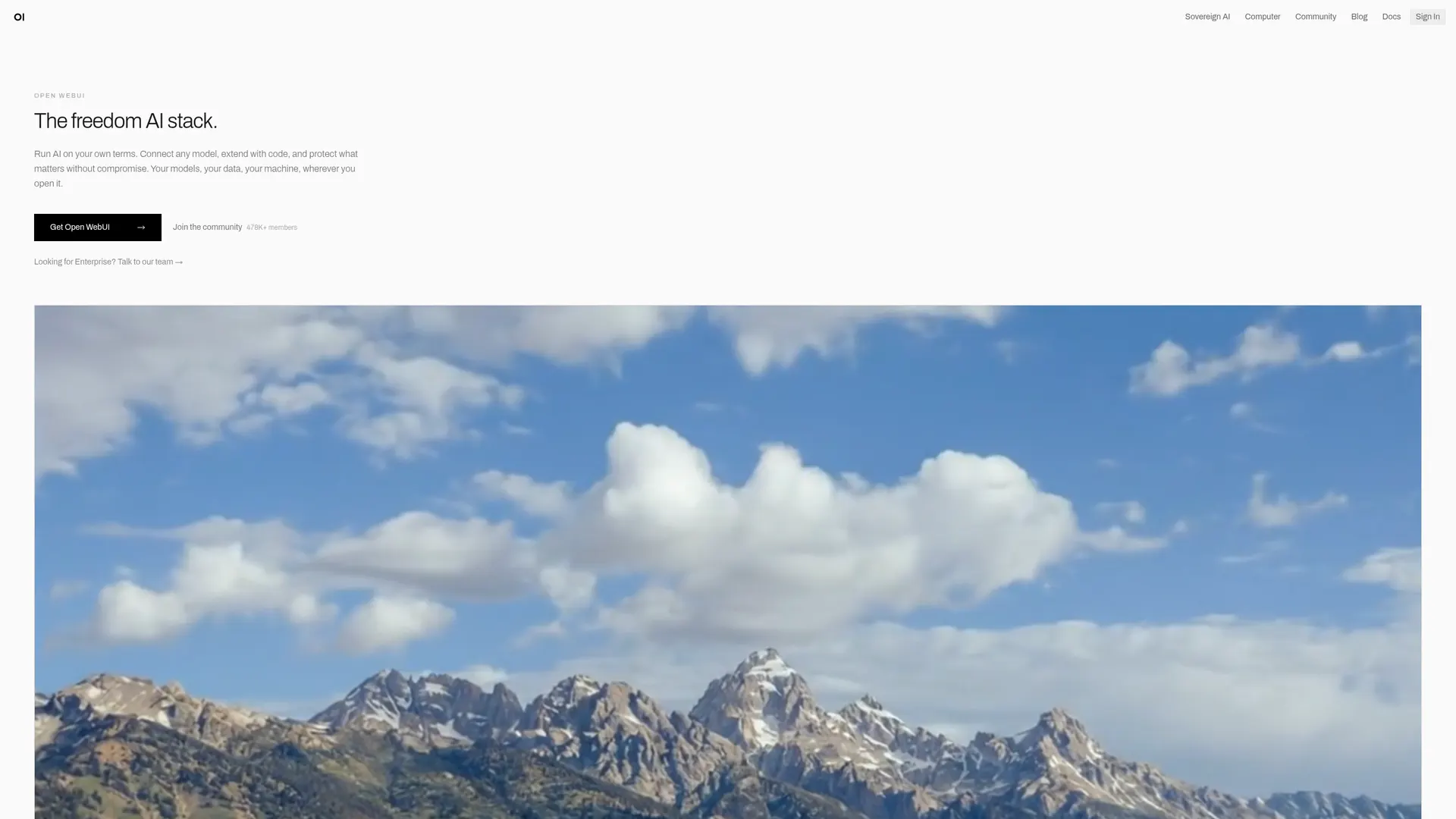
Open WebUI is a self-hosted AI workspace for teams that connects local or cloud models and layers a browser-based interface over chat, files, search, retrieval, generation, and Python extensions. It supports Voice, vision, SSO, RBAC, and audit logs, and can run on-premises or in air-gapped environments. Open WebUI also points to 376M+ downloads, 149K+ GitHub stars, and the Open WebUI customer reference.
What it actually does well
Open WebUI is a single Docker container (or pip/uv install) that gives Ollama or any OpenAI-compatible API a ChatGPT-style multi-user interface: conversation history, document RAG (PDF/DOCX/TXT/MD, chunked and embedded into a local vector store), web search integration, multimodal input, and role-based access control for teams. Its most distinctive feature is the Pipelines/Functions framework — Pipes, Filters and Actions let you inject arbitrary Python into the chat flow (custom routing, guardrails, logging, tool calls) without forking the app. It's the only self-hosted LLM UI with this combination of polish, true multi-user RBAC, and a plugin system, which is why independent write-ups consistently rank it above alternatives like LibreChat or AnythingLLM for team use.
Scale and activity
This is one of the most active open-source AI projects on GitHub (github.com/open-webui/open-webui). The official Docker image has been pulled 464,369 times (hub.docker.com/v2/repositories/openwebui/open-webui, checked 20 August 2026). Latest release is v0.11.0, published 27 July 2026, matching the PyPI package version.
The license, precisely
Timeline, verified against the project's own docs and current LICENSE file: the project started under MIT, moved to plain BSD-3-Clause in January 2025 (github.com/open-webui/open-webui/discussions/8467), then in v0.6.6 (April 2025) added a mandatory branding clause plus a Contributor License Agreement for new contributions (docs.openwebui.com/license/). All code through v0.6.5 stays BSD-3 — nothing was retroactively relicensed. The current clause (raw LICENSE file on GitHub) prohibits altering or removing 'Open WebUI' branding in any deployment, with three exceptions: deployments with 50 or fewer end users in a rolling 30-day window, written permission from the maintainers, or a paid enterprise license. Everything else about the code — using, modifying, self-hosting, even reselling access — remains unrestricted. This change drew real pushback; a November 2025 report describes community discussion of forking from the last BSD-licensed commit, citing Valkey and OpenSearch as precedent, though no maintained fork has emerged as of this writing (biggo.com/news/202511041923_open-webui-license-change-backlash).
Enterprise plan and pricing
There is no public price. The Enterprise page (docs.openwebui.com/enterprise/) lists what it unlocks — white-labeling/rebranding rights, multi-node high-availability deployment, LDAP/Active Directory/SSO integration, and access to add-on features like Terminals — but every path ends at 'Contact Enterprise Sales' and licenses are stated to be available only to registered entities/organizations. The community version stays free indefinitely for any deployment that keeps Open WebUI's branding, or for internal use under 50 users regardless of branding.
Security disclosure volume
Open WebUI has an unusually large number of published GitHub Security Advisories for a project this size — 147 distinct advisory IDs found via the OSV database (api.osv.dev, queried 20 August 2026), covering issues from SSRF and path traversal to a remote-code-execution report via the audio transcription upload endpoint and account-takeover via OAuth token exchange. Nearly all list a fixed version (255 fix entries across the advisories), and the project's security policy states it accepts reports only via GitHub Security Advisories, offers no bug bounty, and asks for 'several weeks' to triage given 'the very high volume of incoming vulnerability reports' (github.com/open-webui/open-webui/security/policy). A large batch of advisories was published in the past three weeks (2 August 2026 and 10 August 2026), several tagged '[AI-ASSISTED]', suggesting automated/AI-driven security research rather than a single incident. The volume reflects both real attack surface (file uploads, admin APIs, OAuth, multi-tenant data) and active, responsive patching — but it means self-hosters must track releases and update promptly rather than treating a deployed instance as fire-and-forget.
Who's behind it
Founded by Timothy Jaeryang Baek, originally shipped as 'Ollama WebUI' in October 2023 and renamed Open WebUI in January 2024. Open WebUI, Inc. was incorporated after the project was selected for the 2024 GitHub Accelerator and the inaugural 2024 Mozilla Builders Accelerator cohort, raising a reported $40,000 combined through those two programs (siliconangle.com/2024/09/23/mozilla-kicks-off-builders-accelerator-program-local-ai-startups, news.ycombinator.com/item?id=40459770). No VC funding is disclosed; the company's own team page describes 'a small core team' and does not list funding sources (docs.openwebui.com/team/). Revenue comes from enterprise licensing, GitHub Sponsors, and site advertising rather than investment.
Works with
- YesOllama
- YesCodex
 Claude Code
 Cursor
- YesGrok
- YesOpenCode
 Cline
Cline- YesYouTube
Frequently asked questions
- What is Open WebUI?
- Open WebUI is a self-hosted AI workspace for teams that connects local or cloud models and layers a browser-based interface over chat, files, search, retrieval, generation, and Python extensions. It supports Voice, vision, SSO, RBAC, and audit logs, and can run on-premises or in air-gapped environments. Open WebUI also points to 376M+ downloads, 149K+ GitHub stars, and the Open WebUI customer reference.
- What is Open WebUI used for? Who is it for?
- Open WebUI is used for self-hosted AI interface, Voice, and vision. It's built for Platform teams, Security and compliance teams, and Developers.
- Does Open WebUI have an API and what does it integrate with?
- It integrates with Ollama, Codex, Claude Code, Cursor, Grok, and 3 more.
- Is Open WebUI open source or self-hostable?
- Open WebUI can be self-hosted on your own infrastructure.
Screenshots
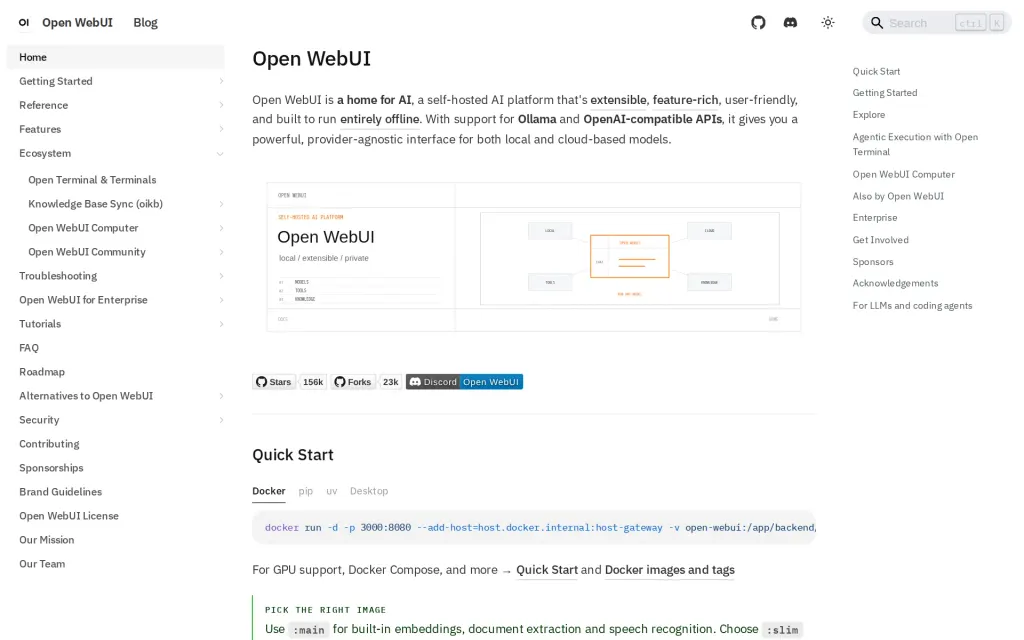
Docs, openwebui.com, captured
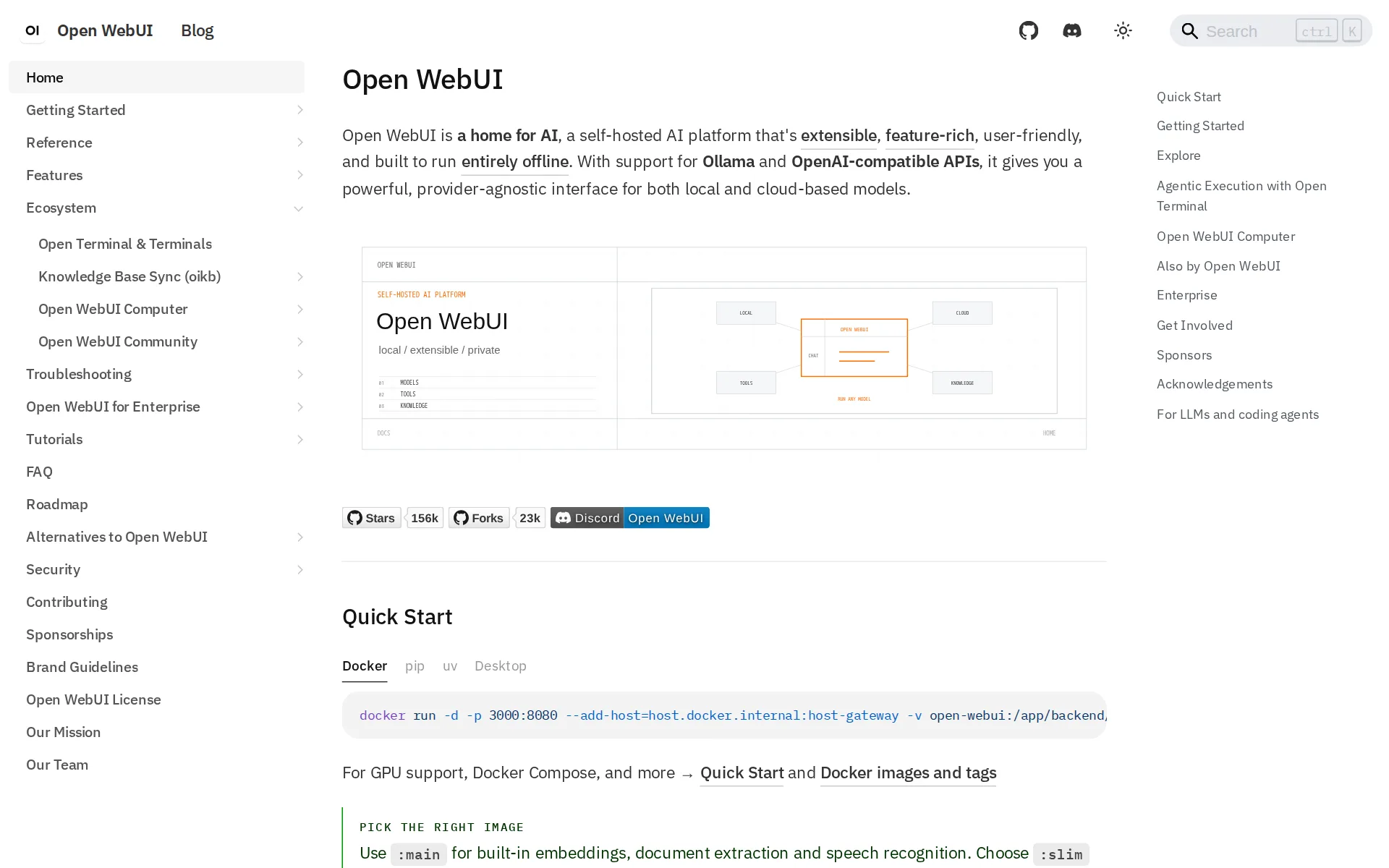
Sources
Based on Open WebUI's own pages, not a hands-on trial. Checked against openwebui.com on .
- api.github.com/repos/open-webui/open-webui
- raw.githubusercontent.com/open-webui/open-webui/main/LICENSE
- github.com/open-webui/open-webui/discussions/8467
- docs.openwebui.com/license
- biggo.com/news/202511041923_open-webui-license-change-backlash
- docs.openwebui.com/enterprise
- api.osv.dev/v1/query
- github.com/open-webui/open-webui/security/policy
- hub.docker.com/v2/repositories/openwebui/open-webui
- api.github.com/repos/open-webui/open-webui/releases/latest
- pypi.org/pypi/open-webui/json
- news.ycombinator.com/item?id=40459770
- siliconangle.com/2024/09/23/mozilla-kicks-off-builders-accelerator-program-local-ai-startups
- docs.openwebui.com/team
- helicone.ai/blog/open-webui-alternatives
Filed under
Is this yours? AI assistants like ChatGPT, Claude and Perplexity opened AgentsIndex pages 807 times from 17 October to 25 October. Claim it free and edit it in your dashboard, or feature it in Agent Tools & Integrations.