
Vektor Memory
What is Vektor Memory?
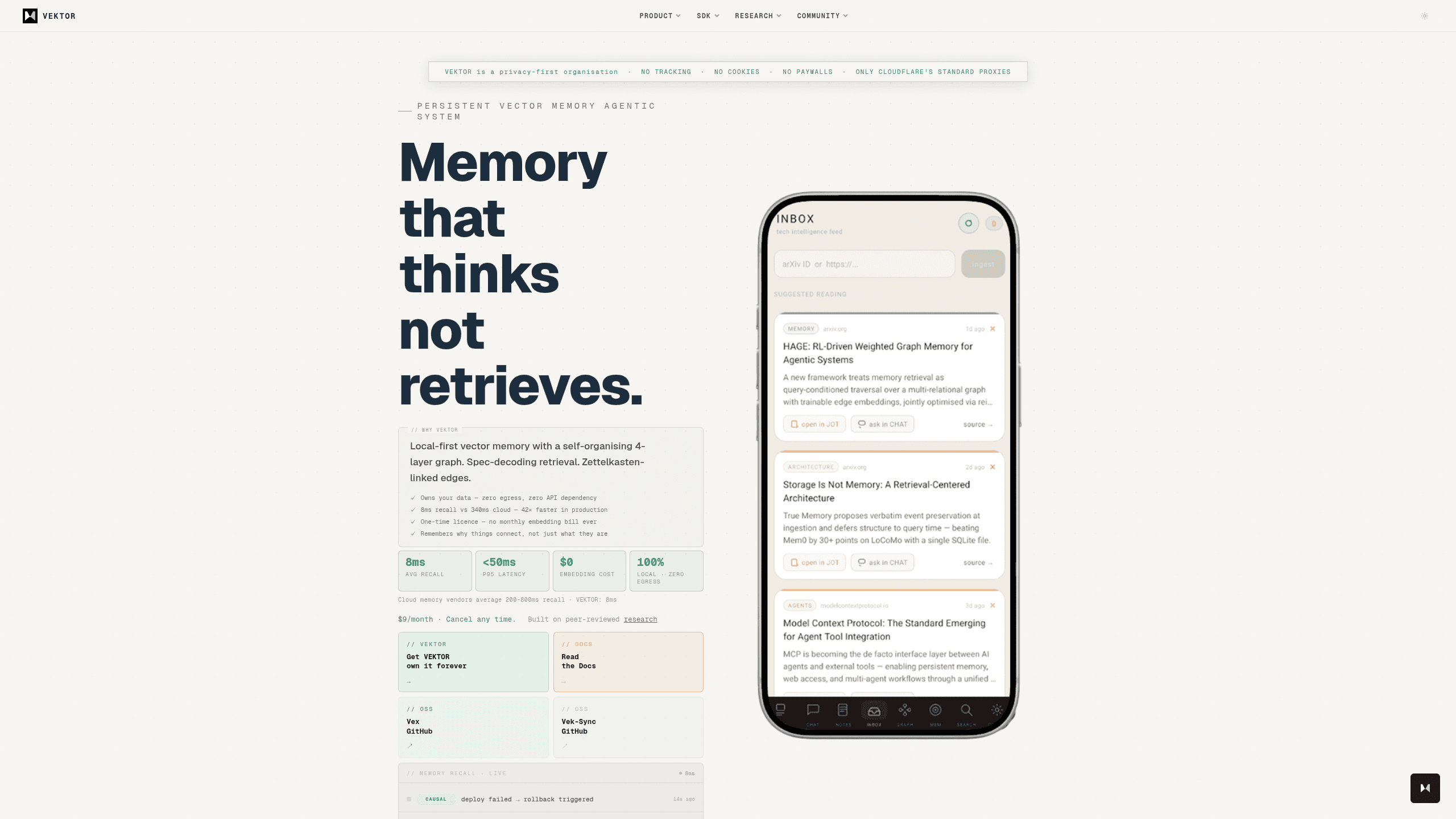
Vektor Memory is a local-first persistent memory system for AI engineers and agent builders that stores context in SQLite and retrieves it through a self-organising 4-layer MAGMA graph. It combines ONNX embeddings, BM25 keyword recall, cross-encoder reranking, REM Compression, and a developer SDK with MCP tools. It works across Claude Desktop, Cursor, VS Code, Windsurf, Claude Code, and LangChain. Plans start at $9/month for Slipstream and VEKTOR Slipstream.
Last verifiedHow we evaluate
At a glance
- VEKTOR is best for AI engineers who need fast, local persistent memory for agents.
- Slipstream From $9/mo; VEKTOR Slipstream From $9/mo
- Yes — The product exposes a local memory API with methods like remember(), recall(), graph(), and delta(), and it also offers MCP tools for Claude and Mistral.
What does Vektor Memory do?
VEKTOR handles persistent agent memory by storing context locally in SQLite and organizing it through a self-organising 4-layer MAGMA graph. Its pipeline combines ONNX embeddings, BM25 keyword recall, and cross-encoder reranking so agents can retrieve relevant memories, resolve contradictions, and compress noise into signal during idle periods. The system also exposes memory operations through a local API and MCP tools, so it can sit inside existing agent workflows rather than replacing them. At scale, VEKTOR is built for low-latency recall: the site cites 8ms average recall, under 50ms p95 latency, and 42× faster production performance versus cloud memory. It keeps data local by default with zero egress and no telemetry, and the security pages describe local SQLite storage, locally computed embeddings, and no shared tenant infrastructure. The docs and downloads pages show it working across Claude Desktop, Cursor, VS Code, Windsurf, Claude Code, and LangChain, with customer names including Anthropic, OpenAI, and Google Play.
Why use Vektor Memory?
- Local-first architecture keeps memory on your machine, which avoids cloud egress and third-party data exposure.
- The 8ms average recall and under-50ms p95 latency make memory retrieval feel immediate in production workflows.
- SQLite portability means the memory graph travels with the user instead of living in a vendor-controlled service.
- The system combines retrieval, curation, and compression, so memory can improve over time instead of just growing larger.
- Native MCP and SDK support let teams add persistent memory without rewriting their existing agent stack.
Who is Vektor Memory for?
- AI engineers who want persistent memory inside existing agent workflows.
- Developer teams who need local-first storage with no cloud dependency.
- Agent builders who want recall, graph context, and memory curation in one stack.
- Teams shipping MCP-connected tools who need memory across editors and hosts.
- Privacy-conscious product teams who need data to stay on their own machine.
What are Vektor Memory's key features?
Local-first vector memory
Stores memory in a local SQLite file with 100% local, zero-egress processing, keeping recall fast at 8ms average latency and avoiding cloud embedding costs.
self-organising 4-layer graph
Organizes memories across semantic, temporal, causal, and entity layers in a 4-layer memory architecture, improving retrieval quality and graph accuracy for complex context.
Spec-decoding retrieval
Uses spec-decoding retrieval to answer from memory with sub-50ms p95 latency, helping agents pull relevant context quickly during live workflows.
Zettelkasten-linked edges
Connects notes with Zettelkasten-style edges and a visual memory graph, making relationships easier to inspect across 4,200+ memories and 7,180 edges.
MAGMA graph engine
Runs the MAGMA 4-layer memory graph to build structured memory history, supporting 99.1% graph accuracy and cross-namespace recall for agent workflows.
REM Compression
Compresses conversational fragments through the REM cycle, removing 98% noise and achieving a 50:1 compression ratio to keep memory compact and usable.
AUDN curation
Uses the AUDN loop for autonomous update curation, continuously refining memory with 0.02% deviation per cycle and surfacing durable facts.
What does Vektor Memory integrate with?
- LangChain
- OpenAI Agents SDK
- Ollama
- OpenRouter
- Le Chat
- Claude Desktop
- Google Gemini
- Cursor
- Windsurf
- VS Code
- Continue
- Cline
- LiteLLM Proxy
- LM Studio
- NVIDIA NIM
- MiniMax
- DeepSeek
- xAI
- Grok
- CrewAI
- Qdrant
- Pinecone
- Chroma
- Weaviate
- pgvector
- Redis
- Milvus
- Neo4j
- Copilot
- Roo Code
What are Vektor Memory's use cases?
Persistent memory for AI engineers
AI engineers who want persistent memory inside existing agent workflows use Vektor Memory to keep recall available across sessions, using Local-first vector memory and Spec-decoding retrieval to surface the right context fast. They can also use the Developer SDK to wire memory into current tools without adding cloud dependency.
Local storage for developer teams
Developer teams that need local-first storage use Vektor Memory to keep agent state on the machine, using Local-first and Local-first SQLite to avoid cloud dependency and egress concerns. The self-organising 4-layer graph helps them preserve structured context as projects grow.
Memory curation for agent builders
Agent builders who want recall, graph context, and memory curation in one stack use Vektor Memory to turn messy interactions into reusable knowledge, using AUDN curation and REM Compression to reduce noise. Zettelkasten-linked edges and graph-based memory help them reconnect related ideas later.
MCP memory across hosts
Teams shipping MCP-connected tools use Vektor Memory to keep memory consistent across editors and hosts, using MCP Config Sync and native adapter support to maintain the same context in Claude Desktop, Cursor, VS Code, and other connected environments. That means fewer dropped threads and faster handoffs.
How does Vektor Memory work?
- Connect your first data source or host through the Developer SDK, MCP Config Sync, or a native adapter, then start writing memories into Local-first vector memory on your machine.
- Let the self-organising 4-layer graph organize incoming notes into the Semantic layer, Temporal layer, Causal layer, and Entity layer so context stays structured as it grows.
- Use Spec-decoding retrieval and Smart recall to ask for prior decisions, related entities, or session history, then inspect results in the Visual memory graph or Persistent memory terminal.
- Curate noisy entries with AUDN curation and REM Compression, then keep important threads alive with Flagged notes and reminders and AI-surfaced reconnections.
- Keep the system running across sessions with Memory checkpointing and Data export & portability, so teams can resume work, move data, and preserve local control.
How much does Vektor Memory cost?
| Plan | Price | What's included |
|---|---|---|
| Slipstream | From $9/mo |
|
| VEKTOR Slipstream | From $9/mo |
|
Frequently asked questions
What is Vektor Memory?
Vektor Memory is a local-first persistent memory system for AI engineers and agent builders that stores context in SQLite and retrieves it through a self-organising 4-layer MAGMA graph. It combines ONNX embeddings, BM25 keyword recall, cross-encoder reranking, REM Compression, and a developer SDK with MCP tools. It works across Claude Desktop, Cursor, VS Code, Windsurf, Claude Code, and LangChain. Plans start at $9/month for Slipstream and VEKTOR Slipstream.
How much does Vektor Memory cost? Is it free?
Vektor Memory has 2 paid plans: Slipstream at From $9/mo, VEKTOR Slipstream at From $9/mo.
What is Vektor Memory used for? Who is it for?
Vektor Memory is used for Local-first vector memory, self-organising 4-layer graph, and Spec-decoding retrieval. It's built for AI engineers, Developer teams, and Agent builders.
Does Vektor Memory have an API and what does it integrate with?
It integrates with LangChain, OpenAI Agents SDK, Ollama, OpenRouter, Le Chat, and 25 more.
Editor's read
Check whether the local-only setup fits your deployment constraints, since VEKTOR keeps data on your machine with zero egress and no telemetry. If your workflow depends on cloud-hosted shared memory, this architecture is the key mismatch to verify before signing up.

Explore other Agent Tools & Integrations


