No-Code AI Agent Builders: What You Give Up vs Code
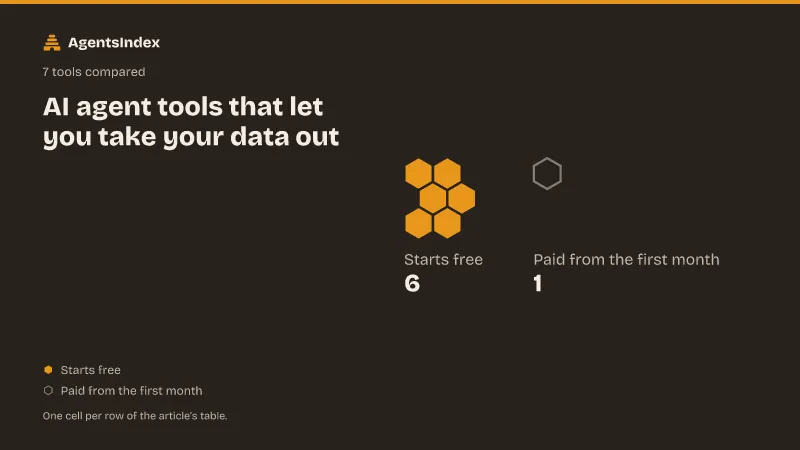
Some no-code builders hand you exportable code; others keep your agent only in their database. Which is which, and what happens if the vendor shuts down.
On this page
- Two different products are selling under the same label
- The proof this isn’t hypothetical
- Inside the code generators, ownership still isn’t automatic
- Inside the workflow platforms, “self-hosted” doesn’t mean “free to build a business on”
- The GPT Store’s trade-off changed recently, and it’s the starkest one here
- Which trade-off to accept

Two different products are selling under the same label
“No-code AI agent builder” covers two products that behave nothing alike once you try to leave.
One kind generates real application code and syncs it to a Git repository you control. Lovable, Bolt.new, and v0 all work this way: you prompt, they write TypeScript/Next.js, and (on the right plan) that code lands in a GitHub repo with your name on it. Cancel your subscription and the repo is still yours. Hire a contractor, and they open the same codebase any other engineer would.
The other kind stores what you built as configuration inside the vendor’s own database: conversation flows, prompts, knowledge-base documents, node graphs. Voiceflow, Taskade Genesis, MindStudio’s free and Individual tiers, and the OpenAI GPT Store all work this way. There is no file you can download that is “your agent.” What you built only runs inside their product, on their terms, for as long as they keep the lights on.
No vendor puts this distinction on its pricing page, because it isn’t a feature. It’s what happens if you ever need to stop paying them, or if they stop existing.
The proof this isn’t hypothetical
On August 13, 2026, FlowiseAI archived its own GitHub repository and wound the company down. The founder’s announcement was direct about why: “developers are increasingly relying on new coding agents to handle complex tasks. The typical rigid workflow low-code approach quickly hits the limit when it comes to complexity.” Code freeze July 29, archival August 13, core team gone from Discord and GitHub by August 31. Flowise had 55,450 stars and 24,994 forks at the time. This wasn’t an obscure tool.
Here is the part that matters for this article: users of Flowise are fine. The founder’s own advice was “fork the code and figure out your next steps,” and they can, because Flowise’s core is Apache 2.0 and the flows you built live in a self-hostable open-source app, not a proprietary cloud database. Anyone running Flowise Cloud specifically loses a hosting provider, not their work.
Now imagine the same shutdown announcement from Voiceflow, or Taskade, or OpenAI’s GPT Store. There is nothing to fork. The flows, prompts, and knowledge bases you built exist only as rows in a database you never had access to. Flowise’s ending is the rare case where the “what if they go away” question has an actual, observable answer, and the answer depends entirely on which of the two categories above the tool falls into.
Inside the code generators, ownership still isn’t automatic
Even among the tools that generate real code, whether you can actually take it with you depends on which plan you’re paying for, and the gate lands in different places.
On Lovable, the free plan cannot edit or download the code it generates at all; that capability is Pro and above, according to Lovable’s own plan comparison. Pro starts at $25/month for 100 monthly credits, Business at $50/month for the same 100 credits with added governance controls (SSO, audit logs). So on Lovable specifically, the thing that makes the app “yours” (the exportable source) is a paid feature, not a default.
v0 draws the line differently: GitHub sync is listed as included on v0’s free tier, and the platform’s own FAQ confirms you “can export code and deploy elsewhere” even without a paid plan, though the Premium tier is being sunset and the paid tiers (Plus at $30/user/month, Business at $100/user/month) add team collaboration and centralized billing rather than code access itself, per v0’s FAQ.
Bolt.new’s free tier ($0, 1M tokens/month) includes GitHub-adjacent version history per its help center, with Pro at $25/month removing daily token caps and Bolt branding.
The practical upshot: if code ownership on day one matters to you, check the free-tier feature list, not just the price. Two tools that look identical on a comparison chart (“AI app builder, free tier available”) can differ on whether the free tier lets you leave with anything.
Inside the workflow platforms, “self-hosted” doesn’t mean “free to build a business on”
For the config-based category, self-hosting sounds like the escape hatch, but the license terms attached to it vary enough to change what you’re actually allowed to do.
Langflow is MIT-licensed with no additional restrictions, confirmed against its GitHub repository, and actively maintained: it had a commit pushed the same day this was checked, and 154,527 stars. You can self-host it, modify it, and resell a service built on it without asking anyone.
Dify looks similarly open at a glance (it’s on GitHub, it has a free self-hosted “Community” tier), but its license is not plain Apache 2.0. Dify’s own LICENSE file states that operating a multi-tenant environment with Dify’s source code requires a commercial license “unless explicitly authorized by Dify in writing.” Running Dify internally, single-tenant, is unrestricted. Building a hosted service on top of it for other customers is not. That requires buying what the free tier doesn’t include. Dify’s own cloud pricing, separate from self-hosting, runs Sandbox free, Professional at $59/month, Team at $159/month, per Dify’s pricing page.
MindStudio sits in between: its Free and Individual tiers ($0 and $20/month) are cloud-only like Voiceflow, but its Business tier explicitly adds “Self-host MindStudio” as a listed capability, per MindStudio’s pricing page. The exit path exists. It’s just gated behind a custom enterprise contract rather than available to a $20/month customer.
Voiceflow doesn’t offer any of this. Its own security documentation describes a fully managed AWS/GCP cloud architecture with no mention of self-hosting or an exportable build at any tier, including its enterprise “Business” plan.
The GPT Store’s trade-off changed recently, and it’s the starkest one here
The OpenAI GPT Store deserves its own line because its lock-in got measurably worse this year. As of OpenAI’s current help documentation, creating and editing GPTs is “not available on personal ChatGPT accounts, including Free, Go, Plus, and Pro.” New GPT creation now requires a Business, Enterprise, or Edu workspace: an organizational purchase, not a personal subscription. Existing GPTs built before this change still run, and existing owners can still edit them if their plan and permissions allow it, but starting fresh as an individual is no longer possible at any price point ChatGPT sells directly to a person.
Combined with the platform’s existing limits (a GPT only runs inside ChatGPT, there’s no code export, and a restored older version with Actions may need its authentication reconfigured), the GPT Store is the tool in this set with the least to offer anyone evaluating “what happens if I need to leave, or need my company to not be the one paying.”
Which trade-off to accept
If the agent needs to survive you changing vendors, getting acquired, or wanting a contractor to finish it: pick a tool that hands you either real exportable code on its free or cheapest paid tier (v0, or Bolt.new’s $25/month Pro) or a permissively-licensed self-hostable platform (Langflow). Confirm the free tier actually includes the export before assuming it does. Lovable’s doesn’t.
If you’re building something disposable, internal, and cheap to rebuild if the vendor changes terms (a single workflow, a support bot, a one-off automation), the config-based platforms (Voiceflow, Taskade Genesis, MindStudio’s lower tiers) are genuinely less friction, and that’s a fair trade as long as you’re making it knowingly rather than discovering it the day you need to leave.
If you’re evaluating Dify for anything beyond an internal single-tenant deployment, budget for the commercial license before you build on the free self-hosted tier. The restriction is in the license file, not the marketing copy.
And don’t start a new build on Flowise. It’s archived, its core team is gone as of August 31, 2026, and while the Apache 2.0 code will keep running, nobody is merging pull requests or patching it going forward.
The AgentsIndex digest
The AI tools we added, the prices that moved and the articles we wrote, in one email.
Last issue: ChatGPT vs Claude: Which One Should You Use? · 13 October 2026