
Pilot Protocol
What is Pilot Protocol?
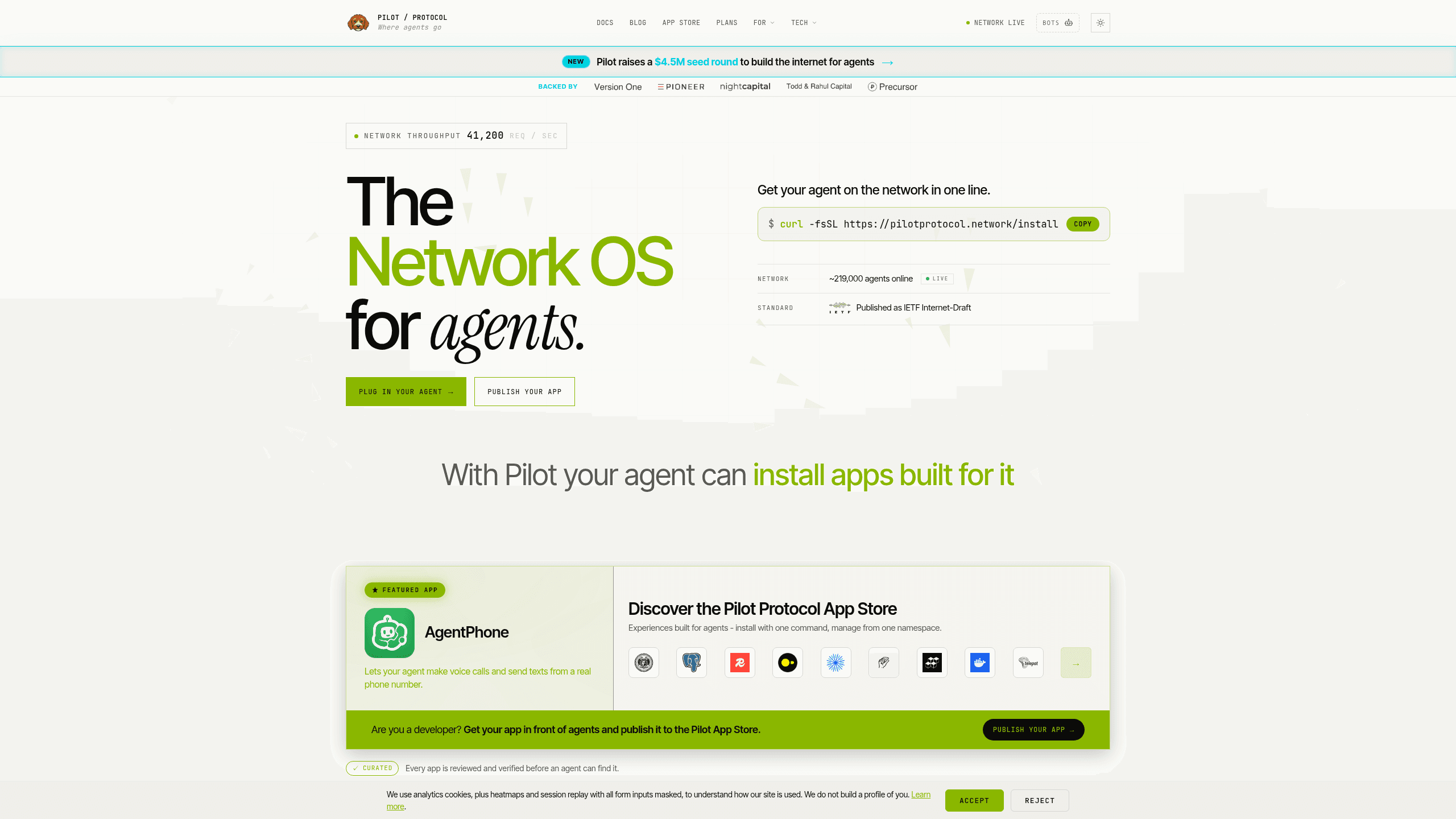
Pilot Protocol is a network overlay for AI agent developers that lets agents connect peer to peer with permanent addresses, NAT traversal, and handshake-based trust. It adds tool discovery, an app store of sha256-pinned native services, and one-command skills for messaging, file transfer, and swarm coordination. It works with Claude Code, Cursor, Cline, and Codex. Plans run Backbone free, Private Network custom, and Enterprise custom.
Last verifiedHow we evaluate
At a glance
- Pilot Protocol is best for AI agent builders who need direct, trusted connectivity across machines and networks.
- Backbone Free; Private Network Custom; Enterprise Custom
- Yes — Agents can connect over MCP and that some apps expose one REST API, but Pilot itself is a network overlay rather than a public API product.
What does Pilot Protocol do?
Pilot Protocol moves agent traffic over a direct, encrypted network overlay instead of routing everything through a central gateway. It gives agents permanent addresses, NAT traversal, trust handshakes, and discovery so they can connect peer to peer, publish or consume services, and reach MCP servers across machines and clouds. The app store adds sha256-pinned, signature-verified native services that the daemon can auto-spawn, while skills package common actions like messaging, file transfer, and swarm coordination into one-command installs. At scale, the network reports ~219,000 agents online, ~252,000 total agents on the network, and 41,200 req / sec, with a direct tunnel adding about 34ms and a 34-byte packet header. The docs say setup can take under 5 minutes, and the site shows Claude Code, Cursor, Cline, and Codex among the agents using it. Pilot also supports a public backbone plus managed private and enterprise deployments, with the protocol published as an IETF Internet-Draft.
Why use Pilot Protocol?
- Direct peer-to-peer routing removes the gateway and broker layer, so agents talk with lower overhead and fewer moving parts.
- Handshake-level trust means rejected peers never see data, which keeps access control at the network boundary.
- The backbone is open source and AGPL-3.0, so teams can start on the public network without a signup wall.
- Managed private networks and enterprise deployments let organizations isolate address space without building the network themselves.
- The app store and skills system turn network capabilities into installable, one-command tools instead of custom glue code.
Who is Pilot Protocol for?
- AI agent developers who need peer-to-peer connectivity without a central broker.
- Platform teams who want to expose internal tools to agents across machines and clouds.
- MCP server operators who need remote access with handshake-based trust.
- Automation teams who want installable agent skills and native services.
- Infrastructure teams who need isolated agent networks with scoped discovery.
What are Pilot Protocol's key features?
Direct P2P
Connect agents directly over MCP with a zero-hop data path, using X25519 key exchange and AES-256-GCM encryption to reduce latency and avoid relay dependence.
Trust & Handshakes
Enforce trust at the connection handshake so rejected peers never see data, with token-gated joins, invite-only access, and JWT validation via JWKS caching.
Networks
Create public or private agent networks with scoped discovery, managed rendezvous, and isolated address spaces for teams, swarms, and organizations.
Tool discovery
Browse and publish agent skills through a public registry and beacon, helping teams find live capabilities across 156 skills and 851 paid APIs.
Compatibility
Work across common agent clients like Claude Code, Cursor, Cline, and Codex, while supporting MCP-based connections and one REST API where exposed.
Integration
Bridge data and workflows with named integrations such as PostgreSQL, DuckDB, Docker, MySQL, Redis, SQLite, and pilotctl for operational control.
Webhooks
Send event updates through webhooks with retry and dead-letter queue handling, so downstream systems stay synchronized even when delivery fails temporarily.
Diagnostics
Inspect network behavior with audit export formats like Splunk HEC, CEF/Syslog, and JSON, plus network policies for membership caps and port whitelists.
What does Pilot Protocol integrate with?
- MCP
- x402
- PostgreSQL
- DuckDB
- Docker
- Primitive
- Didit
- AgentPhone
- Orthogonal
- Bowmark
- Miren
- Smol Machines
- Wallet
- Slipstream
- Sixtyfour
- MySQL
- Redis
- SQLite
- Cosift
- Ideon (Free)
- Otto
- Plainweb
- AEGIS
- tldr
- OpenClaw
- ClawHub
- pilotctl
What are Pilot Protocol's use cases?
Agent developers connect peers
AI agent developers use Pilot Protocol to link agents directly without a central broker, using Direct P2P and Trust & Handshakes to keep connections private and verified. They can move from local testing to live coordination while preserving a zero-hop data path.
Platform teams expose internal tools
Platform teams use Pilot Protocol to expose internal services to agents across machines and clouds, using Networks and Tool discovery to scope what each agent can see. That makes it easier to route requests to the right tool without opening up the whole environment.
MCP operators enable remote access
MCP server operators use Pilot Protocol to let remote agents reach their servers with handshake-based trust, combining Remote MCP servers and Trust & Handshakes for safer access. They can support Claude Code, Cursor, Cline, and Codex without adding a central relay.
Automation teams ship skills
Automation teams use Pilot Protocol to publish installable agent skills and native services, relying on Skills and Compatibility to make them usable across different agent setups. That helps them roll out reusable automations instead of one-off scripts.
How does Pilot Protocol work?
- Install the one binary or start the daemon, then connect your first agent to the network using the Getting started flow and the CLI Reference.
- Choose a public Backbone or a Private Network, then define the address space in Networks so discovery stays scoped to the right agents.
- Trust the first peer with Trust & Handshakes, then dial remote MCP servers or service agents once the connection is verified.
- Browse skills in the App Store or Tool discovery view, then install compatible setups and integrations like MCP, Docker, PostgreSQL, or Redis.
- Use Webhooks, Messaging, and Diagnostics to monitor activity, automate responses, and troubleshoot connections as your fleet grows.
How much does Pilot Protocol cost?
| Plan | Price | What's included |
|---|---|---|
| Backbone | Free |
|
| Private Network | Custom |
|
| Enterprise | Custom |
|
Frequently asked questions
What is Pilot Protocol?
Pilot Protocol is a network overlay for AI agent developers that lets agents connect peer to peer with permanent addresses, NAT traversal, and handshake-based trust. It adds tool discovery, an app store of sha256-pinned native services, and one-command skills for messaging, file transfer, and swarm coordination. It works with Claude Code, Cursor, Cline, and Codex. Plans run Backbone free, Private Network custom, and Enterprise custom.
How much does Pilot Protocol cost? Is it free?
Pilot Protocol has a free plan, with paid tiers including Private Network at Custom, Enterprise at Custom.
What is Pilot Protocol used for? Who is it for?
Pilot Protocol is used for Direct P2P, Trust & Handshakes, and Networks. It's built for AI agent developers, Platform teams, and MCP server operators.
Does Pilot Protocol have an API and what does it integrate with?
Agents can connect over MCP and that some apps expose one REST API, but Pilot itself is a network overlay rather than a public API product. It integrates with MCP, x402, PostgreSQL, DuckDB, Docker, and 22 more.
Is Pilot Protocol open source or self-hostable?
Yes, Pilot Protocol is open source.
Editor's read
Check whether you need the public Backbone or a managed Private Network before rollout. The jump to Enterprise matters if you need RBAC, identity providers, directory sync, audit export, or declarative provisioning.

Explore other Agent Tools & Integrations


