

What is Shopify Sidekick?
Shopify Sidekick is an AI assistant for merchants that turns plain-language prompts into store actions, content, and recommendations. It helps with theme selection, product photos, design tweaks, field setup, and product copy, while Shopify Magic extends AI across image generation and content workflows.
Sidekick sits inside Shopify's commerce stack, which includes Shopify Checkout, Shopify POS, Analytics, and Commerce for Agents. Plans run Basic $29/mo, Grow $95/mo, Advanced $360/mo, Plus from $2,300/mo, POS Pro +$89/mo, and Agentic $0/mo.
What it costs, and what 'included' actually means
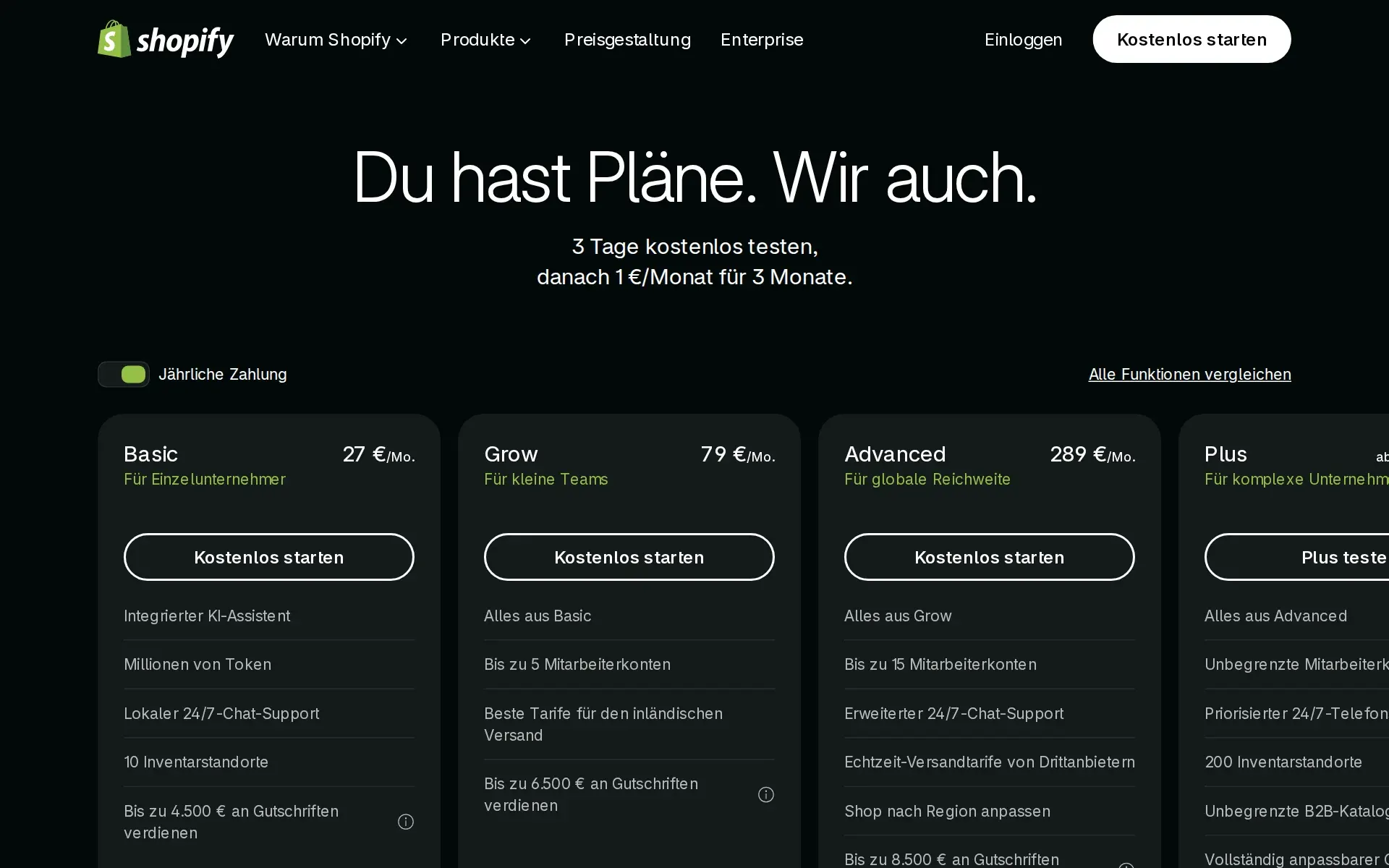
There is no standalone price. Shopify's pricing page lists "Sidekick, AI assistant for commerce" with an Included marker against all four plans (Basic, Grow, Advanced, Plus), and the Shopify Magic help page states that "Shopify Magic tools and experiences are available for free, regardless of your subscription plan." The floor cost is therefore a Shopify subscription: the EU pricing page we fetched on 14 August 2026 showed Basic at €27/month (about $30) billed annually, with a stated 25% annual discount. That page is geo-localized — the same URL serves different currencies and figures by country — so treat any single number as country-specific rather than as the global price.
Two qualifications matter more than the headline. First, the same pricing table lists a separate line item, "Millions of tokens," with the tooltip "Tokens power AI capabilities. Millions is plenty to power your AI assistant for everyday use." Sidekick usage is metered, and Shopify does not publish the per-plan token allowance anywhere we could find — so how much heavy use is 'too much' is not established. Second, app generation is gated: Shopify's help documentation states that "Generating apps with Sidekick is available only to stores on the Grow plan, Advanced plan, and Shopify Plus plan," with hourly and weekly limits that also go unquantified in public docs.
What merchants actually use it for — and it changes with store age
The most useful thing Shopify has disclosed about Sidekick is not a feature list but a usage profile. On the Q2 2026 earnings call (quarter ended 30 June 2026, results released 5 August 2026), president Harley Finkelstein said: "In a merchant's first 30 days, roughly half of their conversations with Sidekick are about store setup, design, and theme configuration," and "For merchants five years in, that drops to about 8%, while analytics and reporting climbs past 40%."
That is the honest shape of the product. If you are launching, it is a setup and theming assistant that compresses a lot of documentation-reading. If you are an established store, its value is almost entirely as a query layer over your own data — asking a question in English instead of opening three analytics reports. Shopify's Winter '26 release added the supporting pieces for both modes: theme customization by instruction, email editing by description, conversation memory across sessions, interactive to-do lists, element selection for context, and Sidekick Pulse, which surfaces up to five proactive recommendations from your store data without being asked. Voice mode and screen sharing are documented, including a voice-only mode on Apple Watch.
All of these are Shopify's own descriptions of its own releases, and the conversation-mix figures are the company's characterization of its own telemetry. We have no independent measurement of answer quality.
The app generator is the part that isn't a chatbot
The genuinely unusual capability here is that Sidekick will generate a working internal app for your admin, not just text. Shopify's documentation says generated apps "can access store data through the Admin API, including orders, products, customers, discounts, content, and analytics." Finkelstein said on the Q2 2026 call that Sidekick "was used to create more than 36,000 custom apps, up from 12,000 in Q1" — a vendor figure, uncorroborated, but the quarter-on-quarter direction is at least consistently reported.
The boundaries are documented and worth knowing before you plan around it. Per Shopify's help docs: "Generated apps only work within the Shopify admin. They aren't visible to customers and can't access functions or use data outside the Shopify admin, such as themes, checkout, or customer account apps." Generation requires a desktop browser (not mobile or tablet), and staff need the App development > Develop permission. Shopify also warns that generated apps can modify customer-facing store data and should be tested thoroughly before installation — which is the right warning, and worth reading as: this produces code you own the consequences of, on a plan tier that starts above Basic.
Where it stops
The single most common misconception is worth clearing first, and Shopify states it plainly in its own docs: "Sidekick can't talk to your customers or handle customer support conversations." It is a merchant-side tool. If you want AI answering shoppers, that is a different product (Shopify's own customer-facing tooling, or an app), not this.
Other documented or observed boundaries: it cannot make store changes without your approval; it cannot edit images or share data between merchant accounts; and it is unavailable in mobile browsers — you need the Shopify app. Two limits come from merchants rather than Shopify. A Shopify Partner posting in the Shopify Community in April 2026 reported that Sidekick cannot search the Files/Content library for an image by description, which matters when a client has uploaded hundreds of badly-named assets; the thread ran to seven posts and was not resolved by anyone with a workaround inside Sidekick. A separate April 2026 thread from a merchant managing 7,000+ products asks for Excel/CSV upload so Sidekick can read and verify data, stating that it currently accepts image uploads only. Neither is a scandal — they are the edges of a tool that reasons over structured store records, and they tell you where it will and won't save you time.
How Sidekick recommends apps, and why that is worth knowing
Since September 2025, Sidekick recommends and installs Shopify apps inside the conversation. Shopify's developer changelog describes it as "Up to three relevant app cards for broad queries," a single highlighted card for strongly-matched apps, app-to-app comparisons, and install directly from chat — with Guided search and comparisons in the App Store slated to retire.
The part a merchant should internalise is how those cards are ranked. The same changelog entry tells developers that "Achieving the Built for Shopify badge improves search ranking in both the App Store and Sidekick," and advises enabling Shopify-managed installation "To optimize your app's visibility in Sidekick." So when Sidekick suggests an app, it is surfacing App Store search results shaped by Shopify's own ranking signals — not conducting an independent evaluation of which tool suits you. That is a reasonable design and Shopify documents it openly; it just means an app recommendation from Sidekick carries roughly the weight of a top App Store result, and should be checked the same way.
For app developers and agencies: the extension surface
Sidekick app extensions went generally available to all developers on 17 June 2026, after a December 2025 announcement and an early-access program Shopify says had eighteen launch partners live, including Klaviyo, Loop, Smile, Judge.me, Checkout Links and Matrixify. There are two types: App data (your app's content becomes searchable inside Sidekick) and App actions (Sidekick navigates the merchant into your app pre-filled with context, and the merchant confirms).
The documentation is unusually concrete about limits, which is what makes it plannable: 20 tools per app across all extensions, 5 intents per app, 4,000-token response size, 500-character query strings, 256-token extension and summary descriptions, 2,048-token instructions, and response-time budgets of 1 second for app data and 3 seconds for app actions. Sidekick supports integrations with up to 20 apps per user on a store. There is also a content and safety policy enforced at deploy and at runtime, with results written to a Sidekick event log: extensions must not "redefine who Sidekick is, steer its decision-making, or bypass the merchant's confirmation," and — a clause worth reading twice if your growth plan depends on it — "Use Sidekick to sell. Upsells, plan-upgrade nudges, competitor comparisons, false urgency, and fabricated endorsements are not allowed."
How many apps have shipped extensions to date is not established; we found no public count beyond the eighteen launch partners.
What's under it, and what Shopify has published about making it reliable
Google Cloud's Shopify case study states that "When developing Sidekick, Shopify needed a large language model capable of understanding what merchants want and delivering highly accurate results. Shopify chose Anthropic's Claude Sonnet for its advanced reasoning and tool-calling capabilities," running on Google Cloud's Agent Platform, and describes "Claude Sonnet 4.5 on Agent Platform managing complex processes like reasoning in the background" — plus a claim that upgrading from Claude Sonnet 4.0 to 4.5 reached production in under 24 hours. The case study carries no visible date; the model version named in it may well have moved on, so read it as evidence of the architecture (Anthropic models, hosted on Google Cloud) rather than a current version number.
More substantive is Shopify's own engineering write-up (Andrew McNamara, 26 August 2025), which is candid in a way vendor content rarely is. It describes an agentic loop with just-in-time tool instructions rather than one large system prompt, and an evaluation stack combining human-labeled ground-truth sets sampled from real merchant conversations, an LLM-as-judge calibrated against human agreement (Cohen's kappa reported improving from 0.02 to 0.61 against a 0.69 human baseline), and a merchant simulator. It also names three reward-hacking failure modes seen during reinforcement-learning training: opting out of hard tasks by explaining it cannot help, over-using customer tags as a catch-all instead of proper fields, and schema violations such as hallucinating IDs or wrong enum values. Those are the exact failure shapes to watch for in your own use.
Your data
Shopify's help documentation states that "Shopify doesn't use any merchant's store-level data to power Shopify Magic for other merchants," while noting that a merchant's own store data may be used to improve results for that merchant. Sidekick's docs separately say it cannot share data between merchant accounts. Shopify does not name its model providers in that documentation; the Anthropic/Google Cloud relationship comes from Google Cloud's case study, not from Shopify's own privacy or AI documentation.
What is not established from primary sources we checked: whether merchant conversations with Sidekick are used to train or fine-tune Shopify's models generally (the engineering post makes clear real merchant conversations are sampled and human-labeled for evaluation), and what retention applies to conversation history now that it persists in the sidebar and Sidekick "remembers your preferences." If that matters to your legal position, ask Shopify directly rather than inferring it.
Adoption, and whether the free ride lasts
Shopify's own Q2 2026 numbers, from the earnings call and therefore vendor claims: daily active merchants using Sidekick up 3.6x year-on-year, daily sessions up 4.8x, "nearly 34 million conversations" in the quarter, and "an 8% increase in merchants reaching five orders within 15 days" attributed to Sidekick's onboarding guidance. The context is a strong quarter — Shopify's 8-K press release reports Q2 2026 revenue of $3.58 billion, up 34%. PYMNTS, reporting on the same call, corroborates the 3.6x and 34-million figures and adds that AI-referred traffic and AI-channel orders both roughly tripled year over year.
The more interesting line for a buyer came from CFO Jeff Hoffmeister: "The vast majority of AI costs related to merchant use of Sidekick appear in subscription solutions gross profit," and Shopify "was able to hold gross margins at a relatively consistent level quarter-over-quarter while Sidekick usage scaled." Read together with the unpublished token allowance on the pricing page, that is the honest picture: Sidekick is free today, Shopify is absorbing real inference cost to keep it that way, and the metering mechanism to change that is already built and already disclosed in a tooltip. Nothing suggests a price is coming — but if you are planning workflows that depend on very heavy Sidekick use, that is the variable to watch.
One absence worth stating plainly rather than dressing up: there is no independent review corpus for Sidekick. It is not sold or listed separately, so it has no G2, Capterra or App Store rating of its own, and ratings you may see for 'Shopify' cover the platform. Merchant evidence is limited to forum threads and vendor telemetry.
How much does Shopify Sidekick cost?
Basic
$29/mo
- For solo entrepreneurs
- Sell online, in person and in AI chats
- Card rates from 2.9% + 30¢ USD
- AI assistant for commerce: content, insights, store tasks and more
- Millions of tokens
- Earn up to $5,000 in credits
Grow
$95/mo
- For small teams
- Everything in Basic
- Card rates from 2.7% + 30¢ USD
- Up to 5 staff accounts
- Up to 87% off shipping
- Earn up to $7,500 in credits
Advanced
$360/mo
- For global reach
- Everything in Grow
- Card rates from 2.5% + 30¢ USD
- Up to 15 staff accounts
- Live 3rd-party shipping rates
- Tailor your store by region
- Earn up to $10,000 in credits
Plus
from$2,300/mo
- For complex businesses
- Everything in
- Card rates from 2.25% + 30¢ USD
- Unlimited staff accounts
- Fully customizable checkout
- Up to 200 POS Pro locations
- Sell wholesale/B2B
- Priority 24/7 phone support
Agentic
Free
- For selling in AI channels
- Add your products to Shopify's Catalog
- Choose which AI channels to sell in
- Only pay when you make a sale
- Card rates from 2.9% + 30¢ USD online
Price and terms
- Free trial
- Yes3 days
- Sign up without sales
- YesYes
What needs a higher plan
- Shopify Enterprise
- Uptime promise
From shopify.com/pricing, checked .
The AgentsIndex digest
Price changes and new tools like Shopify Sidekick, at most once a week.
Last issue: ChatGPT vs Claude: Which One Should You Use? · 13 October 2026
Works with
 ChatGPT
- YesGoogle
- YesCopilot
- YesShop Pay
- YesShopify
- YesShopify Inbox
- YesShopify Email
- YesKlaviyo
- YesYotpo
- YesShogun
- YesJudge.me
- YesLoox
- YesRecharge
- YesSmile
- YesStamped
- YesRebuy
- YesJustuno
- YesOctane AI
- YesPageFly
- YesCarro
- YesT Lab
- YesInstafeed
- YesWeglot
- YesGrowave
- YesHydrogen
- YesGemini
- YesShopify Payments
- YesShopify Partners
- YesAmazon
- YesWalmart
For AI agents
- MCP server
- Partly
- API
- Yes
The facts, with their sources
What it costs to start
- What the price counts
- YesFlat monthly platform subscription per store, with no separate charge for the assistant; staff seats and usage limits differ by plan rather than being metered.
No. Sidekick is included with your Shopify plan. Features and usage limits vary by plan.
shopify.com/sidekick - Free tier
- PartlyThere is no standing free plan for the admin assistant: access comes with a three-day trial and a discounted introductory period, after which a paid plan is required.
Try 3 days free, then €1/month (about $1.12) for 3 months.
shopify.com/pricing - Self-serve signup
- YesA merchant signs up online and starts the trial without contacting sales, and the assistant is already switched on in the admin; only the Enterprise plan is sold through a sales conversation.
Open your Shopify admin and click the purple glasses icon. That's it. No setup, no configuration. Just start asking questions about your business and…
shopify.com/sidekick - Contract
- YesSubscriptions bill in rolling thirty-day periods, so a buyer can stay month to month; a yearly option is priced lower and the Enterprise plan commits terms in a contract instead.
Subscription Fees are paid in advance and will be billed in 30 day intervals (each such date, a "Billing Date").
shopify.com/legal/terms - Cancel any time
- PartlyA store owner can close the account at any time with no termination fee named, but prepaid time is not refunded, so canceling mid-period costs the remainder of that billing interval.
Shopify does not provide refunds.
shopify.com/legal/terms
What it works with
- Works with
- YesThird-party Shopify apps connect through Sidekick app extensions that expose their data and actions, and the assistant can search that data, with a published ceiling on how many apps one user reaches.
Sidekick currently supports integrations with up to 20 apps for each user on a store.
shopify.dev/docs/apps/build/sidekick - Public API
- YesShopify documents a public extension framework on its developer site for connecting app data and actions to the assistant, including declared tools, intents, response size and timing limits.
When a merchant invokes an app extension, Shopify's platform powers the interaction. The app extension is executed in the Shopify sandbox, and has…
shopify.dev/docs/apps/build/sidekick - MCP server
- PartlyShopify runs MCP servers on merchant stores for outside AI agents, covering catalog, cart, checkout, orders and customer accounts, but these are shopper-facing surfaces rather than a server exposing the admin assistant itself.
Storefront MCP let AI agents search a store's catalog and manage carts over the Model Context Protocol (MCP). UCP now provides these capabilities at…
shopify.dev/docs/apps/build/storefront-…
What it does on its own
- Acts on its own
- PartlyIt runs multi-step analysis and drafts work on its own, but changes to the store are proposed and held for the user: the vendor states nothing is published without explicit approval.
It checks with you before making any changes, and nothing goes live without your explicit say-so.
shopify.com/enterprise/blog/sidekick-ai… - Limits on what it may do
- YesScope is inherited from the admin account in use, so a staff member's existing role limits which data and features the assistant can reach, and no separate agent permission model is needed.
Every staff member can use Sidekick based on their admin permissions. It respects access controls, so team members only interact with data and…
shopify.com/sidekick - No code needed
- YesNothing is installed or configured, and the vendor states that custom apps and automations are described in plain language instead of built by a developer.
Describe what you need, and it builds it. No technical background required.
shopify.com/enterprise/blog/sidekick-ai…
What happens to your data
- No training on your data
- YesThe vendor states flatly that store data does not go into foundation model training and is not shared with other merchants, so no opt-out setting is needed for that use.
Store data is never used to train foundation models or shared with other merchants.
shopify.com/enterprise/blog/sidekick-ai… - Retention you control
- PartlyAccount tools let a merchant access or delete customer personal data during the subscription, and data is deleted or returned after termination, but backup and legal retention continues and no retention period is published for assistant conversations.
During Your use of the Services, You may leverage account tools to access, return to yourself, or delete Your Customer Personal Data.
shopify.com/legal/dpa - Data stays in your region
- NoThe data processing addendum has the merchant accept processing in any country where Shopify, its affiliates or its service providers sit, and names Singapore and Canada, so the buyer does not pick a region.
You acknowledge that Your Customer Personal Data may be transferred and processed in any country in which Shopify, its affiliated companies or third…
shopify.com/legal/dpa - Self-hosted
- NoThe assistant exists only as a feature of the hosted Shopify admin, reached through an icon in that admin, and the vendor describes it as built into the platform rather than as software a buyer installs.
Sidekick is the AI assistant built into Shopify. It helps merchants get things done without leaving their flow.
shopify.dev/docs/apps/build/sidekick - Open source
- NoThe platform the assistant is part of is licensed proprietary software: users agree not to decompile or reverse engineer the Services, and no source license is offered.
You agree not to work around, bypass, or circumvent any of the technical limitations of the Services, including to process orders outside Shopify's…
shopify.com/legal/terms - Take your data out
- YesAccount tools let a merchant retrieve customer personal data while subscribed, and on termination Shopify deletes or returns that data at the merchant's choice.
Following termination, Shopify will, at Your choice, delete or return Your Customer Personal Data.
shopify.com/legal/dpa
Whether a company can buy it
- Security audits
- PartlyA GDPR data processing addendum with standard contractual clauses and binding corporate rules is published, and audit reports are offered on written request, but no SOC 2, ISO 27001, ISO 42001 or HIPAA certification is named on the pages read.
Shopify may fulfill Your right of audit under European Data Protection Laws in relation to the processing of Your Customer Personal Data by providing…
shopify.com/legal/dpa - Uptime promise
- PartlyMarketing pages quote 99.9% platform uptime as a measured figure, and a committed service level is described as part of the Enterprise plan contract rather than published for the self-serve plans.
The Shopify Enterprise plan is for organizations running at greater scale and complexity, with higher platform limits, deeper control over how the…
shopify.com/platform/enterprise
Frequently asked questions
- What is Shopify Sidekick?
- Shopify Sidekick is an AI assistant for merchants that turns plain-language prompts into store actions, content, and recommendations. It helps with theme selection, product photos, design tweaks, field setup, and product copy, while Shopify Magic extends AI across image generation and content workflows. Sidekick sits inside Shopify's commerce stack, which includes Shopify Checkout, Shopify POS, Analytics, and Commerce for Agents. Plans run Basic $29/mo, Grow $95/mo, Advanced $360/mo, Plus from $2,300/mo, POS Pro +$89/mo, and Agentic $0/mo.
- How much does Shopify Sidekick cost? Is it free?
- Shopify Sidekick has a free plan, with paid tiers including Basic at $29/mo, Grow at $95/mo, Advanced at $360/mo. A 3-day free trial is available.
- What is Shopify Sidekick used for? Who is it for?
- Shopify Sidekick is used for World's best checkout, Sidekick, and Website Builder. It's built for Solo entrepreneurs, Small teams, and Retail operators.
- Does Shopify Sidekick have an API and what does it integrate with?
- Shopify Sidekick doesn't publish a public API. It integrates with ChatGPT, Google, Copilot, Shop Pay, Shopify, and 25 more.
Screenshots
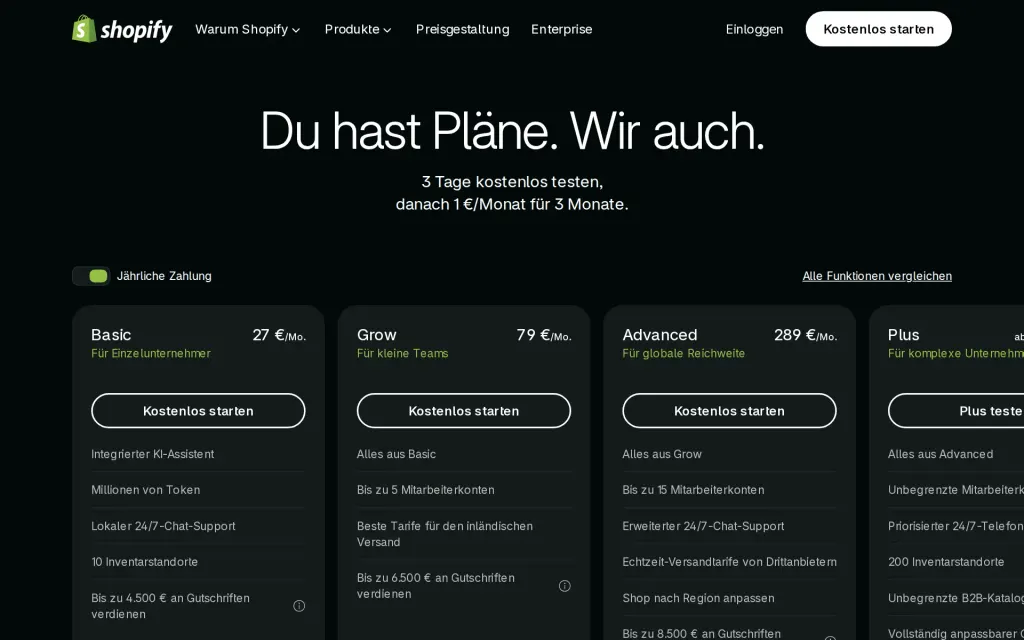
Pricing page, shopify.com, captured
Filed under
Sources and updates
Last changed
Is this yours? Claim it free and edit it in your dashboard, or feature it in Commerce & Ecommerce Agents.