
Intercom Fin
What is Intercom Fin?
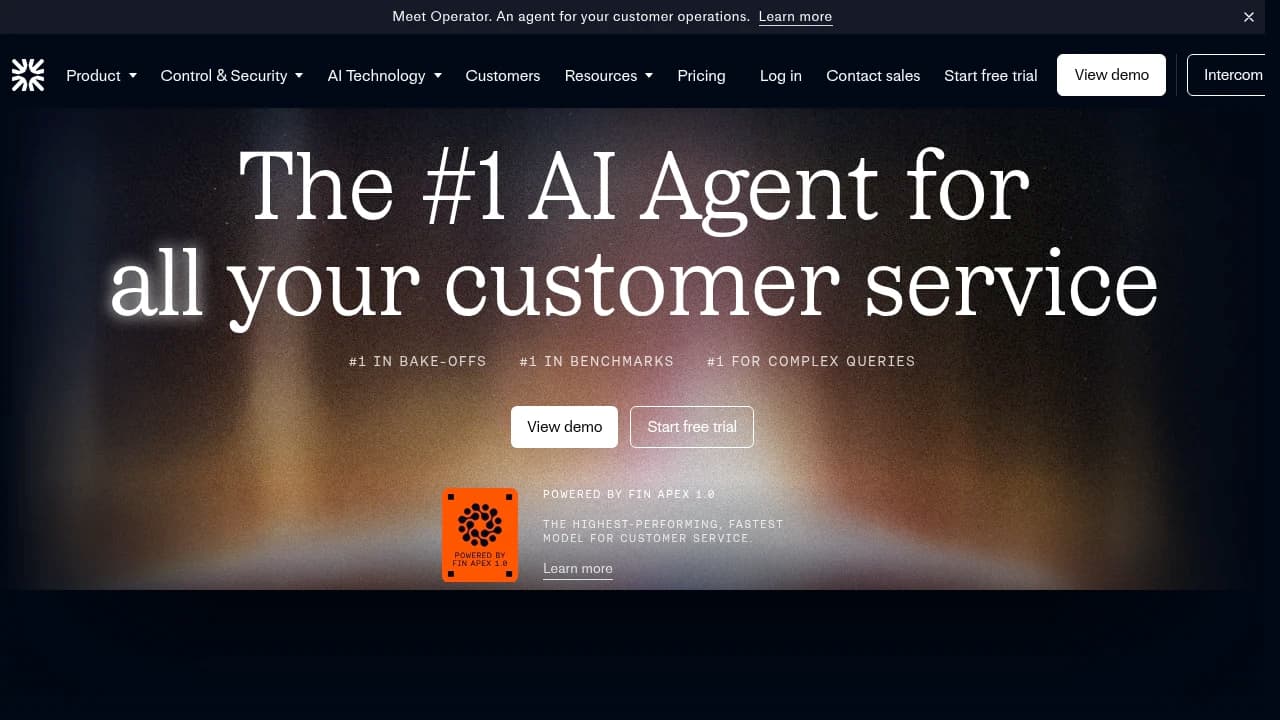
Intercom Fin is an AI customer agent and helpdesk platform for support, sales, and commerce teams that automates customer conversations without losing context. It combines Customer Agent, AI Engine, Training and Testing, Analytics, Messenger, shared inbox and ticketing, and a workflows automation builder, with integrations for Salesforce, HubSpot, Slack, Zapier, and Stripe. Intercom says 30,000+ companies use its products, including Linktree, Robin, and Synthesia, and Fin can also run with existing helpdesks such as Salesforce. Plans run Essential $29 per seat/mo, Advanced $85 per seat/mo, Expert $132 per seat/mo, and Fin AI Agent $0.99 per outcome.
Last verifiedHow we evaluate
At a glance
- Intercom Fin is best for support leaders who want AI to resolve conversations across chat, email, and helpdesk workflows.
- Essential $29 per seat/mo; Advanced $85 per seat/mo; Expert $132 per seat/mo; Fin AI Agent $0.99 per outcome
- 14 days
- Yes — Yes, Fin has an API for integrating its AI capabilities into other platforms.
What Fin does well
Fin can be live on an existing helpdesk (Salesforce, HubSpot, Freshdesk, Zendesk via API/MCP) in under an hour without a migration project, and it works across chat, email, voice, WhatsApp, SMS and Slack from one configuration. The clearest independent evidence of real-world performance comes from Anthropic's own published case study: after roughly two years of tuning, Fin is involved in 80% of Anthropic's incoming support queries, resolves 79% of the conversations it touches, and now closes 63% of Anthropic's total support volume end-to-end (about 560,000 resolutions/month), up from 'nearly half' of conversations in its first weeks live. Anthropic picked Fin after evaluating build-vs-buy and has publicly credited the underlying Claude models for answer quality. Intercom was also an early mover on usage-based AI pricing (charging per resolved outcome rather than per seat) starting in 2023, a model most competitors have since copied.
Resolution rate: what the number measures
Fin's own marketing claims a 76% average resolution rate across 12,000+ AI Agent customers (30,000+ companies use the broader Fin/Intercom product line). VentureBeat reported in March 2026, based on benchmarks Intercom shared with the outlet, that Fin's average resolution rate had grown from 23% at 2023 launch to 67%, rising roughly 1 percentage point per month since — a trajectory consistent with today's higher vendor figure. VentureBeat also noted Intercom declined to name the base model behind its 'Apex' model, despite describing itself as transparent, and could not independently verify the vendor-supplied benchmark comparisons against GPT-5.4 and Claude. Separately, a cluster of blog posts (Builts AI, CloneDesk and similar sites) claim independently-tested resolution rates in the 38–53% range; these sites sell competing AI-support or automation services and don't disclose that conflict prominently, so treat their specific numbers as competitor marketing rather than neutral benchmarks. The one number we could trace to a specific, named customer with public attribution is Anthropic's 79%.
How outcome-based pricing works
As of today, Fin costs $0.99 per 'outcome' on every plan. Used with the Intercom helpdesk, that's layered on top of per-seat pricing: Essential from $29/seat/month, Advanced from $85/seat/month, Expert from $132/seat/month (annual billing; roughly 25-30% more if billed monthly). Used standalone with another helpdesk, it's $0.99/outcome with no seats required but a 50-outcome/month minimum and custom quoting via sales. Per Intercom's own help documentation, an outcome is billed once per conversation and includes a 'confirmed resolution' (the customer says it helped) as well as an 'assumed resolution' — the customer simply doesn't reply again after Fin's last answer, whether or not they were actually satisfied. Reported G2 reviews cite this outcome-based model as the most common source of pricing complaints, with costs described as unpredictable and rising quickly at higher volume once seats and outcomes are both scaling.
Ownership in transition: the pending Salesforce acquisition
In May 2026 Intercom renamed its corporate entity to Fin, and on June 15, 2026 Salesforce announced a definitive agreement to acquire Fin for approximately $3.6 billion — Salesforce's largest AI-agent acquisition to date. The deal is expected to close in Salesforce's fiscal Q4 2027, subject to regulatory clearance, and had not closed as of this listing. Fin was founded as Intercom in 2011, raised roughly $292M in venture funding, and was last valued around $1.3B in a 2018 private round — the acquisition price represents a large step up from that figure. Fin currently markets itself as helpdesk-agnostic (works with Salesforce, HubSpot, Freshdesk and others), but Salesforce is also the maker of the competing Agentforce product line; buyers who are not already on Salesforce and who value long-term platform independence should treat the roadmap and continued multi-helpdesk support as an open question until the deal closes and Salesforce states its integration plans.
Security, compliance, and one recent incident
Intercom/Fin publishes a real security page (not just marketing copy) listing SOC 2 Type II, ISO 27001, ISO 42001 (AI governance), ISO 27701 (privacy) and AIUC-1 (an AI-agent-specific standard) certifications, plus GDPR/CCPA compliance and a self-serve trust center for audit reports. On April 30, 2026, Intercom's official 'intercom-client' npm package (7.0.4) was compromised for about two hours as part of the 'Shai-Hulud' supply-chain worm campaign: attackers used a stolen CI/CD credential (not a stolen maintainer account) to publish a version containing a credential-harvesting payload, affecting a package with roughly 361,000 weekly downloads. GitHub's security advisory rates it CVSS 9.3 (critical); Intercom pulled the package and the community coordinated a fix within the exposure window. This is a CI/CD pipeline compromise on a client SDK, not a breach of Fin's hosted infrastructure or customer data — but it's a data point on their software-supply-chain security posture worth knowing.
How much does Intercom Fin cost?
| Plan | Price | What's included |
|---|---|---|
| Essential | $29 per seat/mo |
|
| Advanced | $85 per seat/mo |
|
| Expert | $132 per seat/mo |
|
| Fin AI Agent | $0.99 per outcome |
|
Frequently asked questions
What is Fin used for?
Fin is Intercom's Customer Agent for support, sales, and commerce. It combines AI with Intercom's customer communication platform so teams can answer questions, resolve issues, and route conversations across the customer journey.
Does Fin have a free trial?
Intercom says Fin includes a 14-day free trial with no credit card required, giving full access to all features, Fin, and add-ons.
What platforms does Fin support?
Fin currently supports web-based applications. The vendor's FAQ says it is designed for web use rather than native desktop or mobile apps.
Can Fin connect to existing tools?
Yes. Fin offers integrations for tools like Salesforce and HubSpot, and the integrations catalog also includes Slack, Zapier, Stripe, Jira, Google Analytics, Mailchimp, Facebook, and WhatsApp.
How is Fin priced?
Fin AI Agent is priced at $0.99 per outcome. Intercom also sells seat-based plans, Essential, Advanced, and Expert, while the Fin AI Agent option can be used with no seats required on existing helpdesks like Salesforce.
Can Fin work with my current helpdesk?
Yes. Intercom says Fin AI Agent can be used with your current helpdesk, including Salesforce, and can be set up in under an hour on that stack.
What support features does Intercom include?
Intercom includes ticketing, automated responses, omnichannel support, AI-powered insights, live chat, a help center, and workflows automation. The platform also adds SLAs and multibrand capabilities on higher plans.
Is there an API for Fin?
Yes. Fin has an API that lets teams integrate its AI capabilities into other platforms, which is useful when you want Fin to sit alongside existing systems.
Editor's read
Check whether your rollout depends on the Fin AI Agent usage model or a seat-based plan. The listing includes both $0.99 per outcome and seat tiers from $29 to $132 per seat/mo, so the billing shape matters before committing.

Explore other Customer Service Agents


