


What is Midjourney?
Midjourney is an AI image and video generation tool for creative teams that turns text prompts into visual outputs through a web workflow for exploration, creation, and organization. It includes image and video generation, web and mobile interfaces, and Discord-based community interaction, backed by a 60-person research group. The service runs on large-scale cloud systems with inference optimization and data center and cluster management.
Prompt in, image or five second video out
Midjourney generates images from text prompts on the Create page of its website, and the same subscription drives the Midjourney bot in Discord, where most features and tools are offered on both platforms under sometimes different names.
Video is an extension of the image product rather than a separate one: you feed it an image as the first frame, add an optional prompt, and get a 5-second video. All tiers can make videos in Fast mode, HD video needs Standard or above, and Relax mode video needs Pro or Mega.
The web app carries the control surface around generation: an Editor, style references, Moodboards, Personalization profiles trained by rating images, folders and bulk actions on the Organize page. Draft mode trades quality for speed at a lower GPU cost, with a conversational mode that helps write prompts by text or voice.
GPU time is the real meter behind the flat price
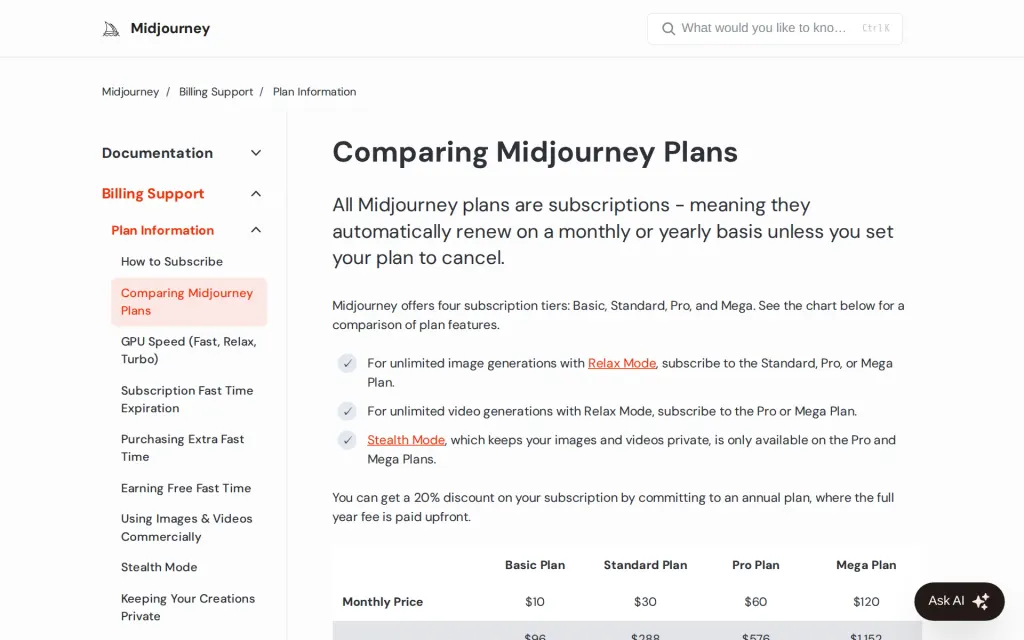
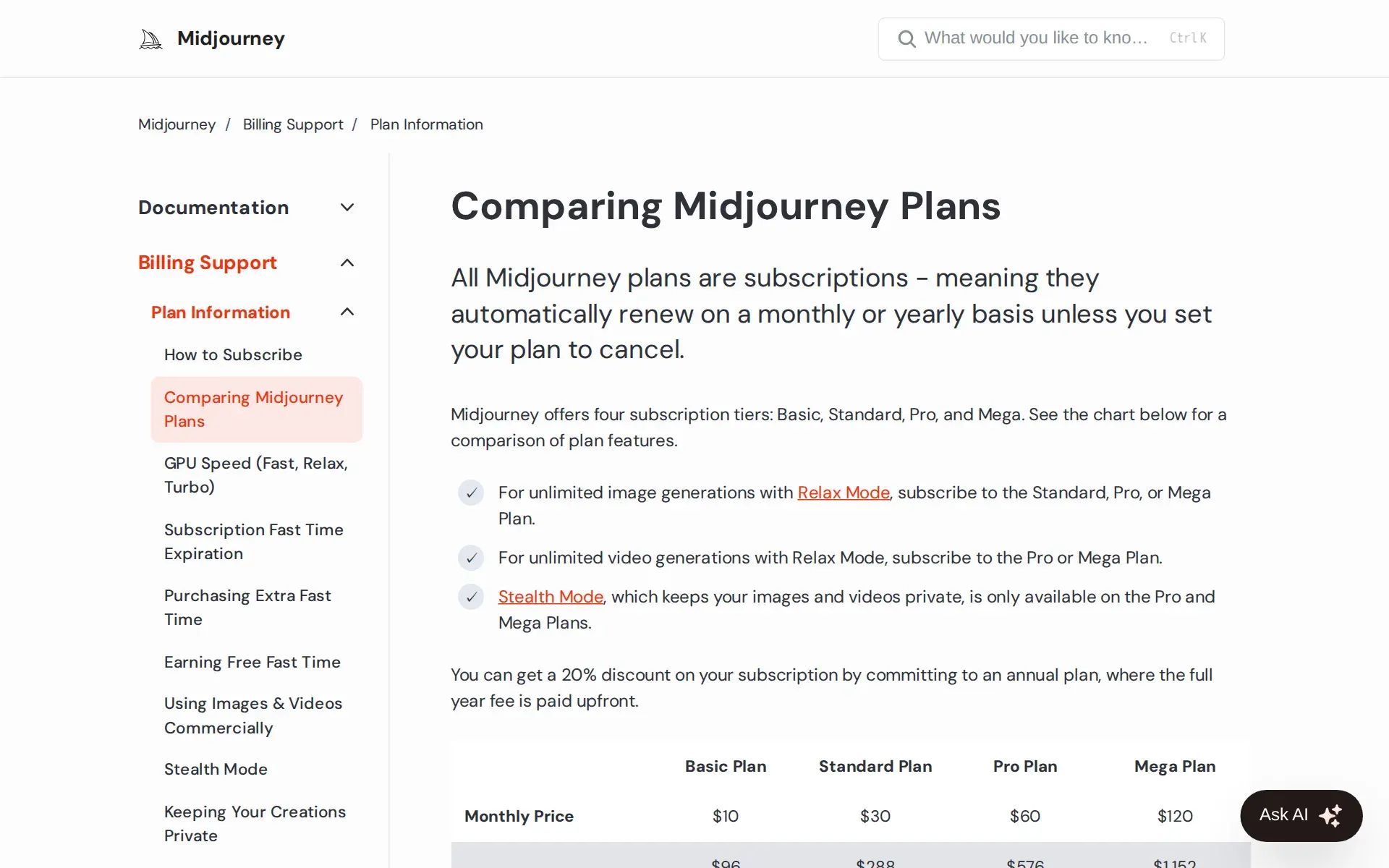
The four tiers read as flat monthly prices, $10, $30, $60 and $120, but what they actually buy is Fast GPU time: 3.3 hours a month on Basic, 15 on Standard, 30 on Pro, 60 on Mega. Relax mode gives unlimited images from Standard upward, and Basic has no Relax allowance at all, so a Basic subscriber who exhausts 200 minutes stops.
More Fast time costs $4 per hour, is non-refundable and expires after 60 days, and needs an active subscription to spend. Free Fast hours are also earnable: the top 2,000 image raters each day get an extra hour, which expires 30 days after it is awarded.
Annual billing takes 20% off with the full year paid upfront, so Basic is $96 a year. Refunds are tightly drawn: you qualify only if you have used less than 20 GPU minutes across the lifetime of the account.
There is no free plan on the website
The vendor is explicit that no free trial is currently available in Discord or the midjourney.com website. The only free trial it names sits in the separate niji journey mobile app for iOS and Android. A buyer who wants to see the web product pays $10 first, and payment runs through Stripe, which rules out PayPal.
One piece is genuinely free and does not need an account: the image checker at midjourney.com/verify, which reads the hidden ID tag Midjourney writes into files to confirm whether it made an image.
Single-user by design, with no team layer
The terms state that only one user may use the service per registered account and each user may have only one account. That rule shapes everything a company might want. Bulk billing exists for organizations needing 50 or more yearly Pro or Mega plans, yet the same page says the vendor does not offer seat or admin management, terms and policy negotiations, or SSO logins, and gives no discount beyond the standard yearly price.
Schools get the same answer: Midjourney supports educational use, but each student must have their own account and their own subscription, with schools reimbursing students rather than managing them.
Commercial rights come with a revenue test instead of a business plan: anyone who has subscribed may use their assets commercially, but a company grossing more than $1,000,000 USD a year needs Pro or Mega.
Your prompts train the models, and that is stated plainly
Midjourney's EU-facing training summary answers the question directly: asked whether data from user interactions such as user input and prompts was used to train the model, it ticks Yes. No opt-out is documented at any tier.
Stealth Mode is often mistaken for that opt-out. It is a privacy control over publication, available only to Pro and Mega Plan members, and it does not hide creations made in public Discord channels. By default the terms make your content publicly viewable and remixable, and the licence you grant on input is perpetual and irrevocable.
Personal data is stored on Midjourney servers in the US with no region choice, with standard contractual clauses covering EEA, Swiss and UK transfers. Account and data deletion is self-service from the account page, with a 7-day window to change your mind, and the privacy policy points to an export path in Account Settings.
No API, no MCP server, no uptime promise
Nothing in the help center documents a public API or an MCP server, and the terms close the door explicitly: you may not use automated tools to access, interact with, or generate Assets through the service. Any Midjourney API a buyer finds on a third-party site is unofficial and against those terms.
The same document declines any availability commitment. No guarantees are made about quality, stability, uptime or reliability, and customers are told not to create dependencies on the service. Disputes go to binding arbitration in Santa Clara County, California, under California law. No SOC 2 report, ISO certificate or data processing agreement is published anywhere on the site.
Where it fits, and where it does not
This suits an individual making stylized images and short clips, who works in a browser or on Discord and wants the editing, style and organization tools in one place. The $10 entry price and the ability to cancel at any time keep the risk small.
It fits badly anywhere a pipeline is involved. There is no programmatic route, so it cannot be wired into a content system or a batch job without breaking the terms. There is no shared workspace, no SSO and no admin console, so procurement at a company ends with individual cards or a bulk invoice over accounts the company cannot administer. Teams needing their prompts kept out of training, a signed DPA or a region choice will not find any of those here.
Plans and pricing
Price and terms
- Free to start
- PartlyPartlyNo free plan or trial on midjourney.com or in Discord
The terms in full
The only free entry is a limited trial in the separate niji journey iOS and Android app. Separately, the image checker at midjourney.com/verify is described as free and usable without an account. Subscribers can also earn free Fast time by rating images or answering surveys, but only with an active paid plan.
- Card to start
- NoRequired
- Sign up without sales
- YesYes
Checked .
The AgentsIndex digest
Price changes and new tools like Midjourney, at most once a week.
Last issue: ChatGPT vs Claude: Which One Should You Use? · 13 October 2026
Works with
- YesDiscord
For AI agents
- MCP server
- No
- API
- No
The facts, with their sources
What it costs to start
- What the price counts
- PartlyFour flat monthly tiers from $10 to $120, each with a fixed monthly allowance of Fast GPU time, and metered Fast hours sold on top at $4 per hour.docs.midjourney.com/hc/en-us/articles/2…
- Free tier
- PartlyNo standing free plan on the website or in Discord; the only free way in is a limited trial inside the separate niji journey mobile app.
A limited trial is available on the niji · journey app, available for iOS and Android devices. No free trial is currently available in Discord or the…
docs.midjourney.com/hc/en-us/articles/2… - Self-serve signup
- YesA buyer creates an account, opens the Manage Subscription page and presses Subscribe on a tier without contacting anyone at the company.
Once you're on your Manage Subscription page, scroll down to the plans section. Find your perfect plan and press the Subscribe button below it.
docs.midjourney.com/hc/en-us/articles/3… - Card to start
- YesEvery route into the web product is a paid subscription charged through Stripe, since the vendor states no free trial exists on the site or in Discord.
No free trial is currently available in Discord or the midjourney.com website. See our How to Subscribe article for help subscribing to Midjourney.
docs.midjourney.com/hc/en-us/articles/2… - Contract
- YesPlans renew monthly by default with no seat minimum, and the yearly option is a 20% discount a buyer chooses rather than a required commitment.
All Midjourney plans are subscriptions - meaning they automatically renew on a monthly or yearly basis unless you set your plan to cancel.
docs.midjourney.com/hc/en-us/articles/2… - Cancel any time
- YesCancellation is a button in the account area with no fee, though it only takes effect at the end of the paid cycle and refunds need under 20 GPU minutes used.
You can cancel your Midjourney subscription at any time by going to your Manage Subscription Page and clicking the Cancel Plan button. Your…
docs.midjourney.com/hc/en-us/articles/2…
What it works with
- Works with
- PartlyThe subscription works across the website and Midjourney's Discord bot with most tools on both, and the vendor names no other business systems it connects to.
With your Midjourney subscription, you have the freedom to create images on both our website and Discord. Most features and tools are offered on both…
docs.midjourney.com/hc/en-us/articles/3… - Public API
- NoNo public API is documented anywhere in the help center, and the terms forbid reaching the service with automated tools at all.
You may not use automated tools to access, interact with, or generate Assets through the Services.
docs.midjourney.com/hc/en-us/articles/3… - MCP server
- NoNothing in the documentation offers an MCP server, and the same terms clause that blocks automated access would cover an assistant calling the service.docs.midjourney.com/hc/en-us/articles/3…
What it does on its own
- No code needed
- YesCreation happens by typing a prompt into the Imagine bar on the website's Create page, with editing, folders and style tools as interface features.
The Create page is the heart of your creation journey. It's where you bring your ideas to life and see your images and videos generate in real-time.
docs.midjourney.com/hc/en-us/articles/3…
What happens to your data
- No training on your data
- NoThe vendor's own EU training summary confirms user prompts train its models, and the help center documents no setting to withhold them; Stealth Mode only hides output publicly.
Was data from user interactions with the AI model (e.g. user input and prompts) used to train the model? ☒ Yes □ No
docs.midjourney.com/hc/en-us/articles/4… - Retention you control
- PartlyA buyer can delete the whole account and its data with a seven day reversal window, but retention length is set by the vendor and no per-item retention control is documented.
Midjourney will retain Your Personal Data only for as long as is necessary for the purposes set out in this Policy.
docs.midjourney.com/hc/en-us/articles/3… - Data stays in your region
- NoPersonal data sits on US servers with no region choice offered, and the policy warns data may move outside a user's own jurisdiction.
The personal information you provide is stored on Midjourney servers in the US.
docs.midjourney.com/hc/en-us/articles/3… - Take your data out
- YesGenerated images and videos stay owned by the user after cancellation, and account settings carry an explicit data export path alongside deletion.
To manage your privacy preferences or export your data, please visit your Account Settings page.
docs.midjourney.com/hc/en-us/articles/3…
Whether a company can buy it
- Security audits
- PartlyGDPR and CCPA rights plus standard contractual clauses for EEA, Swiss and UK transfers are published, while the vendor states it will not negotiate terms or policies for organizations.
When We share Personal Data of individuals in the EEA, Switzerland or UK with third parties, We make use of a variety of legal mechanisms to…
docs.midjourney.com/hc/en-us/articles/3… - Single sign-on
- NoBulk billing for 50 or more yearly Pro or Mega plans is available, but the vendor lists SSO logins among the things it explicitly does not offer.
Please note that we do not offer the following: Seat or admin management Terms and policy negotiations SSO logins
docs.midjourney.com/hc/en-us/articles/2… - Uptime promise
- NoThe terms disclaim any uptime commitment outright and tell customers not to build dependencies on the service's availability.
No guarantees are made with respect to the Services’ quality, stability, uptime or reliability. Please do not create any dependencies on any…
docs.midjourney.com/hc/en-us/articles/3…
Frequently asked questions
- What is Midjourney?
- Midjourney is an AI image and video generation tool for creative teams that turns text prompts into visual outputs through a web workflow for exploration, creation, and organization. It includes image and video generation, web and mobile interfaces, and Discord-based community interaction, backed by a 60-person research group. The service runs on large-scale cloud systems with inference optimization and data center and cluster management.
- What is Midjourney used for? Who is it for?
- Midjourney is used for image and video generation, community-backed research group, and web and mobile interfaces. It's built for Creative professionals, Product designers, and Research-minded builders.
- Does Midjourney have an API and what does it integrate with?
- Midjourney doesn't publish a public API. It integrates with Discord.
Screenshots
Docs, midjourney.com, captured
Filed under
Sources and updates
Sources on docs.midjourney.com11
- /hc/en-us/articles/27870484040333-Comparing-Midjourney-Plans
- /hc/en-us/articles/32083055291277-Terms-of-Service
- /hc/en-us/articles/32083472637453-Privacy-Policy
- /hc/en-us/articles/27870399340173-Free-Trials
- /hc/en-us/articles/25384024738573-Canceling-Your-Subscription
- /hc/en-us/articles/27870607078285-Group-Plans-Corporate-Billing
- /hc/en-us/articles/31974654274573-How-to-Subscribe
- /hc/en-us/articles/32084462534541-Data-Deletion-and-Privacy-FAQ
- /hc/en-us/articles/33329300781837-Web-vs-Discord
- /hc/en-us/articles/33329460426765-Website-Overview
- /hc/en-us/articles/48067080311309-Public-Summary-of-Training-Content
Updates1
- Categories · Free tier · Price · What it does
Is this yours? Claim it free and edit it in your dashboard, or feature it in AI Apps & Utilities.