
At a glance
- Category
- AI model providers
- Tags
- Open source
For developers
- Works with
- Node, Python, HTTP, Slack, Salesforce, Google Calendar and 8 more
Replicate in our research
All researchStudy
AI Tool Pricing Index, November 2026
Pricing
Usage-based
43 of the 361 tools we checked bill by usage.
Edition price, checked 14 November 2026.
Pricing pages of the AI tools, November 2026 editionas of n = 361 tools checked
What is Replicate?
Replicate is an AI model inference and fine-tuning platform for software teams that exposes models through a simple API for generating text, images, speech, music, video, and more. It includes the Playground, model comparison, and docs for Node, Python, and HTTP workflows. The catalog spans over 50,000 AI models and is used by Alibaba, OpenAI, Anthropic, and Google. Pricing is usage-based, starting at CPU (Small) $0.000025/sec.
One API in front of a large catalog of hosted models
Replicate runs machine learning models in the cloud and exposes them through a single HTTP API. Its pricing page describes "thousands of open-source machine learning models" contributed by the community alongside "a wide variety of proprietary models", and its enterprise page puts the catalog at "50,000+ models through one API and one contract" as of November 2026.
Models are packaged with Cog, which the pricing page calls "our open-source tool for packaging machine learning models". The same tool is how a team deploys its own private model or fine-tune, so the platform serves both people calling someone else's model and people hosting their own. The about page states the aim plainly: "You should be able to import an image generator the same way you import an npm package."
Billing is pay as you go, by hardware time or by output
There are no plans or seats. The pricing page says "You only pay for what you use on Replicate. Some models are billed by hardware and time, others by input and output." Time-billed models run on a hardware tier priced by the second, and the smallest, CPU (Small), is listed at $0.09/hr. GPU tiers cost more per second, and the larger multi-GPU and H200 configurations carry the note that capacity "is available with committed spend contracts." Output-billed models are priced per image, per second of video or per token: Ideogram v3 Quality, for example, is listed at $0.09 per output image. Each model's page carries its own cost estimate.
What you pay for depends on whose model it is. The billing docs say public models bill only active time, and "Setup and idle time for the model is free." Private models and deployments bill "the time they spend setting up; the time they spend idle, waiting for requests; and the time they spend active". The exception is fast booting fine-tunes, which bill only active time. Accounts are billed either from prepaid credit or in arrears at the start of each month, and Replicate may charge early when usage first crosses certain limits, which it says helps it "catch fraud".
The free way in is small and undefined. The billing docs say "You can run select models on Replicate for free, but after a bit you'll be asked to set up billing" and that "Some features are only available to customers with billing set up." No allowance or duration is published.
The billing docs give two answers on failed runs
The billing docs state "For all models, if a run fails, we don't charge you." The same page then qualifies that twice. For a model that calls other models, "If the model fails, you will be billed for the duration of the run, plus the cost of the downstream models that were called before the failure occurred." For private models and deployments, "failed and canceled runs are billed for the time the instances they ran on were active, as normal." Canceling a run of an official model "may still" be charged.
The same page is candid about shared capacity on public models: requests "enter a shared queue alongside other customer requests" and "you will sometimes encounter cold boots or scaling limits depending on how other customers are using the model." Its suggested fix is a deployment, which then bills setup and idle time. The enterprise page promises customers can "Scale usage without provisioning or queues", a claim made for contracted enterprise accounts rather than the default shared pool.
A hosted server connects tools to the whole HTTP API
The docs say "The server supports all of the operations in Replicate's HTTP API", including searching, comparing and running models and fetching predictions. The recommended route is the hosted server at mcp.replicate.com, which uses a web sign-in to take a Replicate API key; a local version runs from the replicate-mcp npm package. The docs note that the local server works with the Claude desktop app and that the claude.ai web app needs the remote one. A "Code mode" for the server is marked experimental.
API prediction data is deleted after an hour by default
The data retention docs say that for predictions created through the API, "all input parameters, output values, output files, and logs are automatically removed after an hour, by default." Anyone who needs the outputs must store them, and the docs point to webhooks for that. The web interface works the other way: "Data for predictions created through the web interface is kept indefinitely" until a user deletes the prediction from the dashboard.
On compliance, the enterprise page lists data processing agreements, controls "for access, encryption, and incident response", indemnity coverage and SLAs, all as contract terms through sales.
Cloudflare owns Replicate, which runs on as its own brand
Replicate announced on November 17, 2025 that it was joining Cloudflare. The models you're using today will keep working."
The effect is visible on the site today: the about page sends job seekers to "the Cloudflare careers page". Replicate's own pages still sell the product under its own name and pricing.
Where it fits, and where it does not
Replicate suits developers who want to call many image, video, audio and language models from one account and one API, or to host a Cog-packaged model without running GPUs themselves.
It is a harder fit for buyers who need a fixed monthly bill: costs move with run time, hardware choice and idle time on private deployments, and the billing docs leave the free allowance unquantified. Teams with latency targets on public models face the shared queue and cold boots the vendor itself describes, and the larger GPU configurations require a committed spend contract.
Replicate price and terms
Terms
- Free to start
- PartlyLimited free useSelect models can be run free for a limited amount of use, then billing must be set up
The terms in full
some features are only available to customers with billing set up.
For AI agents
- MCP server
- YesChecked by us,
- API
- Yesreplicate.com,
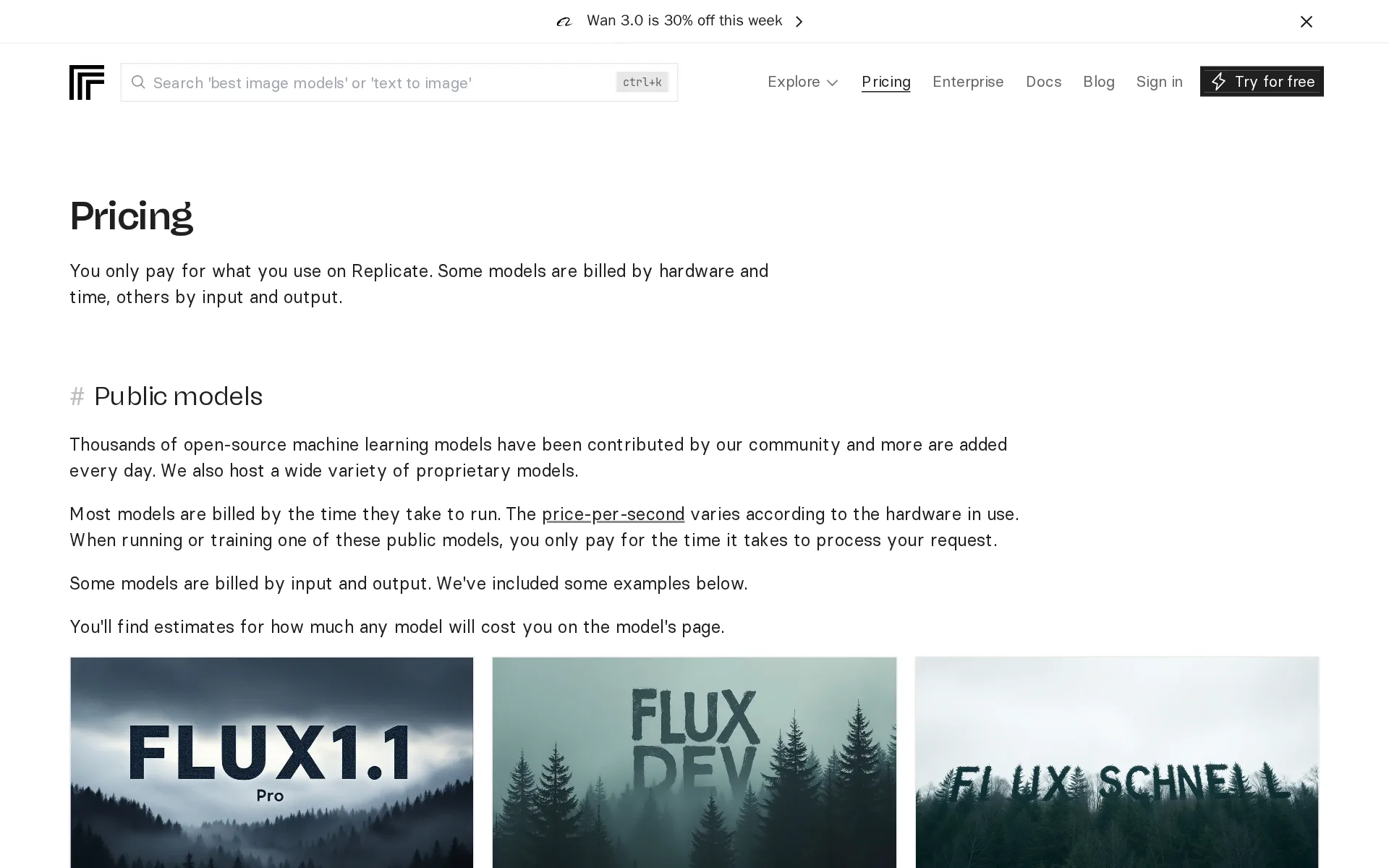
Pricing page, captured
replicate.com/pricing, checked
What we checked on Replicate
What the price counts
Replicate charges by actual model use, with hardware-time and input-output meters depending on the model.
You only pay for what you use on Replicate. Some models are billed by hardware and time, others by input and output.
replicate.com/pricingChecked
Free to use
Select models can be run for free for a short while, after which billing must be set up; some features need billing from the start, so there is no standing free plan.
You can run select models on Replicate for free, but after a bit you’ll be asked to set up billing.
Public API
A documented public HTTP API covers predictions, models, deployments, trainings, hardware and webhooks, authenticated with bearer tokens, plus an OpenAPI schema and official Node, Python, Go and Swift clients.
All API requests must include a valid API token in the Authorization request header.
MCP server
Publishes its own MCP server on GitHub
"Code Mode" makes Replicate's MCP server much faster
github.com/replicate/replicate-mcp-code…Checked by us,
Open source
Cog, the tool every Replicate model is packaged with, is published under Apache License 2.0, and the API clients and CLI are on GitHub; the hosted platform itself is a paid cloud service.
Apache License Version 2.0, January 2004
Replicate alternatives
Replicate and Fireworks AI
Replicate beside its alternatives: the price on each one's site and the day it was checked Tool Price Checked Replicate From $0.00 per second Fireworks AI From $0.05 per 1m input tokens

Questions about Replicate
- How much does Replicate cost?
- Replicate costs $0.00 per second. From replicate.com/pricing, checked 14 November 2026.
- Does Replicate have an API or an MCP server?
- Replicate has an API. From replicate.com/docs/reference/http, checked 14 November 2026. Replicate has an MCP server. We checked github.com/replicate/replicate-mcp-code-mode ourselves on 15 November 2026.
- Is Replicate open source, and can you host it yourself?
- Replicate is open source. From github.com/replicate/cog/blob/main/LICENSE, checked 14 November 2026.
- What have we checked on Replicate?
- 5 facts, under these headings: What it costs to start, how you build with it.
- How do we check Replicate?
- We hold 5 facts on Replicate, quoted from 6 pages. Facts last checked 15 November 2026. Price last checked 14 November 2026. Last change found 15 November 2026.
Sources and changes
Last full check
Sources5
What changed2
- What it does
- What it does
Replicate price history
Plans for Replicate started at $0.00 per second on both of our reads, from 30 October 2026 to 14 November 2026.
| Price | Plan | First seen | Last seen | Readings | Source |
|---|---|---|---|---|---|
| $0.00 per second | 30 October 2026 | 14 November 2026 | 2 | Pricing page, read 30 October 2026 |
From our research, read twice since 30 October 2026. A date is when we read the page, not when the price changed.
Similar to Replicate
- ERIUS PHONERented cloud Android phones, each in its own container, that keep an agent's apps and sign-ins between sessions.
- TinyFishWeb search, page fetching, cloud browsers and goal-driven web automation for AI agents, with search and fetch free.
- SmitheryPublic MCP server registry, now run by Arcade, listing direct vendor MCP URLs after its proxy shut down.
- UI DiscoveryA library of real websites, iOS apps and dashboards with each one's palette, fonts and original build prompt.


Is Replicate yours?
Free, and the page then carries the verified owner mark. You confirm it with an email at replicate.com. Claim this listing
Report an error if a fact is wrong.