
Vertex AI Agent Builder
What is Vertex AI Agent Builder?
Vertex AI Agent Builder is Google Cloud's platform for enterprise AI teams and business users that builds, deploys, and governs AI agents and generative AI experiences. It includes Agent Studio, Agent Development Kit (ADK), Agent Runtime, Agent Designer, Memory Bank, Agent Simulation, and Agent Evaluation, plus ready-made agents like Deep Research, Data Insights, NotebookLM Enterprise, and Gemini Code Assist. It connects with BigQuery and Pub/Sub, supports existing applications through its API, and is cited by MLB, Virgin Media O2, and Mattel. Plans run Free, Pay as you go, and Custom pricing.
Last verifiedHow we evaluate
At a glance
- Vertex AI Agent Builder is best for enterprise AI teams who need to build and govern custom agents on Google Cloud.
- Free; Pay as you go; Custom pricing
- 90 days
- Yes — API available; it supports integration with existing applications and services to add AI capabilities.
The product you're looking up has been renamed and absorbed
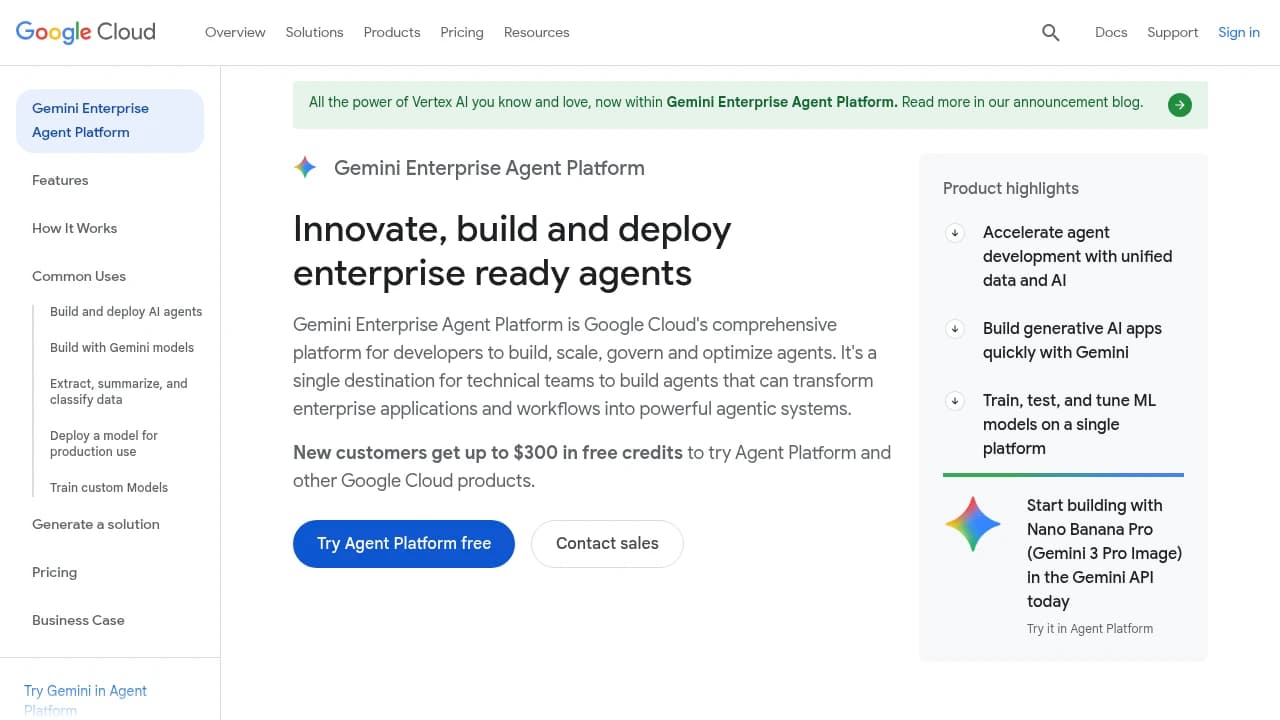
cloud.google.com/products/agent-builder now 301-redirects to cloud.google.com/products/gemini-enterprise-agent-platform, with the page's own title reading 'Gemini Enterprise Agent Platform (formerly Vertex AI)'. Google's documentation says it plainly: 'Agent Builder has transitioned to become part of Gemini Enterprise Agent Platform.' This was announced at Google Cloud Next on April 22, 2026 as a platform-wide rebrand of Vertex AI, not a cosmetic rename of one product — Vertex AI's ML tooling, the old Agentspace agent layer, and Agent Builder's search/conversation tools were all consolidated under one umbrella and one console. Existing API endpoints and workloads keep running unchanged, per Google's own migration guidance, so nothing breaks for current users — but anyone evaluating 'Vertex AI Agent Builder' today is really evaluating this larger platform, and any pricing or docs page still bookmarked under the old name will bounce you to the new one.
What's actually in the box
Google organizes the platform into four pillars. Build: Agent Development Kit (ADK), a low-code Agent Studio canvas, a prebuilt-agent library (Agent Garden), Model Garden access to 200+ models (Gemini, Anthropic's Claude, Gemma and others), RAG Engine, and Vector Search. Scale: Agent Runtime (the hosted execution environment, formerly called Agent Engine), Agent Platform Sessions and Memory Bank for state/persistent memory, and sandboxed code execution. Govern: Agent Registry, Agent Identity, Agent Gateway (policy enforcement on tool calls), and content/semantic governance policies. Optimize: agent evaluation tooling (Multi-Turn AutoRaters, online evaluation), simulation for stress-testing agent behavior, and an observability/trace viewer. This is a materially bigger surface than the old 'Agent Builder' branding implied — it's now Google's full agent stack, not just a search-and-conversation builder.
The framework itself is genuinely open source and actively maintained
ADK (the code-first agent framework at the core of the 'Build' pillar) is Apache-2.0 licensed and developed in the open at github.com/google/adk-python: 21.2k stars, 3.9k forks, 434 contributors, 82 releases (latest v2.7.1), and commits landing within the hour of this check. That's a real, currently-active open-source project, not an abandoned SDK wrapped around a hosted API — a legitimate strength if vendor lock-in to a specific model or a black-box agent format is a concern, since ADK itself is model-agnostic and has sibling SDKs in Java, Go and TypeScript. The gap: ADK being open source doesn't make the platform open source. Runtime, Sessions, Memory Bank, Vector Search, Agent Gateway and everything else it talks to are closed, metered Google Cloud services — you can self-host the agent logic, but production deployment on this platform means a GCP billing account.
How pricing actually works
There's no flat subscription. Google's own pricing page (docs.cloud.google.com/gemini-enterprise-agent-platform, confirmed live 2026-08-20) bills 'Scale' pillar usage (Runtime, Sessions, Memory Bank, Skill Registry, Agent Gateway) on three meters: Agent Compute at $0.085/vCPU-hour after a 50-hour/month free tier, Agent Memory at $0.009/GiB-hour after 100 GiB-hours free, and Agent Storage at roughly $0.000411/GiB-hour (~$0.30/GiB-month) after 1 GiB-month free. Generative AI usage (text/chat/code) is billed separately starting at $0.0001 per 1,000 characters, and Vector Search/Pipelines have their own separate meters. New customers get the standard $300 Google Cloud trial credit — that's a general GCP incentive, not something specific to this product. One thing worth flagging directly: Memory Bank, Sessions, and Skill Registry billing has not started yet — Google's pricing page states it 'will commence on September 1st, 2026' — so anyone testing those specific features today is using them for free in a way that will not continue past that date, roughly ten days from this check.
Independent user sentiment is hard to pin down right now
G2 and Gartner Peer Insights both host reviews, but under a mix of old and new product names that are actively being reconciled — Gartner Peer Insights still lists the product as 'Vertex AI' with 340 reviews, and G2 has separate listings for 'Google Vertex AI' and 'Gemini Enterprise Agent Platform'. Both sites blocked automated access during this check (G2 returned a CAPTCHA wall, Gartner a Cloudflare challenge page), so an aggregate star rating could not be independently verified — not established. Buyers should read reviews directly on those platforms rather than trust a secondhand summary, and should check which product name a given review is actually about, since the rename has split historical review volume across two listings.
How much does Vertex AI Agent Builder cost?
| Plan | Price | What's included |
|---|---|---|
| Free | Free |
|
| Custom pricing | Custom |
|
Frequently asked questions
What is Vertex AI Agent Builder?
It is Google Cloud's enterprise platform for building, deploying, and governing AI agents. Google describes it as a single, secure platform for centralized visibility and control across agents made by Google, third parties, or your own teams.
Does it have a free trial?
Google Cloud says Agent Builder's Express mode gives new users a free 90-day trial of its core features, with no credit card required.
Can I use an API with it?
Yes. The API is available and is described as supporting integration with existing applications and services so teams can add AI capabilities to current systems.
Can it connect to third-party tools?
Yes. Google says the Agent Platform supports integrations with popular tools and platforms, and the published FAQ specifically mentions BigQuery and Pub/Sub as supported integrations.
Is it self-hosted or cloud-only?
The public product pages position it as a Google Cloud platform accessed through the Google Cloud console. The available documentation here does not describe a self-hosted edition or open-source license.
What support do enterprise customers get?
Enterprise customers get 24/7 technical support, including help with cloud setup and operational assistance, according to Google's published FAQ.
What can I build with it?
You can build, deploy, and govern custom agents, plus use ready-made agents such as Deep Research, Data Insights, NotebookLM Enterprise, and Gemini Code Assist. Google also shows Agent Designer, Agent Studio, Agent Runtime, Memory Bank, Agent Simulation, and Agent Evaluation.
How do I get started?
Google says to start by visiting Agent Platform in the Google Cloud console and exploring the available tools and features. From there, teams can choose the right environment for building agents and connect internal systems.
Editor's read
Check whether your team needs the Google Cloud stack around BigQuery and Pub/Sub, since those integrations are part of the platform's value. Also verify whether Free's $300 credits and 20+ free-tier products are enough before moving to usage-based or custom pricing.

Where we've written about Vertex AI Agent Builder
Explore other Agent Frameworks



