
Aident Loadout
What is Aident Loadout?
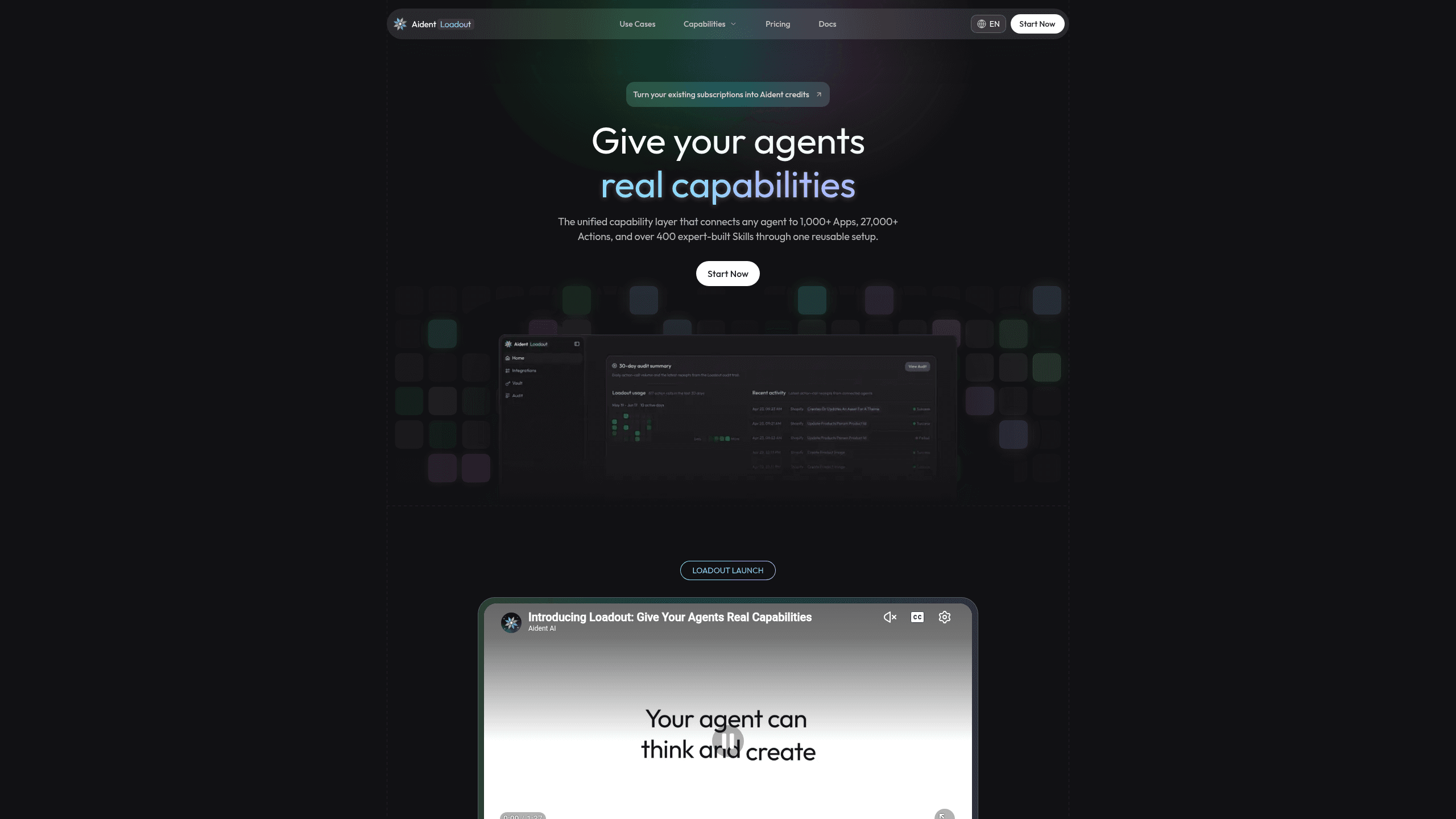
Aident Loadout is a reusable capability layer for AI builders that connects agents to real apps and actions across coding agents, chat apps, CLI, and MCP. It combines Aident Vault for credential handling, Audit for execution visibility, and a marketplace of expert-built Skills. It supports 1,000+ apps, 27,000+ actions, and 400+ Skills, with Google Calendar, Notion, GitHub, and Slack among the listed examples.
Last verifiedHow we evaluate
At a glance
- Aident Loadout is best for AI builders who need one reusable way to connect agents to real apps and actions.
- Yes — You can request an app or connect its API as a custom App, and it exposes the same capabilities through the CLI and MCP.
What it actually does
Loadout is a credential and action broker that sits between your AI agent and the outside world. You connect apps once (OAuth in-browser for services like Gmail or GitHub, API keys stored in a Vault for others), and any MCP-compatible client — the docs list Codex, Claude Code, Cursor, OpenCode, ChatGPT, Claude Desktop and others — can then call those integrations through a single MCP server at loadout.aident.ai/mcp. The agent gets action results, not raw credentials; an Audit tab logs which action ran, which account it used, whether it succeeded, how long it took and how many credits it cost. Access tokens last 7 days with 30-day refresh tokens rotated on each use.
Catalog scale and how it's built
The vendor claims 1,000+ connected Apps and 27,000+ executable Actions. The public catalog at aident.ai/loadout/apps is paginated across 38 listing pages, and the Skills marketplace lists exactly 419 skills as of this check — close to, but not identical to, the '400+' figure used in the homepage copy. Many catalog entries are short auto-generated descriptions ('X Tools: X is a ... platform ...'), and the product's own changelog contains repeated references to 'Composio recovery,' 'Composio billing overrides,' 'Composio unavailable alerts' and 'virtual Composio execution' across releases from March through May 2026 — indicating the integration catalog runs substantially on Composio's toolset infrastructure. Aident publishes a blog post positioning Composio as a competing product for a different buyer (developers building agent products vs. teams wanting governed access), which is a fair distinction on the governance layer, but it doesn't disclose that Composio also appears to be a dependency underneath its own catalog.
Pricing and how the balance works
Pay-as-you-go is $0/month with a chosen top-up amount for credits. Pro is $9.90/month and adds $5.00 of credit monthly, plus up to 5 connected accounts per app, a 5% discount on additional Credit Boosts, and priority support. Team is $59/month and adds a $30.00 shared balance monthly, the same 5-accounts-per-app limit for every member, a dedicated support channel, and (marked 'coming soon' on the pricing page) private Skill uploads shared across the team. Custom/on-premises deployment is quote-only via sales. Note the subscription price is noticeably higher than the credit it grants each month (Pro: pay $9.90, get $5 credit; Team: pay $59, get $30) — the difference buys the account-connection limits, support tier and discount, not more usable spend.
Company and maturity
Aident AI, LLC is based in Sunnyvale, CA, founded in 2024 per its LinkedIn page, which lists company size as 2-10 employees (with 14 individual profiles self-identifying as employees). The company's original product was a no-code 'Aident AI' playbook/automation builder (Product Hunt launch referenced in a LinkedIn post from roughly nine months before this check, followed by a 'Beta 2' relaunch about six months before this check); Aident Loadout — the product reviewed here — launched roughly one month before this check, per the same LinkedIn feed. No funding round, investor, or amount could be verified from any public source checked in this session. The company's Discord server has 174 members and 7 online at time of check.
Open-source components aren't the product
Aident-AI's GitHub org holds three public repos. open-cuak ('Open CUA Kit', Apache-2.0, 392 stars) was an earlier browser-automation agent project; it is not archived, but its last code push was 28 June 2025 and its README still describes itself as being 'in its very early days.' It is not part of the Loadout product being reviewed here. aident-skill (MIT, 5 stars) is a small, actively maintained companion repo of skill definitions and CLI scaffolding, last pushed 5 September 2026 — useful if you want to see how Skills are authored, but it isn't the Loadout platform itself, which is closed-source and only available as a hosted SaaS product.
What's missing from independent verification
Trustpilot and Product Hunt both returned HTTP 403 to direct fetch attempts, so no independent customer reviews could be checked this session. No dedicated security/trust or compliance page (SOC 2, DPA, sub-processor list) was found at aident.ai/security or elsewhere on the site — only a generic privacy policy covering standard web analytics and cookie practices. No public status page was found.
Frequently asked questions
What is Aident Loadout?
Aident Loadout is a reusable capability layer for AI builders that connects agents to real apps and actions across coding agents, chat apps, CLI, and MCP. It combines Aident Vault for credential handling, Audit for execution visibility, and a marketplace of expert-built Skills. It supports 1,000+ apps, 27,000+ actions, and 400+ Skills, with Google Calendar, Notion, GitHub, and Slack among the listed examples.
What is Aident Loadout used for? Who is it for?
Aident Loadout is used for One balance, Every action stays visible, and Setup once. It's built for AI builders, Operations teams, and Developers.
Does Aident Loadout have an API and what does it integrate with?
You can request an app or connect its API as a custom App, and it exposes the same capabilities through the CLI and MCP.
Editor's read
Check whether your team needs the same capability layer across coding agents, chat apps, CLI, and MCP. If you only need a single surface, the reuse advantage is less important than the broader app and Skills catalog.

Explore other Agent Tools & Integrations


