
Middleware OpsAI
What is Middleware OpsAI?
Middleware OpsAI is an observability and incident-response platform for SRE, platform, DevOps, application, and Kubernetes teams that correlates telemetry across applications, infrastructure, databases, containers, logs, RUM, synthetics, and LLMs to find root causes and trigger remediation. It includes Automated error fixing, Kubernetes debugging and auto-fix, Anomaly detection, and Log pattern analysis, and connects with GitHub, Kubernetes, Docker, AWS, Slack, Grafana, and Prometheus. Plans run Free Trial $0, Pay As You Go $0.3GB of metrics, logs, traces, and Enterprise custom pricing.
Last verifiedHow we evaluate
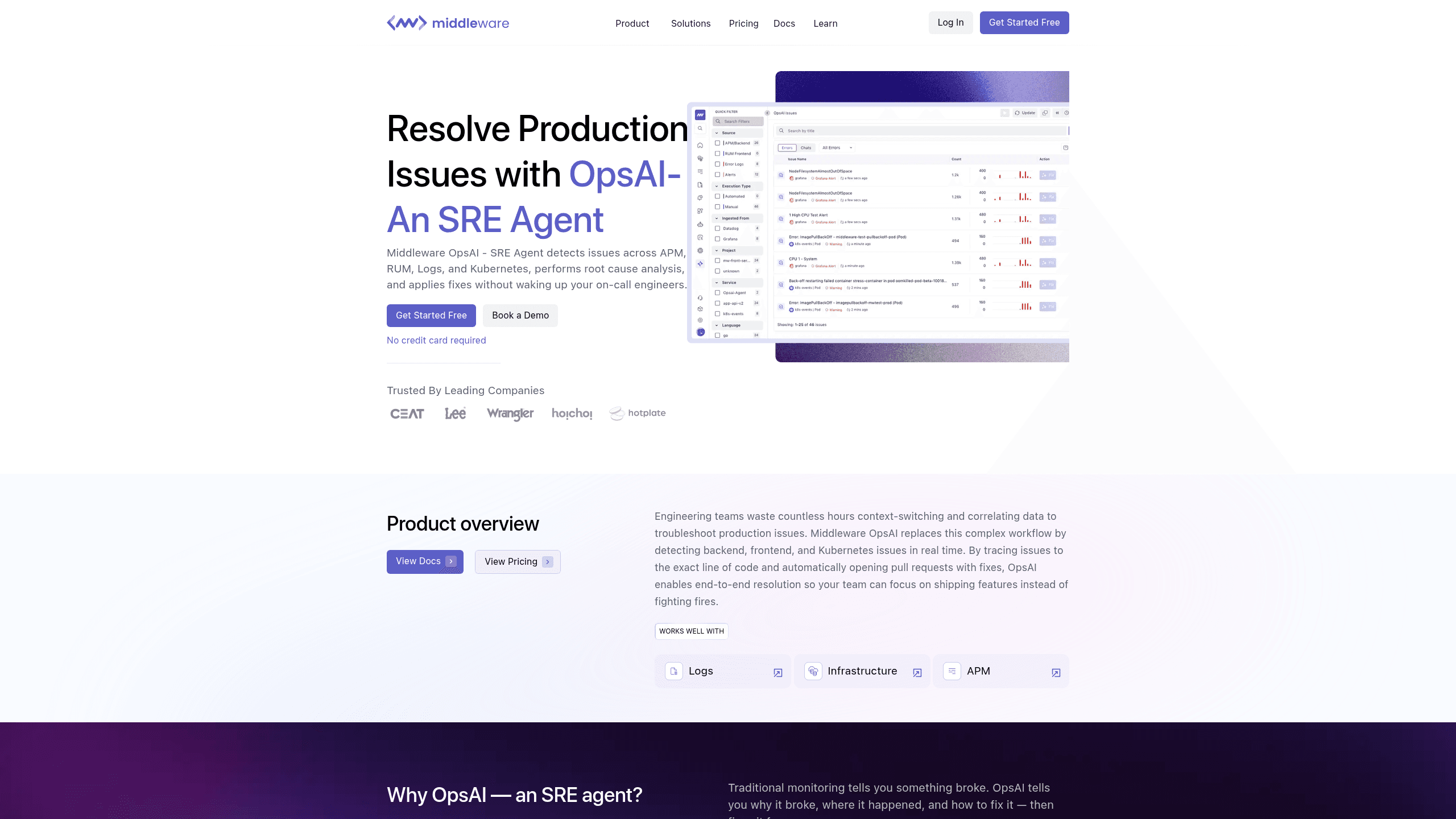
At a glance
- OpsAI is best for SRE and platform teams who want faster root-cause analysis and automated remediation.
- Free Trial $0; Pay As You Go $0.3GB of metrics, logs, traces; Enterprise Custom
- 14 days, no credit card
- Yes — The page links to API docs and mentions a public API docs section.
What does Middleware OpsAI do?
OpsAI watches telemetry across applications, infrastructure, databases, containers, logs, RUM, synthetics, and LLMs, then correlates signals on one timeline to spot anomalies and trace them back to root causes. It combines automatic issue detection, suggested fixes, and automated remediation so teams can move from alert to action without stitching together separate tools. The same workflow also supports Kubernetes debugging and auto-fix, plus log pattern analysis for faster triage. At scale, Middleware says it serves 4,200+ engineers and connects to 200+ tools and services, with 450+ built-in integrations listed on the integrations page. The platform is built for cloud-native environments and supports public API docs at docs.middleware.io. Customer proof on the site includes Trademarkia and Corgi, and Middleware says it reduced debugging and resolving time by nearly 90% in one customer story.
Why use Middleware OpsAI?
- OpsAI ties detection, diagnosis, and remediation together, so teams can move from alert to fix without switching tools.
- The unified timeline across logs, metrics, traces, RUM, synthetics, and LLMs reduces the guesswork in cross-signal debugging.
- Automatic PR generation and suggested fixes help teams turn incident response into repeatable workflows.
- The platform's 200+ tool and service integrations make it easier to fit into an existing observability stack.
- Public API docs give engineering teams a path to automate workflows around observability data.
Who is Middleware OpsAI for?
- SRE teams who need to detect incidents quickly and shorten time to resolution.
- Platform engineers who want correlated visibility across logs, metrics, traces, and containers.
- DevOps teams who need automated fixes and clearer incident triage across cloud-native systems.
- Application engineers who want log, APM, and RUM signals in one workflow.
- Kubernetes operators who need debugging help and auto-fix for cluster issues.
What are Middleware OpsAI's key features?
Automated error fixing
Detects production errors and applies fixes automatically, helping teams cut debugging time and resolve incidents faster across metrics, logs, and traces.
Kubernetes debugging and auto-fix
Troubleshoots Kubernetes issues and suggests or applies remediation, which matters when containerized services need fast recovery in Kubernetes environments.
Third-party alert ingestion
Ingests alerts from tools like Slack, Pager duty, Opsgenie, and Atlassian JIRA so OpsAI can centralize incident signals in one workflow.
Anomaly detection
Flags unusual behavior across observability data to surface incidents earlier, reducing time spent hunting regressions in large-scale systems.
Log pattern analysis
Analyzes log patterns to identify recurring failure signatures, helping teams pinpoint root causes faster in log-heavy production systems.
Unified Experience
Brings Infrastructure, Container, Log, Database, Synthetic, APM, RUM, and LLM Observability into one interface for faster cross-signal investigation.
Integrations
Connects with GitHub, Kubernetes, Docker, Amazon Web Services, Slack, Grafana, and Prometheus to fit into existing engineering workflows.
What does Middleware OpsAI integrate with?
- GitHub
- Datadog
- Grafana
- MySQL
- PostgreSQL
- MongoDB
- Cassandra
- Aurora
- Scala
- Deno
- Ruby
- .NET
- Vercel
- Node.JS
- Cloudflare worker
- Next.JS
- PHP
- Java
- Python
- Go
- Heroku
- Google Cloud Platform
- Microsoft Azure
- Amazon Web Services
- Kubernetes
- Docker
- Elasticsearch
- Clickhouse
- MariaDB
- Redis
What are Middleware OpsAI's use cases?
SRE incident triage
SRE teams use OpsAI to spot production incidents faster and cut resolution time, using Anomaly detection and Log pattern analysis to narrow down likely causes. They can then use Automated error fixing to move from alert to remediation without bouncing between tools.
Kubernetes cluster debugging
Kubernetes operators use OpsAI to investigate noisy cluster issues and apply fixes with less manual digging, using Kubernetes debugging and auto-fix to identify what broke. Unified Experience keeps container, infrastructure, and log context together so they can restore service faster.
DevOps alert-to-fix workflow
DevOps teams use OpsAI to turn incoming alerts into actionable triage, pulling signals through Third-party alert ingestion and Integrations from their existing stack. With Automated error fixing, they can reduce repetitive firefighting and get cloud-native systems back online sooner.
Unified signals for app engineers
Application engineers use OpsAI to follow a single investigation path across logs, APM, and RUM, relying on Unified Experience to correlate user impact with backend behavior. Log pattern analysis helps them isolate regressions and confirm whether a release actually fixed the issue.
How does Middleware OpsAI work?
- Connect your first source through Integrations, starting with logs, metrics, traces, or Kubernetes so OpsAI has live production context to analyze.
- Route alerts into Third-party alert ingestion and map them into the Unified Experience, so incidents arrive with the surrounding telemetry already attached.
- Let Anomaly detection and Log pattern analysis surface the most likely failure points, then review the investigation trail inside OpsAI.
- Trigger Automated error fixing or Kubernetes debugging and auto-fix to apply the recommended remediation, then verify recovery across APM, RUM, and infrastructure views.
How much does Middleware OpsAI cost?
| Plan | Price | What's included |
|---|---|---|
| Free Trial | $0 |
|
| Pay As You Go | $0.3GB of metrics, logs, traces |
|
| Enterprise | Custom Pricing |
|
Frequently asked questions
What is Middleware OpsAI?
Middleware OpsAI is an observability and incident-response platform for SRE, platform, DevOps, application, and Kubernetes teams that correlates telemetry across applications, infrastructure, databases, containers, logs, RUM, synthetics, and LLMs to find root causes and trigger remediation. It includes Automated error fixing, Kubernetes debugging and auto-fix, Anomaly detection, and Log pattern analysis, and connects with GitHub, Kubernetes, Docker, AWS, Slack, Grafana, and Prometheus. Plans run Free Trial $0, Pay As You Go $0.3GB of metrics, logs, traces, and Enterprise custom pricing.
How much does Middleware OpsAI cost? Is it free?
Middleware OpsAI has a free plan, with paid tiers including Pay As You Go at $0.3GB of metrics, logs, traces, Enterprise at Custom Pricing. A 14-day free trial is available.
What is Middleware OpsAI used for? Who is it for?
Middleware OpsAI is used for Automated error fixing, Kubernetes debugging and auto-fix, and Third-party alert ingestion. It's built for SRE teams, Platform engineers, and DevOps teams.
Does Middleware OpsAI have an API and what does it integrate with?
The page links to API docs and mentions a public API docs section.
Editor's read
Check the Pay As You Go meter before committing: metrics, logs, and traces are billed at $0.3GB, while RUM sessions, synthetic checks, and browser test runs have separate usage charges. If your incident workflow depends on heavy test automation, those add-ons can move the bill faster than the base ingestion rate.

Where we've written about Middleware OpsAI
Explore other Workflow Automation


