
TinyFish
What is TinyFish?
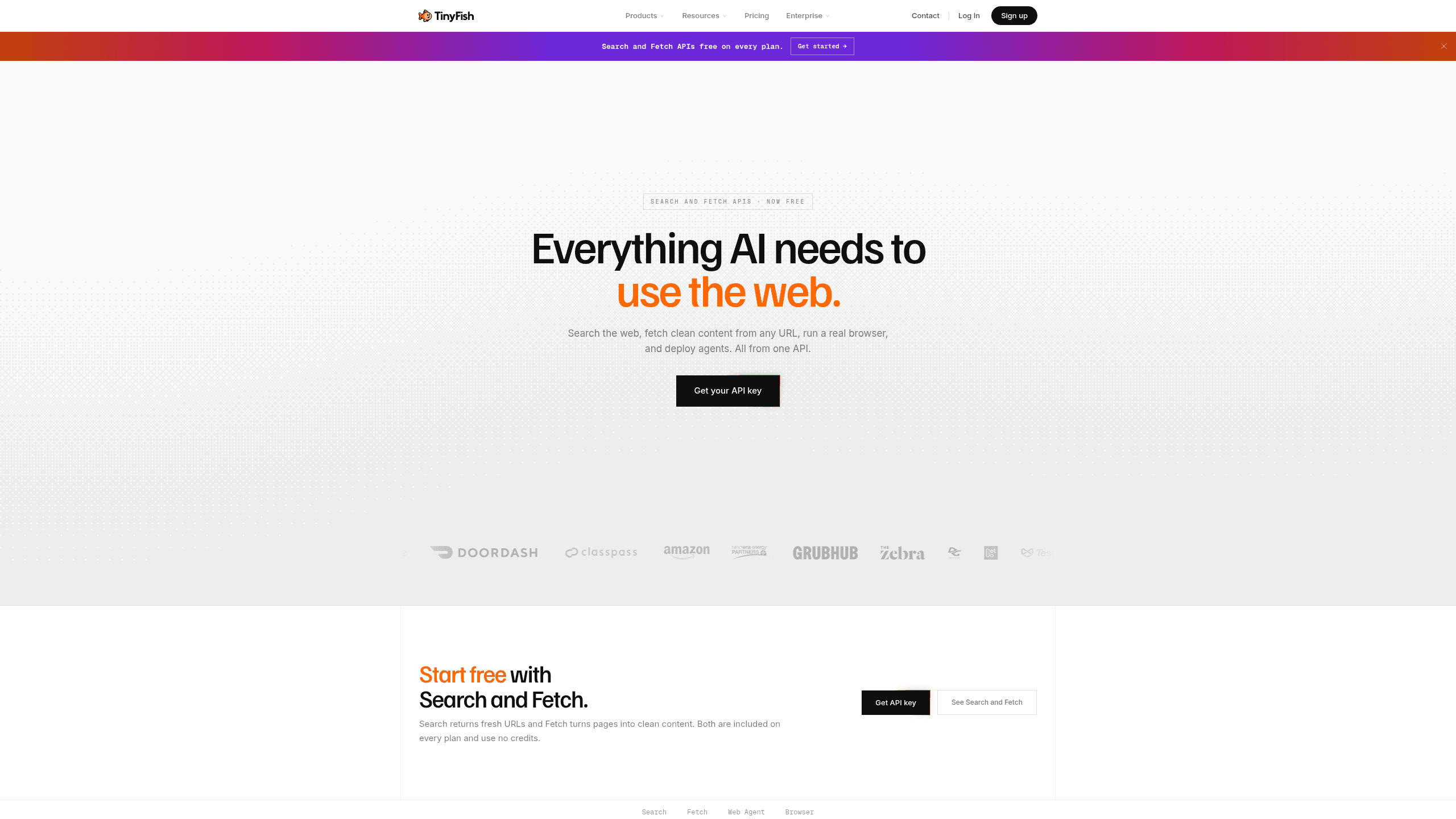
TinyFish is a web automation platform for developers that combines live search, page fetching, browser sessions, and multi-step agent workflows in one API. Its Search, Fetch, Web Agent, and Browser API products let teams move from lookup to extraction to action without stitching tools together. Customers include Google, DoorDash, Amazon, and Grubhub. There are no monthly plans: Search and Fetch are free within rate limits, Agent costs $0.016 per step and Browser $0.002 per minute from a prepaid Wallet, and Enterprise is priced by contract.
Last verifiedHow we evaluate
At a glance
- TinyFish is best for developers who need reliable web search, extraction, and browser automation in one API.
- Pay as you go: Search & Fetch free, Agent $0.016/step, Browser $0.002/min; Enterprise Custom
- Yes — All products share one API key, and the site says direct API is available for custom integrations.
What it actually is
TinyFish is enterprise infrastructure for AI web agents, sold as four API products under one key and one prepaid Wallet: Search (structured web search), Fetch (URL-to-clean-content), Browser (managed remote Chrome sessions with anti-bot handling), and Agent (natural-language multi-step automation — navigation, form filling, logins). Search and Fetch are free within rate limits; Agent and Browser draw from the Wallet. It ships a CLI, an MCP integration, and a coding-agent context file, and connects to n8n and Dify. Founded in 2024 by Sudheesh Nair (former Nutanix president), Shuhao Zhang (ex-Meta engineering) and Keith Zhai (ex-Wall Street Journal), it launched publicly in August 2025 after operating in stealth.
Benchmark claims and how corroborated they are
TinyFish reports 89.9% overall and 81.9% on 'hard' tasks on Online-Mind2Web (300 tasks, 136 live sites), against 43.2% for OpenAI Operator and 32.4% for Claude Computer Use on the same benchmark — and it publishes every one of the 300 run traces, including failures, for anyone to check (https://tinyfish.ai/blog/mind2web). On Steel.dev's community Online-Mind2Web leaderboard it sits 4th at 90.0%, behind Browser Use Cloud (97.0%) and two others — that board mixes self-reported and independently-verified rows, so its ranking is a supplement, not a substitute, for the primary claim. Separately, an outside eval lab (Mersault) ran WebVoyager across 641 tasks on 15 live sites in May 2026 with all agents on the same underlying model and a bias-controlled judge, and ranked TinyFish first at 91.1% ahead of Browser Use, Smooth and Notte — this is the closest thing to an independently-run result. That same evaluation also recorded TinyFish's weakest scores (Google Flights 74%, Cambridge Dictionary 67%) and the highest CAPTCHA-block/timeout count of the four agents tested, figures TinyFish itself publishes rather than hides.
Pricing
Published, numeric, and simple: there are no monthly plans and no minimums. Search and Fetch are free within rate limits (Search 30 requests a minute and 500 an hour; Fetch 150 URLs a minute and 1,000 a day). Agent costs $0.016 per step and Browser $0.002 per minute, both drawn from a prepaid Wallet: new accounts start with $8 in it, top-ups are $10 minimum, and auto-reload is optional. That price bundles LLM inference, residential proxies, anti-bot handling and run storage rather than metering them separately. Accounts start at 2 concurrent Agent runs and 5 Browser sessions; Enterprise, priced by contract, sets limits to the workload and adds SSO, audit logs, VPC deployment and a 99.99% uptime SLA. Customers on the earlier credit plans see their rates and balance in their account dashboard.
Credential handling for logged-in automation
The Agent product can log into sites during a run by syncing credentials from a connected password manager (1Password, Bitwarden) rather than TinyFish storing passwords itself. By design the AI planning layer only ever sees field labels, not credential values — TinyFish's execution layer fills the actual password, and per TinyFish's own documentation the value exists in memory only for the input action and isn't written to logs, screenshots or streaming output. Vault access is opt-in per run (use_vault: false by default) and provider tokens are stated to be encrypted at rest.
Security and compliance disclosure
TinyFish runs a real trust center at trust.tinyfish.ai showing ISO 27001:2022 certification (with a linked certificate) and a public breakdown of controls across infrastructure security, organizational security, product security, internal procedures, and data/privacy — this is a genuine compliance page, not a marketing 'enterprise-grade security' line. No SOC 2 report is referenced there as of this check.
Funding and company
TinyFish raised a $47M Series A, announced August 2025, led by ICONIQ Capital with participation from U.S. Venture Partners, Mango Capital, MongoDB Ventures, Alpine Software Group, and Sandberg Bernthal Venture Partners. No valuation was disclosed. The company also runs a $2M seed-check accelerator program for startups building on its API, backed by Mango Capital.
Customers
TinyFish names DoorDash, Grubhub, ClassPass, GetGo, Digital Garage, Google Hotels, The Zebra and TestSprite in vendor-published case studies with specific (vendor-stated) outcomes — e.g. ClassPass keeping 32,000+ studio schedules accurate, The Zebra compressing insurance quote turnaround into seconds. Several more case studies (a global car rental company, a beverage company, a healthcare provider) are published with metrics but without the company named. None of these figures are independently corroborated; they are TinyFish's own account of its customers' results.
Independent reception
The open-source cookbook repo (github.com/tinyfish-io/tinyfish-cookbook, MIT licensed) has 2,114 stars and was pushed to within the last week of this check, with 60 open issues — an actively maintained example set, not an abandoned repo. A 'Show HN' benchmark post from a TinyFish employee drew modest engagement (17 points, 12 comments); reception was mostly curious and technical, though one commenter flagged the post's own upvote pattern as looking self-promoted. No reviews were found on G2 or Gartner Peer Insights as of this check — consistent with a company that only left stealth a year ago and sells enterprise/sales-led rather than self-serve at scale.
How much does TinyFish cost?
| Plan | Price | What's included |
|---|---|---|
| Pay as you go | $0.016/agent step |
|
| Enterprise | Custom |
|
Frequently asked questions
What is TinyFish?
TinyFish is a web automation platform for developers that combines live search, page fetching, browser sessions, and multi-step agent workflows in one API. Its Search, Fetch, Web Agent, and Browser API products let teams move from lookup to extraction to action without stitching tools together. Customers include Google, DoorDash, Amazon, and Grubhub. There are no monthly plans: Search and Fetch are free within rate limits, Agent costs $0.016 per step and Browser $0.002 per minute from a prepaid Wallet, and Enterprise is priced by contract.
How much does TinyFish cost? Is it free?
TinyFish has no monthly plans. Search and Fetch are free within rate limits; Agent ($0.016 per step) and Browser ($0.002 per minute) are paid from a prepaid Wallet, and new accounts start with $8 in it. Enterprise is priced by contract.
What is TinyFish used for? Who is it for?
TinyFish is used for Search, Fetch, and Web Agent. It's built for Product engineers, Automation teams, and Data operations teams.
Does TinyFish have an API and what does it integrate with?
All products share one API key, and the site says direct API is available for custom integrations. It integrates with Cursor, Grok, Vercel, n8n, AG2, and 5 more.
Editor's read
Estimate your Agent and Browser volume before you commit: both draw from a prepaid Wallet at $0.016 per agent step and $0.002 per browser minute, while Search and Fetch are free within their rate limits. Accounts start at 2 concurrent Agent runs and 5 Browser sessions; higher limits, SSO, audit logs and an uptime SLA come with an Enterprise contract.

Explore other Browser Agents


