
Vynaris
What is Vynaris?
Vynaris is an OpenAI-compatible gateway for AI teams that routes each request to a model it expects can handle the task at lower cost. It includes automatic routing, per-request receipts, a CSV ledger, and a model directory, while keeping SDKs, prompts, and tool definitions intact. The service exposes an API at api.vynaris.com/v1 and offers Router costs plus Vynaris S, L, and XL plans.
Last verifiedHow we evaluate
At a glance
- Vynaris is best for AI teams who want lower LLM spend without changing their OpenAI-compatible stack.
- Router costs Provider list price + 3% / 1%; Vynaris S plan $20/mo; Vynaris L plan $45/mo; Vynaris XL plan $150/mo
- Yes — The product exposes an OpenAI-compatible API at https://api.vynaris.com/v1 and provides API keys, docs, and API health endpoints.
What it does: a drop-in router with a cost receipt
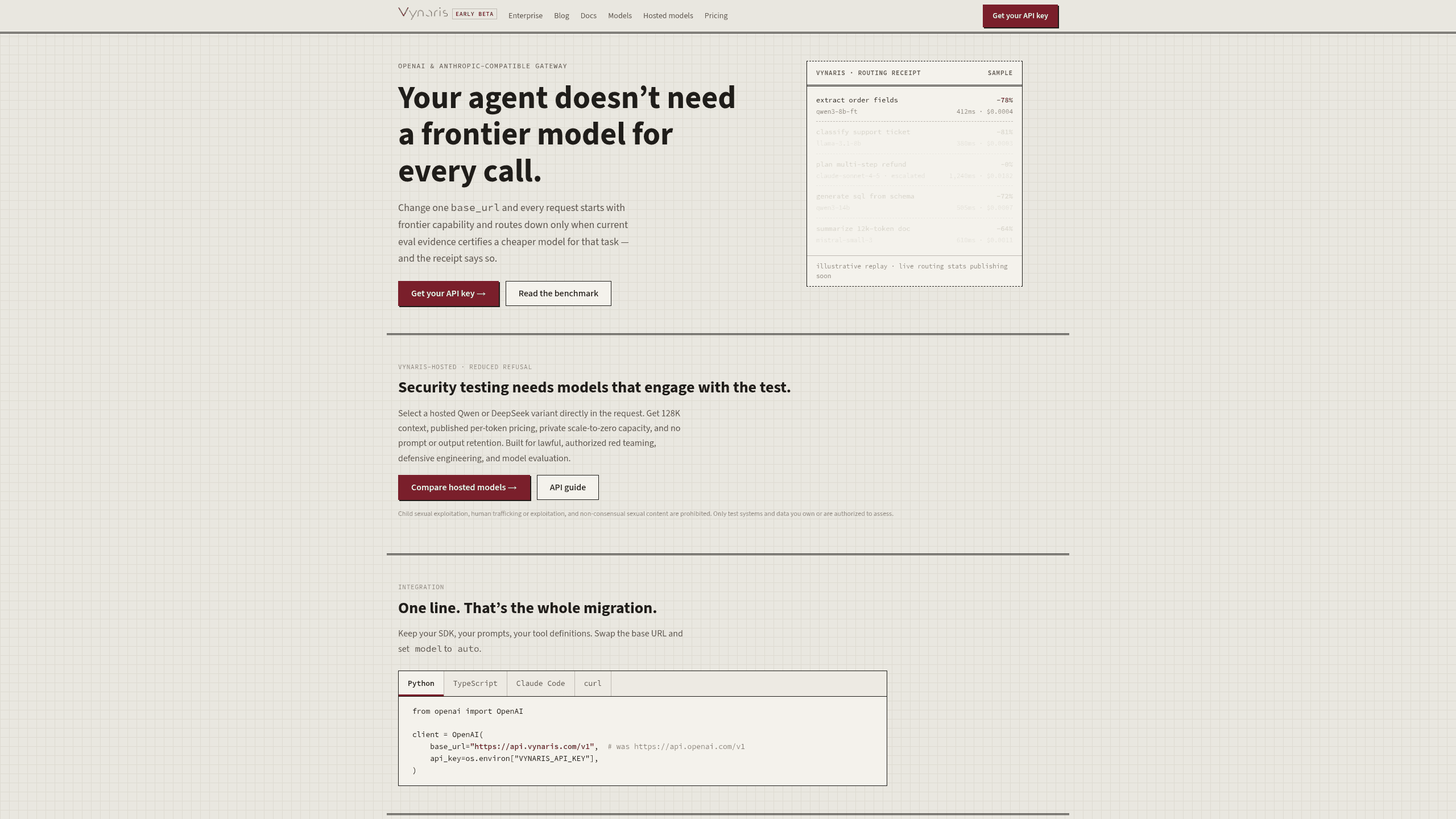
Vynaris sits in front of the major model APIs behind one OpenAI- and Anthropic-compatible endpoint (https://api.vynaris.com/v1). You change base_url and set model to "auto"; each request starts in what Vynaris calls a quality-safe frontier pool and is routed down to a cheaper model only after the vendor says eval evidence clears a quality bar for that task. Every response carries response headers (x-vynaris-served-model, x-vynaris-cost-usd, x-vynaris-baseline-usd, x-vynaris-saved) showing exactly which model served the request and what the same tokens would have cost at the originally-requested model's list price. That per-response, exportable attribution — rather than a single blended "we saved you X%" marketing number — is the most concrete thing on the site (https://vynaris.com/docs#hosted-models).
Pricing: cheap on routed traffic, three ways to pay
Pay-as-you-go: you're billed provider list price for whichever model actually served the request, plus a Vynaris fee of 3% on the first $500 of usage per calendar month, then 1% beyond that; a $500 top-up activates the 1% rate immediately (https://vynaris.com/pricing, verified 2026-09-15). Prepaid top-ups start at $20 and don't expire. Fixed monthly plans convert a flat payment into rolling API credit: $20/month, $45/month, and $150/month, all with the same feature list (full model pool, receipts, no overage charges, unused credit rolls over); the $45 and $150 tiers additionally unlock the privately hosted "uncensored" models. An enterprise tier ($5,000/year) installs the gateway inside the buyer's own infrastructure, routed through the buyer's own provider accounts and rates — Vynaris never touches that compute spend and is paid only the flat annual fee for setup, patches, and updates (https://vynaris.com/enterprise).
The savings claim, and what backs it
The homepage claims 96-98% measured savings on live routed requests versus the requested model at list price, sourced to nothing but Vynaris's own traffic (vendor claim, unverified by us). To its credit, the site does not publish house benchmarks for model quality and says so explicitly — it cites three independent academic sources for the general idea of quality-preserving model routing (FrugalGPT, arxiv.org/abs/2305.05176; RouteLLM, arxiv.org/abs/2406.18665; Hybrid LLM, arxiv.org/abs/2404.14618) and states plainly that its own contribution is the per-request receipt, not the routing technique. The /models page's "worked example" (500K requests/month at Claude Sonnet 4.x pricing routed instead to DeepSeek V3) is disclosed as arithmetic on published list prices, not a benchmark or a promise about any particular buyer's traffic (https://vynaris.com/models).
The hosted "uncensored" models: a distinct, narrower product
Separately from routing, Vynaris directly hosts three reduced-refusal open-weight models (Qwen3.6-35B-A3B, Qwen3.8-27B, DeepSeek-V4-Flash-uncensored) at published per-token rates ($1-2 input / $5-11 output per million tokens, 128K context) and positions them for "lawful, authorized red teaming, cyber defense, and model evaluation," explicitly prohibiting CSAM, trafficking, and non-consensual sexual content (https://vynaris.com/uncensored-models). Vynaris states that prompt and output bodies for these specific model IDs are never persisted, even if transcript capture is enabled elsewhere on the account — a narrower and more specific retention promise than the general privacy policy gives routed traffic. The site is also honest that reduced refusal does not imply accuracy or safety, and that most of its "uncensored model directory" entries are research guides to community Hugging Face releases rather than models Vynaris actually hosts — only 3 of 11 listed families carry a real Vynaris model ID.
Data handling: routed prompts leave Vynaris, hosted-model prompts don't
For ordinary routed traffic, prompts and completions pass through to whichever third-party provider serves the request, and each API key starts on "metadata-only" logging (Vynaris retains model, tokens, cost, latency — not content) unless the customer explicitly enables transcript capture on that key, in which case full request/response payloads are stored for dashboard debugging, quality-refund review, and — for opted-in keys — sent to a third-party routing-evaluation service (Not Diamond) purely to compare model-selection recommendations. Vynaris states it does not train on customer content itself, but a provider may do so if the customer enables provider data collection for a key. The company's own servers are US-based; routed prompts also cross into whichever region the serving provider operates in (https://vynaris.com/privacy, effective 21 August 2026).
Company: a solo operator, nine months old
Vynaris is a product of Wavicle.tech, a one-person, fixed-price AI consulting studio ("Built by someone who ships" — https://www.wavicle.tech/about) rather than a funded startup. The terms of service state Vynaris is "operated by a sole proprietor based in India," with disputes governed by the laws of India and the courts of Gujarat (https://vynaris.com/terms, effective 21 August 2026). The Wayback Machine's earliest capture of vynaris.com is 3 November 2025 (https://web.archive.org/web/20251103150307/http://vynaris.com/), putting the product at roughly ten months old as of this review. The site itself carries an "Early beta" badge in its header. We found no independent reviews, no third-party coverage, and no evidence of outside funding; all social presence traces to the same individual (x.com/dhrumiliso31702, linkedin.com/in/bdhrumil).
No uptime guarantee, capped liability
The terms of service state outright that the self-serve plan carries no uptime SLA, that upstream provider outages or degradation are passed through without Vynaris controlling them, and that total liability for any claim is capped at whatever the customer paid Vynaris in the preceding three months, excluding indirect or consequential damages (https://vynaris.com/terms). Refunds of unused prepaid balance are available on request (minus payment-processing fees); promotional credit is not refundable. There's also a "quality refund" mechanism for auto-routed requests that fail, credited as Vynaris balance rather than cash, subject to fair-use review.
How much does Vynaris cost?
| Plan | Price | What's included |
|---|---|---|
| Router costs | Provider list price + 3% / 1% |
|
| Vynaris S plan | $20/month |
|
| Vynaris L plan | $45/month |
|
| Vynaris XL plan | $150/month |
|
Frequently asked questions
What is Vynaris?
Vynaris is an OpenAI-compatible gateway for AI teams that routes each request to a model it expects can handle the task at lower cost. It includes automatic routing, per-request receipts, a CSV ledger, and a model directory, while keeping SDKs, prompts, and tool definitions intact. The service exposes an API at api.vynaris.com/v1 and offers Router costs plus Vynaris S, L, and XL plans.
What is Vynaris used for? Who is it for?
Vynaris is used for automatic routing, OpenAI-compatible API, and per-request receipts. It's built for AI product teams, Platform engineers, and Security teams.
Does Vynaris have an API and what does it integrate with?
The product exposes an OpenAI-compatible API at https://api.vynaris.com/v1 and provides API keys, docs, and API health endpoints. It integrates with OpenAI-compatible API, Google Meet, Cal.com, Hugging Face, o3, and 12 more.
Editor's read
Check whether the Router costs fee structure fits your usage pattern: it charges provider list price plus 3% until monthly usage reaches $500, then 1%, with a $500 top-up activating the lower rate immediately. If you expect steady volume, compare that against the monthly credit plans.

Explore other AI Model Providers


