
Hyper
What is Hyper?
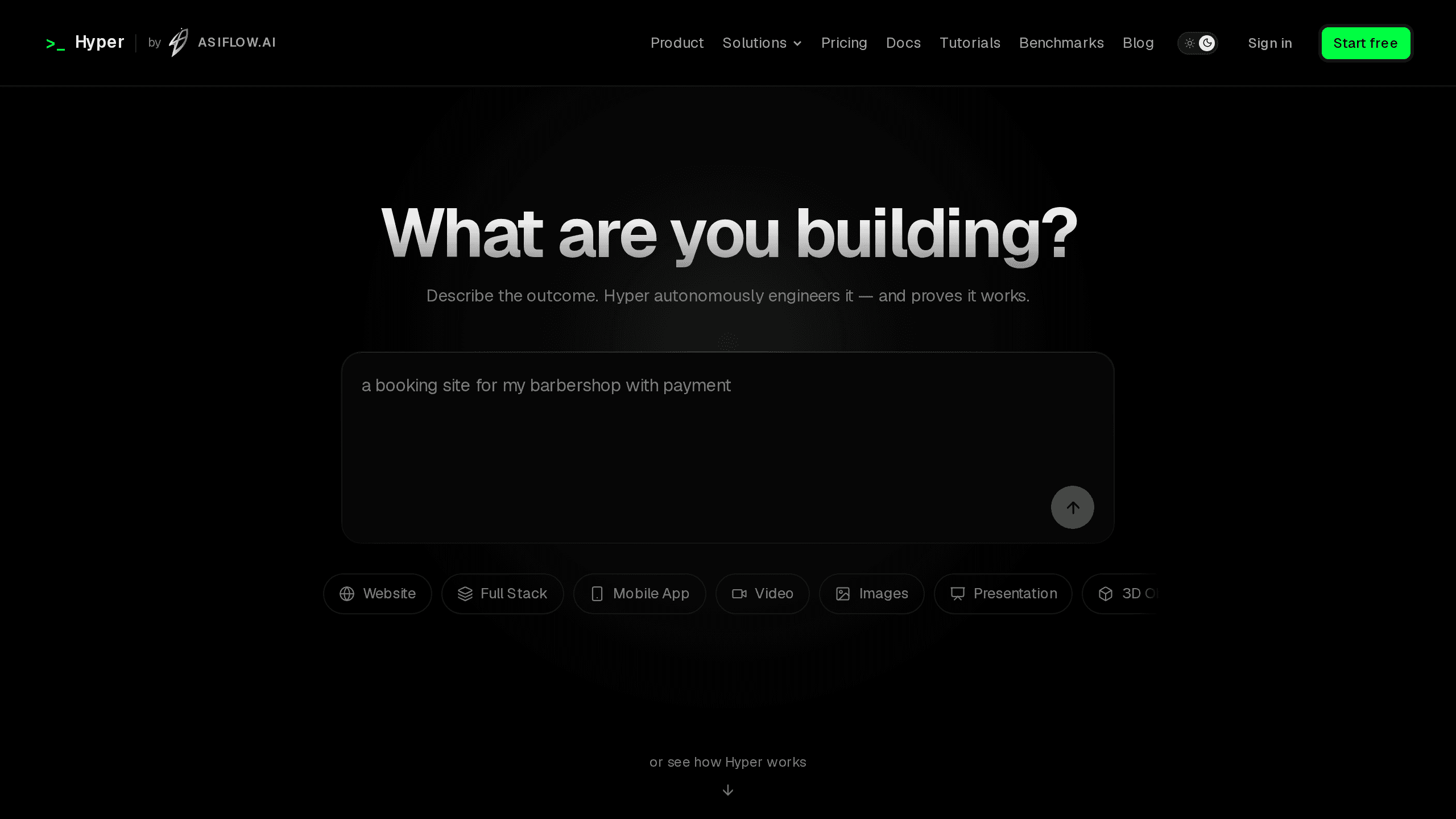
Hyper is an autonomous coding agent for engineers and founders that plans, executes, and verifies software work inside an isolated single-tenant sandbox before shipping it as branches, commits, and pull requests. Key capabilities include Plans Before It Builds, Checkpoints & Rewind, Cross-Session Memory, and Multi-Agent parallel sessions, plus an Agent API via MCP, REST, and A2A. It integrates with GitHub, Slack, Jira, Notion, Linear, Supabase, Vercel, and Cloudflare. Plans run Free, Pro $20/month, Team $30/month, Max $70/mo, Ultra $100/mo, and Apex $200/mo.
Last verifiedHow we evaluate
At a glance
- Hyper is best for engineers and founders who need an autonomous coding agent to ship verified, reversible pull requests rather than unverified code suggestions.
- Free $0; Pro $20/mo; Team $30/mo; Max $70/mo; Ultra $100/mo; Apex $200/mo
- Yes — Hyper exposes an Agent API accessible via MCP, REST, and A2A, with Python and TypeScript SDKs for programmatic access.
What it actually does
Hyper is a browser-based IDE, not a terminal tool or editor plugin: you connect a GitHub repo (or start a blank sandbox), describe an outcome in plain language, and an agent reads the code, plans, edits across files, runs a real shell inside an isolated per-session cloud container, and commits through normal git operations. The docs list 67 tools the agent can call (bash, file edit, code-intelligence/language-server queries, browser automation, git operations, MCP calls) and 49 slash commands (https://hyper.asiflow.ai/docs). Bigger jobs run through 'Autopilot' — a project is broken into dependency-ordered tasks, each run in its own sandbox against a written acceptance check, with a hard dollar cap you set before it starts (https://hyper.asiflow.ai/docs/platform/hyper-autopilot).
The thing it leads with: tests are re-run, not self-reported
Hyper's central pitch is that an agent's claim of success is checked mechanically rather than taken on faith: the server re-runs the project's actual test suite and records the exit code, commit SHAs are validated so a 'nothing to commit' run can't be reported as a pass, and a failing run—via the run_tests tool—is recorded as a tool error rather than something the agent can talk around (https://hyper.asiflow.ai/docs:read_full). For web deliverables there's also a runtime gate: the agent loads the page in a real headless browser inside the sandbox and must return a clean console plus a screenshot before declaring the work done (https://hyper.asiflow.ai/security). This is a genuine design choice, not just marketing copy — it shows up as actual tool wiring (run_tests, check_page) in the published tool catalogue, not just in the homepage text.
Pricing: metered credit, not a flat subscription
Free tier: $0/month, no card, $5/month of included model credit (unverified accounts are capped at $1.50/day until verified by a $0 card check, GitHub login, or 48 hours of clean use). Pro: $20/mo ($200/yr) with $20/month of credit. Team: $30/mo ($300/yr), one invoice for a small team. Max: $70/mo ($700/yr). Ultra ($100/mo, $1,000/yr) and Apex ($200/mo, $2,000/yr) switch from a dollar meter to rolling 5-hour/weekly usage windows at 10x and 20x Pro usage respectively. Annual billing is ten months for twelve on every tier (https://hyper.asiflow.ai/pricing). Every plan meters against the underlying model's real provider cost with a hard cap enforced in the metering layer — the product's own framing is 'approve the number, not just the idea.' The trade-off worth weighing: because credit is spent at frontier-model rates, the dollar figure on the plan card isn't a fixed amount of work — the changelog lists models from $0.10/$0.50 per million tokens up to $4/$20 per million tokens on the same roster (https://hyper.asiflow.ai/changelog), so a Pro plan's $20 of credit buys very different amounts of agent time depending on which model a session is routed to.
Security posture and what's not certified yet
Each session runs in a single-tenant, ephemeral sandbox that is destroyed at teardown along with the repository clone; there is no persistent server-side copy of your code. Auth uses short-lived RS256/EdDSA-signed JWTs verified on every call, GitHub OAuth scopes are limited to the repos you pick and revocable instantly, and the vendor states code is never used to train any model (https://hyper.asiflow.ai/security). On compliance, the company is explicit that it holds no certifications today: 'badges_displayed: only ones we've earned. currently: zero' — SOC 2 and ISO 27001 are stated as roadmap items, not implied as in-progress or informally compliant (https://hyper.asiflow.ai/compliance, last reviewed per the page 23 July 2026). There's also no published bug-bounty program; the vendor states that plainly rather than gesturing at one. For a team that needs a signed SOC 2 report to clear procurement today, this isn't there yet — but the architecture description is specific and falsifiable rather than generic 'enterprise-grade security' copy, which is unusual for a product at this stage.
Independent signal: thin, but what exists doesn't contradict the pitch
Two third-party directory sites have scored Hyper independently of the vendor. Legit.show, which runs a deterministic public-surface check (security headers, HTTPS, accessibility, structured data — not a test of coding ability), scored it 95/100 as of 2026-10-13, strongest on security/privacy/reliability headers and weakest on page-load performance (https://legit.show/s/hyper-asiflow-ai). Agentic.ai, which scores autonomy/planning/safety dimensions via an independent reviewer credited as David Kooi of Skylark Creations, rates it 22/36 ('Domain Specialist'), last re-evaluated 10 October 2026 (https://agentic.ai/t/hyper-by-asi-flow). Neither is a benchmark of code-generation quality. The vendor's own AppBench results (6/6 tasks passed vs. a 4/6 one-shot baseline) are a vendor-run, vendor-hosted benchmark published on its own GitHub (github.com/asiflow/appbench) and should be read as a vendor claim, not independent verification, however transparently the methodology is published (https://hyper.asiflow.ai/benchmarks). We found no G2, Capterra, or Product Hunt review history to corroborate day-to-day user experience at the time of writing.
Company, continuity, and the open-source portfolio
Hyper is built by ASI Flow, Inc., a Delaware C corporation with four named co-founders (Sherief Attia, Khaled El Azab, Hossam Hegazy, Muadh Alsaadi) (https://hyper.asiflow.ai/about). The company is actively hiring five remote leadership roles as of this writing and describes itself as small and founder-led (https://hyper.asiflow.ai/careers); we found no funding announcement from ASI Flow to verify, so treat funding/runway as not established rather than assume either well- or under-funded. The hosted product itself ships frequently — the public changelog lists dated entries through 7 October 2026 (https://hyper.asiflow.ai/changelog). Separately, ASI Flow publishes four smaller open repos under github.com/asiflow that it frames as the 'open-core foundations' behind Hyper: DevCortex (Apache-2.0, 0 stars, last pushed 4 July 2026 — over three months stale as of this writing), hyper-claude-code (MIT, 5 stars, actively pushed as recently as 24 September 2026), claude-nexus-hyper-agent-team (MIT, 18 stars, 2 forks, last pushed 22 May 2026), and a lighter fork at 12 stars (https://github.com/asiflow). None are archived, but engagement is small and two of the four haven't seen a commit in months — this is a company publishing adjacent tooling in the open, not a project with an active outside contributor base; the hosted Hyper product's actual engineering sits closed-source.
How much does Hyper cost?
| Plan | Price | What's included |
|---|---|---|
| Free | $0 |
|
| Pro | $20/month |
|
| Team | $30/month |
|
| Max | $70/mo |
|
| Ultra | $100/mo |
|
| Apex | $200/mo |
|
Frequently asked questions
What is Hyper?
Hyper is an autonomous coding agent for engineers and founders that plans, executes, and verifies software work inside an isolated single-tenant sandbox before shipping it as branches, commits, and pull requests. Key capabilities include Plans Before It Builds, Checkpoints & Rewind, Cross-Session Memory, and Multi-Agent parallel sessions, plus an Agent API via MCP, REST, and A2A. It integrates with GitHub, Slack, Jira, Notion, Linear, Supabase, Vercel, and Cloudflare. Plans run Free, Pro $20/month, Team $30/month, Max $70/mo, Ultra $100/mo, and Apex $200/mo.
How much does Hyper cost? Is it free?
Hyper has a free plan, with paid tiers including Pro at $20/month, Team at $30/month, Max at $70/mo.
What is Hyper used for? Who is it for?
Hyper is used for Plans before it builds, Proof, not promises, and Reaches your whole stack. It's built for Founders, Product managers, and Engineers.
Does Hyper have an API and what does it integrate with?
Hyper exposes an Agent API accessible via MCP, REST, and A2A, with Python and TypeScript SDKs for programmatic access. It integrates with Gmail, Slack, Jira, Notion, Linear, and 21 more.
Our take
Max, Ultra, and Apex tiers swap the dollar-metered budget cap for rolling five-hour and weekly usage windows instead of a visible cost meter; confirm which cap model, dollar-based or window-based, fits your team's budgeting process before upgrading past Pro.

Where we've written about Hyper
Explore other Coding Agents


