Best AI Agents for Sales: A 3-Category Guide to Choosing the Right Tool
AI agents for sales split into 3 categories, not one. Compare 11x.ai, Artisan Ava, Apollo.io, Clay, and Coldreach AI by use case, price, and ROI.

Written by AgentsIndex
The phrase "best AI agents for sales" hides a real problem: most lists lump together three completely different categories of tool. Autonomous SDR bots that replace outbound reps. AI-enhanced platforms that make existing reps more productive. Market intelligence tools that tell you who to contact and why. These solve different problems, require different budgets, and deliver different results. Treating them as one category is why so many sales teams buy the wrong tool.
The numbers are moving fast. According to Fortune Business Insights, the global AI SDR market was worth $4.27 billion in 2025 and is projected to grow from $5.22 billion in 2026 to $24.32 billion by 2034, a 21.2% CAGR. SNS Insider reports a 52% jump in AI SDR adoption in 2025 alone, with 80% of organizations expected to use AI-powered sales tools by the end of 2025, per SNS Insider and Mick-Mar Inc. research. And Autobound's 2026 guide reports 56% of sales professionals now using AI daily, up from 24% in 2023 — while also finding that companies using AI to augment human SDRs saw 2.8x more pipeline than those attempting full replacement. Adoption is close to universal. Wholesale replacement is not.
TL;DR: AI tools for sales fall into three categories: autonomous AI SDRs (11x.ai, Artisan, Coldreach AI) that run outbound without human reps; AI-enhanced platforms (Apollo.io, Clay) that supercharge existing reps; and intelligence tools (AlphaSense) for complex enterprise account research. The AI SDR market was worth $4.27 billion in 2025 (Fortune Business Insights). Choose your category before choosing your tool.
AI agents for sales is a blanket term covering three distinct tool types. The first is autonomous AI SDR agents like 11x.ai and Artisan that replace the outbound development rep entirely, running prospecting, personalized outreach, follow-ups, objection handling, and meeting booking without a human in the loop. The second is AI-enhanced sales platforms like Apollo.io and Clay that give human reps better data, smarter sequences, and automated personalization, while keeping the rep in control. The third is AI sales intelligence tools like AlphaSense that monitor market signals across filings, earnings calls, and news to tell enterprise sales teams when and why to reach out to a specific account.
This guide covers all three categories with six specific tools, honest pricing, trade-offs, and a decision framework that maps your situation to the right category. For the full index of options across all three categories, the AgentsIndex Sales Agents category has every tool we've indexed in one place.
What separates a true AI sales agent from sales automation?
A true AI sales agent operates autonomously across the full outbound workflow, prospecting, personalized messaging, follow-up, objection handling, and meeting booking, without manual intervention between setup and results. Tools that only automate email sequences or require a rep to write the copy are sales automation tools, not agents. The distinction matters because the two categories require different setups, different oversight models, and very different budgets.
Here's a practical way to tell them apart. With a true AI SDR agent, you configure an ICP and a goal, then the agent runs. You review outcomes (meetings booked, replies received), not individual emails. With a sales automation platform, a human rep still defines the strategy, approves messaging, and manages the relationship. The AI makes the rep faster. It doesn't make the rep optional.
Organizations that implemented autonomous AI SDR agents reported a 300% pipeline increase, 25% more qualified leads, 40% shorter sales cycles, and 32% more appointment bookings within six months, according to Custom Market Insights citing SuperAGI implementation data. Those results depend heavily on setup quality and ICP clarity. Practitioners on Reddit's r/AI_Agents forum are consistent on this point: the companies getting the best results from AI SDRs all share one thing, a really clear ICP. The agents that fail are deployed by teams that haven't figured out who they're trying to reach.
One more thing worth knowing upfront: Amplemarket evaluated 231 features across eight AI sales platforms and found that purely autonomous agents scored far lower on feature breadth. 11x.ai scored 21/231 and Artisan scored 35/231, compared to much higher scores for integrated human-in-the-loop platforms. This needs context: Amplemarket sells a competing product and the scoring reflects their criteria. But it does illustrate the real trade-off. Autonomous agents are optimized for autonomy and top-of-funnel output, not breadth of features. That trade-off is intentional. Whether it works for your team depends on what you're actually trying to solve.
A practical way to frame that trade-off is cost per meeting. A fully loaded human SDR runs $96,000 to $144,000 per year in salary, benefits, and overhead. Against that baseline: 11x.ai publishes an entry tier at $3,750 per month billed annually, Coldreach AI starts at $899 per month ($10,788 per year), and Artisan no longer publishes prices at all — every plan is scoped through a sales conversation. Apollo.io at $49 to $119 per seat per month sits well below any of those. The math only holds if the tool books meetings at a comparable rate to a human rep. That rate depends on ICP clarity, message quality, and sequencing setup, not on the tool alone. Use cost per meeting booked, not sticker price, as the comparison unit when running your internal business case.
The SME segment of the AI SDR market is growing at 25.11% CAGR through 2034, per Fortune Business Insights, meaning affordable autonomous outbound is no longer just an enterprise play. Entry-level pricing has come down enough that startups and mid-market teams can now access tools that were enterprise-only two years ago.
What are autonomous AI SDR agents and how do they work?
Autonomous AI SDR agents are built to replace or replicate the work of a human outbound SDR. They handle the full sequence end-to-end: sourcing leads from a built-in database, researching contacts, writing personalized outreach, managing follow-ups, handling initial objections, and booking meetings, without a human writing individual emails or monitoring threads. North America holds 39.4% of the global AI SDR market, with Asia Pacific the fastest-growing region at a 27.42% CAGR, according to Fortune Business Insights.
11x.ai (Alice)
11x.ai's Alice is one of the earliest and most recognized autonomous AI SDR agents. Alice handles end-to-end email and social outreach across 105+ languages (multi-language outreach starts on the Pro tier), and 11x no longer quotes a fixed contact-database size — it now describes its data as verified at the point of outreach rather than pulled from a static list. Sequence length is yours to set: 11x prices per lead, not per send, so three touchpoints and thirty cost the same. It handles objections, schedules meetings, and syncs to major CRMs. In May 2025, 11x.ai launched Julian to extend coverage to phone; Julian now runs inbound qualification across voice, email, SMS, WhatsApp, and chat alongside Alice's outbound.
11x now publishes its entry pricing: the Growth plan starts at $3,750/month billed annually, covering up to 5 users and 2,000 new prospects per month, with Pro and Enterprise custom-quoted. Get the annual figure in writing before you sign — the FAQ on that same page quotes "$36,000 per year," which doesn't reconcile with $3,750 × 12. For the tiers above Growth, Landbase's third-party estimates put mid-market engagements at $60,000–$120,000 per year, scaling from there. A fully-loaded human SDR costs $96,000–$144,000/year, so the entry tier now lands at roughly a third of a human hire rather than level with one. The value case still comes from consistency, scale, and availability, but the price gap is doing more of the work than it used to. One flag: Amplemarket's 231-feature scorecard gave Alice 21/231 points, with reviewers noting concerns following 2025 leadership changes. Amplemarket sells a competing product, so weigh that framing accordingly. 11x.ai on AgentsIndex has the current full profile.
The 231-feature scorecard result is worth understanding in context. Autonomous agents like 11x.ai (21 of 231 features) and Artisan (35 of 231) score low on comprehensive feature assessments because they are built for a narrow purpose: running the top-of-funnel outbound sequence without human involvement. They are not designed to cover reporting depth, CRM flexibility, or advanced sequencing controls that human-in-the-loop platforms prioritize. Treating a low feature score as a quality signal misreads what these tools are for. The relevant question is not how many features a tool has, but whether the features it does have solve the specific problem you are hiring it to solve.
Best for: Mid-market and enterprise B2B SaaS companies with defined outbound playbooks, a clear ICP, and annual budgets of $36,000 or more.
Artisan (Ava)
Artisan's Ava is an autonomous AI SDR that automates 80% of traditional BDR tasks, per Artisan.co and Landbase's pricing analysis, sourcing from a 250M+ verified B2B contact database enriched from 22+ data sources. Ava handles lead research, personalized email and LinkedIn sequences, intent-driven prospect prioritization, and meeting booking end-to-end, with an AI dialer available as a per-seat add-on. Pricing is no longer published: plans are Team (~2,500 leads contacted/month), Scale (~6,000 leads contacted/month), and Enterprise, all scoped through sales. The per-contact math that used to make Artisan the cheap entry point against a $96,000–$144,000/year human SDR is not something you can run before a sales call any more. A G2 reviewer noted: "Ava outperforms our best rep and scales end-to-end. She lets SDRs focus on high-impact tasks instead of prospecting drudgery."
Worth flagging: despite being one of the two most prominent autonomous AI SDR tools in 2026, Artisan is entirely absent from ChatGPT's current responses for this keyword. That reflects citation sourcing patterns, not tool quality. Artisan on AgentsIndex has the full profile.
Best for: B2B teams wanting autonomous email and LinkedIn outbound with a dialer option, particularly mid-market teams that want a dedicated CSM included on their plan and are willing to go through sales to get a number.
Coldreach AI
Coldreach AI takes a different approach than 11x and Artisan. Rather than high-volume cold outreach, Coldreach monitors 113 million+ accounts in real time across job postings, LinkedIn activity, news, and SEC filings to detect buying intent signals: funding announcements, hiring surges, leadership changes, and new technology adoptions. When an account shows an active signal, Coldreach crafts timely personalized outreach triggered by that context, across email and LinkedIn.
The logic is precision over volume. Reaching out to 100 accounts that have a detectable reason to buy now typically outperforms generic messaging to 5,000. Coldreach's self-service ladder starts at $899/month (Starter) and runs through Growth ($1,099/mo), Pro ($1,499/mo), and Enterprise ($1,999/mo), with a fully managed Done-For-You plan at $3,000/month. It holds a G2 rating of 5.0/5 from 12 users (small sample worth noting). Coldreach AI on AgentsIndex has the full listing.
Best for: Teams that prefer quality over volume in outbound, or that run account-based sales motions where relevance and timing matter more than raw contact count.
How does Clay transform outbound sales through AI-powered data orchestration?
What are the key features of AI-enhanced sales platforms?
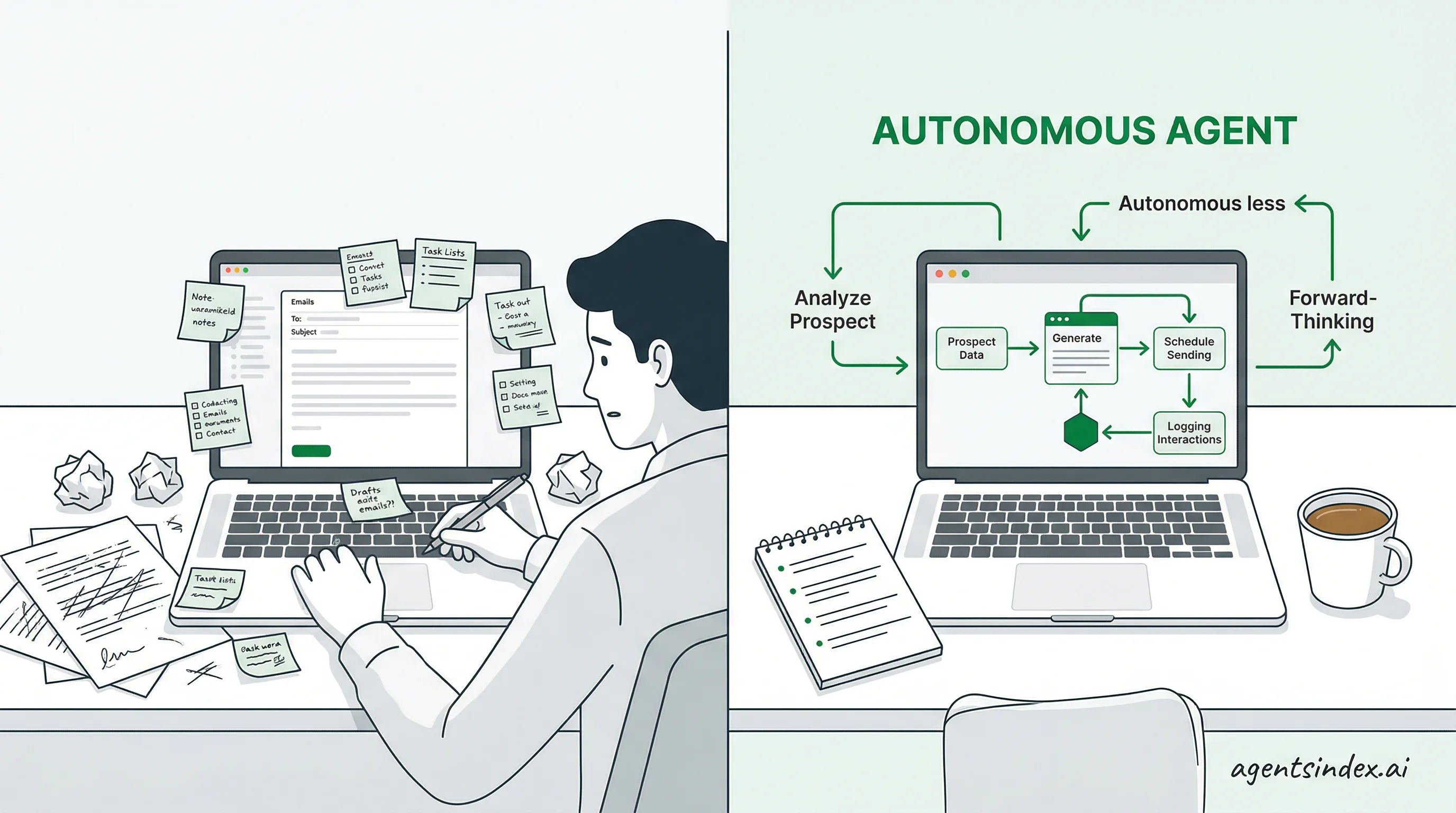
AI-enhanced sales platforms don't replace your reps. They make each rep measurably more productive by automating research, data enrichment, personalization, and sequencing. The human is still in the loop for strategy, messaging approval, and relationship management. This is the lower-risk adoption path and the category with the largest installed base of active users in B2B sales.
Apollo.io
Apollo.io is the most comprehensive AI-enhanced sales platform currently available, with a database of 240 million+ verified contacts. The platform grew 500% year-over-year in 2025 in active usage, according to Apollo.io's own reporting. Its AI Research Agent books 46% more meetings and increases booking rates by 42%, with AI-written icebreakers delivering 35% higher conversion rates, figures from Apollo's Martech Breakthrough Awards 2025 submission.
In October 2025, Apollo launched Vibe GTM, which it describes as the industry's first fully agentic end-to-end GTM platform, and followed it in March 2026 with an AI Assistant that Apollo says already has nearly 20,000 weekly active users. This blurs the line between Category 1 and Category 2 tools: Apollo is adding autonomous agent capabilities on top of its existing data infrastructure. Paid plans run $49 (Basic), $79 (Professional), and $119 (Organization, minimum 3 seats) per seat per month billed annually, on top of a free tier. For teams that want a single platform covering prospecting, outreach, and light CRM functionality, Apollo's database size alone is a significant differentiator. Apollo on AgentsIndex has the full current feature breakdown.
Best for: Teams of any size that want a single platform for AI-enhanced prospecting and outreach. The 240M+ contact database gives broad coverage, making it particularly strong for teams targeting diverse ICPs across many industries.
Clay
Clay is a data orchestration engine that connects 100+ data sources to automate lead research, enrichment, and personalization. It isn't an AI SDR. What it does is remove the manual work that makes outbound slow: building lead lists, enriching contacts with firmographic and technographic data, verifying emails, and drafting personalized icebreakers at scale. Reps can then push that enriched data to a sequencer like Instantly, Outreach, or Salesloft — or use Clay's own Sequencer, which now sends campaigns natively, including on the free plan.
The results, when implemented well, are meaningful. RevPartners data shows Clay-powered outbound achieves 15–25% reply rates compared to the 3–5% industry average for cold email, roughly a 5x improvement. Clay crossed $100 million in ARR in December 2025, having gone from $1 million to $100 million in two years, reflecting rapid adoption among high-growth GTM teams. Pricing is public and credit-based: a free tier with 6,000 actions/year, Launch from $167/month, Growth from $446/month, and custom Enterprise. Clay on AgentsIndex covers setup context.
Best for: Outbound teams where data quality and personalization depth are the specific bottleneck. Clay is a force multiplier for reps who already know how to run outbound, not a replacement for a missing outbound motion.
Which AI sales intelligence tools should you consider?
AI sales intelligence tools aren't SDR replacements or workflow accelerators. They're research and signal-monitoring platforms that tell complex enterprise sales teams when and why to reach out to a specific account. They sit upstream of any outreach, surfacing the context that makes a cold call not feel cold to the person receiving it.
AlphaSense
AlphaSense is a market intelligence platform used by enterprise sales and revenue teams to monitor signals about prospects and customers. It aggregates earnings calls, company filings, analyst reports, expert transcripts, and news into a searchable intelligence layer. A sales rep covering a major enterprise account can see exactly what challenges their prospect discussed on their last earnings call, what strategic pivots they've announced, and what peer companies are doing, before picking up the phone.
AlphaSense doesn't run your outbound. It tells you what to say when you do reach out and why it will land. That distinction matters for complex, research-intensive sales where walking into a conversation without account context is a fast way to lose credibility with a senior buyer. AlphaSense publishes no rate card — its pricing page offers enterprise-wide or per-seat plans through sales only — but third-party spend data puts seats at $10,000+/year, reflecting its target market of financial services firms, strategy consulting practices, and large B2B software companies. AlphaSense on AgentsIndex has the full listing.
AlphaSense doesn't appear in any major competitor roundup for this keyword despite serving a real segment of the sales market. Teams doing account-based enterprise sales with long deal cycles and high average contract values need something different from a volume-outbound SDR bot. AlphaSense fills that gap.
Best for: Enterprise sales reps managing complex accounts where business context drives every conversation. Particularly relevant for financial services, consulting, and enterprise SaaS teams selling to C-suite buyers at large publicly traded companies.
How do these six tools compare to each other?
The table below maps each tool to its category, primary use case, starting price, and whether it operates autonomously. Use it as a starting point. The right choice depends on your team size, budget, and the specific problem you're solving, not on how tools rank in a generic list.
| Tool | Category | Best For | Starting Price | Database / Coverage | Autonomous? |
|---|---|---|---|---|---|
| 11x.ai (Alice) | Autonomous AI SDR | Enterprise outbound, 105+ languages | $3,750/month (Growth, billed annually) | Real-time verified data, no published count | Yes |
| Artisan (Ava) | Autonomous AI SDR | Mid-market autonomous email and LinkedIn outbound | Quote only (Team / Scale / Enterprise) | 250M+ contacts | Yes |
| Coldreach AI | Autonomous AI SDR | Signal-based precision outreach | $899/month | 113M+ accounts monitored | Yes |
| Apollo.io | AI-Enhanced Platform | All-in-one prospecting and sequences | $49–$119/seat/month | 240M+ contacts | Partial |
| Clay | AI-Enhanced Platform | Data enrichment and personalization at scale | Free; paid from $167/month | 100+ data sources | No |
| AlphaSense | AI Sales Intelligence | Enterprise account research and signals | $10,000+/year | Market intelligence layer | No |
A note on Apollo.io's "Partial" autonomous rating: Apollo launched Vibe GTM in October 2025 and its AI Assistant in March 2026, adding agentic capabilities to its existing platform. The line between AI-enhanced platform and autonomous agent is blurring there. Apollo can increasingly run parts of the outbound sequence without human intervention, but its foundational strength remains the 240M+ contact database and AI-assisted rep workflows. That evolution is worth watching for teams evaluating it now.
What three questions should you ask before buying an AI sales tool?
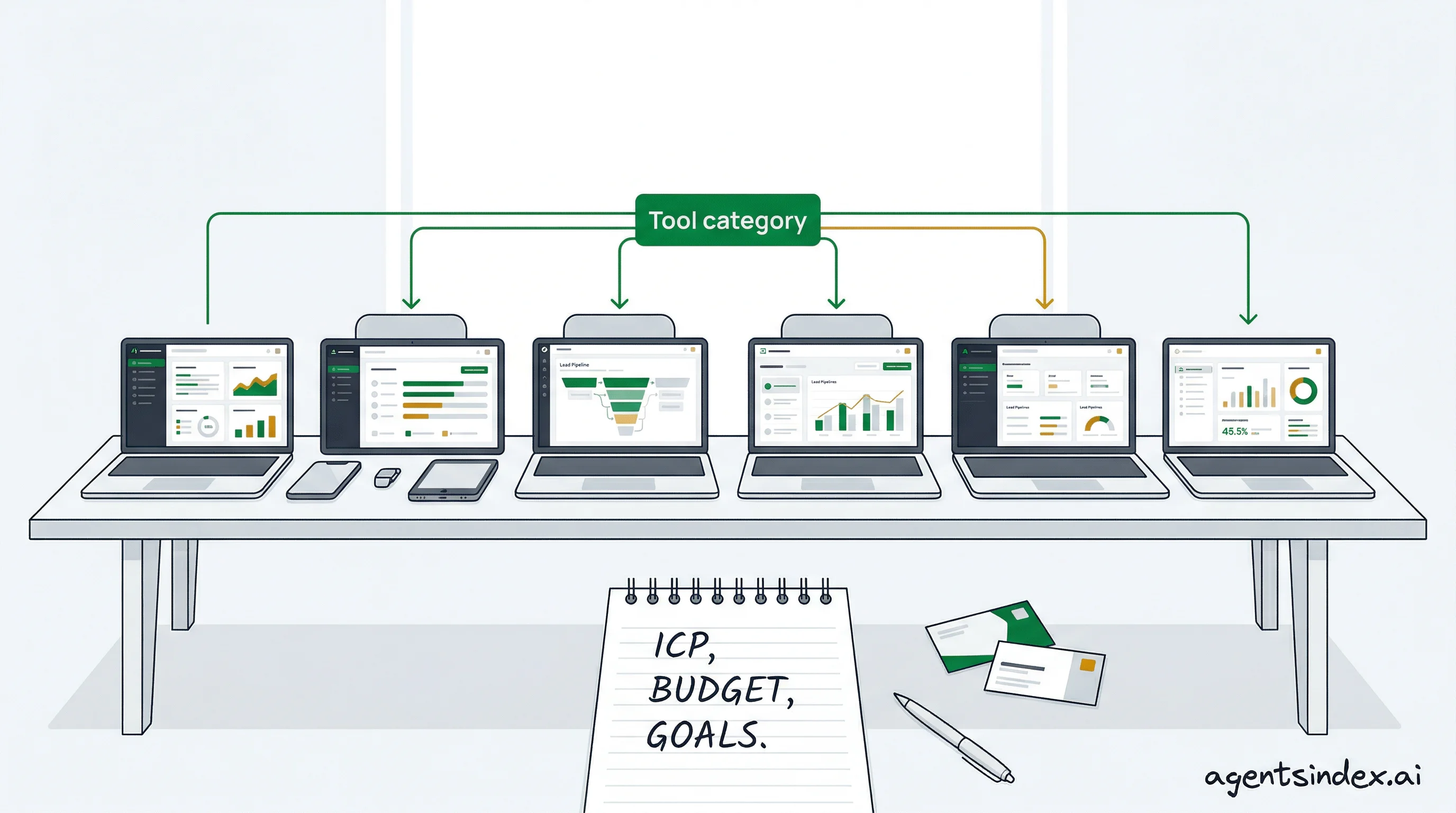
Every comparison guide ends with "it depends on your needs" and leaves you to work out the rest. Here's something more concrete: three questions that map your specific situation to one of the three categories above. Answer them in order.
Question 1: Do you want to replace a rep or make reps more productive?
If your goal is to scale outbound without proportionally scaling headcount, reduce hiring costs, or cover more accounts than your current team can reach, you're in Category 1 territory (Autonomous AI SDR). If your existing reps are the constraint and you need them to handle more pipeline, send better-personalized emails, or research accounts faster, you're in Category 2 (AI-Enhanced Platform). This is the most important question. Buying an autonomous agent for a team that isn't ready to remove the human from the loop usually ends in poor results and a cancelled contract six months in.
Question 2: What is your monthly outbound budget?
Budget determines which options are realistic:
- Under $1,000/month: Coldreach AI ($899/month) is the most accessible autonomous option with signal-based targeting. Apollo.io ($49–$119/seat/month) is the lowest-cost AI-enhanced platform with the largest database, and Clay's Launch plan starts at $167/month.
- $1,000–$5,000/month: Coldreach's upper tiers sit here (Growth $1,099, Pro $1,499, Enterprise $1,999, or $3,000 fully managed), as does 11x.ai's Growth plan at $3,750/month and Clay's Growth plan at $446/month for teams already running their own sequences.
- Quote-only: Artisan no longer publishes prices. Its plans are sized to lead volume, mailboxes, and dialer seats, so you'll need a sales conversation to find out where it lands. 11x.ai's Pro and Enterprise tiers are the same, with third-party estimates putting mid-market engagements at $60,000–$120,000 per year.
- Enterprise research budget ($10,000+/year): AlphaSense operates at this level, targeted at enterprise sales teams in financial services, consulting, and large B2B software.
Question 3: How clearly defined is your ICP?
Autonomous AI SDR agents work best when you have a precise ICP: specific industry, company size range, job titles, geography, and tech stack. Broad or fuzzy targeting leads to low reply rates regardless of how sophisticated the AI is. If your ICP is well-defined and validated, you're ready for Category 1. If you're still refining targeting, Category 2 tools give you more human control to iterate. Coldreach AI sits in the middle: signal-based triggers compensate partly for ICP ambiguity by letting buying intent surface which accounts to prioritize.
For teams selling into complex enterprise accounts where business context matters more than outreach volume, that's a separate category entirely. AlphaSense provides account intelligence that no autonomous agent or enrichment platform currently replicates. Getting clear on which problem you're solving before buying is the one thing that separates teams that get ROI from those that don't. For more on how AI agents are being deployed across different business functions, the AI agent use cases guide covers measurable outcomes across 15 industries.
How does the cost of AI sales agents compare to hiring a human SDR?
A fully-loaded human SDR costs $96,000–$144,000 per year in salary, benefits, tools, and management overhead, according to data compiled by Landbase and Enginy.ai from hiring market data. Autonomous AI SDR agents range from $899/month (Coldreach AI) to $3,750/month (11x.ai's published entry tier), putting the annual cost at roughly $10,800–$45,000, typically 40–60% cheaper than a human equivalent at comparable outbound volume.
The raw sticker comparison misses important nuance. The table below breaks it down more honestly:
| Cost Factor | Human SDR | AI SDR Agent (Entry Tier) |
|---|---|---|
| Annual base cost | $60,000–$100,000 salary | $10,800–$45,000/year |
| Benefits and overhead | $36,000–$44,000 additional | Included in subscription |
| Ramp time | 3–6 months to full productivity | Days to weeks |
| Scale | Limited to working hours | 24/7, unlimited contact volume |
| Requires active management | Yes (ongoing coaching, quota management) | Minimal (ICP setup and deliverability) |
| Relationship building | Yes | Limited to early-stage sequences |
| Late-stage deal support | Yes | Not applicable |
Companies report a 70% boost in conversions and 40–60% lower operational costs compared to traditional human SDR teams when using AI-powered outbound, per Landbase's 2025 study on AI SDR agent impact. That figure comes from a vendor with an obvious interest in the framing, so treat it as directional rather than a precise benchmark. But the directional finding aligns with what adoption rates suggest: autonomous outbound is materially cheaper per meeting booked at scale.
Where autonomous agents don't yet match human SDRs: complex deal negotiation, late-stage relationship management, and situations requiring nuanced reading of buyer context. The clearest ROI case is top-of-funnel work at volume, prospecting, initial outreach, meeting booking, where consistency and scale matter more than judgment. A thread on Reddit's r/MarketingAutomation community put it well: "AI can save you time and effort, but it won't replace your sales team. The teams winning with AI are using it to handle the first 40% of the pipeline so their best reps can focus entirely on closing."
AI handles the volume work. Humans close. The question is whether your team structure and budget are set up to take advantage of that split.
Frequently asked questions
What is an AI sales agent?
An AI sales agent is software that autonomously performs outbound sales tasks, including prospecting, personalized outreach, follow-up sequences, and meeting booking, without requiring manual intervention between setup and results. The term covers a range from fully autonomous SDR replacements to AI-assisted platforms where human reps remain in the loop. The global AI SDR market was worth $4.27 billion in 2025 and is projected to reach $5.22 billion in 2026, according to Fortune Business Insights, reflecting rapid mainstream adoption across B2B sales teams of all sizes.
What is the difference between an AI SDR and a traditional CRM AI tool?
AI SDR agents like 11x.ai and Artisan operate autonomously. They find leads, write emails, follow up, and book meetings without human direction between setup and results. Traditional CRM AI tools like Apollo.io, Clay, and HubSpot AI enhance what human reps already do, enriching data, suggesting next steps, scoring leads, or personalizing messages, but human reps still control outreach strategy. The core difference is whether a rep is in the loop between setup and outcomes.
How much do AI sales agents cost?
Prices vary widely by tool type. Autonomous AI SDRs: Coldreach AI from $899/month, 11x.ai from $3,750/month on its published Growth plan, and Artisan quote-only with no published pricing. AI-enhanced platforms: Apollo.io from $49–$119/seat/month billed annually, Clay free to start with paid plans from $167/month. Intelligence tools: AlphaSense at $10,000+/year enterprise pricing. All autonomous options are significantly cheaper than a fully-loaded human SDR at $96,000–$144,000/year. Enterprise tiers on every tool here still require a demo for exact pricing.
Can AI agents completely replace human SDRs?
For top-of-funnel outbound work, prospecting, cold email sequencing, and meeting booking, autonomous AI SDR agents can handle the full workflow without human reps. The evidence on going further is not encouraging: Autobound's 2026 guide found that companies using AI to augment human SDRs saw 2.8x more pipeline than those attempting full replacement. Complex deal negotiation, late-stage enterprise relationship management, and situations requiring nuanced contextual judgment still benefit meaningfully from human involvement, particularly in high-value deals.
Which AI sales agent is best for small businesses?
For teams with budgets under $1,000/month, Coldreach AI at $899/month is the most affordable autonomous option with signal-based intent targeting. Apollo.io, starting at $49/seat/month billed annually, is the most accessible all-in-one AI-enhanced platform for SMBs needing a large contact database with built-in outreach tools, and Clay has a genuinely usable free tier before its $167/month Launch plan. Artisan is worth a call if you want fully autonomous outreach, but it will not quote you a price without one.
Who has the best AI sales agent?
There is no single "best" AI sales agent. The right pick depends on what you actually need to do. Artisan (Ava) and 11x.ai (Alice) are the two tools teams pick when they want fully autonomous outbound. Clay is where data-heavy outbound teams end up when personalization at scale is the priority. Apollo.io is the cheapest entry into a 240 million contact database with outreach built in, which is why it has the biggest SMB footprint. AlphaSense is different: it is a research tool for enterprise sales teams in regulated industries, not an SDR replacement. Pick based on the workflow you actually run.
Who are the big 4 AI agents?
There is no official "big 4" in AI sales agents. The category is too new for a settled hierarchy. In sales specifically, the four names that keep showing up in 2025-2026 buyer guides and AI-SDR roundups (including Amplemarket's 231-feature evaluation) are 11x.ai, Artisan, Apollo.io, and Clay. One thing to keep in mind: this list is about sales and SDR automation. General-purpose AI assistants like ChatGPT, Claude, Gemini, and Perplexity are a different category and were not built for outbound sales.
Can an AI agent do sales for you?
Yes, for the top-of-funnel part of sales. Modern autonomous AI SDR agents like 11x.ai (Alice) and Artisan (Ava) run the full outbound workflow: lead research, personalized outreach, follow-up sequences, and meeting booking. There is no human in the loop between setup and results. What the data does not support is firing the team: Autobound's 2026 guide found companies augmenting human SDRs with AI generated 2.8x more pipeline than those attempting full replacement. Where AI agents still fall short is complex deal negotiation and late-stage enterprise relationship management, which is why high-value contracts usually keep a human rep involved.
What should you know before making your final decision?
The category confusion around AI sales tools is real and it costs teams money. Buying a fully autonomous AI SDR when you need better data enrichment is a different kind of mistake than buying a data platform when you actually need autonomous outreach. Getting the category right matters more than getting the specific tool right.
Here's where each option fits:
- If you want to run outbound without adding headcount, look at Artisan (Ava) for mid-market budgets, 11x.ai (Alice) for enterprise-scale investment, or Coldreach AI if intent-signal precision matters more than volume.
- If you want to make your existing reps more productive, Apollo.io covers the full prospecting-to-outreach workflow at the lowest entry price with the largest database. Clay is the right choice when data quality and personalization depth are the specific constraints your team is hitting.
- If you're selling complex deals to enterprise buyers where business context drives every conversation, AlphaSense operates in a category of its own.
None of these tools does everything. The ones that get positioned as catch-all solutions usually disappoint on the things outside their core strength. The clearer you are about which specific problem you're solving, the better your outcome will be with any of them.
For broader context on how AI agents are being applied across sales, customer support, finance, and operations, the AI agent use cases guide covers measurable outcomes across 15 industries. The AgentsIndex Sales Agents category has every indexed tool in one place for further comparison as you evaluate options.