
At a glance
- Category
- Agent tools and integrations
- Tags
- Freemium
For developers
- Works with
- Langchain, Dspy, CrewAI, Autogen, Cerebras, Aleph Alpha and 24 more
What is Netra?
Netra is an AI observability platform for AI product teams that traces agent behavior from intent to response and adds evaluation and simulation for debugging, quality checks, and performance monitoring. It includes Observability, Evaluation, Simulation, Trace every decision, and Track every dollar, and integrates with Langchain, CrewAI, OpenAI, Claude, and Google Gemini. Plans run Free $0, PRO $39/month, and Custom pricing.
Netra captures agent runs as spans, then grades them
Netra sits around an agent rather than inside it. The SDK auto-instruments the libraries an app already calls, and every prompt, model call, tool invocation and retrieval arrives as an OpenTelemetry span that can be replayed. The vendor's framing of the problem is the failure that logs miss: a run that returns 200 and still answers wrongly, described on the home page as "including the ones that return 200 and still get it wrong".
On top of that trace store sit six more surfaces, each with its own docs section: prompt management with versioned prompts, offline evaluation against datasets, multi-turn simulation with personas and goals, red teaming, online evaluation of live traffic, and clustering of production sessions by intent. The docs index describes evaluation as "datasets + evaluators (LLM-as-judge and code) + test runs for regression tracking", which is the shape a team already running CI will recognise.
Voice is a first-class target, not a late addition. The integration list covers LiveKit and Vapi as voice frameworks and Deepgram, ElevenLabs and Cartesia for speech, described as "Evaluate and simulate voice agents through automated call testing and telemetry ingestion".
Pricing is flat per month, with spans as the meter that bites
Three tiers, two of them priced. Free is "$0 forever" with 5,000 spans a month, 25 test runs, 100 evaluator executions, 5 users and 7-day retention. Pro is $39 a month for 200,000 spans, 100 test runs, 5,000 evaluator executions, 50 users and 30-day retention. Custom is "let's talk".
The number to model is spans, because a single agent request produces many of them. Pro publishes its overage openly at "+$5 per 100k after", which is more than most observability vendors disclose and makes a rough bill calculable before signup. Seats are not metered separately at either paid level.
No monthly and annual billing control exists on the pricing page: the plan cards state one term each, and the page carries no annual toggle, pill or discount sentence. Several capabilities are tier-gated rather than priced, and one of them is a headline feature: red teaming, Agent Insights, unlimited test runs and custom data retention are listed only in the Custom column.
The top tier is where the deployment options live too. On-premise and multi-region deployments, an isolated database, enterprise SSO and dedicated Slack support are all Custom-only, so a team that needs its data in its own environment is in a sales conversation rather than a self-serve one.
The MCP server is the most developed part of the integration story
Netra runs a remote MCP server at region-specific endpoints, authenticated with an x-api-key header, and the docs enumerate "21 tools" grouped into observability, datasets, evaluators and test runs. Setup snippets are published for Cursor, Claude Code, Windsurf, Antigravity and Codex.
What the tools do is worth reading closely, because the docs are unusually candid about the boundary. MCP covers evaluation setup and result inspection; the agent under test still has to be executed separately. The docs say creating a test run "registers the run but does not execute your agent or trigger evaluators on its own". An assistant can therefore query traces, build a dataset and read scores from the IDE, but the run loop belongs to the SDK.
Alongside it the vendor publishes Netra skills for coding agents, offered on the home page as a single paste-in prompt that works with "Claude Code, Cursor, Codex, and any skills-ready agent".
Open source here means the red team tool, not the platform
Two things carry an Apache 2.0 licence. The Python and TypeScript SDKs are public repositories under KeyValueSoftwareSystems, and so is Agent OPFOR, the red teaming engine, which the home page links with a star count and labels "Open source red teaming". Its README calls it "Open-source adversary emulation for AI agents, LLM apps, and MCP servers" and maps its suites to OWASP LLM, Agentic AI, MCP and API Security top tens plus an EU AI Act bias suite.
OPFOR is usable without Netra at all: a CLI, a browser extension, an SDK, IDE skills, and a mode where it runs as an MCP server so a coding assistant can red team other agents. It also integrates with Langfuse, a competing trace backend, which is a fair signal that it is a real project rather than a lead magnet.
The platform itself is not published. Netra is sold as hosted cloud, dedicated cloud or on-premise, and the on-premise route is a Custom-tier commercial arrangement rather than source anyone can read.
KeyValue builds it, and the compliance claims are specific
Netra comes out of KeyValue, an Indian product engineering company. The about page says the team has been "building and shipping software for 10 years" and deployed more than 25 agents in production for clients before building the platform, which matches the OPFOR README's claim of 130 products for 90 startups.
The security claims are named rather than gestured at. The FAQ states Netra is "SOC 2 Type II certified and HIPAA and GDPR compliant" and adds tenant isolation, encryption in transit and at rest, PII detection and masking, and US and EU residency with no cross-region sharing. Residency is visible in the product rather than only in prose: separate US and EU app hosts, OTLP endpoints and MCP endpoints are documented, and the signup link on the site points at the EU host. No SOC 2 report, trust centre page or standalone DPA is published for a buyer to read, so the certification rests on the FAQ sentence.
The reliability and efficiency figures on the home page (1B+ spans a month, 99.99% uptime, 95% reduction in mean time to resolution, 75% reduction in AI spend) are vendor-stated, with named customer quotes from Pencil, Aartha AI and Skydda attached but no independent audit behind the percentages.
Where it fits, and where it does not
It fits a team that already has agents in production, writes the code, and wants traces, eval gates and simulation in one place instead of three tools. The migration pages for Helicone and Portkey suggest the vendor expects buyers to arrive from a narrower tool, and the 14 model providers, 10 orchestration frameworks and 8 vector databases in the integration list cover most current Python and TypeScript stacks.
It does not fit a buyer who wants reliability without engineering. Nothing happens until an SDK is installed and initialized, and the evaluation loop runs from code. A product or operations owner cannot self-serve value here.
Two other mismatches are worth naming. A team whose main requirement is adversarial testing can take Agent OPFOR for free and skip the platform, since red teaming inside Netra is Custom-tier. And a small team on Free will find 5,000 spans and 7-day retention enough to prototype and not enough to debug a live incident from last week, which is the use case the product is sold on.
How much does Netra cost?
Prices excluding tax, as Netra publishes them.
Free
Free
Built for prototyping and testing.
- No credit card needed.
- 5,000 spans/month
- 100 evaluator executions/month
- 2 custom evaluators
- 5 datasets
- 2 prompts
- 5 users
- 3 projects
- 7-day data retention
- US/EU residency options
- Community support
PRO
$39/month
- Built for teams running agents in production
- Everything in FREE
- 200,000 spans/month Additional: $5/100k spans
- 100 test runs/month
- 5,000 evaluator executions/month
- 10 custom evaluators
- 50 datasets
- 100 online eval runs/month
- 10 prompts
- 50 users
- 10 projects
- 30-day data retention
- US/EU residency options
- Priority support
Custom
Custom
- Everything in PRO
- Custom metrics
- Agent Insights
- Unlimited test runs
- Unlimited datasets
- Unlimited online evals
- Red teaming
- Unlimited users
- Custom data retention
- On-premise / multi-region deployments
- Isolated database
- Enterprise SSO
- Dedicated support (Email, Slack)
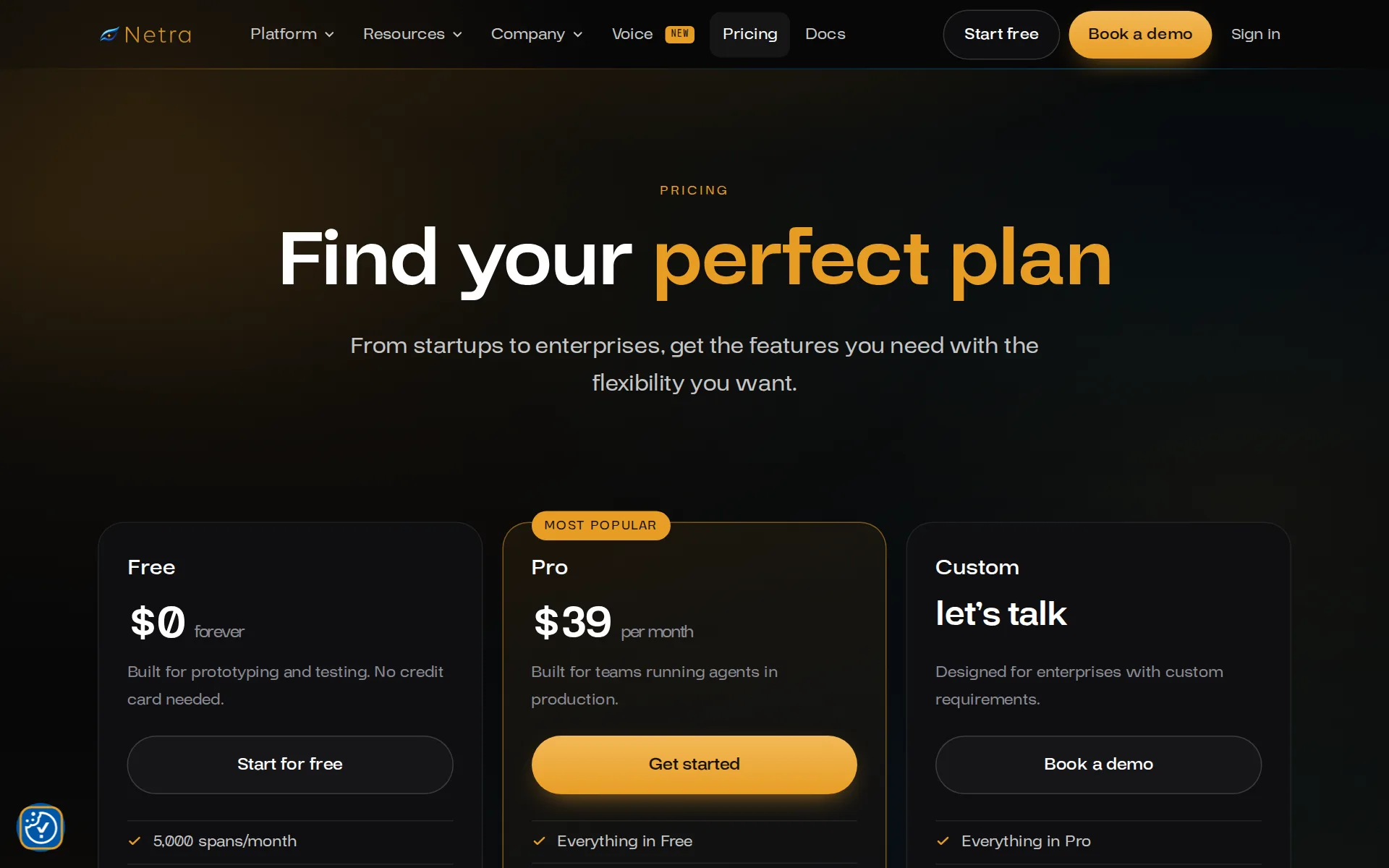
Pricing page, captured
getnetra.ai/pricing, checked
For AI agents
- MCP server
- Yes
- API
- Yes
What we checked on Netra
What the price counts
Flat monthly plan price with a published per-span overage on Pro: $39 a month covers 200,000 spans, then $5 per additional 100k, while the top tier is quote only.
Pro $39 per month Built for teams running agents in production. ... 200,000 spans/month +$5 per 100k after
getnetra.ai/pricingChecked
Free tier
A standing Free plan at $0 forever, no credit card, capped at 5,000 spans, 25 test runs and 100 evaluator executions a month with 7-day retention.
Free $0 forever Built for prototyping and testing. No credit card needed.
getnetra.ai/pricingChecked
Public API
Official Python and TypeScript SDKs authenticate with an API key against a documented OTLP endpoint and give programmatic access to traces, usage, dashboard queries, evaluations and simulations.
Netra provides official SDKs for Python and TypeScript/JavaScript, enabling you to instrument your AI applications with minimal code changes.
MCP server
A remote MCP server with US and EU endpoints exposes 21 project-scoped tools for querying traces, managing datasets and evaluators, and creating test runs from Cursor, Claude Code, Windsurf or Codex; agents still run separately.
Netra exposes a remote MCP server so you can pull observability context and run evaluation workflows directly in your editor or agent workspace.
Netra alternatives
- This spot is openBe the first tool people see on Netra's page.
- First on your rivals' pages
- Top of your category
- First in the home page list
- First in our search
- In comparisons and guides
Netra and TinyFish
Netra beside its alternatives: the price on each one's site and the day it was checked Tool Price Checked Netra Free, then $39 a month TinyFish Free, then $0.002 per minute

Questions about Netra
- How much does Netra cost?
- Netra has a free plan. From getnetra.ai/pricing, checked 7 November 2026.
- Does Netra have an API or an MCP server?
- It has an API. It has an MCP server.
- What have we checked on Netra?
- 4 facts, under these headings: What it costs to start, how you build with it.
- How do we check Netra?
- We hold 4 facts on Netra, quoted from 3 pages. Facts and price last checked 7 November 2026.
Sources and changes
Last changed
Similar in Agent tools and integrations
See all in Agent tools and integrations
- ERIUS PHONEA dedicated virtual Android phone per AI agent, with Google Play apps and sign-ins that persist between sessions.
- ClineFlowGit-native project memory and handoffs for coding agents.
- UI DiscoveryLibrary of real website and app UI sections, queryable by AI assistants over MCP and a REST API.
- AgentMailEmail inbox API that gives each AI agent its own address, threads, webhooks and MCP server.


From our research
- Aissist.io review (2026): pricing, pros and consAissist.io resolves tickets inside your helpdesk, billed per interaction with a free plan; it suits smaller support teams but has no public API.
- Best AI agents for sales: three kinds and how to chooseClay and Apollo research and enrich leads, Amplemarket drafts sequences from buying signals, and digital workers run outbound sequences and inbound calls.
- Best sales agents for marketing teams, and what to checkApollo suits teams starting free, VoiceDrop suits voicemail campaigns, and PipeLime suits hands-off email and LinkedIn prospecting.
The Netra team has claimed this listing
We check its facts against the Netra site.
- Facts checked
- 7 November 2026
Report an error if a fact is wrong.