
Routeweiler
What is Routeweiler?
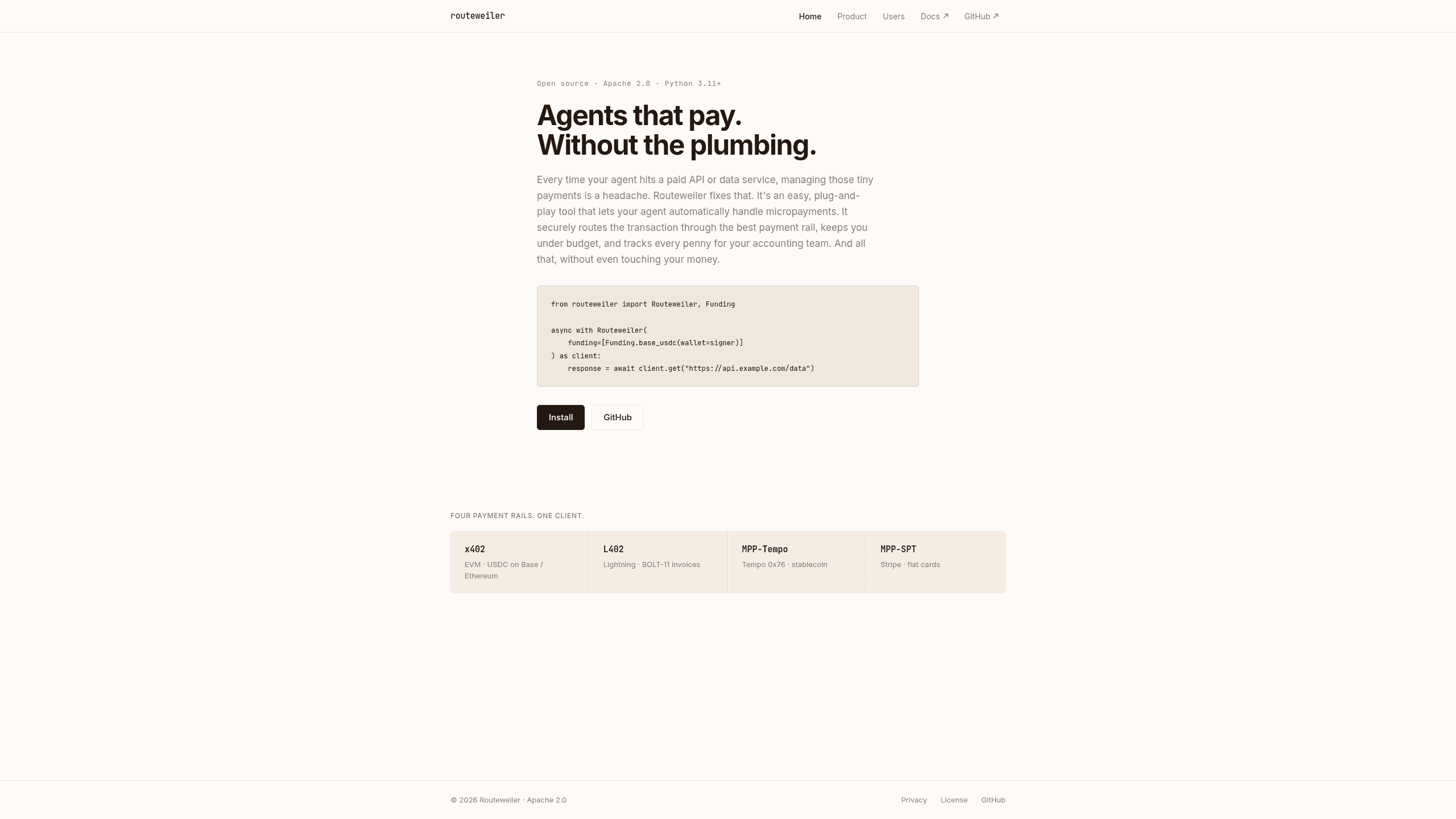
Routeweiler is a non-custodial Python SDK that lets AI agents autonomously pay HTTP 402-gated APIs under a hard spend cap. It intercepts payment challenges, applies a declarative Policy object for allowing or denying rails, routes across four payment rails (on-chain USDC, Lightning, stablecoin, and Stripe-based fiat) via Multi-rail payment routing, and enforces spend through BudgetEnvelope. Every attempt emits a TraceEvent to local SQLite for tamper-evident auditing, with no hosted backend and no pricing tiers published.
Last verifiedHow we evaluate
At a glance
- Routeweiler is best for engineering teams building AI agents that need to pay paywalled APIs autonomously under a hard spend cap.
- Yes — Provides a Python SDK (routeweiler) for integrating payment handling into AI agent code.
What it actually does
Routeweiler is an async Python HTTP client (await routeweiler.get(url)) that intercepts 402 Payment Required responses, works out which payment protocol the server is asking for, signs and sends the payment client-side, and retries the original request — so the calling code just sees a 200. It currently normalizes four distinct, mutually incompatible payment rails behind one interface: x402 (EVM, USDC on Base/Ethereum), L402 (Bitcoin Lightning, BOLT-11), MPP-Tempo (Tempo-chain stablecoin), and MPP-SPT (Stripe's Shared Payment Token for card rails). Routing between them is policy-driven — you can allow, deny, or preference a rail per URL pattern, network, or amount, and it picks the cheapest available quote.
Where it's genuinely strong
The real value is standards fragmentation: x402 (backed by the Linux Foundation's x402 Foundation, with Visa, Stripe and Google as members) and Lightning Labs' L402 are two live, competing specs for the same HTTP 402 mechanism, and Tempo and Stripe SPT add two more. An agent developer who wants to hit paid endpoints regardless of which rail they picked currently has to hand-roll support for each. Routeweiler collapses that into one client call and one Funding object per rail, which is a legitimate integration-cost saving. Its custody model is also worth crediting on its own terms: keys are supplied by the caller (Account.from_key(), an LND client, a wallet signer) and never transmitted or stored by Routeweiler — the only thing that persists is a local SQLite trace of what was paid, when, and on which rail, with spend caps enforced by a BudgetEnvelope that makes overspend within a single process structurally impossible rather than policy-enforced after the fact.
Who's behind it
There is no company. The site, docs and SDK are the work of one developer, Nikolaos Schoinas, published under an individual GitHub account (github.com/nikoSchoinas/routeweiler-python-sdk) with Apache-2.0 licensing. The privacy policy names no legal entity and no jurisdiction. The 'Users' page on the marketing site describes hypothetical personas (agent platforms, inference services, finance/ops teams) rather than named customers or case studies — there is no independent evidence yet of production adoption.
Maturity and maintenance
The repo has 31 stars, 1 fork, 3 open issues and 301 commits as of this check. It's actively worked on — the most recent commit was July 26, 2026 (hardening macaroon parsing, fixing retry-without-repaying bugs) — but the last published PyPI release is v0.1.2 from May 25, 2026, about two months behind the GitHub main branch, and the package is explicitly at beta/pre-1.0 status. A query against the OSV vulnerability database returned no known advisories for the routeweiler PyPI package, and GitHub shows no published security advisories — but the repo also has no SECURITY.md and no evidence of a third-party security audit, which matters more here than for a typical library because this one signs financial transactions.
The regulatory claim, stated plainly
The docs and product page assert that because Routeweiler never custodies funds or transmits private keys, this 'keeps Routeweiler outside money-transmitter and CASP regulatory scope.' That is the maintainer's own legal interpretation of the architecture — there is no independent legal opinion, regulator guidance, or audit cited to support it, and we found none in our own search. Whether a non-custodial payment-routing library actually falls outside money-transmitter licensing in a given jurisdiction is a real, non-trivial question that a team relying on this for anything regulated should have their own counsel confirm rather than take from the vendor's docs.
Cost and licensing
Free and open source under Apache 2.0 — pip install routeweiler, no paid tier, no hosted service to subscribe to. There is nothing to disclose or hide on pricing because there is no pricing; the cost to a buyer is entirely the underlying rail fees (on-chain gas, Lightning routing fees, Stripe processing) plus their own integration time.
Frequently asked questions
What is Routeweiler?
Routeweiler is a non-custodial Python SDK that lets AI agents autonomously pay HTTP 402-gated APIs under a hard spend cap. It intercepts payment challenges, applies a declarative Policy object for allowing or denying rails, routes across four payment rails (on-chain USDC, Lightning, stablecoin, and Stripe-based fiat) via Multi-rail payment routing, and enforces spend through BudgetEnvelope. Every attempt emits a TraceEvent to local SQLite for tamper-evident auditing, with no hosted backend and no pricing tiers published.
What is Routeweiler used for? Who is it for?
Routeweiler is used for Intercept 402, Enforce policy, and Multi-rail payment routing. It's built for Agent platform engineers, LLM and inference service providers, and Finance and ops teams.
Does Routeweiler have an API and what does it integrate with?
Provides a Python SDK (routeweiler) for integrating payment handling into AI agent code. It integrates with Stripe.
Is Routeweiler open source or self-hostable?
Yes, Routeweiler is open source and can be self-hosted on your own infrastructure.
Our take
Routeweiler is non-custodial and self-hosted with no published pricing tiers; confirm the Apache 2.0 licensing and self-hosting requirements fit your infrastructure and compliance setup before integrating the SDK into production agent workflows.

Explore other Agent Tools & Integrations


