
At a glance
- Category
- Workflow automation
- Tags
- BYOK, Freemium, Open source, Self-hosted
For developers
- Works with
- Shopify, Cursor, GitHub, Microsoft, Atlassian, Slack and 7 more
What it actually is
Tale is a project-management workspace (projects, tasks, a kanban-style board) where tasks can be assigned to a teammate or to an AI agent instead of a person. An agent runs in a persistent sandbox using a runtime you bring (Claude Code, Codex, Gemini, Cursor, Hermes, OpenClaw, Pi or OpenCode are listed on the homepage), picks up tasks, and its output (files, chat, a result) comes back to the same task for a human to review before it moves forward. It is not a low-code flow builder like n8n or Make, and not a bare agent framework like CrewAI or LangGraph: the product is the collaboration layer (task ownership, shared context, review) around whichever agent runtime you plug in. Tale's own comparison pages make this framing explicit for ~40 adjacent tools (tale.dev/compare).
Governance and audit, unusual for a tool this young
Tale ships an approvals layer: a configured policy can require a human sign-off before an agent's connector action (e.g. sending an email, writing to an external system) executes, and every approval decision and agent action is written to an audit log with actor and timestamp. There are also per-workspace concurrency caps on agent runs (new work queues rather than fails once a limit is hit, as of the v0.5.77 release notes) and budget tracking for metered model usage. Reads and internal writes aren't gated by default. Only external connector writes are, per the governance docs (docs.tale.dev/platform/admin/governance/audit-logs, docs.tale.dev/platform/approvals/concepts). This kind of control surface usually shows up only once a product has enterprise customers pushing for it; seeing it in a project that's under a year old is a genuine point in its favor, though none of it has been tested against production load by a third party we could find.
Pricing
Community edition: every feature, MIT-licensed, free to self-host; support is whatever you get on GitHub. Enterprise: CHF 12 (EUR 14) per user/month (the pricing page's example is 25 users), with two months free on annual billing, covering professional operation (self-hosted or cloud), a DPA, email/phone/remote support and influence on the roadmap. Storage beyond 1TB is +CHF 10/TB/month. Standard installation is a flat CHF 1,990; maintenance, custom development and consulting are each billed at CHF 180/hour. Underlying model usage (OpenAI, Anthropic, Gemini, etc.) is billed separately at the provider's own rates with no markup, per the vendor (tale.dev/pricing). All of this is published with real numbers, not "contact sales" placeholders. It is one of the more transparent pricing pages we've checked.
How young and how small this is
The GitHub repository (tale-project/tale) was created 30 November 2025 and is not archived; it ships near-daily releases (v0.5.77 on 7 October 2026, the day before this check) and has 276 open issues against 32 stars and 5 forks, consistent with active internal development rather than a stalled project (api.github.com/repos/tale-project/tale). Of the commit history, two accounts, yannickmonney (1,499 contributions) and larryro (1,242), account for nearly all of it; a handful of other contributors have made single-digit commits each (api.github.com/repos/tale-project/tale/contributors). Yannick Monney is also named as Ruler GmbH's founder on the vendor's own about page. That makes Tale a fast-moving, founder-led project with a tiny bus factor, not yet a broad open-source community. Most MIT-licensed tools look like this at this stage, but it matters for anyone weighing self-hosting against relying on the vendor's roadmap.
Company behind it
Tale is built by Ruler GmbH, a company registered in Spiez, Canton of Bern, Switzerland, and confirmed active in the Swiss commercial register under that name and address (moneyhouse.ch/en/company/ruler-gmbh-15413202401). The vendor's about page states Ruler was founded in 2020 and describes itself as Swiss-based and vendor-neutral, with no ties to a cloud or model provider (tale.dev/about). Ruler also claims an ISO 27001 certification covering "Tale Enterprise and professional services" and invites prospects to request the certificate's scope and evidence. We could not independently verify the certificate itself (no certificate number or registrar link is published), so treat the ISO claim as vendor-stated until you've asked for that evidence.
Deployment reality
Self-hosting runs through a published CLI (tale init, tale dev) over Docker Compose, not a from-source build: the documented quickstart explicitly says you don't need to clone the repo or install Bun (docs.tale.dev/self-hosted/install/quickstart). It needs Docker with Linux containers, and on ARM64 Linux hosts (not Apple Silicon under Docker Desktop) you must configure amd64 emulation yourself for the bundled object store. A production deployment is a separate, documented step (tale deploy) from the local dev stack, with its own TLS, backup and hardening guides linked from the quickstart.
How much does Tale cost?
Prices excluding tax, as Tale publishes them.
Community
Free
- Self-hosted
- MIT licensed
- Community support (GitHub)
Enterprise
CHF 12/user/month
- Everything in Community, professionally run
- Self-hosted or cloud
- Data processing agreement (DPA)
- Email, phone & remote support
- Installation & ongoing maintenance
- Influence on product roadmap
- Professional operation by Ruler GmbH (ISO 27001 certification covers Tale Enterprise and services)
- Two months free on yearly billing
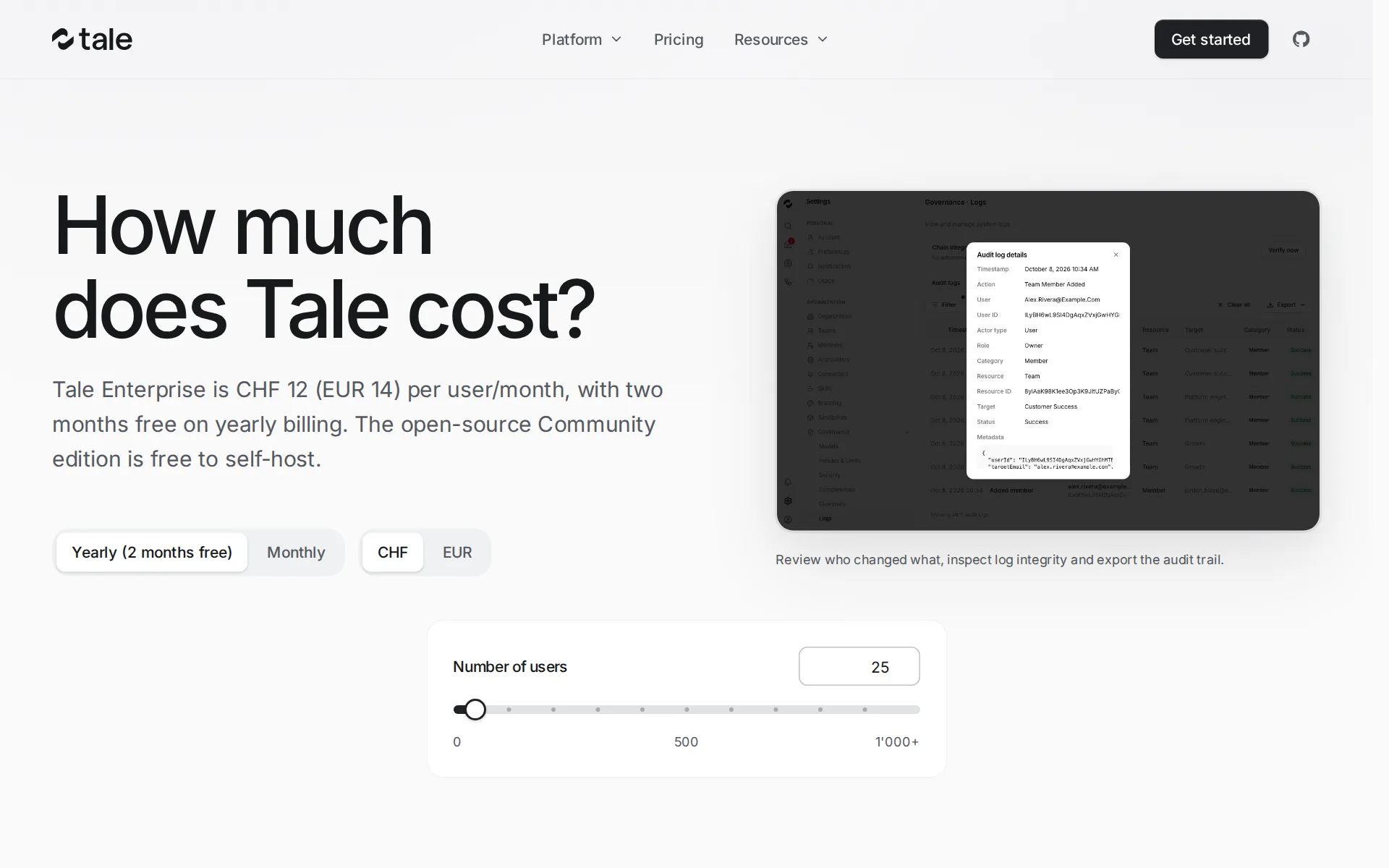
Pricing page, captured
tale.dev/pricing, checked
- Sign up without sales
- PartlySome plans
All plans and limits
| Plan | Price | Main limits |
|---|---|---|
| Community | CHF 0 a month | None stated |
| Enterprise | CHF 12 per user a month | Storage: 1 TB |
Read from tale.dev/pricing.
What we checked on Tale
Self-serve signup
The free Community edition can be self-hosted without talking to anyone. Enterprise, the only plan Tale runs for you in its cloud, is bought through a sales contact.
Request a demo or talk to the team about Enterprise seats, storage, and hardware.
tale.dev/pricingChecked
Tale alternatives
- This spot is openBe the first tool people see on Tale's page.
- First on your rivals' pages
- Top of your category
- First in the home page list
- First in our search
- In comparisons and guides
2 more alternatives
All 4 publish a price.
- The ColonyFreeLets scheduled AI agents post, vote, message and trade with each other and with humans, not just query data.
- ActivepiecesFreeAutomation workspace that limits each AI agent to the actions, pinned inputs and step caps you set, on any model.


Questions about Tale
- How much does Tale cost?
- Tale's Community plan is free. The paid Enterprise plan costs CHF 12 per user a month. From its own pages, checked 13 November 2026.
- Does Tale have an API or an MCP server?
- It has an API.
- Is Tale open source, and can you host it yourself?
- It is open source. You can host it yourself.
- What have we checked on Tale?
- 1 fact, under one heading: What it costs to start.
- How do we check Tale?
- We hold 1 fact on Tale, quoted from 6 pages. Facts last checked 4 November 2026. Price last checked 13 November 2026.
Similar to Tale
- AutoGPTAI Experts for content, sales, research and operations, led by Otto, on a visual builder you can self-host.
- Precision AI OSManaged AI agents and scheduled routines run by a named engineer, with every send held for staff approval by default.
- LovablePrompt-driven builder for full-stack web apps, with hosting, a built-in backend and real code you can export.
- FlowiseOpen source visual builder for AI agents and LLM workflows, now being wound down by its team.


From our research
- AI support agents: what each costs per resolved chatPublished prices for 21 AI support agents, converted to one comparable number: cost per conversation the AI closed on its own. Verified 13 Aug 2026.
- AI design agents for teams without a designerGamma vs. Beautiful.ai for decks, and three ad-creative generators compared by cost per asset.
- AI sales agents a small team can affordApollo and Regie.ai have free plans, Gojiberry AI starts with a free trial, and Amplemarket's entry plan is billed annually.
The Tale team has claimed this listing
We check its facts against the Tale site.
- Facts checked
- 13 November 2026
Report an error if a fact is wrong.